Doing the DMZ (Part One)
I think that when you visit Seoul, you have to visit the DMZ. As far as I know, there’s no law requiring it. It’s just what you do. Today was my day.
I booked a full-day tour, scheduled to last seven to nine hours. This post will narrate the morning portion of the tour. I’ll post another entry for the afternoon.
First, a couple of preliminary notes.
I don’t care how many non-American Anglophones pronounce it “dee em zee.” I’ve heard some Canadians pronounce it that way. For those who do, stop it. It’s “dee em zed,” dammit. Not “dee em zee.” “Dee em zed.”
They’re initials. It stands for demilitarized zone. I believe that for every literate Anglophone outside of the United States, including in my country, Canada, the last letter of the alphabet is zed, not zee; zed being the first letter of “zone.” I’m Canadian. It’s the dee em zed. Sorry. It just is. That’s a hill I’ll die on. Preferably not literally
Don’t ask me why it’s DMZ, not DZ. Demilitarized is one unhyphenated word. I don’t see why the word “militarized” is so high and mighty that it feels the need to stand on its own and get its own initial. To my mind, we should deemphasize “militarized” and emphasize the “de.” But maybe that’s just me.
That out of the way, how does one go about visiting the DMZ?
I’d read that you can go out there on your own and then get on a tour sold there, but that it’s best to pre-book a tour out of Seoul. According to what I read, the latter tends to visit sights that the former doesn’t. Plus, you don’t waste your time trying to figure out how to get out to the DMZ and then find a tour (all of which are also fee-based) to go on.
How do you choose a tour out of Seoul? Good question. There are lots of them. Because pretty well every tourist in Seoul does it, lots of companies run tours. They don’t all go to all of the same sites in and near the DMZ. There are one or two sites that all of them visit, but there are others that vary for different companies and even different tours from the same company.
I had no idea which of the sites I’d most enjoy seeing. My strategy was to check out the Viator (a pretty much worldwide tour booking engine) website (I also have its app) and book the first of the tours I saw that had a sufficient number of people rating it, and even after the ratings were averaged, it still received the top available grade. And here I am.
Another thing, unless you book a private tour, you’re probably going to be on a large-group tour. When we headed out, the guide said there were 40 people on our tour in a 42-seat bus.
When I went on the Seoul Food Tour the other day, most of the other people on the tour had already been to the DMZ. They all said theirs was a large-group tour. One said that before booking, she looked extensively to try specifically to find a small-group tour, but she failed.
Okay. Those preliminaries out of the way, let’s head in the general direction of the DMZ.
On the Way to the DMZ
The tour bus I was on had two pickup spots in the city. I got on at the first one. After we left the second, it took us about an hour to get to our first stop on the DMZ tour.
During that time, the guide, Ray, talked for much of the time about the history of Korea, the nature of the DMZ, the military and the relationship, or lack thereof, between the Republic of Korea (South Korea) and the Democratic People’s Republic of Korea (DPRK, North Korea)*. Ray also spoke extensively between stops to give us information about what we were going to see and further information about the Koreas, including about a few defectors from and captives of the North.
I learned a lot. One thing I remembered that I hadn’t previously known, or maybe that I knew, but forgot, was that South Korea never signed the armistice that brought the fighting in the Korean War to an end. It could have, but it refused. The United Nations and the United States signed for the South.
As a result, South Korea still has no authority over the DMZ. Any activity in the DMZ requires the authorization of the UN or the US acting for the south side.
There was a large video screen at the front of the bus on which Ray ran a PowerPoint presentation to support his talk.
Oh, one thing I’m happy to report is that Ray pronounced it the dee em zed, not dee em zee. A point for our side.
In the last sentence of the preceding section, I said “head in the general direction of the DMZ” because neither of the two stops this morning was in the DMZ, but they’re considered standard stops on a DMZ tour. They were in the civilian area before you get to the military area, which is before you get to the demilitarized zone.
* Aside: I don’t imagine the irony of North Korea including “democratic” in the official name of its country escapes many people. It’s an example I use when right-wingers claim that Nazis had to have been socialists because they had “Socialist” in the official name of their party. No. It’s the name they misleadingly called their party, not what they were, exactly like North Korea isn’t democratic just because it includes Democratic in its official name..
I could legally change my first, last, and/or middle name to “Brilliant,” but that wouldn’t make me brilliant. People who know me in real life can assure you of that.
Gamaksan Suspension Bridge
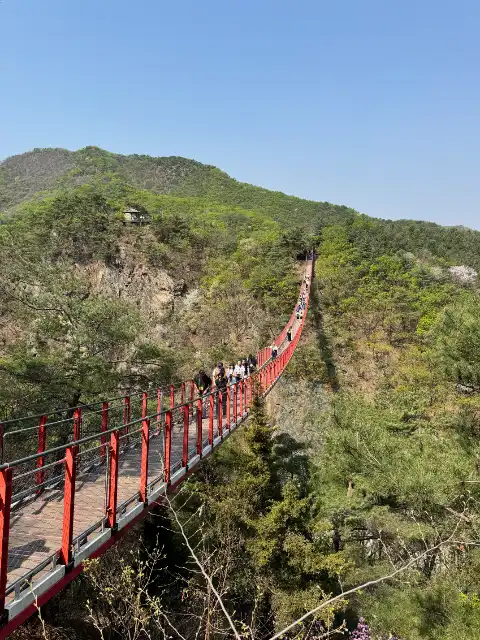
The first stop on the DMZ tour was at the Gamaksan Suspension Bridge. Well, not at the bridge. The bus stopped at the base of a small mountain.
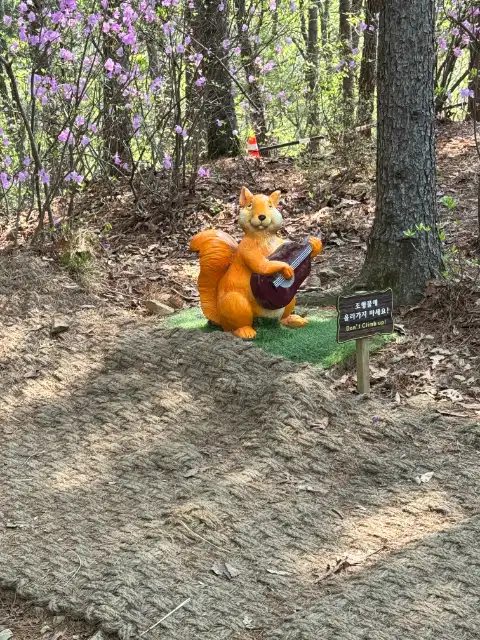
We then hiked about ten minutes up the mountain. Beside the path on the way up the mountain, there was a series of life-size, and sometimes larger than life-size, plastic wildlife animals of a few different varieties. Don’t ask me why.
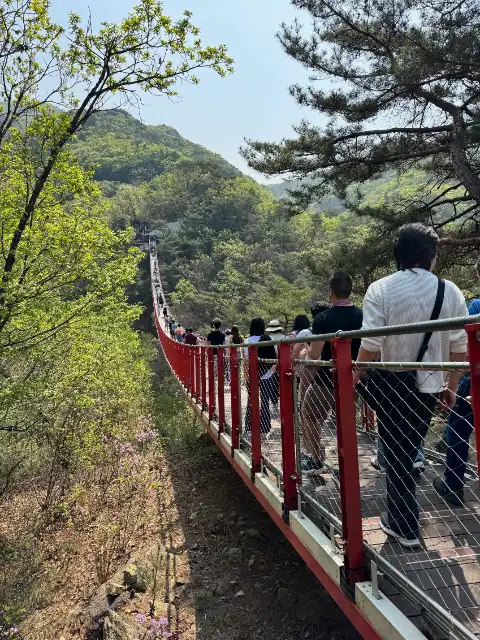
At the top, there’s one end of a long, wooden suspension bridge over a canyon. We then walked across the bridge. My acrophobia didn’t act up as much as it normally does on those sorts of bridges.
The sides, although just posts, railing, and fencing rather than a solid wall, felt substantial and sturdy enough that my brain told me, “Oh, come on, you pathetic little wuss. If you let your fear of heights get the better of you here, that’s it. I’m leaving you!”
As implied above, anyone who knows me well knows that my brain leaving me is not much of a threat. It barely takes up residence as it is. But I kept my acrophobia in check anyway.
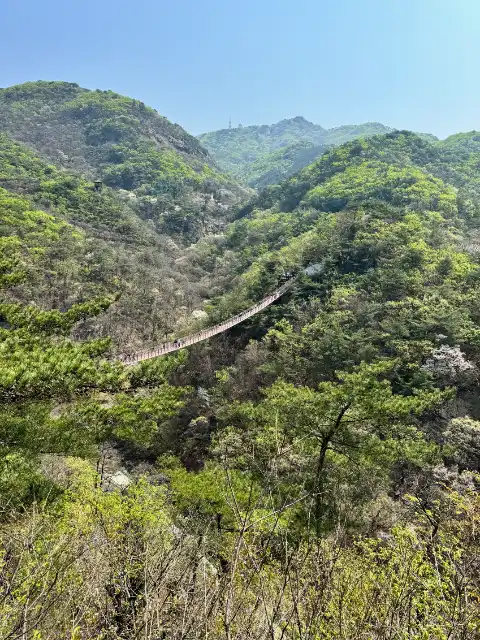
There was quite a wobble on the bridge at times. My fear of losing my balance is a totally separate thing from my fear of heights, and it acted up at times. But I made it across.
When I got to the other side of the bridge, I took in the view and was about to cross back when Ray stopped me at a picture-taking area and offered to take my picture. “No, thank you.” “But you have to.” “No, thank you.” “I won’t let you back on the bus unless you do.”
He laughed when he said that last one, and I’m 99.99% certain he was joking, but, just in case, I handed over my camera and let him take my picture.
You probably think that’s a lead-up to me posting here one of the pictures he took. Think again. I hate most pictures of me. These were not exceptions.
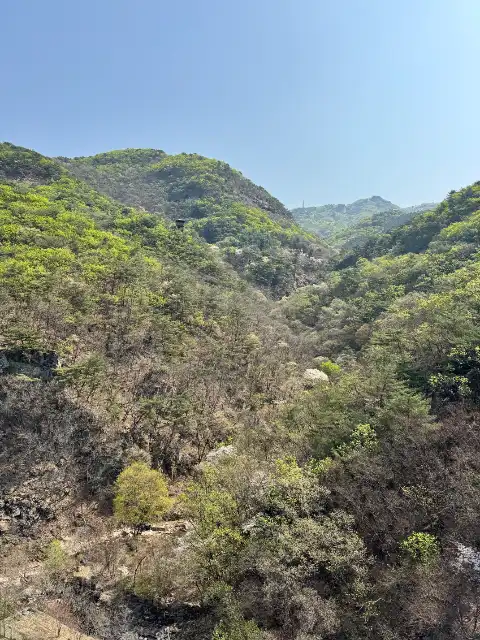
Once back on the original side, Ray suggested we hike up a little bit to a viewing platform with a panoramic view of the bridge and valley. I did.
Imjingak Pyeonghoa-Nuri Park
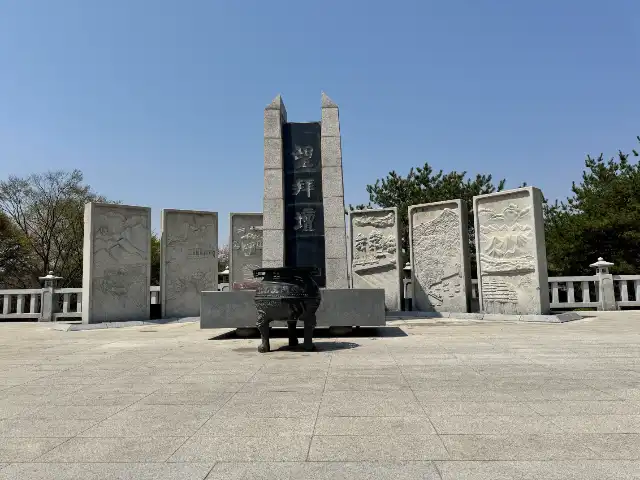
Imjingak Pyeonghoa-Nuri Park, the next stop on the DMZ tour I was on, is not a park with grass and trees. It has an amusement park, but that’s not why we stopped there.
At one time, Korean refugees were processed there.
Today, there’s a prominent refugee monument in the park. Once a year, there is a major ceremony where people come in the thousands to pay their respects at the monument.
There is also a statue commemorating a 1983 television show. It was not just any television show. The English translation of the title was “Finding Dispersed Families.”
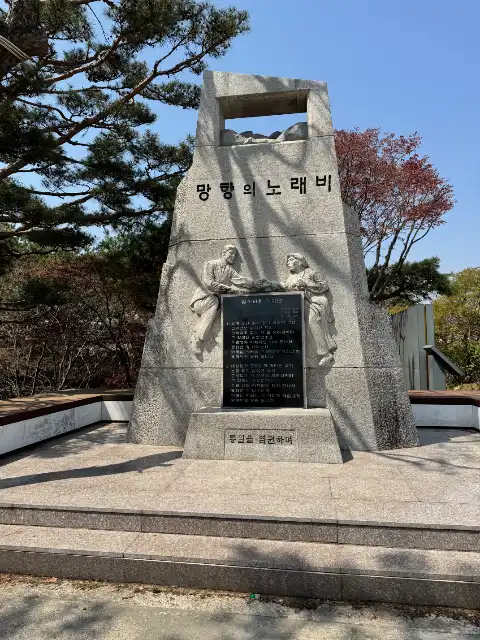
The idea was that people who became separated from family members during the war and had lost track of them would come on the show with any information they had about the people they sought. That would be broadcast with the hope that the family member would see it and they could be reconnected.
The plan was that it would be one ninety-minute show. Unexpectedly, more than 100,000 people applied to be on it. In the end, the show lasted more than 450 hours, spread over 183 successive days.
It was hugely successful, with 10,000 families reunited, and it received UNESCO recognition for its efforts. At one point, then US President Ronald Reagan broadcast an appeal saying he had heard about the show, and he urged North Korea to participate in the program.
At the monument, there’s a button you can press to listen to some of the theme song from the show. At the time, it became the most popular song in Korea. Its composer, who had been unknown before the show, became famous.
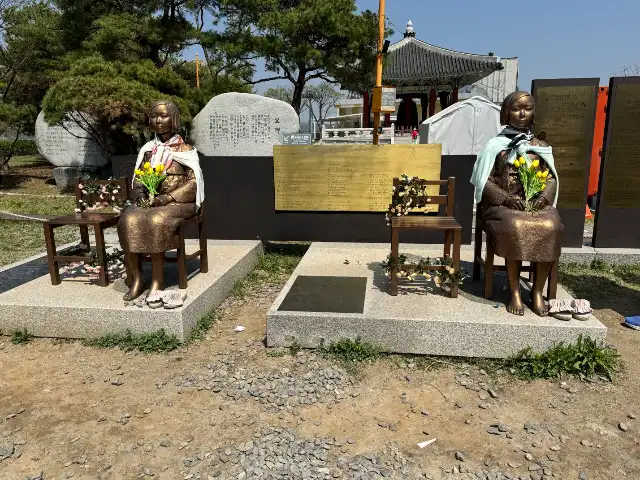
There’s also another monument in Imjingak Pyeonghoa-Nuri Park. It’s composed of four chairs, two of which are empty and two of which have sculptures of women sitting on them. It’s a monument to comfort women, women who were forced by the Japanese to be sex slaves when the Japanese occupied Korea.
At the end of the Japanese occupation, Japan knew the shame that the comfort women would bring to them. So they rounded many of them up and shot them. Only a minority managed to survive. The identities of many of the rest remain unknown. Hence the empty chairs.
But why four chairs? The government of South Korea knows that many comfort women were North Korean. The government recognizes that they are people too and deserving of respect and commemoration. One empty and one occupied chair represent the North Koreans. The plan is that when North Korea is willing to accept it, the two chairs, one empty and one with a woman sitting on it, that represent the North Korean women, will be sent to North Korea for display there.
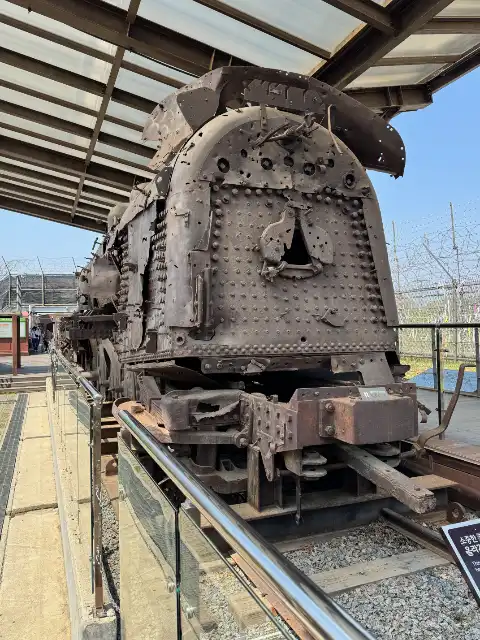
In addition to the monuments, there’s also an old locomotive in the park that’s somewhat mangled and riddled with bullet holes. It was the last train to cross between North and South Korea during the war. The railway bridge was destroyed.
Technically, it’s not true that it was the last train to cross during the Korean War. Technically, the war is still on. North Korea, the United Nations, and the United States (but not, as I said above, South Korea) signed a ceasefire agreement, but never a peace agreement.
There have been brief periods of tentative entente between North and South Korea, including one when they built a joint industrial zone in North Korea, just inside its border. About 1,000 South Koreans, mainly engineers, worked there during the few years (I forget how many) it was operational. They commuted to work on a train over a new railway bridge. So, technically, there have been more recent trains between North and South Korea during the war because it still hasn’t ended.
As I said, the two stops this morning were in the civilian area, not the military area or the DMZ. That was something for this afternoon. Stay tuned.
Discover more from Joel's Journeys & Jaunts
Subscribe to get the latest posts sent to your email.


Absolutely beautiful scenery and moving monuments. I had a little mental disquisition when I read your title in my email notification, chastising myself about automatically hearing DM zee in my head rather than my native DM zed. Why? I asked myself. U.S. media I answered myself. By why this term and no other? I say Generation zed to myself, for example (lot of talking going on in there). War movies? News reports? This nattering goes on in my noisy head until your blog opens up and I hear you going on about it in the entry. From my head to your blog, or something like that. That (over)said, I am learning a lot, and look forward to learning more in your followup about the afternoon’s adventures.
Yes. To be honest, I catch myself saying DM zee sometimes too. I have bruises from beating myself mercilessly when I do.