DMZ Part 2: Third Tunnel, Dora Observatory, JSA Museum
If you read my morning post about the DMZ tour I took today, you know that it didn’t actually get into the DMZ in the morning. However, it did in the afternoon, the subject of this post. This afternoon, the tour went to the Third Tunnel and the Dora Observatory, both of which are in the DMZ, and the JSA, which is not.
A bit of a warning: Don’t expect many pictures in this post. At two of the stops, the Third Tunnel and the Dora Observatory, pictures were strictly prohibited in most areas of both sites. And there were limited photogenic scenery and objects that we were allowed to take pictures of at any of the afternoon stops.
Before the DMZ, there is a military zone. Before joining the tour, the tour operator informed all customers that they must bring a passport, a US military ID, or a Korean Residency Card. On the bus, travelling to the DMZ, the guide, Ray, passed around a sheet of paper on which we each had to write our name and birthdate.
At the entrance to the military zone, an MP (Military Police, not Member of Parliament) came onto the bus, checked everyone’s passport, and compared it to the list we filled out. Only then could the bus continue into the military zone and through that to the DMZ.
On the way back, an MP came onto the bus again to check passports before we could leave the military zone. Toto, I’ve got a feeling we’re not in Kansas anymore.
The Third Tunnel
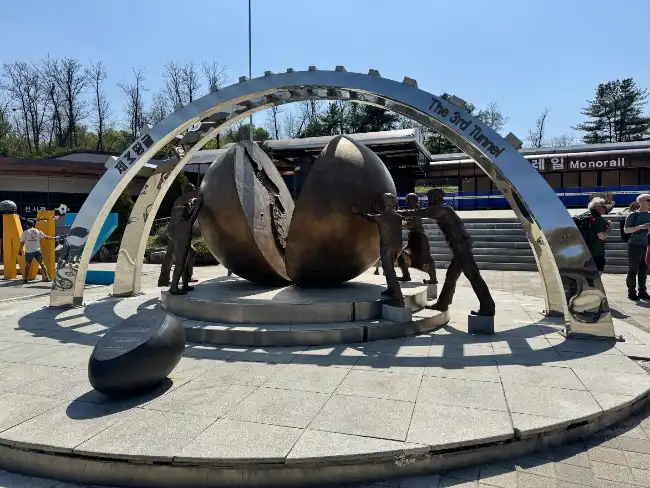
I forget when, but at one point after the Korean War hostilities stopped, South Korea found that North Korea had dug penetration tunnels, presumably to launch an attack on South Korea. South Korea has found four of the tunnels, but it thinks there may be more, as of yet undiscovered.
One of the tunnels, the Third Tunnel, has been opened for tourist visits, limited to the portion under South Korea.
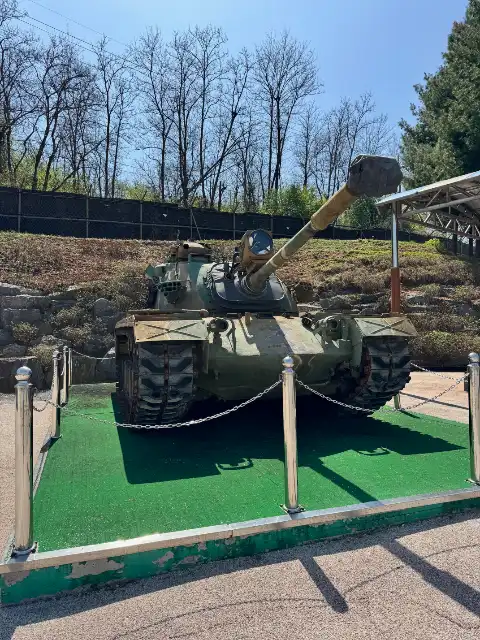
We were allowed to take pictures in the parking lot between the theatre and the tunnel entrance building. There is a sculpture and an old tank there. I took pictures of them because there was nothing else worth taking a picture of.
Before going into the tunnel, we were shepherded into a small theatre with a couple of other tour groups, where we watched an eight-minute film about the tunnels.
Inside the Third Tunnel was one of those places where photographs were strictly prohibited. Not only that, but we had to place our phones and any other electronic devices other than watches, as well as wallets, backpacks, and hats (I didn’t have either of the latter two) into the provided lockers. I don’t know why.
We then had to go through a metal detector. I don’t know what it was, probably my belt, but I set it off. I had to be patted down. Don’t ask me why security is so tight.
We were then loaned a hard hat, which we had to wear in the tunnel.
When South Korea discovered the Third Tunnel, it dug an interception tunnel to get to it. That’s where the journey starts, not in the Third Tunnel.
I don’t remember if the guide told us how deep the Third Tunnel is, but it must be very deep. The interception tunnel is 350 metres long. It continues downward the full length, at a not terribly shallow angle. The interception tunnel is reasonably tall and has smooth walls.
The Third Tunnel, however, is rough rock, with low ceilings. Large sections of it were made lower with scaffolding that we had to walk under. I guess it was there to prevent any rockfalls from injuring people. There were some sections without the scaffolding, and many of those rock ceilings were low, too.
That’s where the hard hats were necessary. I’m of less than normal adult height, but I stooped most of the way through the Third Tunnel. But even with stooping, I still bonked my hard hat on the rock or scaffolding a few times. I wasn’t the only one. Regular bonks sounded from other people walking through the tunnel, too.
I forgot how many metres before the North Korean border (the number 120 is sticking in my head, but I might be misremembering), the South Koreans have blocked the tunnel off with a concrete barrier. I was able to get that close to North Korea. That’s something I thought I’d never be able to say until this trip. I got to less than a couple of hundred metres from the hermit kingdom.
After reaching the barricade, we walked back the way we came. The Third Tunnel is level, but upon getting back to the interception tunnel, 350 metres continuously down to enter became 350 metres continuously up to leave. My Fitbit tells me I haven’t come anywhere close to my record number of steps for a day, only 14,420 today, but I’ve climbed the equivalent of 137 floors. I need a rest.
The Dora Observatory
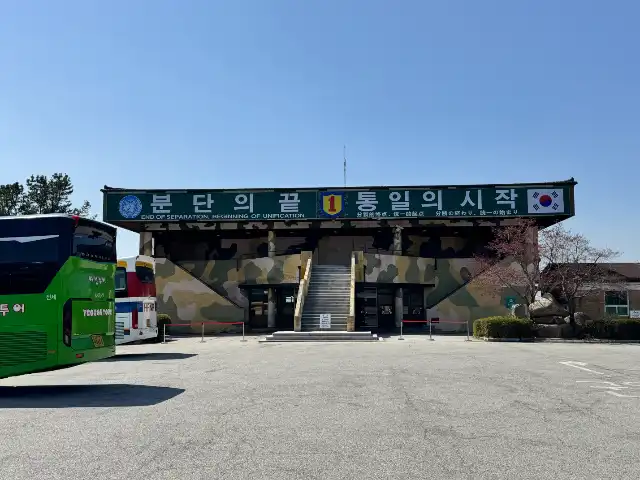
Beside the parking lot for the Dora Observatory, there is an old military observatory that had served as the tourist observatory at one point. We were allowed to take a picture of that old observatory, and I did.
They’ve since built a brand new, three-storey observatory, the Dora Observatory, with lots of shiny marble or other stone inside, a cafe, what looks like a lecture hall, and the observatory area on the roof of the building.
There are also several industrial-strength binoculars available for use on the observation deck.
Up on the deck, Ray pointed out the landmarks in the DMZ on the North and South sides. Towns are allowed in the DMZ on both sides, provided they don’t serve a military purpose. He pointed to North Korea’s show village that it built to prove that it was a real, progressive country. But it is a Potemkin village.
The walls of the buildings are solid, with windows that aren’t windows, but rather paint on the walls made to look like windows. Ray said that North Korea tried to move people into the village for show, but, without windows, and without heating and air conditioning, the buildings were uninhabitable in the bitter winters and sweltering summers. The village was abandoned. They’ve since built another show village in another visible location that is occupied.
Ray also pointed out where the joint industrial zone I mentioned in this morning’s post was during a brief, tenuous entente between the North and South. That entente ended, and the industrial zone ended with it. The zone, being on the north side, is under North Korea’s control, but the industrial zone shut down because North Korea doesn’t have its own sufficient electrical supply to run it.
Ray also told us about a flag war in the DMZ. South Korea put up a large, prominent flagpole flying the South Korean flag on its side of the border. The North took that as a provocation and put up its own, taller flagpole. Not to be outdone, the South replaced its flagpole with a taller one. I forgot how many iterations that went through, but South Korea eventually gave up and let North Korea win the flagpole war.
The thing is, though, each time North Korea put up a taller pole, they hung a bigger flag on it to be proportionate with the pole. The North doesn’t have any lightweight fabric materials. South Korea does.
When I was there, the South Korean flag was waving freely. The North Korean flag wasn’t visible because it just hung down, being too heavy to unfurl in the wind. Ray said the wind has to be particularly strong before you can see the North Korean flag flying.
Pictures are strictly prohibited at the Dora Observatory. I asked Ray why. He said that they used to be allowed, but people posted their photos and videos on social media. North Korea objected because it said the images might capture images of military assets. Rather than get into a big fight with North Korea about it, South Korea banned photographs and videos at the Dora Observatory.
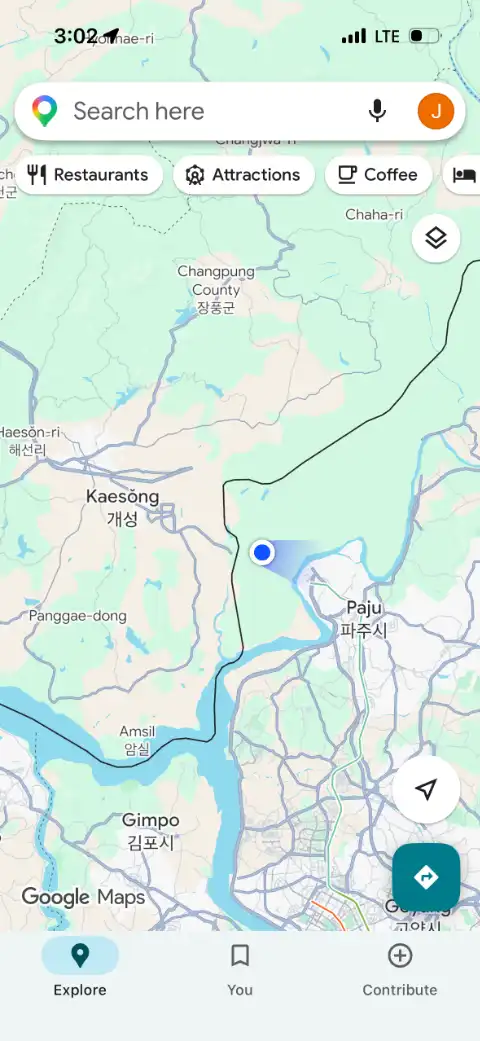
When we were back in the bus, before we left the observatory parking lot, Ray suggested that we open Google Maps, zoom out and take a screenshot so we could show people how close we were to the border. That’s what I did.
JSA Museum
JSA stands for “Joint Security Area.” The JSA museum is small. I think it’s run by the company that runs the tour I was on (they run a few different ones into the DMZ), just for their own customers. It is outside of the DMZ.
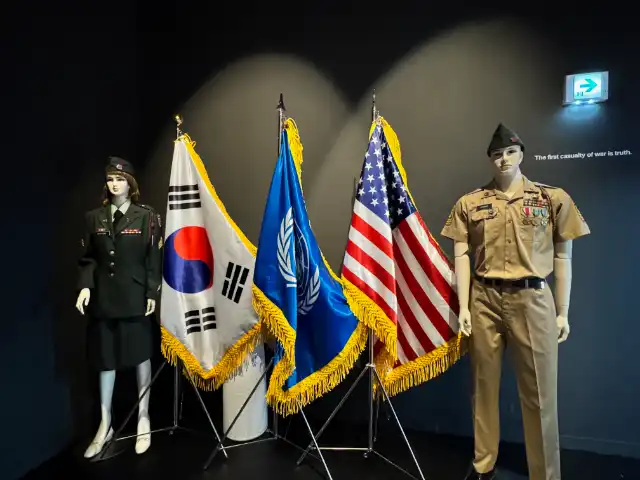
To be honest, it wasn’t much. There was a room with some video screens playing scenes related in some way to the Joint Security Area. The videos didn’t have either text or audio narration. In another room, there were some old-style phones. If you lifted the receiver and put it to your ear, you could listen to speeches from historical personages, mostly about the Korean War. Some were in Korean, some, such as speeches from Truman and Eisenhower, were in English.
I think there was another room in the museum, but I forgot what it contained.
After leaving the museum, we headed back to Seoul to end the tour.
Discover more from Joel's Journeys & Jaunts
Subscribe to get the latest posts sent to your email.

Changdeokgung and Changgyeonggung Palaces

Return to Seoul: COEX Aquarium and Bonguensa
Now that was an experience. It must be impressive if only for the very eeriness of it. It reminds me of stories people used to tell of taking windowless trains through East Germany into West Berlin when it was still a divided city. Hopefully, this animus will end in a similar way one day. You have the story to tell.
The guide, who said he was 35, said reunification is an official goal of the South Korean government. He also said that South Koreans don’t call it South Korea. They just call it Korea. According to him, young people don’t think much about reunification, they just think of North Korea as any other country. At the same time, Kim Jong Un doesn’t seem to be mellowing. He keeps firing off rockets and is grooming his daughter to be the successor dictator. So I don’t know how it will end in peace and harmony, but one can hope.
I’m reminded of Get Smart, the spy parody of beloved memory. (I just learned Mel Brooks was involved in the show. Didn’t know that. Did you?) All you needed was for your guide to shout your details at you under the Cone of Silence. Or test your credulity about some aspect of the setting with classic diminishing exaggerations. The provocation: The show village is a brilliant model community. Would you believe it won the Pritzker Architecture Prize? It’s hard to believe it even qualified. Would you believe it was featured in Architectural Digest? That’s a stretch. How about a mention in the National Enquirer?
the catch phrase: “Would you believe …” “Sorry about that, Chief.”
Maxwell Smart: And I happen to know that at this very minute, seven Coast Guard cutters are converging on this boat. Would you believe it, seven?
Mr. Big: I find that pretty hard to believe.
Maxwell Smart: Would you believe six?
Mr. Big: I don’t think so.
Maxwell Smart: How about two cops in a rowboat?
I loved Get Smart. Mel Brooks being involved with it seems to ring a bell.
It was absolutely the very best show of all time. What? You don’t believe it was the best? Would you believe …?
Turning back to the DMZ, most of the problems between the two Koreas could be resolved if only Kim Jong Un would use his powers for niceness instead of evil.