Changdeokgung and Changgyeonggung Palaces

This was a palace morning for me in Seoul. I visited two, Changdeokgung and Changgyeonggung. That was less daunting than it sounds.
Changdeokgung and Changgyeonggung are next to each other. They are separately ticketed, and each has a separate entrance off the street. Those entrances are relatively distant from each other. And they’re on different streets. But there’s a gate between the two grounds and a ticket office by the gate where you get a ticket for the other one if you don’t already have one.
Oh, about ticketing, as at the other palaces I’ve visited in Seoul, entrance is free for people over 65, youth 18 or under, and anyone of any age wearing traditional Korean garb, hanboks.
Changdeokgung Palace

On Monday, when I reported on my visit to Gyeongbokgung Palace, I said that I would have visited Changdeokgung Palace on Tuesday (it’s closed on Mondays), but the palace contains a separate, ticketed attraction that requires buying a timed ticket for a tour to visit it.
The tours are in different languages at different times. The tours in each time slot are limited to just fifty people.
When I tried early Monday morning to buy a ticket for Tuesday, the website told me all the Tuesday English slots were sold out. I snagged a ticket for the only time slot today, Thursday, for which the site reported any English tour availability, 10:30.
That special attraction is the Secret Garden.
When I got to the Changdeokgung Palace ticket office with my electronic Secret Garden ticket in hand, I still had to pick up a free senior’s ticket for the encompassing palace. There, an electronic signboard showed the number of Secret Garden tickets available for each tour throughout the day in each language.

My tour was, indeed, sold out. But the sign showed some availability for all remaining English tours today, and lots of availability for the tours later in the day. Why do they do that? Why not let me snag a ticket online rather than telling me it’s sold out? The misleading information could, and did, affect the planning of my days.
Harrumph.
I arrived at Changdeokgung Palace more than half an hour before they would let me into the Secret Garden, so I explored the rest of the palace for a while, went on the Secret Garden tour, and then finished looking around the rest of the Palace.
I’ll create a separate subsection about the Secret Garden within this Changdeokgung Palace section. I usually write these entries following the chronological order I take in the sights, but it makes sense to group all of the non-Secret Garden parts of the palace together, so that’s what I’m going to do. I realize this housekeeping note is not of interest to anyone, but I worry about this entry possibly being too short, so I wanted to pad it. Sorry for wasting your time.
Non-Secret Garden Parts of Changdeokgung Palace

Changdeokgung Palace runs free tours of the palace compound, excluding the Secret Garden, in different languages at different times. There were only two tours in English today. One was while I was booked for my tour of the Secret Garden. The second was well after I expected to leave the palace. So, I wandered around on my own. Hence, the following is personal observation or information I got from other sources, mostly, but not exclusively, Changdeokgung Palace’s website.
The palace was built in 1405 as a secondary palace to Gyeongbokgung Palace because you can’t expect a king to limit himself to just one grand palace in a city, now can you? How, oh, so very confining that would be.
Changdeokgung Palace has the honour of being the best-preserved palace in Seoul. One of my guidebooks also described it as the most beautiful. I don’t know. That’s so subjective, isn’t it?
(Aside: Before today, I’d read somewhere that there are four royal palaces in Seoul. I think I stated that in an earlier post. The guide who gave the Secret Garden tour said there are five. I also read somewhere today, I forget where, but maybe on a sign at Changdeokgung Palace, that there are five. So, I stand corrected. Unless my first source was right, in which case I stand mistaken.)

The entry gate buildings are indeed grand. More than enough to announce that the occupant lives a life that most of his subjects could only dream of, and then only if the dreams were induced by hallucinogens. Then again, everyone who ever lived there, whether as king, queen, king’s concubine, loyal servant, or defender, is dead. So, in the end, what good did it do them?
There were several buildings of various sizes in the palace compound. Their roofs came close to matching my recollection of the roofs at Gyeongbokgung Palace, although without the miniature statues along the corner spines of some of the roofs.

The roofs are tiled with cylinders. At the end of each cylinder, there’s a patterned end piece. I thought it was very attractive.
Some of the buildings were long, somewhat plain, covered structures with one open side. (I’m pretty sure there’s a relatively common word for that sort of structure. I’ve been trying without success to pull that word up from the dark, dusty recesses of my so-called brain, but I’ve failed so far. Maybe it will come to me before I push the “publish” button, in which case you won’t see these sentences.)
The public isn’t allowed into the buildings, but some had open doors. I could see some beautiful furnishings inside.
All things considered, I thought Changdeokgung Palace was beautiful. But I suspect that the guidebook called it the most beautiful only after taking into account the Secret Garden, which is fair enough, seeing as though it is part of the palace.

Secret Garden
Before starting the tour, the guide gave some rules for the garden. No eating. No drinking of alcoholic beverages. No smoking. And a few other noes that I’ve forgotten. She also told us we were free to take photos and videos of anything, except please don’t take photos or videos of her. She didn’t want to see her face or hear her voice on social media anymore.

She also told us that we were free to not go on the tour, but rather just wander around on our own. They strictly enforce the timed entry, with the entry slots determined by the tour start times, but once you’re inside, you can ignore the tour.
And, despite having mandatory timed entries, there are no timed exits. The guide said that, whether we went on the tour or not, we were free to hang around in the Secret Garden for as long as we wanted, up to closing time.

I went on the tour.
The guide told us that the garden has had different names at different times. I’ve forgotten some of them, but one of the former ones was the “Rear Garden,” so called because it’s at the rear of the palace. I forgot when it was assigned the name “Secret Garden,” but it was quite some time ago. The guide said that locals have gone back to calling it the Rear Garden, but the Palace still promotes it as the Secret Garden because it sounds more intriguing for tourists. Marketing. Everything is marketing.

I must admit, “Secret Garden” implanted the wrong impression in my mind. I figured it would be a hidden-away, magical place filled with nothing but beautiful flowers, bushes, trees, garden ponds, and maybe some real faeries and gnomes too.
There are lots of trees and flowers, and a few ponds, in the garden, but there are also buildings. There’s an attractive two-storey royal library, some quarters, a smaller library for those quarters, and some other buildings I’ve forgotten.

The guide told us about the buildings, their purposes, and when they were built. She also told us some of the history of the garden. Regular readers would have been more shocked had I remembered most of it, or even much of it. I don’t.

Changgyeonggung Palace

After wandering around the rest of Changdeokgung Palace upon finishing with the Secret Garden, I walked to the gate between Changdeokgung Palace and Changgyeonggung Palace, which is right beside the entrance to the Secret Garden, got a free senior’s ticket for Changgyeonggung Palace, and went there.
(Aside: If you think I’ve ever been able to type either Changdeokgung or Changgyeonggung without copying and pasting it from somewhere else, you’re crazy. And don’t expect me to remember either name, let alone remember which is which, for more than five seconds.)

The entrance from Changdeokgung Palace is probably about the equivalent of a couple of storeys above the main compound of Changgyeonggung Palace. As I walked down the path to the main compound, avoiding the stairs that offered a more direct route, I passed some beautifully lush, brightly coloured flowering bushes.
There were no guided tours in Changgyeonggung Palace that I was aware of. So I just wandered around.
Changgyeonggung Palace has fewer and smaller buildings than Changdeokgung Palace, but the buildings have similar designs. The palace compound is smaller, too, but the Secret Garden plays a large part in the latter’s larger size.

Changgyeonggung also has a back garden. It’s not nearly as large as the Secret Garden, and as far as I know, it doesn’t have a formal name, but I marginally prefer it to the Secret Garden. The vegetation is lusher. There is only one pond, rather than the few at Changdeokgung, but that pond is larger and more rustic than any of the ones at Changdeokgung.

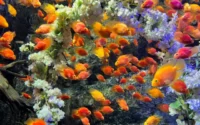
There’s only one building in Changgyeonggung’s back garden. It’s a more modern one: A greenhouse filled with tropical plants and a small, round decorative pool with some aquatic plants and goldfish.
After wandering around Changgyeonggung and its garden, I ended my morning, well past the end of morning.
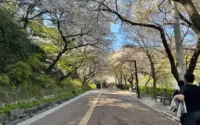
Pictures from the back garden at Changgyeonggung Palace:


Discover more from Joel's Journeys & Jaunts
Subscribe to get the latest posts sent to your email.

Always nice to end off a blog with goldfish. What a riot of colour! May be weeks until we get any of them there flowers here in the Great North. I would make due with a tree in leaf at this point. But then again the palace gardens have to keep up with the vibrancy of the palace decorations not to let down their side of things. Nothing quite so demanding here. Harrumpph. Lovely morning and a half you had!
When I see fish, I think of you. Wait. That didn’t come out right. You know what I mean.
Everything is in full bloom here. This is a winter city. They get snow. But it’s been warm here. I don’t know if it’s normal to be this warm this early in the year.
In my zone, spring has sprung. Crocuses, daffodils, and tulips colorful vanguard to flowering shrubs and trees: azaleas, forsythia, magnolia, and early season cherry. Quite glorious. I’d like a secret garden of my own, something that improves on the shaggy plantings in the backyard. The colorful flora you describe compete with the bold and varied schemes on ceilings, rooftops, beam ends, and walls at today’s polysyllabic palaces. Wow.
I don’t think spring is yet in full bloom back in my hometown, so you have that. But everything is blooming here. I won’t tell anyone about your garden. It can remain your secret garden.