Jaman Mural Village and More
I read somewhere that there are a few mural villages in Korea. One of them, Jaman Mural Village, is across a busy street, which is almost a highway, from Jeonju, close to the Jeonju Hanok Village.
I visited that to start the afternoon before taking a riverside walk, visiting a market, and checking out some old government administrative offices.
If that sounds tiring, it wasn’t. If it didn’t sound tiring, it still wasn’t.
By the way, I expect this entry will turn out to be image-rich, but verbiage-poor. Lucky you.
I enjoyed the afternoon. Nevertheless, I don’t have all that much to say about most of the sights I saw, but I took pictures that can do a better job of presenting them than my words can. At a couple of the sights, I took a lot of pictures, and I don’t want to be terribly selective on which ones I include here. So my pictures will do a lot of the talking this afternoon.
Jaman Mural Village
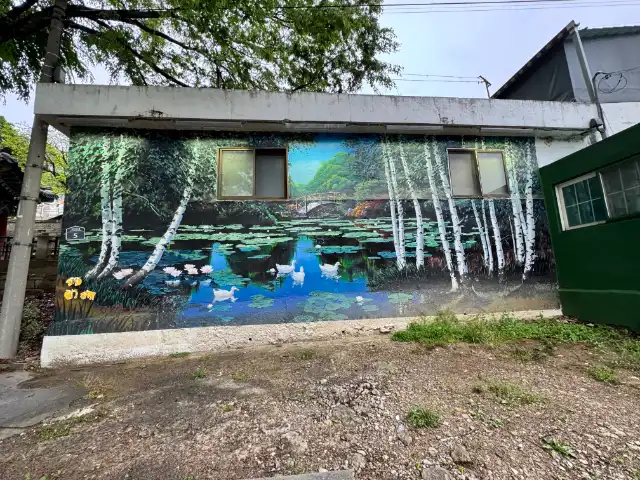
Jaman Mural Village is the first mural village I’ve seen, so I don’t know if it’s typical for that breed of village.
What makes Jaman Mural Village a mural village is that it has a lot of murals. Duh.
The first one I saw was a brilliant landscape. Others were more whimsical, but not inanely so. For example, there was a Wizard of Oz mural.
At first, I thought Jaman Mural Village was somewhat limited. The main lane in Jaman Mural Village might be wide enough for a car, but I don’t think any cars can go up there. It runs parallel to the street that separates Jaman Mural Village from Jeonju.

That lane is fairly straight. When I entered it, I could see pretty much to the end. It didn’t look like it went on very far. But I walked along it and saw that another, narrower lane winds off, up the hill and doubles back. It rejoins the main lane at a point that I must have passed before, but didn’t see.
The murals in question are on the lane-facing walls of the mostly residential buildings. Not just some walls. Pretty well all walls. Plus, on that smaller lane, some lots with buildings facing the main lane extended up to the smaller lane. They had walls along the smaller lane providing their privacy for their properties. There were murals on those walls, too.
Almost all lane-facing walls in the village sported murals. Some of them were fantastic.
I posted above an image of the first mural I saw, the large landscape I mentioned above, and one other. I posted all of the others immediately below in a slideshow that you can scroll through.


Jeonjucheon River Walk

In this morning’s post, I mentioned that I saw the Jeonjucheon River Walk on my walk from sight to sight and thought it looked pretty. I said I might take a walk along its banks this afternoon or tomorrow if the weather cooperates and I have time.
The title of this section is a dead giveaway that I did it this afternoon.
There’s an entry point to the riverside walk close to Jaman Mural Village. The rain from late this morning had mostly stopped. And the forecast said it wouldn’t last much longer. So, I decided to go take the walk.
As it turned out, the rain did not stop when the forecast instructed it to. Instead, it lasted off and on most of the afternoon. There should be someone I can report that to so the rain god can be disciplined.

The river is beautiful. There are some trees along the shore, a few meadow sections, some nice bridges, and a couple of spots with artificially placed stepping stones to allow people to cross the river.
At one point, I saw a lithe, long-legged bird of a species I didn’t recognize (if it’s not a robin or blue jay, I probably won’t recognize it). It was wading slowly in the river, minding its own business.
This is another section where I’ll post more pictures (including the slideshow immediately below) and fewer words than usual. Exactly this few words.


Nambu Market

While I was walking along the Jeonjucheon riverside, I spotted a market on the other side of a road that ran parallel to the river. I didn’t walk all that much farther along the river before I doubled back and visited the market. Some online searching told me it was Nambu Market.
It’s fair-sized with two or three parallel aisles and two or three more that intersect perpendicularly with them.
The aisles are paved with asphalt.
Nambu Market is covered, with a greenish, translucent material above the aisles. The ends of the aisles are wide open. Some vendors around the perimeter of the market are outside.
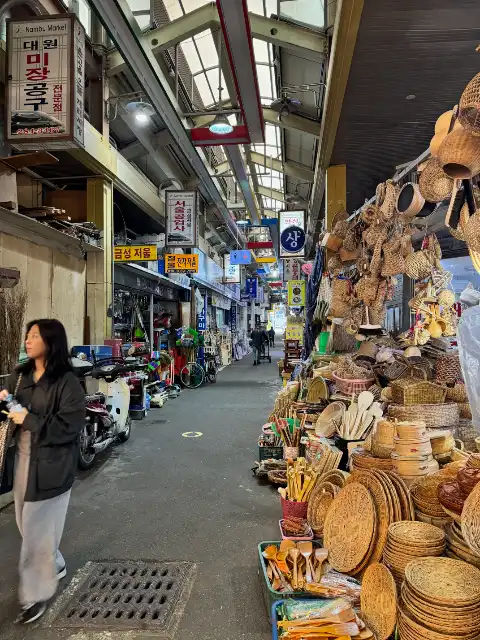
The vast majority of vendors, by far, sell clothing and other textiles. But I also saw a couple of fishmongers, one butcher, a very small number of sellers of other foodstuffs, a couple of kitchenware vendors, and a few foodstalls and small restaurants. There was also one guy selling motorcycles and another selling wood furniture. But, as I said, far and away, the vast majority sold one sort of textiles or another.
I didn’t spot any branded clothing. Some looked pre-worn. If you spot any luxury brands there, I’d be skeptical if I were you.

Oh, I did see one other type of vendor, a couple of arcade stalls. One had some of those claw machines that I saw frequently in Jeonju yesterday. Another had a shooting gallery, where customers had to hit a target to win a prize. I didn’t see an attendant in either of those stalls. That didn’t surprise me with the claw stall; I didn’t see any attendants in any of the claw machine enterprises elsewhere in Jeonju either.
But unless I just didn’t see an attendant, I guess the shooting gallery must detect target hits and dispense the prizes automatically. Either that or they never give out prizes, so why bother paying an attendant?
More pictures from Nambu Market:


Jeolla Gamyeong

Jeolla Gamyeong (sometimes spelled Jeolla Gamyoung) used to be a local government office in Jeonju that oversaw the affairs of the entire Jeolla-do province. When I say “used to be,” I mean during the Joseon Dynasty, which lasted from 1392 to 1910. (I’ve seen some variation on the start and end dates of the dynasty in different sources. I got those dates from britannica.com.)
I’m a bit confused about the timeline of Jeolla Gamyeong. I saw an article that said that it served for the entire Joseon Dynasty. According to a free pamphlet available at the free entrance, Jeolla Gamyeong was established and built in 1392, i.e., at the start of the Joseon Dynasty. But what happened to the buildings after that is what I’m not sure of.

The pamphlet timeline shows some of the buildings being destroyed at different times due to different causes. I’ve also seen an article that says the buildings were destroyed during the Korean War. However, the site pamphlet doesn’t mention any destruction due to the Korean War.
One thing I’m confident of is that the buildings there now are not the originals. The buildings are mostly wood. The wood looks far too new to be the original. Plus, the brochure says that the site was excavated in 2006, a restoration and recreation committee was struck in 2014, and phase one of the restoration project was completed in 2019. The timeline in the brochure ends in 2019. So, unless they just haven’t bothered updating the brochure, I think I saw only phase one of the restoration and recreation.

There are a few buildings on the site. I could go into most of them after taking off my shoes. They were generally sparsely decorated, although an open-sided pavilion had an attractive wood ceiling.
One of the buildings had a table with about a half-dozen old photos on it under glass. Beside each photograph, there was a rectangular magnifying glass that was large enough to see most of the photograph at a glance.

The magnifying glasses were mounted on swivelable, gooseneck stands. That was helpful for anyone interested in the photos because it was almost impossible to view them through the magnifying glasses. Swivelling them out of the way greatly improved the view of the photos. The magnifying glasses were all horribly smudged and reflected a glare from bright, focused, overhead lights.
By swivelling the magnifying glass away, however, it was quite easy to make out the photos clearly, although there was still some glare from the lights because the photos were under glass. I’m not sure what the point of the magnifying glasses was.
Nevertheless, Jeolla Gamyeong made for an interesting sight. And it put a bow on my day.

Discover more from Joel's Journeys & Jaunts
Subscribe to get the latest posts sent to your email.
Jeonju Hanok Village (For Real) and More

Joel in Jeonju, South Korea

The mural village was colourful, if sometimes a little dorky for my taste, although cheering all round. The river was lovely. I liked all your photos – nice. I saw the fish in the market, but not quite the way I like to see them. Not so cold, quiet, and ready to eat that is, although I do like a good fish meal. Some lovely traditional architecture, and – more arcade games! Yay!
Yes, most of the murals were on the dorky side, certainly not Renaissance masterpieces. Then again, I’m on the dorky side and certainly not a Renaissance masterpiece. Maybe that’s why I quite liked the mural village. It brightened the gloom.
It is a fine river and made for an enjoyable walk even if it was in some drizzle.
I prefer to show you live fish, but that’s not always possible.
Dorky, kitschy, and artless as some of the murals are to my eye, the enterprise was redeemed by others that captivated. In all, the murals transform the community from meh to my, my, my.
I agree with all of your adjectives. And to my mind, the dorkiness, kitchiness, and artlessness made them all the more fun.