John Rylands Library; People’s History Museum; River Irwell
If there’s an unintentional theme to my time in Manchester, it might be libraries. Yesterday, I visited the Manchester Central Library, which was the starting point of the Manchester walking tour I took the other day. This morning, I went to the John Rylands Library, which was also mentioned on the walking tour. And this afternoon I’ll visit another library.
After leaving the John Rylands Library, I walked over to and visited the People’s History Museum. Then, I ever so briefly explored a small piece of the River Irwell, which flows behind the People’s History Museum.
John Rylands Library
Mainz, Germany
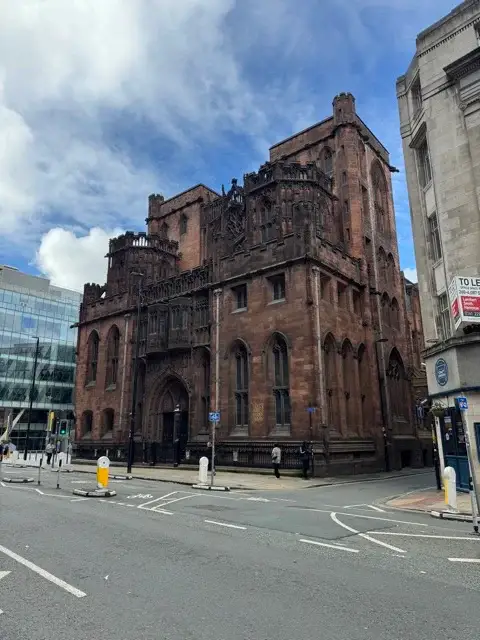
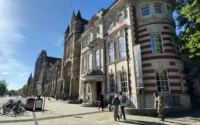
In my post about the walking tour, I included a picture of the side of the John Rylands Library. It looks much the same today, so I didn’t post another photo of the side today. You can view it in the earlier post if you’re interested. However, I posted above a picture that I took today of the front of the building, taken from a slight angle and across the street.
It’s difficult to see in the picture, but the front doors are big, heavy-looking, and dark. There’s a black wrought-iron fence in front of the John Rylands Library. The gate in that fence was ajar. I pushed it open and went through it. The doors of the building were decidedly locked. Both of them.
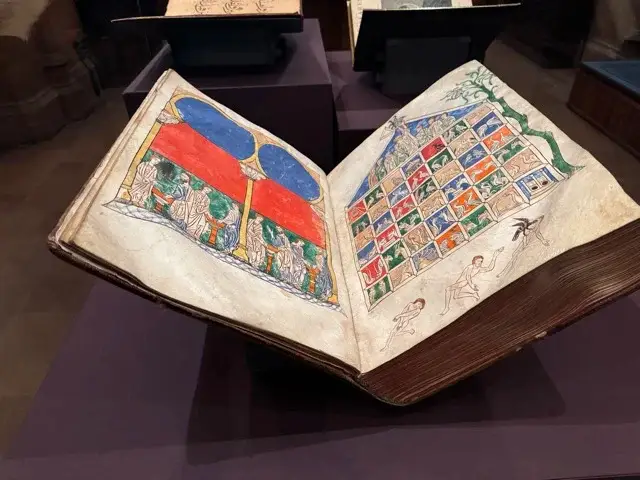
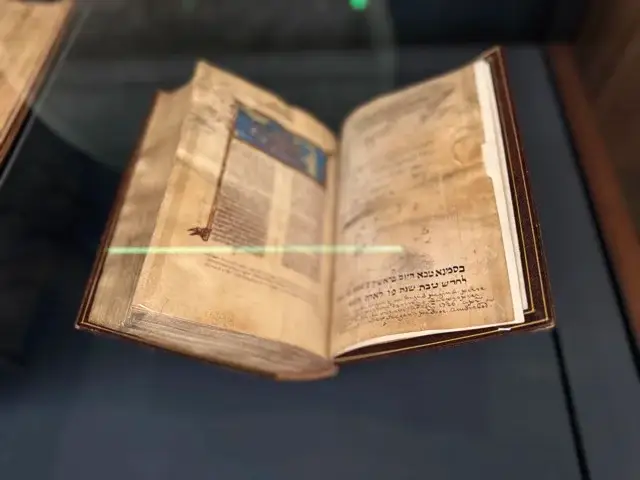
Beatus super Apocalypsim (Commentary on the Apocalypse of St John), late 12th century By Beatus of Liébana
I figured the DLJSSIA (Don’t Let Joel See Stuff International Association) was active on the site. Google Maps and the library’s website said that the library is open Wednesday through Saturday, inclusive. Today is Wednesday. I feared that the DLJSSIA talked them into making an exception and closing today in my honour.
But I walked around toward the back of the building and saw a modern, small structure wedded to the library. The new building now serves as the John Rylands Library’s visitor entrance. It was open. I went in. I’m glad I did. It’s amazing and beautiful.
When I spoke about the John Rylands Library in my post about the walking tour, I think I might have gotten a small bit of the information wrong. That was probably a result of my faulty memory, not faulty information from the guide.
I thought John Rylands and his wife Henriqueta built it. It was, instead, commissioned by Henriequeta alone to honour her formerly very wealthy, but by then very dead husband, after he died in 1888. The library opened to the public on January 1, 1900. Henriqueta was instrumental in acquiring most of its books.
The building was built in the Neo-Gothic style. Its hallways on the ground level are dark stone, with lots of fluted columns and diagonally intersecting ribs on the ceiling. There are carved decorations at the intersection points of the ribs. The dimness and design made it feel, for me, as if it were much older than it is, Gothic rather than Neo-Gothic. But what do I know? (That’s a rhetorical question. Please don’t answer it.)
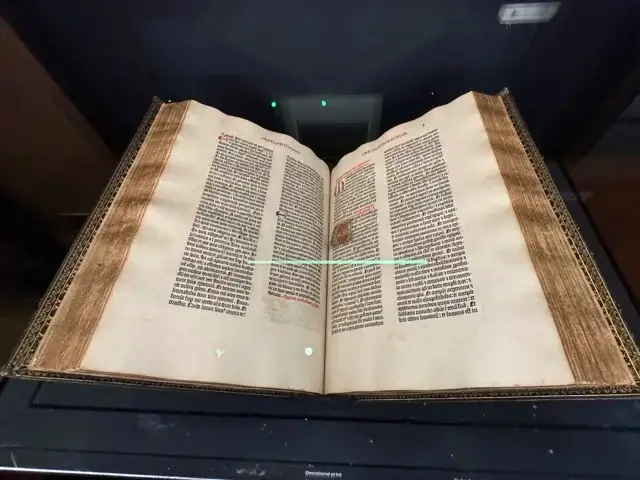
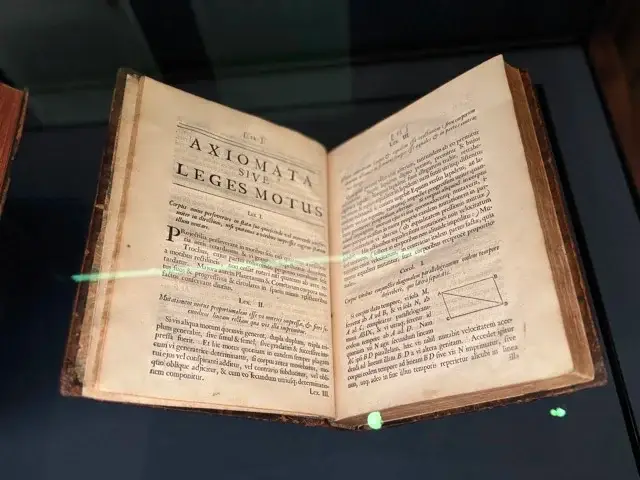
On that ground floor, there’s a room with several old, rare volumes opened to an inside leaf and on display under or behind glass. For example, there was a Gutenberg Bible, dating from 1454-1455; an illustrated Bible commentary dating from the 12th century; Newton’s Principia, dated 1687; and an illuminated Hebrew Bible from the 14th century, among others.
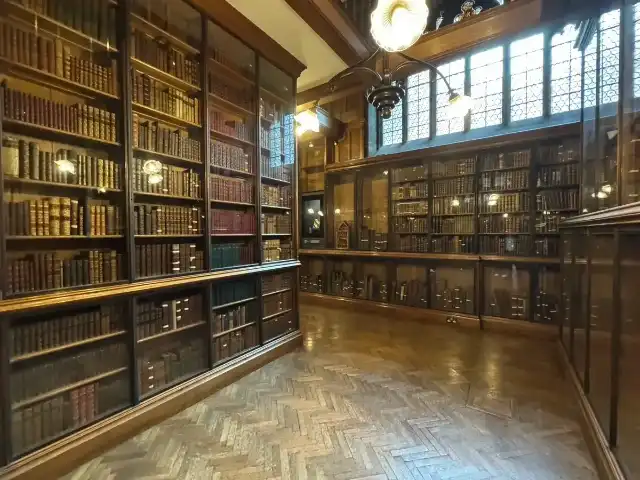
This floor also contains a couple of rooms with bookshelves, as one would expect in a library. The books on the shelves were old. They, too, were behind glass doors. The spines all faced out. Most didn’t have dates on the spines, but I randomly scanned a few of the rows and saw a few that did have dates ranging from the, if memory serves, 17th to the early 20th century.
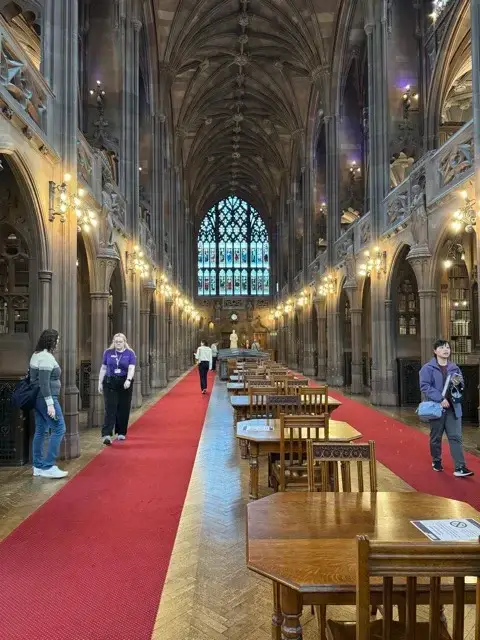
The library’s reading room is on the floor above that. A long centre hall extends most of the way along the length of the reading room. About one-third of that space has glass cases with more old books in them. Most of the remaining space has small tables for reading.
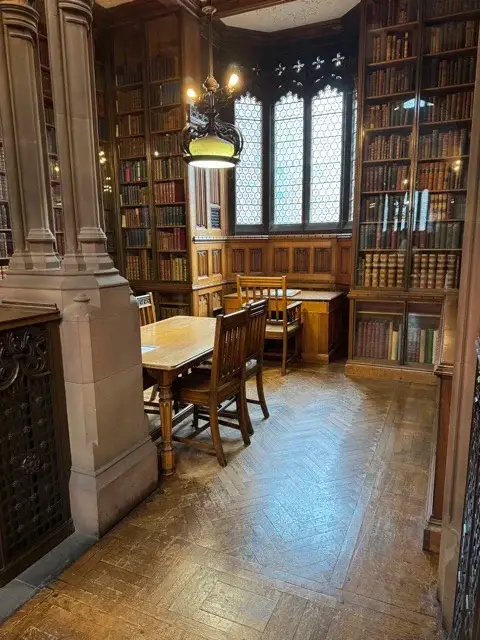
Along each side of the reading room, there is a series of alcoves. Each alcove has bookshelves with books, a table with a couple of chairs, and a desk with a chair.
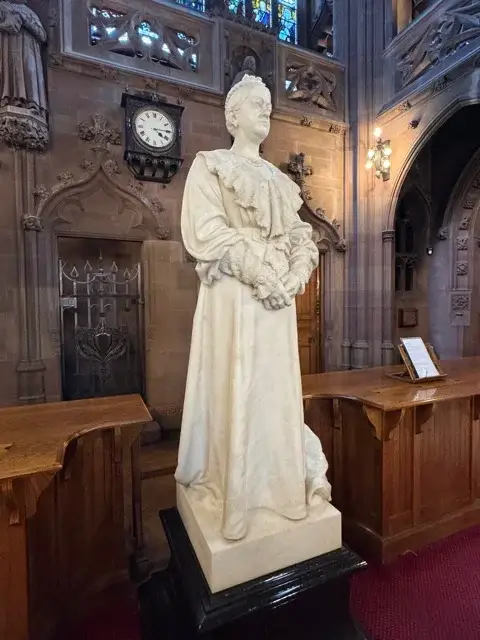
In the post about the walking tour, I mentioned that the guide told us that there are statues of Henriqueta and John Rylands in the library. He said that the statues face each other so Henriqueta and John can look at each other for all of eternity, or until the library crumbles, whichever comes first. The guide said that the statues do indeed face each other, but that they are far apart. He suggested, I assumed jokingly, that he thought that, while Henriqueta was okay with looking at John forever, she didn’t want to be too close to him. Henriqueta was much younger than John. The guide speculated, I think jocularly, that what Henriqueta most loved about John Rylands was his money, and physical closeness wasn’t something she wanted for all eternity.
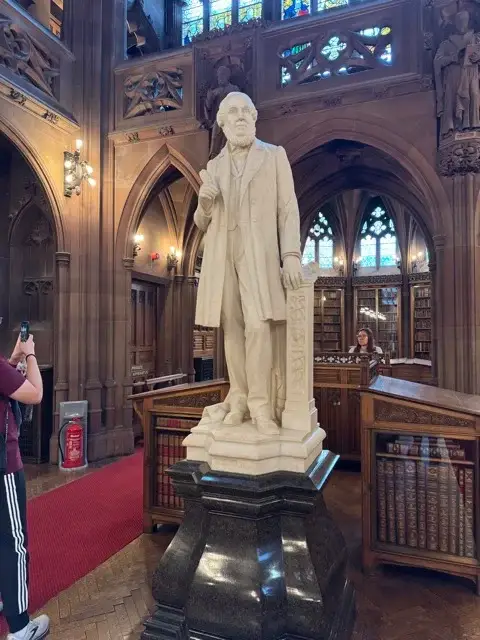
As I said, I thought the guide was joking. And he might indeed have been kidding about Henriqueta’s thinking, but not about the physical distance of the statues. They’re up in the reading room at opposite ends of that long centre hall. And it is a very long hall. I included close-up pictures of each statue, along with one of Henriqueta’s statue that I took while standing beside John. Yeah, that’s not a suggestion of emotional closeness between the two.
The John Rylands Library is fabulous. I’m glad I went.
People’s History Museum
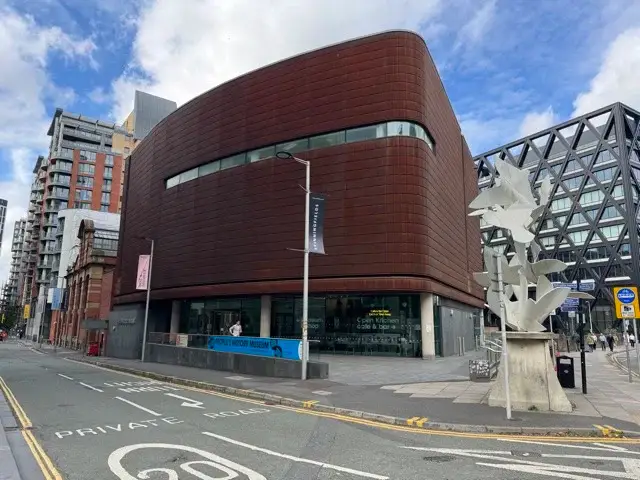
The contents of the People’s History Museum are what the current regime in power in the United States (it’s now 2025) would, with disgust in their voice, call “damned socialist and communist crap!” Then again, they call everything contrary to the MAGA manifesto “socialist and communist,” so there’s that.
That having been said, the material in the People’s History Museum is very far left and does, indeed, cover both socialism and communism. The labour movement features prominently and very positively.
Three galleries in the People’s History Museum were open to the public when I was there. One had a temporary exhibit not particularly related to the museum’s theme. It held a collection of, I think it was, 60 guitars—both acoustic and electric. The public donated the guitars, and professional local artists hand-painted them. The guitars will be auctioned off in a few days to raise money to support grassroots music in Manchester.
The other two galleries were both on topic. One covered the period up to 1945. The other covered the period from 1945 onward.
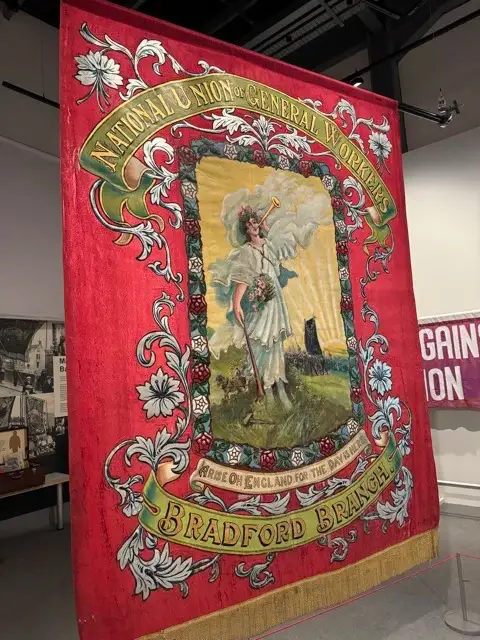
The subject matter dealt with social injustice and the fights for democracy and social justice. The exhibits were comprised of several political cartoons and other artwork, including several banners, some of which were quite beautiful. There was also considerable text describing social conditions over time, and the protests and actions for change.

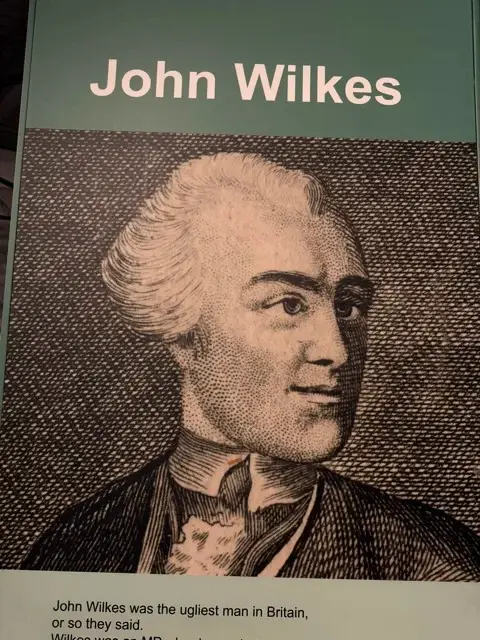
One of the text panels showed an illustration of John Wilkes (1725-1797). The text said that he was said to be the ugliest man in Britain. He was a member of parliament who demanded an end to corruption in government. His reward for championing this cause was to be sent to prison. I fear that the United States might be headed in that direction these days.
There was also a coffin on display. A sign encouraged opening its lid. Inside, there were several newspapers and a sign that explained that “Until 1836, newspapers were taxed. They were stamped to prove it had been paid – a tax on knowledge. Newspapers highlighting the unfairness of society or critical of the government were untaxed and unstamped. These illegal papers were sometimes moved in coffins as government agents would be reluctant to search the contents.”
I worry that knowledge is being stifled again these days, but not through taxes. It’s being overwhelmed by so many nonsensical conspiracy theories and other false information distributed freely. Sigh. It was time to leave the museum before I got too depressed.
River Irwell
As I said, the River Irwell flows behind the People’s History Museum. At that point, at least, the city turns its back on the river. On the museum’s side, the buildings mostly sit almost immediately beside the river, with plain, ugly lower portions of their walls bordering the river.
There is a small, unattractive deck next to the river behind the museum and what looked like an abandoned building abutting it. I would have gone there to take a picture, but there was some professional photography, or maybe videos, being done there. It looked like they were capturing images of Coop employees. So I didn’t go onto the deck.

A road with a bridge over the river is beside the People’s History Museum. The neighbourhood on the other side of the bridge is technically not part of the City of Manchester. It is considered to be part of Greater Manchester, but it’s another municipality called Salford.
On the Salford side, there are some new-looking buildings with an open plaza (“plaza” as in a public space, not “plaza” as in a shopping mall) beside the river. Plus, there’s a nice, but short, river walk on that side. I followed the walk for a piece before it appeared to end at another bridge. There, I crossed back to the City of Manchester side and set out to forage for lunch.
Etymology
The most interesting aspect of the River Irwell is the etymology of its name. In 1158, the powers that be at the time decided that the river needed a name. Until then, everyone simply called it the “You Know, That River Over There River.”
Because that didn’t form a convenient acronym, saying it got cumbersome when the river became more heavily used. The local Official Geography Namer, a gentleman by the name of Manfred Fredman, Esq., went to survey the river in the hope that seeing it for the first time would inspire him to formulate the perfect name for it.
But Fredman was stumped. Nothing came to him. Nothing at all.
The scribe Fredman brought with him to scribble the great namer’s thoughts stood patiently with his quill hovering over a parchment he held in the palm of his other hand. But no words came for him to inscribe.
Finally, Fredman sputtered, “I shall name this river … er … well …”
Obviously, Fredman was stalling for time in the desperate desire that something would come to him shortly. But at that instance, the frustration became too much for him, and it stopped his heart permanently.
However, the scribe misunderstood and thought Fredman’s last words were not a stall, but rather his declaration of the river’s new name. The scribe mis-transcribed it as “River Irwell.”
The rest, as the cliché goes, is history.
Clearly, this entire etymology section is balderdash. Completely. Don’t you wish you hadn’t wasted your time reading it? Sorry about that.
Discover more from Joel's Journeys & Jaunts
Subscribe to get the latest posts sent to your email.
Sackville Gardens; Manchester Museum

Chetham’s Library; Museum of Science and Industry; Manchester Summary
What a delicious library that is. Seeing those desks tucked in by the lovely bookcases and lit by the leaded glass of the neo-Gothic window just makes me want to sit at one and get lost in one of those books. Gorgeous Beatus manuscript. What a treasure! I am with Borges: “I have always imagined that Paradise will be a kind of library.” There is a niche tourist market for seeking out the great libraries of the world, but I had no idea there was a gem in Manchester. As to your balderdash about the river Irwell, I am proud to say that I could see it coming from the length of the room that separates Henriqueta from her beloved John. Ah, for a good yarn, though.
Damn! All this time, I never knew you were prescient. Somewhere in that small new building that they attached to the John Rylands Library as a new entryway, I saw the Jorge Borges quote about imagining Paradise as a kind of library.” I forget if it was a sign on a wall or printed on some of the merchandise in the gift shop that’s also in that add-on building, but it was there quite prominently. Appropriate, I’d say.
Yes, it is a delightful library. Although, I don’t think they let people read or even touch any of the books. I don’t think there are any that aren’t at least somewhat old, and often very old, and at least somewhat rare, and often quite rare.