Chetham’s Library; Museum of Science and Industry; Manchester Summary
One fabulous library deserves another. After visiting the amazing John Rylands Library this morning, I visited the equally wonderful Chetham’s Library in the afternoon. I then ended the day at the Museum of Science and Industry.
Tomorrow morning, I’ll be catching a train for my next destination. Consequently, you’ll find a summary of my time in Manchester at the bottom of this post.
Chetham’s Library

Do you see that picture of the largish red brick building with a Chetham’s Library sign on a low wall jutting out from it? I was about to say the picture beside this paragraph, but then I realized it will be beside this paragraph only if you’re viewing this on a computer screen with a large enough browser window. If the window is too small, particularly if you’re on a mobile device, the photo may appear above or below this paragraph.
Wherever the image appears, it’s the one I captioned “Not Chetham’s Library.” The reason I labelled it thus, the Chetham’s Library sign notwithstanding, is, as the deep thinkers among you might surmise, it’s not Chetham’s Library. Nor will you find a photo of the exterior of Chetham’s Library anywhere on this page.
There’s a reason for that.

Public entrance to Chetham’s Library is only by a time-specific, capacity-limited, paid guided tour led by volunteers. At the start of the tour, two guides—one male, one female—met the small, sold-out group that had gathered outside the gate beside that building. The male guide took names and checked us off his list of pre-booked customers. Pre-booking is mandatory, so they already had the names.
The male volunteer did most of the leading and gave most of the spiels. The female guide trailed behind and kept people from straggling behind. She also did the talk in one of the rooms and answered questions asked of her.
Before we went through the gate between the pictured building and a guardhouse, the male volunteer gave us a short introduction. He said that the building and some others in the compound that Chetham’s Library is in are a music and boarding school. Students frequently walked through the grounds. For privacy and security reasons, we weren’t allowed to take pictures outdoors beyond the gate. However, we were allowed to take as many photos as we liked inside the library.

The library is across a small parking lot and a slightly smaller adjacent grass courtyard from the gate.
Chetham’s Library is designed to look exactly like it’s a Medieval building. The reason for this is that it’s a Medieval building. It became a library only in 1653. But the building it’s housed in has a history that predated that by more than two centuries.
It was built in 1421 to accommodate priests of the nearby collegiate church, which is now, after some extensions and renovations, the Manchester Cathedral. There was less need for priests when the church switched from Catholic to Protestant. The latter didn’t believe in hell or purgatory. Thus, the fees the church earned by charging rich people for prayers to speed their journey from purgatory to heaven diminished.
Eventually, all the priests left.

During the English Civil War, the parliamentary forces were based in Manchester, and the monarchist forces were based across the river in Salford. The compound was then used to store munitions.
Even before the Civil War (1642–1651), Humphrey Chetham (1580-1653), a wealthy textile merchant, was interested in the property, but the owner wouldn’t sell. After the war, the property fell into disrepair, and it became available.
When Chetham’s Library was founded, there was no institution for independent scholarship in Northern England. According to Chetham’s Library’s website, “Humphrey Chetham’s will of 1651 stipulated that the Library should be ‘for the use of schollars (sic) and others well affected’, and instructed the librarian ‘to require nothing of any man that cometh into the library’. “

The lower level of the Chetham’s Library building does not contain the library. There is a beautiful three-sided cloister that leads into a couple of rooms. The first of those rooms is “the audit room.” The collegiate church, back in the day when it was a collegiate church, owned a lot of land, and they charged rents. So they needed an audit room. Plus, the guy in charge of the collegiate church (I forget his job title) worked out of there.
The other room was a dining hall for the priests and, later, for the school that used the building for some time. There is currently a very large fireplace extending out from the room. That wasn’t originally there.
Originally, there was a big fire pit on the floor in the room.

At the front of the room, there is one portion that’s on a slightly raised platform. Over the platform, there’s a curved wood piece that hugs the back wall vertically and then, after the bend, hugs the ceiling horizontally.
The fire pit was in the middle of the portion of the room without the platform or the curved wood piece over it. Because of the fire pit, it got very smoky in the room during meals. Important people ate at a table on the slightly raised portion. The curved wood is said to have pushed the smoke back into the other section where the plebs ate.
I imagine the fireplace they knocked out of a wall at the side of the room to eliminate the need for the fire pit alleviated that.
Chetham’s Library is upstairs. The stacks are in an L-shaped room. On one arm of the L, the tall bookcases are out in the open.
On the other arm of the L, the bookcases are in open bookcases along one wall, but also in a series of adjacent alcoves strung out along the length of that arm of the L. Each alcove has a tall gate in front of it.
When the library opened, the bookcases were relatively low. All of the books were secured to the bookshelves by chains. If someone wanted to read one of the books, they had to grab one of the available stools, bring it to where the book was and read it there.
When Chetham’s Library acquired too many books to fit in the available shelves, it built extensions on top of the existing shelves. They were then so high that the chain method of securing the books was no longer practical. Instead, if someone wanted to read a book, they had to tell the librarian which book they were interested in. The librarian would then unlock the appropriate alcove, the reader would go in, and the librarian would lock them in. When the reader was done, they had to call for the librarian to let them out.

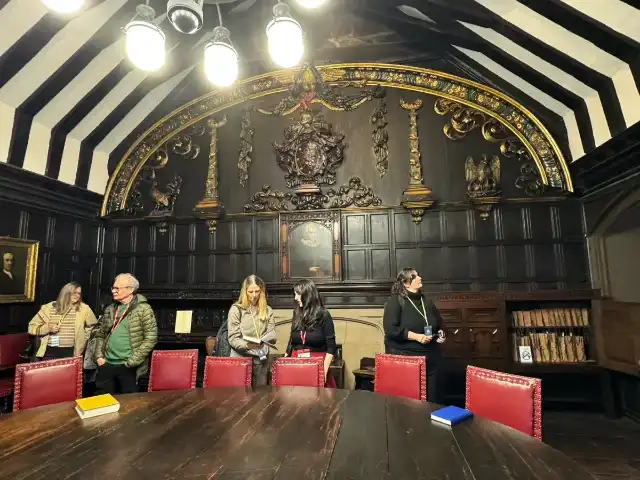
There’s a lovely reading room in Chetham’s Library. It has a large round table with chairs around it. There are also decorations on the walls. The library has placed replicas of some of its more valuable books on the table for visitors on the tour to browse through.
In the reading room, there’s a small portable library bookcase containing books still affixed by chains.
Also in the reading room, there’s an alcove that juts out from the rest of the building, with a table and chairs in the alcove.

Back in the 19th century, there was a young lad who was born in the Kingdom of Prussia who had some ideas about social justice that his wealthy textile manufacturer father didn’t approve of. His father sent the son to manage his textile mills in Manchester, thinking that would straighten the son out. It did the opposite. When the son saw the poverty in Manchester and the oppression of the working class there, he became even more strident in his social justice views.
The son had made a friend in Paris. When the friend came to Manchester for a while, the two of them came daily to Chetham’s library and sat in the alcove reading and discussing socialist and communist ideas. The son was Friedrich Engels. The friend was Karl Marx.
(It was only as I typed it just now that I noticed that if you split Friedrich into two, it becomes “fried rich,” which I think is what the two of them wanted to do to the rich, at least metaphorically.)
Chetham’s Library was very much worth the visit.
Museum of Science and Industry

The Museum of Science and Industry has a few buildings in its complex. However, much of it is closed for renovations now or, possibly, just because I was there. In fairness, I knew that before I went, as I saw a notice about it on the museum’s website.
What’s open to the public now during the week is housed in two large rooms on a single floor in one building. (There’s an interactive exhibit, mostly for children, that’s open on another floor on weekends.)
(Needless to say, if you’ve stumbled on this page considerably after I wrote it, some of the areas that were closed when I was there may be open now. Check the museum’s website.)
One of the rooms has a collection of old technologies and scientific equipment. Along with that, there are information panels about some famous local scientists and inventors. There’s an old car. A recreation of what the accompanying sign says was the first computer with electronic memory is also there. It was called the Manchester Baby. Don’t ask me why. And more.

There’s a very small sub-room sectioned off on one side of this room with an, I think temporary, exhibit on Stephen Hawking. The exhibit comprises a few of his personal effects, including his wheelchair and communication device. There’s also a three-minute video about him.
The other big room contains a lot of large, old, still-functional textile equipment in honour of Manchester’s former leading role in the cotton industry. When I was there, a couple of guys were running off and on one of the big, multi-spool spinning machines. It was loud, but it was impressive. I think they were testing it, or maybe doing repairs on it. The action didn’t seem to be part of a formal presentation. The room also contained other spinning machines, along with some looms and other textile equipment.
That was pretty much the extent of what was open during the renovations. But it was free, so I got more than my money’s worth.
Manchester Summary

I didn’t love Manchester. But I very much liked Manchester. Wandering around, there are several architectural gems here and there. I should say that they were architectural gems to my eyes. I occasionally read articles by architecture critics in the mass media. Often, buildings that they denigrate in the strongest possible terms, I love if I’ve seen them in person or through pictures. And I often dislike or hate buildings they love. So, I can’t say whether you’d think that the buildings I really liked or loved here are gems.

And there are a lot of very interesting and/or fascinating attractions to explore, such as the Manchester Jewish Museum, the Manchester Museum, the John Rylands Library and Chetham’s Library. There are more I’m forgetting. Feel free to skim my Manchester Pages in this journal to find them.
As to timing, four nights, translating into three-and-a-half days, was about right. Any less and I would have had to rush to not miss some of the stuff I ended up enjoying. Any more and I don’t know what I would have done during any additional days. Although if you’re a football fan (North American soccer), there is a National Football Museum here. I didn’t go because I wasn’t interested.

That being said, as I stated at the start of this summary, I liked, but didn’t love Manchester. There are some great and good sights and activities here, but nothing that’s a blockbuster. I don’t think there’s anything that will be on many people’s bucket lists. If you’ve only got enough time and/or money to visit one city in the world, there are other cities I’d recommend over Manchester. But if you’ve got some time, and you find yourself in England, I think you’d enjoy a visit to Manchester.
Discover more from Joel's Journeys & Jaunts
Subscribe to get the latest posts sent to your email.
Wowie wow wow what a library. I love a good medieval building. And an intriguing history. I appreciate your measured and honest appraisal of Manchester. I think the buildings you chose to show us were gems and there was much more of interest in the city than I knew about before I followed your blogs, so you are doing a service to the world. At least my world, and what other world can I attest to the reality of anyways? Not that I want to get into any discussion about that. To get my head around that question I’d have to read more of those books.
I know you said you didn’t want to get into it, but can we even attest to our own world? There is the question that has now become a cliché. What if we’re living in a simulation?
The person running the simulation might decide to reboot it. Manchester might then cease to exist or become something very different. The simulation master would likely do that with the sole purpose of messing up this journal. Come to think about it, they probably have already done that. This likely was a literary masterpiece in a previous simulation run.