Sackville Gardens; Manchester Museum
This morning, I set a goal of visiting the Manchester Museum. When I looked at the walking route there, I saw on Apple Maps a small park, Sackville Gardens, that looked interesting and required a diversion of only a couple of blocks. So I went there first.
I figured those two destinations wouldn’t fill up my morning. But, as has become my most common practice over the past few years, I didn’t make any firm decisions about what else to do until I saw how much time I had left before my normal lunchtime range, lunch being a mandatory activity.
It turns out that’s all I did in the morning.
In yesterday’s post about the Manchester Cathedral and the Manchester Jewish Museum, I said that the only excuse I could come up with for why I accomplished so little yesterday morning was that I’m now an old man and I’m slowing down.
Regrettably, I didn’t wake up any younger this morning. If I manage to keep travelling, in a few years, my morning posts in this journal might all be: I woke up, had breakfast, and then sat on a park bench until it was time for lunch. My afternoon posts will probably be identical, but will substitute lunch and dinner for the boundary meals and omit the waking-up part. I would put going to sleep in those future entries to pad them a little, but I’d be asleep before I could type it.
Stay tuned. You won’t want to miss those posts about the park benches I sit on around the world. On the upside, they’ll be fast reads.
Sackville Gardens

What drew me to Sackville Gardens is that, in addition to an Alan Turing memorial, Apple Maps said it contains The Beacon of Hope and The Tree of Life. Who the heck wouldn’t want to put themself in the presence of a beacon of hope and a tree of life simultaneously? Seriously. Uplifting and life-sustaining at the same time. How could I not?
It turns out The Beacon of Hope is a tall, shiny, silver-coloured pole sitting on a roughly heart-shaped base pixelated with coloured tiles. That base sits on a larger, similar-shaped base of concrete. The pole is decorated with small black and grey hearts.
The plaque beside The Beacon of Hope says it was erected in 2000 and “stands as a memorial to everyone lost to HIV and as a symbol of solidarity with everyone living with HIV today.”
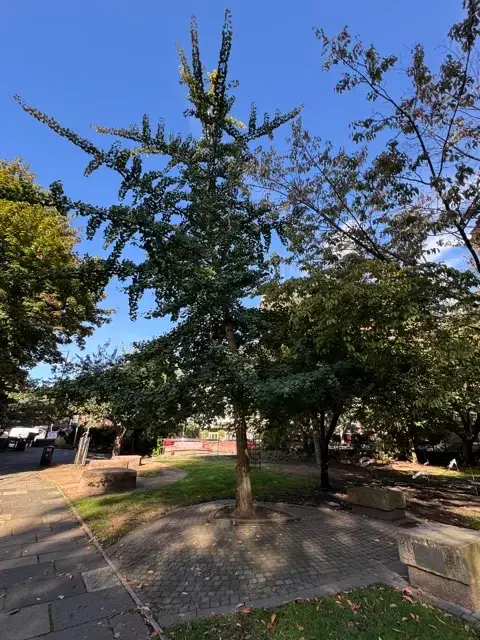
The Tree of Life is a tree that’s fairly normal-looking. The plaque beside it says, “This TREE was planted by the lord Mayor and Lady Mayoress of Manchester on behalf of the Village Charity in memory of those lost to HIV/AIDS.”
I suppose I should’ve guessed the general theme from the fact that the park is located near, or possibly in, I’m not sure, Manchester’s gay district, an area well-marked on maps and celebrated in the city.
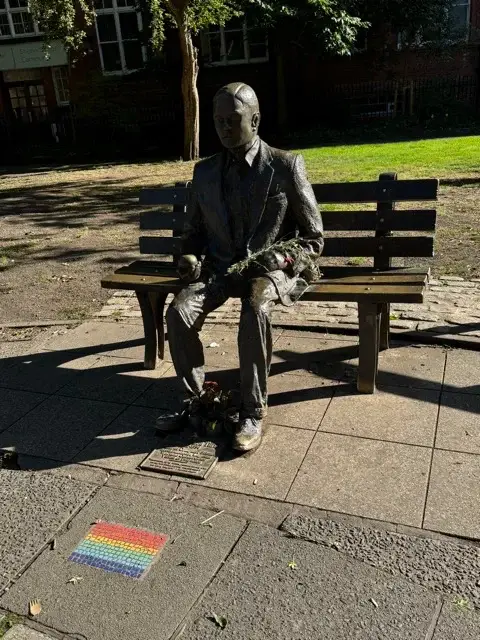
The Alan Turing memorial should have been a giveaway, too. As you probably know, he was among the pioneers of modern computing. In 1952, he admitted he was gay (although it wasn’t yet called gay). At the time, male homosexuality was illegal. He was offered the choice of jail or chemical castration. He chose the latter. In 1954, he was found in his room, dead from cyanide poisoning.
In addition to a statue of him in the park, there’s a plaque beside it providing a brief synopsis of his life.
That reminds me of something that Gareth, the tour guide on yesterday’s Manchester Walking Tour (if I got his name right), said. He said that Manchester is a very diverse and accepting city. I meant to report that yesterday in the walking tour post, but forgot.
Gareth talked about the vibrant Gay District and the city’s major Pride weekend. But he said that the diversity extended beyond that. A recent census found that 31% of the people living in Manchester were born outside of the United Kingdom.
There is a large Chinese population. They’ve been here for a while, but the Chinese population expanded greatly when the U.K. offered Hong Kong citizens passports either after it handed over Hong Kong to China or possibly when China started removing democracy and civil rights from Hong Kong. I forgot which.
There is also a large population of people of Italian heritage here, as evidenced by the many pizza and other Italian restaurants. Plus, there are several people of Irish descent, among other nationalities.
And, as I mentioned yesterday in my post about the Jewish Museum, there’s a surprisingly large Jewish community in Manchester. (Surprising to me, anyway.) And, according to one of the guides at the Jewish Museum, antisemitism is not nonexistent, but it isn’t much of a problem here.
Furthermore, according to Gareth, when a terrorist detonated a suicide bomb at an Ariana Grande concert here in 2017, allegedly in the name of Islam, the large Muslim community in Manchester strongly condemned the act. Muslims distributed food to people who came for a vigil, claiming that the bombing was an act against what Islam stands for, not supporting it. I don’t know how much of that is true and how much of it is Mancunian civic pride, but it sounds like a city that other cities should strive to be like.
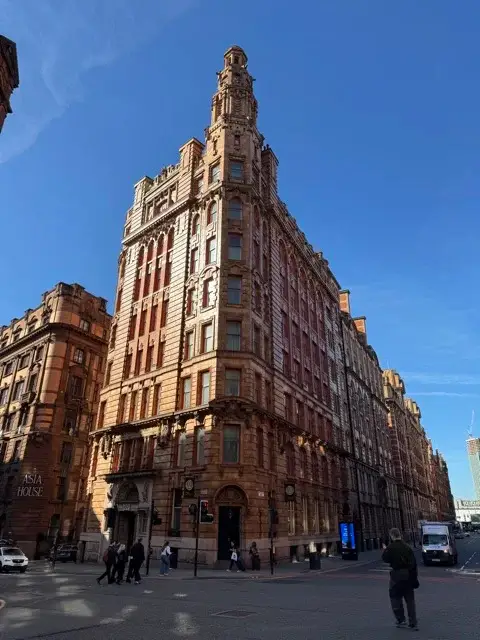
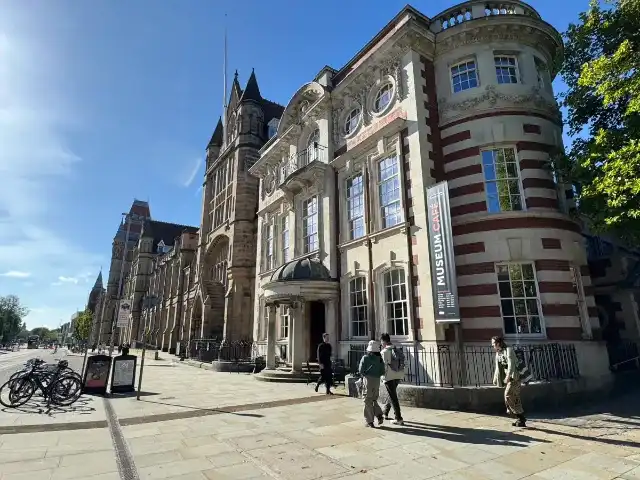
On the walk between Sackville Gardens and the Manchester Museum, I passed some almost adjacent buildings that I thought were striking and beautiful. I’ve posted pictures of them immediately below.

Manchester Museum
The Manchester Museum is part of Manchester University. It’s not huge, but it is quite interesting.
The first exhibition room in the Manchester Museum is on the first floor (i.e., the one above the ground floor). It contained a variety of types of archaeological artifacts from a variety of places. According to a sign in the room, “The history of the world is a history of movement.” It went on to explain that, “This installation is a creative exploration of the migration of ancient historical objects by young people with migrant heritage. Drawing on archival research and their own lived experiences, they re-create the stories of the objects on display.”
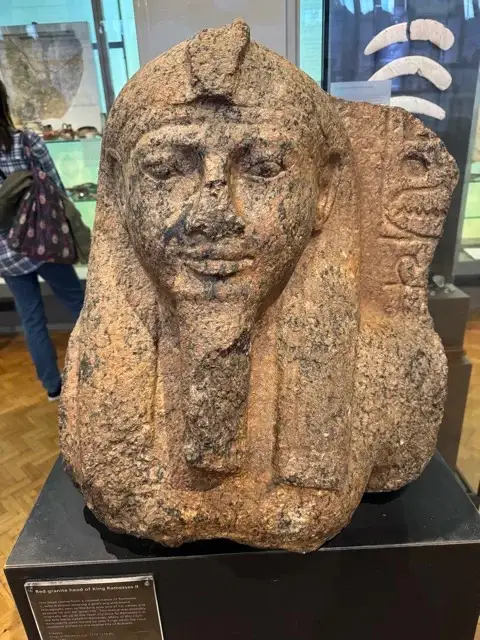
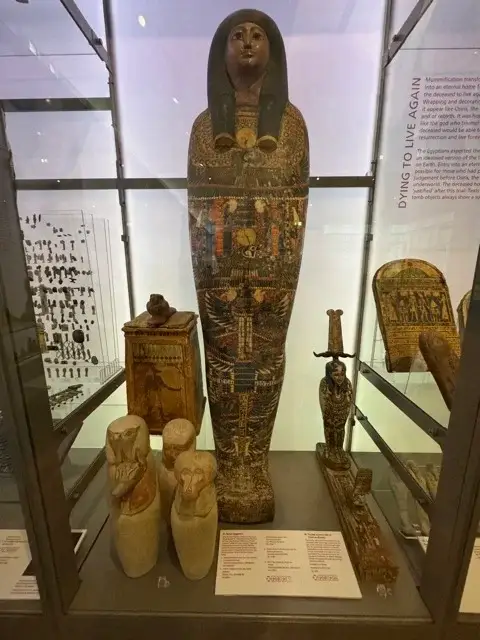
The next room housed a collection of the usual sorts of ancient Egyptian artifacts—mummy cases, pottery, busts, etc.
The Egyptian collection also includes some display cases with large collections of tiny, similar artifacts of a few different types, such as the shabtis (servant figurines) that were placed in tombs as afterlife servants.

Following that, the Manchester Museum offered a two-story collection of mostly taxidermy, including a variety of species.
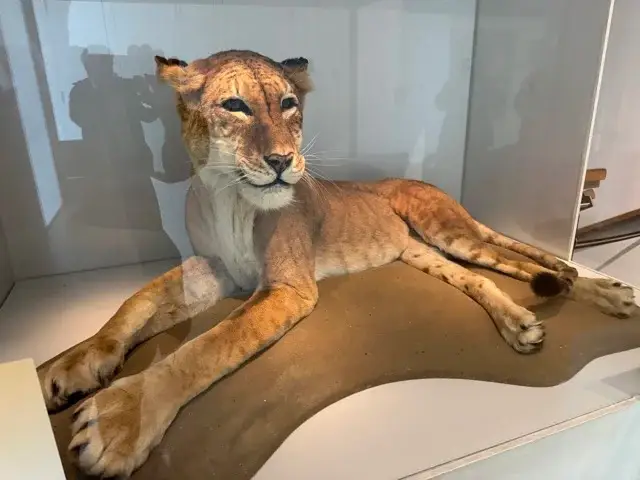
At the start of this section, one stuffed dead animal warranted its own display case, Maude the Tigon. Tigons are a mixed breed of a tiger and a lion. They don’t breed as such in nature because lions and tigers don’t come into contact in the wild, which makes it tough for them to form romantic bonds. Dating apps aren’t yet a thing for lions and tigers. Instead, the hybrids are intentionally bred by some less scrupulous zoos. How much wine do you have to give the lion and tiger to get them to date and mate?
Maude was bred at the Dresden zoo and became the star attraction at the Belle Vue Zoological Gardens. Now, her stuffed body is a star attraction at the Manchester Museum.
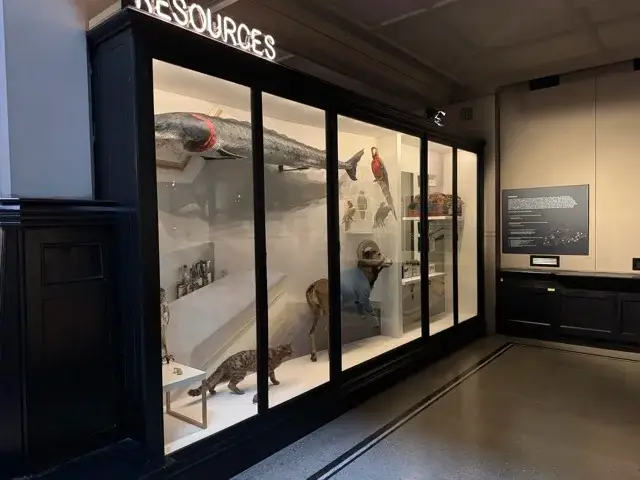
Beyond Maude, on the lower floor of the taxidermy section, each display case contains multiple animals. And each display case has a word or phrase above it written in a neon (or neon-like) light. Examples of the words include “Resources,” “Climate,” “Variety of Life,” among others.
On this page, somewhere close to this paragraph, I included a picture of the display case with “Resources” over it. Do you notice anything weird in it? Look closer.
In case you couldn’t see it, I included a close-up shot of the weird thing. That’s a mouflon (wild sheep) in a tatty, blue, woolly sweater. Um. Okay.
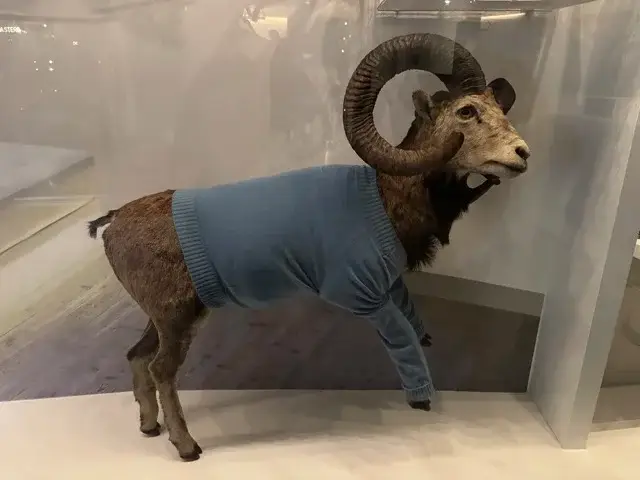
Come to think of it, that wasn’t the only weird thing. In the same display case, on a table to the far left, just out of the frame, there’s a bottle of champagne and a couple of champagne glasses. Like I said, um. Okay.
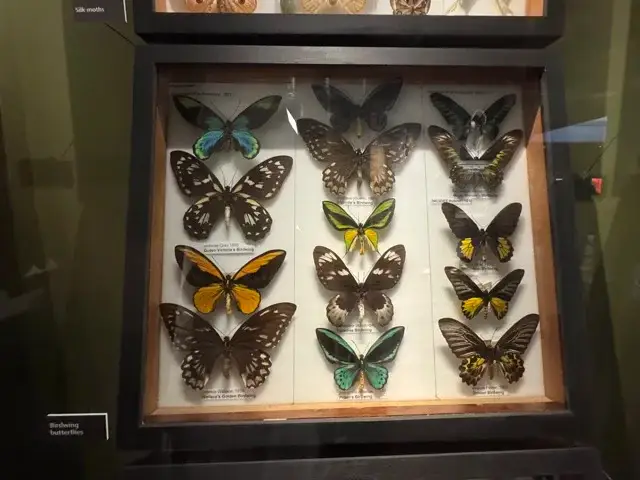
Upstairs in that area, there’s more taxidermy and some skeletons, plus a collection of attractive pinned dead butterflies and less attractive insects, such as beetles.
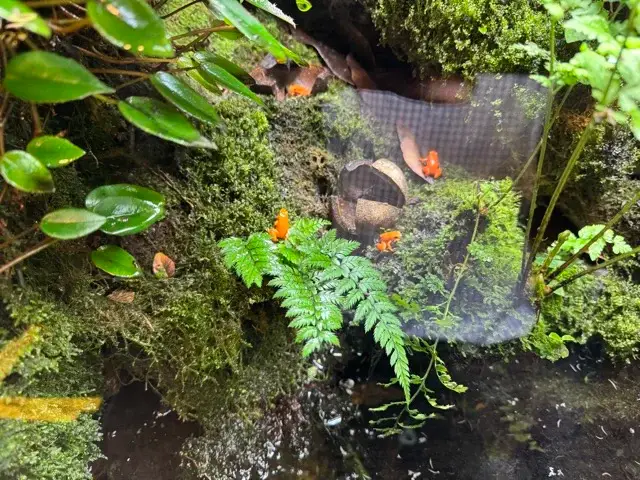
In the next area of the Manchester Museum, there are terrariums with living animals, including some with the smallest frogs I’ve ever seen. One, the strawberry poison-dart frog, grows to only 20 millimetres (just shy of 0.79 inches). How big can their poison darts be?
There were also some lizards and other small creatures in the terrariums.
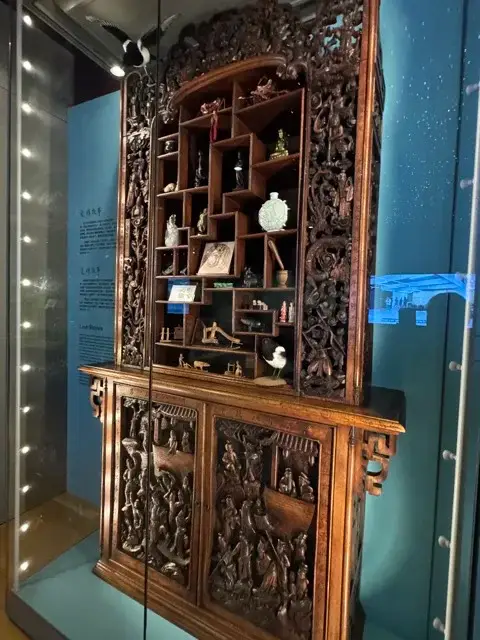
Another small section of the museum is dedicated to South Asia and features textiles, ceramics, art, and a beautifully crafted and filled large wood cabinet. According to the sign accompanying it, the objects in the cabinet tell a love story.
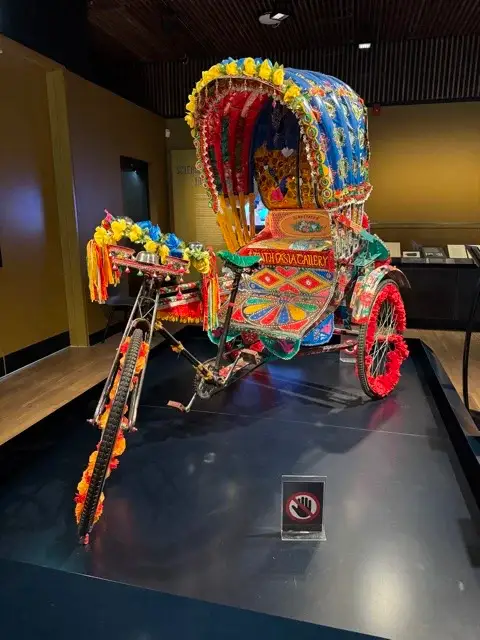
Also in the South Asian section is a vibrantly coloured rickshaw made in Dhaka, Bangladesh. It’s one of two specially commissioned for the Manchester Museum.
After finishing with the South Asian section, I headed out. I got back down to the lobby and stopped. “Wait,” I thought, “there are supposed to be dinosaur fossils here. I haven’t seen dinosaur fossils.”
In the lobby, I consulted a large wall map of the museum. According to the map, they were on the ground floor in a room off to the side of everything else. A volunteer was standing by the map. I asked her for directions.
“They’re in another building connected by a bridge to this building. You have to go upstairs, walk to the end of the exhibit areas up there, and there’s a set of stairs down to the dinosaurs.”
I followed her instructions, and at the end of the exhibit area, in a place I had been to before while exploring the rest of the Manchester Museum, there it was. The stairs that lead down to the dinosaur area.
The reason I hadn’t seen it before was that the completely unobstructed staircase was cleverly hidden immediately under a big sign, with stark black letters on a pure white background. The sign said, in the clearest font possible, “Dinosaurs.”
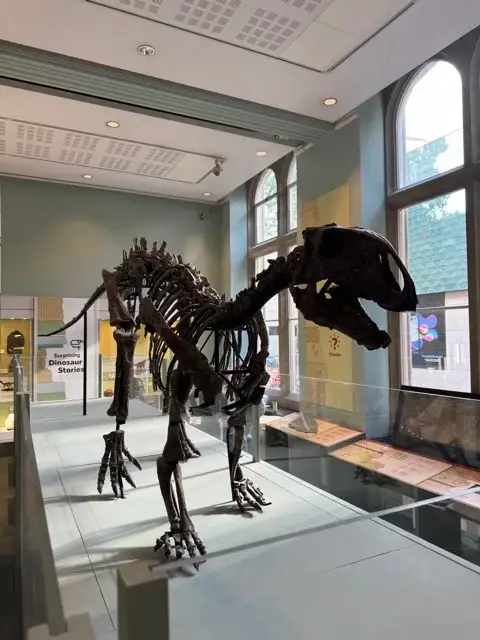
Tenontosaurus
This sort of thing happens to me a lot. If you’re ever travelling with me, don’t let me lead anywhere. You’ll probably miss a lot of stuff if you do.
In the dinosaur section, there is a small collection of dinosaur fossils, including at least one, April the Tenontosaurus, that’s fairly complete. April was named after the wife of the man who first prepared April for display.
With that section done, I trudged back up to the lobby and left the Manchester Museum, having then seen all of it. At least, I thought I saw all of it. Who knows how many other sections I unwittingly missed?
Aside
Time Keeps on Slippin’, Slippin’, Slippin’ Into the Future

Today at the Manchester Museum, I learned something that I don’t think I knew before. If I did, I forgot it and relearned it. Here it is:
In the Middle Devonian period (about 393.3 to 382.7 million years ago), a day was 21.9 hrs and a year was 400 days. And the Earth is slowing by two seconds every 100,000 years.
This raised some important questions for me:
- In the Middle Devonian period, if the year was 400 days, how did they know when to celebrate religious and statutory holidays?
- And if a day lasted only 21.9 hours, how were they able to get enough sleep and still be able to accomplish all of their daily chores?
Yes, I know. I need professional help.
Discover more from Joel's Journeys & Jaunts
Subscribe to get the latest posts sent to your email.


What a cabinet of curiosities that museum was. A lot of little shabtis, a dearly departed tigon, a stuffed sheep with a natty sweater. Oh, that lovely, quirky British humour. Was the champagne bottle consumed during the setting up of that display, I wonder, or perhaps a leftover from that legendary tiger/lion party? And good thing those poison dart frogs are so noticeable, think I. Very neighbourly of them to give you fair warning, considering their miniscule size. Very heartening to hear about Manchester’s diversity and compassion. It may be an urban myth, but an aspirational one, which is what we all need. I am not sure such a peaceable outlook is in force during football matches however. But how would I know?
Yes, I quite enjoyed all of the curiosities and occasional whimsy of the museum. Although, part of why I liked it might have been that it was so large as to be overwhelming.
Those frogs were very boldly coloured, but even so, I had trouble seeing them at first because they were so small. However, once I was finally able to spot one, I started to spot several of them. No worries about the poison. They were in a completely enclosed terrarium. The only way I could see that I could have touched them would have been to smash in the glass. That would have presented a problem of its own. There must be access into the tank somehow for care and feeding, but I couldn’t tell you where it was.
Yeah, I can’t attest to football match behaviour. The English have a bad reputation in that regard, but I don’t know if that applies to fans in all cities. Probably, but I don’t know.