Manchester Cathedral; Jewish Museum

I started this morning by visiting the Manchester Cathedral. After that, I thought it was only fair that I pay homage to my heritage. So I walked to and visited the Manchester Jewish Museum.
Those were the only two sights I saw this morning. In Windermere, England, the previous stop on this trip, in the post about the Lakes Aquarium and Queen Adelaide’s Hill, I warned that my posts from Windermere would probably all be short. Then, I used the excuse that Windermere wasn’t about “doing” things, but rather enjoying the natural beauty.
But I’m now in a city, away from the natural beauty, and this will likely be a shortish post, too, because I didn’t do much this morning. I’m trying to come up with a good excuse that won’t damage my tiny, fragile ego. I can’t. All I can come up with is that I’m an old man, and I’m slowing down. Sigh.
Manchester Cathedral

Apart from the descriptions of the building, which are my own, I got most of the information below from a pamphlet available at the Manchester Cathedral, so I’m reasonably confident in its veracity. The descriptions from me, on the other hand, well, the only promise I can make is that I likely botched them. I’m not very adept at that sort of narrative. Or, some would say, any narrative, for that matter. But those are only people who’ve read my writing.
The Manchester Cathedral didn’t start as a cathedral. Records indicate a stone church stood on the site as early as the 13th century, built by the de Gresle family, Norman barons of Manchester.
In 1421, another baron obtained licenses from both the king and the pope to found a collegiate church. They built “a number of” chapels, each of which had its own priest. (The pamphlet did not give a more precise quantity than “a number of.”)
Later, they knocked down the walls between the chapels to form one bigish church.
After Manchester achieved city status, the Catholics decided it needed a cathedral. In 1847, rather than build a brand-spanking new cathedral, they renamed the collegiate church as Manchester Cathedral, refaced it and extended it somewhat.
Because it wasn’t purpose-built as a cathedral, Manchester Cathedral is smaller than most European cathedrals.
It’s built of grey stone bricks that are somewhat grimy, as always happens to old buildings when they go a while after the last cleaning. I’m not going to complain about that. The alternative could have been for them to erect scaffolding around it to do the cleaning, so I wouldn’t be able to see the building, as so many institutions do when I’m around.

A clock (and I assume bell) tower rises up at the front (or is it the back) of the cathedral. The tower looks roughly twice the height of the rest of the building.
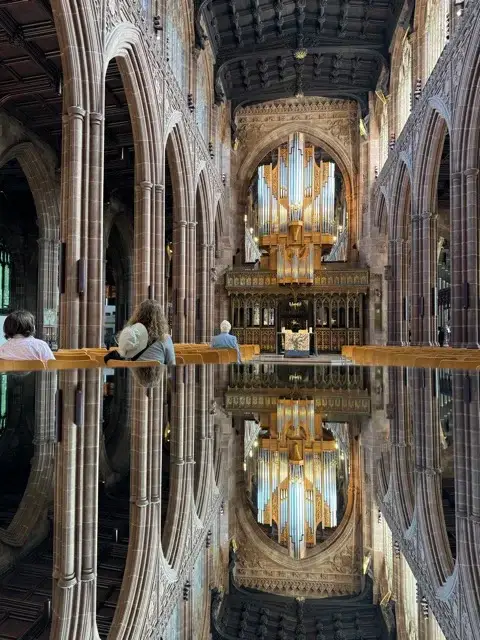
Inside, the Manchester Cathedral is relatively plain, but fairly handsome. The walls are of grey stone. There are lots of stone columns and arches. And it has some nice stained-glass windows.
At about the centre of the cathedral, raised above the floor high enough, and then some, such that the tallest of people can easily walk under it, is a large, two-faced organ. On one side, the pipes are silver-coloured. On the other side, the pipes are gold-coloured.
On the gold-coloured side, on the floor, there are some attractive choir stalls made of dark wood.

For some reason, on the side of the cathedral with the silver-coloured organ pipes, closer to the end of the cathedral, there’s a small table with a mirror embedded on top. A fellow in the church, probably a volunteer, told as many people as he could corner individually about the magic of the table.
If you take your phone camera, turn it upside down, hold it upright on the wood border surrounding the mirror, and then angle it just so, you can get a picture of a double cathedral—one right side up, and the mirror image immediately below it. Um. Okay. I did that.
Manchester Jewish Museum
From the Christianity of the Manchester Cathedral, I went to the Judaism of the Manchester Jewish Museum.

The museum is about a twenty-minute walk away from the Manchester Cathedral, out of the centre of Manchester and in a somewhat grittier area. The area used to be the Jewish district of Manchester, but the Jewish community has long since moved out to the suburbs.
The museum is in a small building attached to what used to be a Sephardic synagogue. Until four years ago, the museum exhibits were in the women’s gallery of the synagogue, but then they constructed the new building beside it, with a doorway cut out between the two, and moved the exhibits into the new building.
One of the inner walls of the new museum was one of the outer walls of the former synagogue.

The former synagogue forms part of the museum, but is now there just so visitors can see what it looked like when it was in use as a synagogue. They’ve done their best to restore it to its original condition. They had a colour picture that showed the deep-red carpet, with patterns around its edges. Using the picture, they had a new carpet custom-woven to recreate it.
The thin, I think wooden, columns of the synagogue had nine coats of paint on them, with the top colour being brown, when the museum took it over. Conservationists carefully scraped away each layer and found the bottom layer beautifully decorated with multi-coloured patterns, where gold-coloured paint dominated. They repainted the columns to replicate that with the original vibrant colours.
How do I know all this? Well, let me tell you.
After I entered the museum and bought my ticket, a volunteer led me up the stairs to the first of two rooms in the museum. (In addition to the ticket desk, the ground floor contains a café, washrooms, and a room they use for school groups. There was one such group in there when I visited.)
In the first room of the museum, the guide spent, I think, at least ten minutes telling me about the history of the Jewish people in Manchester—why and when they came, what many of them did for a living, and the diversity of the Jewish community there.

She said that the museum owns 31,000 artifacts, but has space to display only 1,000 of them. And those 31,000 artifacts? Various people offer the museum a lot of Judaica of various sorts, but the museum only accepts artifacts that have some connection to Manchester. They had to have either originated in Manchester or at least have passed through the city, other than just for the purpose of being offered to the museum. All of those 31,000 artifacts, whether on display or not, meet that criterion.
The Jewish community in Manchester currently numbers about 35,000 people and includes both Sephardic and Ashkenazi Jews.
After she finished her talk, the volunteer told me she’d let me browse around and view the short video just before the second room, and she’d be back to talk to me about the second room.
She didn’t do that. Instead, shortly after I finished watching the video, a second volunteer approached me and led me into the second room. There, she too, spent considerable time providing me with additional information about the Manchester Jewish community.

After I spent some time browsing the second room, the second volunteer led me into the synagogue and spent significant time talking to me about it.
While I was in the museum and synagogue, I didn’t see other visitors. (It was a Monday morning. So that’s probably not surprising.) I don’t imagine that visitors get anywhere close to as much individual attention if the museum is busy.
After I left the synagogue and was back in the museum’s lower level, just as I was about to go to the washroom, the first volunteer came up to me excitedly to let me know that there was a couple up in the museum, and they were from Vancouver. “Imagine that,” she exclaimed, “three Canadians visiting at the same time!”
To fulfill my duty, I should take a step backward and say what was in the museum rooms. The first was dedicated to journeys. It talked about the arrival of the Jews and the history of the Jewish community.

In addition to some text, the room held display cases with a variety of artifacts; among them were a couple that drew my eye. There was a reproduction of an old photograph of a couple with the first names of Joel and Mary. There was also an original invitation to the bris of Joel and Mary’s firstborn son. Admittedly, the only thing that drew my attention to that is the name Joel. Fine name, that.
The second room focused mainly on the social aspects of the Manchester Jewish community. On one of the walls of this room, there was a large map. A dense cluster of orange and dark green dots covered a fair chunk of near the centre of the map. The dark green dots represented former synagogues. The orange ones marked current synagogues. There were, and are, a lot of synagogues in Manchester. Who knew? (Not me until today.)
Some other things I learned from either the signage or the volunteers included:

- Residents of Manchester are called Mancunians. I didn’t know that before today.
- Ashkenazi Jews call synagogues “shuls.” (I already knew that and have called them that for as long as I can remember.) But at least in Manchester—I don’t know if this holds everywhere—Sephardic Jews won’t call them that because it’s considered the Ashkenazi name. Anglophone Sephardic Jews here refer to them only as synagogues.
- Many of the Jews who came to Manchester in the early days came because they were in the textile trades. Manchester was then the centre of the cotton industry in Europe (maybe the world? I forget).
- In 1800, the Rothschild banking family sent one of its members to Manchester with £20,000, which, back then, was a fortune. He lived in the centre of Manchester, not in the Jewish district. By the time he died, he’d amassed £60,000 in Manchester.
To be honest, before going, I didn’t have high hopes for the Manchester Jewish Museum. But I was very pleasantly surprised. If you’re ever in Manchester, a visit would be well worth your time.
Discover more from Joel's Journeys & Jaunts
Subscribe to get the latest posts sent to your email.

Chetham’s Library; Museum of Science and Industry; Manchester Summary
Manchester Walking Tour
My, I did learn a lot from the Manchester Jewish Museum, or at least your account of what you learned there. All the same things you marvelled at were marvels to me. Who would have known there was such a rich Jewish heritage (and presence) in Manchester? Probably people who are not so ignorant as me of the area. My advantage? I can be amazed, informed, and impressed, as I was by your instructive blog. Thank you. And I thought the Manchester Cathedral was impressive as well.
I shared your prior ignorance about the Jewish community in Manchester. If, before I went to the Jewish Museum, someone had asked me to guess the size and vibrancy of the Jewish community in Manchester, I would have guessed “little or none.” Live and learn. (Come to think of it, learning is often claimed as a major Jewish tradition. Tradition. Tradition!)
I’m glad you appreciated the narrative.