Songdo Coast
This afternoon, I went to the Songdo Coast of Busan and took in some attractions there.
I walked there from my last stop of the morning, Gukje Market, in a little over 45 minutes.
For much of the way that my mapping app sent me along, I walked on one of the sidewalks of a busy six-lane street. The buildings on the side of the street I was on were mostly mid-rise and looked primarily industrial. I thought the other sides of those buildings directly abutted one of Busan’s harbours. That’s what I thought, but, well, I’ll get to that a paragraph hence.
The buildings on the other side of the street were mostly residential and completely unmemorable. I forgot if they were all mid-rise or if there were also some low-rise and high-rise buildings.
After a while, the route I was on took me beside one of the industrial-looking buildings to the harbour. There, I saw that there was a wide promenade up a flight of stairs. So, contrary to what I’d previously believed, those industrial buildings didn’t immediately abut the water. The promenade ran from about where I joined it, back the way I came, all the way to the base of the bay, with views of the water all the way along.
Had I known about it, I could have walked to that point along a much more scenic route. I might have had to duck a little out of my way to get to the starting point. But it probably would have been worth it.
From that point, for much of the way to the Songdo Coast, I walked along a path almost right beside the bay. I say almost because there was a wall much taller than I am between me and the water.
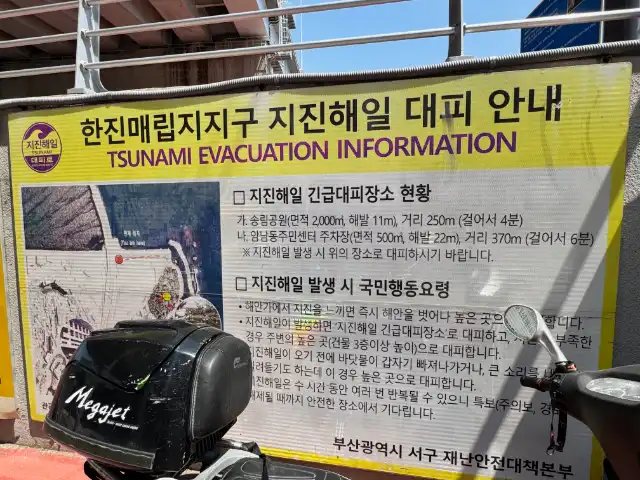
That wall was probably there to offer some protection from the sea.
At one point, there was a large sign affixed to it. I posted a picture of the sign near this paragraph. As you can see, it had a large title that included, in English, “TSUNAMI EVACUATION INFORMATION.” There was also some small-font English in a circle that said, “TSUNAMI EVACUATION ROUTE.” And there was a map. The only English on it was, “You are here.”
But the sign also had two paragraphs exclusively in Korean, one of which appeared to be of a substantial length. I probably should have used Google Translate on it so I’d be prepared in case of a tsunami. I didn’t, but I’m pretty sure that there was one sentence that would have translated to, “LOL, the foreigners will all die if there’s a tsunami because they can’t read this sign.” I might be wrong about that, but I’m not sure.
Why taunt me with that little bit of English in the title if you’re not going to also provide me with the necessary safety information?
But enough about that.
Songdo Beach

The Songdo Coast has a beach on a little bay off the bigger bay. I walked almost, but not quite, to the beach and viewed it from afar.
They built some twisty boardwalk walkways out over the water. Down the centre of those boardwalks, there are a few rectangular sections down the middle, about maybe a third as wide as the walkway, that aren’t solid but rather made of metal grating. The slots in the grating looked to be just barely wide enough for a cellphone or a wallet, or certainly coins, to fall through.

Beside each of these grating sections, there were bilingual signs advising people to watch their belongings. Watch them? What? Watch them fall into the sea? Hold on to them tightly is better advice.
I walked along the walkways, hands in my pockets to make sure nothing fell out.
There are a couple of statues in the water in front of Songdo Beach. One was the tail of a whale flipping out of the water. The other was the head of a whale breaching the water. There were also a couple of dolphins sitting on top of a colourful arch that rose above the water. In addition, a curved pole reached out over the water from a rock on the shore on the other side of the small bay from the beach. A dolphin sculpture sat on top of the curve of that pole. It was all rather playful.
More pictures from near Songdo Beach:


Maybe Busan Air Cruise (Or Maybe Songdo Marine Cable Car)

I saw multiple official signs for this attraction, along with text in my guidebook. But they didn’t all call it the same thing. Official signs called it Busan Air Cruise on some signs, and Songdo Marine Cable Car on others. My guidebook used Songdo Marine Cable Car.
I’m only guessing here, but I suspect that the official name used to be Songdo Marine Cable Car, but a marketer came along and said, “Don’t be daft. That’s too boring. The rubes won’t want to ride it with a name like that. Let’s call it Busan Air Cruise instead. That’ll draw the suckers in.” But they haven’t yet gotten around to changing all of the old signs, and my guidebook is out of date.

It’s only an uninformed guess. And I might be wrong. But it sounds plausible.
Whatever the case, the name is Busan Air Cruise on its website.
It’s a gondola cable car that rides high above the water from a station close to Songdo beach to one in Amnam Park.
You can buy a return ticket. Or you can buy a one-way ticket because there is a road and a boardwalk between the two along the shore.
The boardwalk hugs the Sondgo coast and has a lot of up and down stairs along the way. What’s more, both the road and the boardwalk look like a long walk.
I knew about the distance because I could see how far off the other cable car station was, and it follows a straight line, unlike the road and boardwalk. I didn’t know about the stairs until I rode on the gondola ride on the way out and saw the boardwalk from up there. So, it’s fortunate I bought a return ticket. I did that because of the distance, but the upstairs and downstairs probably would have made it unbearable for a man my age.

If I’d bought a one-way ticket, I could have bought another over at Amnam Park to come back after I’d seen the difficulty of the route. But would I have? I can be stubborn about things like that. “Dammit, I’m not going to give them the satisfaction of me paying them a couple extra bucks for the two one-way tickets!”
Not all of the gondola cabs on the Busan Air Cruise, or Songdo Marine Cable Car, or whatever they want to call it, are the same. There are 39 cars in total. In 13 of them, a large section of the floor is glass.
You have to pay extra to ride in one of the glass-floored cars. They call it a “Crystal Cruise.” Damned marketers.

I took the Crystal Cruise. After you buy your ticket, they direct you to one of two lines, one for the glass-bottomed cars and one for the regular cars. When the appropriate car comes around, they direct people from that line into it.
In the glass-bottom cars, I got to see the water beneath my feet. Because passengers sit on solid benches and the glass doesn’t quite extend to the benches on either side of the cab, I was able to look down at the water below without my acrophobia being triggered in the least. But the views out the side toward the Songdo Coast on one side and the open bay on the other were far more spectacular.
Amnam Park

Amnam Park is a gorgeous, mostly forested park on a mountain at the other end of the Songdo Marine Cable Car. Most of the elevation is accommodated by the cable car, which lets you off fairly high up the mountain. (The Songdo beach station was up four escalators from sea level, so the cable car didn’t climb much more of the height to the station in Amnam Park.)
Immediately beside the Amnam Park station, it’s kind of tacky, with snackbars, colourful decorations, and dinosaur statues. But beyond that, Amnam Park is a gorgeous, wooded mountaintop park. There are wide paths through it that are dotted here and there with artworks, mostly abstract.

The cable car doesn’t take you all the way to the summit. There are some generally gentle hills to get you the rest of the way.
As I walked along the main path, I came to a bilingual directional sign pointing up a long set of stairs. The English on the sign said, “Hope Pavilion. 1 km.”
You know me, I’m an eternal optimist. I refuse to give up hope. So, of course, I had to go up to the pavilion.
(If you believe that nonsense about me being an eternal optimist, I’ve got some water to sell you that will turn you into a scholar.)

It’s a handsome little pavilion with benches around its inner perimeter. I sat for a while, then walked along a slightly more rugged path, without stairs, rejoining the main path farther along. I walked to the end of it, and then turned around and headed back..
As I said, Amnam Park is mainly forested. So, despite being on a mountain. The views are mostly of trees. But there are a couple of observation areas with beautiful views of the coast and out to sea.
More pictures of Amnam Park:


I mentioned the art pieces scattered throughout the park. I didn’t take pictures of all of them. Neither will I discuss them all here, but I did want to highlight three. Each of the pieces had a bilingual sign next to it with the artist’s name and a brief narrative. I’ll quote those with my comments below.
Amnam Park Art
Geun-Bae Kim, 2002, “
Itinerary”
“Life is a long journey. This work symbolizes that journey through the objects contained within a large suitcase: a jacket and umbrella representing the traveler (sic), a chair suggesting a place of rest, and an elephant evoking the natural world.”
Yeah, I kind of see that. But if the artist wanted to depict the full journey of life, shouldn’t there also be a cradle and maybe a cane or a walker? It seems like an abbreviated journey to me. And, when do I get my elephant?

Amnam Park Art
Stefano Beccari, 2002, “Body Fruit”
“This sculpture is approached as a form that embodies both a quiet reflection on life and the unfolding of possibilities yet unknown. Concentrated with a sense of abundant life force, it appears as a single, monumental mass, expressing the overwhelming energy that an amorphous monolithic form can evoke.”
Oh my god, oh my god, oh my god. Even before I read the sign, I instantly got that in its entirety just from looking at the piece.
If you believe that, I’ll sell you a second dose of the scholar water for half price.

Amnam Park Art
David Evison, 2002, “Silken Tread”
“Two different types of steel—each with its own inherent characteristics—intertwine and support one another in this work. The structure forms an intriguing relationship in which the absence of even a single element would distort the entire composition.”
I don’t know, but I don’t think the absence of the bird dropping I saw on it would distort the composition. But maybe that was added later.

Songdo Yonggung Suspension Bridge

Just offshore from Amnam park, there’s a tiny dot of an island. Walking down most of the mountain from beside the Amnam cable car station, either down some stairs or along a gently sloping, but longer path, brings you to the top of a pedestrian bridge. For 1000 won (less than $1 CDN), you can walk across that suspension bridge to the island. I did.
The suspension bridge starts with a set of stairs that descend farther down toward the sea. At the island-end of it, there’s a walkway about two-thirds up the height of the island that is cantilevered out from the side of the island, all the way around the circumference of the pipsqueak islet.
There are fairly high railings and fencing on the seaward side of the walkway. They are high enough that I had to lift my arms high to get a picture over the railing. Fencing on the island side of the walkway prevents you from going on to the island itself. Then again, there wouldn’t be anything to do on the island if you could. Did I mention it’s puny?

The bridge and walkway destroy any beauty that the little island might otherwise have. But the views from the walkway are beautiful. That’s sort of the yin and yang of life in a nutshell, isn’t it? Maybe it was an artwork.
After leaving the island behind, I headed back to the cable car, rode it to the other end, and went back to my hotel.

Discover more from Joel's Journeys & Jaunts
Subscribe to get the latest posts sent to your email.

Wasn’t that a lovely afternoon? I loved all the things you did. Very beautiful seaside and mountain, fun ride, and a puzzling, puny island walk. I was intrigued by the artworks you showed and the chosen extended labels, especially Beccari’s “Body Fruit.” I wonder if I concentrated my abundant life force whether I could transform myself into an amorphous, monolithic, monumental mass expressing my overwhelming energy? Worth a try, don’t you think? There is always hope. And if hope is a shady pavilion with a serene view, then you have found it.
A lovely afternoon, it was indeed.
I guess it came across that I was more than a little baffled about why they did that with the little island. Admittedly, it made for a great viewing platform, but at the expense of a view of what was probably a cute little island just off shore.
Nevertheless, that didn’t diminish my enjoyment of the afternoon much.
An amazingly multimodal afternoon. Up, down, and all around. Over hill, over dale. Over tsunami warnings and cantilevered boardwalks. By cable car and on foot. Suspension bridge and—upon contemplation of deep-thought sculpture—suspension of disbelief. Huzzah.
Indeed. Subway, bus, cable car, and feet. I should have flown somewhere just to complete the roster. It was a good time.