Jagalchi Market, Yongdusan Park, and More

I started the morning of my first full day in Busan at Jagalchi Market. The morning proceeded from there to other sights that were easily walkable from it. I bookended it with another market within the general area, Gukje Market.
Jagalchi Market
The Jagalchi Market is in a multi-storey building. I forgot how many floors there are, but I think six or seven. Only the first two are the publicly accessible parts of the market.

The first floor has three long, parallel aisles that are brutally brightly lit. Vendors of fish (including many eels), shellfish and other allegedly edible sea creatures line both sides of the aisles.
Almost all the vendors in Jagalchi Market sell their creatures that are still alive, swimming around in crowded tanks.
The water in most of the tanks is continuously refreshed by hoses inserted into the tanks. Excess water flows over the top and into the drains in front of each stall.
The second floor of the market contains mostly restaurants.

I’d read in my guidebook that the thing to do as a tourist, or I imagine a hungry local, is to buy your fish on the first floor of the market, then take it up to a restaurant on the second floor of the market where they’ll prepare it for you. My guidebook said that many of the fishmongers will recommend which of the restaurants to take it to. I wonder if there are kickbacks involved.
According to my guidebook, preparing the fish often means serving it raw, I assume sashimi style. But they will cook it for you in one of a variety of available ways if you so choose.

I didn’t have the full Jagalchi Market experience. I didn’t buy or consume any fish. But it is a visually interesting space. I’m glad I went.
The back of Jagalchi Market is pretty much right on the sea, or at least a bay off it. I went back there and took a look before moving on.

BIFF Square

Busan has what it claims to be a world-renowned film festival. That may be so, but until this trip, I’d never heard of it. That’s probably much more on me than on the festival.
The English name of the event is the Busan International Film Festival, or BIFF. That’s two IFFs I know of, BIFF and TIFF, the Toronto International Film Festival. I hope neither Toledo nor Barcelona hold international film festivals. (Of course, I’m speaking of Toledo, Spain. What other Toledo would I be thinking of?)
BIFF Square, which was an easy walk from Jagalchi Market, celebrates BIFF.

It’s lively and pretty, but there’s not much that’s particularly special in the square. The main portion of the square is a rectangle, about a long block or so long and the width of, maybe, a normal two-lane street. Stylish arches over the street decorate the square. Street food and clothing vendors set up shop on the sides of the square.
At the opposite end of BIFF Square from where I entered it is a street that runs perpendicular to BIFF Square, forming a T-intersection. Having said that, this street may also be considered part of BIFF Square. Paving tiles down the centre of the street are laid to look like an unrolled roll of film, with sprockets down the side.

Embedded into the street’s paving stones are several sets of plaques with handprints and signatures, with the year of BIFF that they’re from. It’s sort of like the Hollywood Walk of Fame handprints, except I’m reasonably confident that in Busan, the handprints aren’t real, but rather reproductions of handprints, probably created using moulds.
The reason I say this is that, unlike in Hollywood, where the handprints are in concrete, in Busan, they’re in metal. I seriously doubt that the organizers of BIFF force celebrities to hold their hands in molten metal until it solidifies enough to hold the shape of their hands. The Geneva Conventions probably have something to say about that sort of behaviour.
Yongdusan Park (Busan Tower)
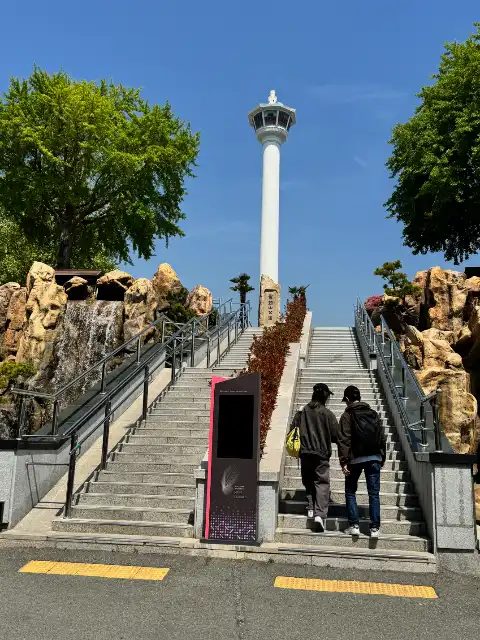
Yongdusan Park occupies a small mountain. The route that my mapping app sent me on took me to a sequential series of four or five escalators that carried me from the base of the mountain almost to the top.
I noticed with some trepidation that there was only one set of escalators, all going up. There were stairs to go down.
Upon seeing this, my knees threatened to never speak to me again if I forced them to walk down all those stairs. I don’t respond well to threats, particularly from my own body parts. I continued up the escalators without looking back.

It’s probably not a good idea to look back when riding an escalator, anyway. You might lose your balance and fall to your death or suffer a grave injury. That’d be horrible because Air Canada likely wouldn’t refund the return airfare for the flight I missed due to death. Worse, in spite of their having my money for the flight, they probably wouldn’t award my Aeroplan points posthumously either.
It’s a good thing I ignored my knees and didn’t look back.
The sides of the mountain are forested, but I didn’t see that on the way up because it wasn’t visible in the long box built over the escalators.
The summit of Yongdusan Park is a two-tiered plateau. At the top of the escalators, an artificial waterfall tumbles from one tier to the other. Also at the summit, there’s a floral clock, a large bell in an open-sided structure with a decorated ceiling, and a statue of Admiral Yi Sun-sin.

Oh, there’s also the 120-metre-tall Busan Tower with an observation deck up there.
I bought a ticket and took the elevator up the tower.
The views are great from up there, but for some reason, the viewing area, which has floor-to-ceiling windows, spans only about, perhaps, two-thirds of the observation deck. There are doors on either side of the closed-off third or so. Signs on the doors prohibit public entry
There is another deck below the first. The elevator takes you to the top viewing area. Then you have to walk down a flight of stairs and get the elevator to go down from there.

The lower level doesn’t have floor-to-ceiling windows. It, apparently intentionally, has a flying submarine theme. Don’t ask. Keeping with the theme, it has a few fairly useless portholes. There are also some video screens showing still pictures of the view from up there, but with animated characters swimming across. Visitors can stand in front of a camera, have their picture taken, choose an illustrated diving suit, and then see the diving suit with their face in its glass bowl as it swims across the screen. No thanks.
I read about it in my guidebook and saw signs in the park for the Busan Museum of Movies. My guidebook says it’s an exhibition and experience centre where visitors can partake in various aspects of filmmaking, including storyboarding, acting in front of a green screen, and doing voiceovers. I didn’t go there because I’ve already made a few videos that I posted on my YouTube channel. I provided links to each video in the relevant journal entries here. What more do I need to know about filmmaking?

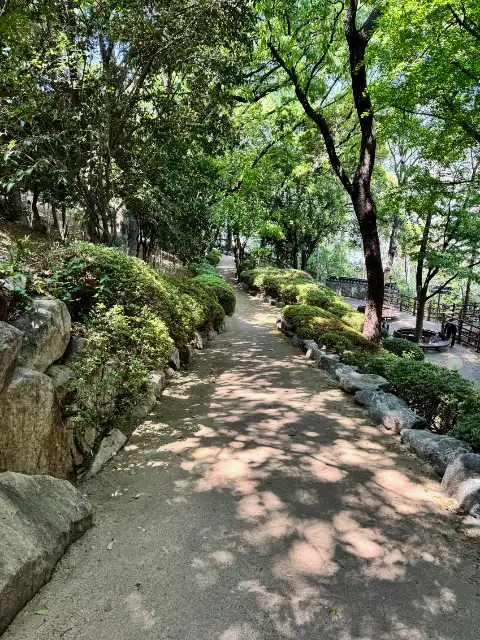
Leaving Yongdusan Park, I found a forested path on the other side of the mountain. The path wraps around half of the mountain as it descends gently without any steps.
That didn’t take me to the base, but it probably got me down at least halfway. Then there was a set of steps to a road that I think is at a slightly higher elevation than the one that led me to the escalators. The long and the short of it is that I’m still on speaking terms with my knees.
Gukje Market

As I mentioned in the introduction, I started this morning with a market, Jagalchi Market, and ended it with another one, Gukje Market. The two markets bear no resemblance to each other whatsoever. For one thing, Bujeon Market offered very little fish. Jagalchi Market offered nothing but fish. And, architecturally, the two were almost completely different.
In its design, Gukje Market is far closer to the Bujeon Market that I stumbled on yesterday than to Jagalchi Market. In both Gukje and Bujeon Markets, there are long aisles with arched, translucent ceilings.
But there are differences between Bujeon and Gukje. There are two parts to Gukje Market, with a busy, open street separating the two parts.
Plus, Gukje was cleaner and more colourful. There were ribbing of different colours in the arched ceilings at Gjukje. If Bujeon had the same thing, it didn’t stand out for me.
And, whereas Bujeon Market had mainly foodstuffs, much of Gukje Market is filled with sellers of clothing and housewares.

There are some vendors of food items to take home at Gukje market, but that takes up only a very small percentage of the space. And there is a large section of street food vendors. That’s where I had lunch. I bought ten steamed dumplings—five filled with kimchi and five filled with pork—and ate them while standing at a counter in front of the stall.
Ten dumplings might sound like a lot for lunch, but they weren’t all that large. And ten was the set number. They didn’t sell them in any other quantity. You could buy ten pork dumplings, ten kimchi dumplings, or five kimchi and five pork dumplings.
I had the steamed dumplings, but I could have chosen to have ten fried dumplings instead. They were delicious. And that was lunch, and the end of my morning.
Discover more from Joel's Journeys & Jaunts
Subscribe to get the latest posts sent to your email.


Poor fish. Lovely vistas. Lively markets. I would not have brought a fish upstairs for lunch either. I need to be at arm’s length with my fish dinners. About the hand prints: what the celebrities could have done is press their hands into a mould which would then be cast in metal. Not saying that they did, but they could have. The hazard inherent in the time difference reading these blogs is that I usually do so before lunch, and now I am definitely feeling the urge coming on for dumplings. Nom nom!
I’m with you on the fish, and any other formerly living food creatures. I like to tell myself that they spontaneously form in packaging in a store or restaurant. I’m very gullible.
The casting via moulds would be my guess.
I love most Asian-style dumplings. (I think every country has its version of dumplings.) I’ve had them a few times on this trip.
So, lemme see. Eels and bells. Market bazaars under distinctive vaulted ceilings. Vistas from a landmark tower. Dumplings for lunch. A picturesque port city — Korea’s “second city,” per Guide Google. An up from the bootstraps ethos, where industrious women (their menfolk absent from home mid-century) sustained their families by selling fish on a graveled beach. Jagal: gravel. And a soaring modern temple (7 storeys sheltered under seagull wings) that became fish-trade central. A whole world to understand and appreciate.
Yup. You’ve got it, but with more information than I had before reading your comment. Thanks.