But, Busan
After a 35-minute high-speed train ride and Uber rides to and from the respective inconveniently located train stations*, having left Gyeongju, I arrived at my hotel in Busan, South Korea, a little after noon. The front desk informed me that my room wouldn’t be ready until 2:00.
This was not surprising. I’d arrived well before the normal check-in time. Sometimes my room is ready when I arrive early. Sometimes not.
I then took the only action that made any sense whatsoever under the circumstances. I checked my bag at the hotel and found a place for lunch.
*To clarify, when I said “inconveniently located train stations,” I didn’t mean that I bought tickets for the wrong train stations. In both Busan and Gyeongju, the only intercity train station is quite a way from the centre of the city. I had no other choice.
Lunch in Busan

I used the Korean mapping app (with an English interface) I’ve relied on in Korea to find a nearby restaurant that had a reasonably high user rating.
My hotel is a high-rise, with a cluster of high-rises around it, but there are low-rise areas beyond the cluster. The restaurant the app sent me to was on one of the low-rise streets.
It was largely a market street. There were several grocery stores selling fruits and vegetables, and a few dry goods shops. Between the shops, some independent vendors sold fruits and vegetables from bowls and other containers sitting on the pavement.
The restaurant was very busy. It was so far from fancy that you couldn’t see fancy from there, even with a powerful telescope.
Someone from the restaurant positioned himself at the front and directed the steady flow of customers. If there were no open seats, he put up his hand like a traffic cop halting traffic. That happened rarely as seats became available continuously.
Then, he waved his hand vigorously to indicate which direction he wanted arriving customers to go. He then pointed to the seat he insisted they take.
Tables were shared space, but with table service.
I ordered bibimbap, which cost 5,000 won, the equivalent of a little less than $5 (CDN). It came about a minute after I ordered it.
The bibimbap arrived, unexpectedly accompanied by a bowl of broth with scallions. I don’t know what type of broth it was, but it tasted like a not-bad chicken soup.
The bibimbap was also very tasty.
Bujeon Market

It still wasn’t time to check into my hotel when I finished lunch. So I wandered a bit.
I started by walking along that market street, continuing in the direction I came. I forget how far I got, I think only a block or two, when that street ended at the entrance to a covered market.
It was huge.
The aisle I entered was about the width of a generous one-lane street and was covered with a translucent white arched ceiling. It seemed to go on forever. I walked along it. Farther along, there was a similar perpendicular aisle. Farther still, there was another similar aisle that cut off obliquely. At least one of the other aisles had a translucent yellow arched ceiling.
I have no idea how many grid and oblique aisles there were. Not a lot, but more than a few.
At one point, while wandering around the market, I decided this must be a major attraction that is likely listed in my walking tour app, which has a guide for Busan, and my guidebooks. I wanted to know what it was.

I figured the best way to find out would be to open the walking tour app, go to its map tab and look for a dot near where I was. There were none.
Then I searched for “market” in the guidebook that, of the two I have, has proven to be most useful here. I found a market it recommended in Busan, but it was a fish market, nowhere close to where I was.
Next, I had the bright idea of looking on my Korean mapping app for something with “market” in its name where I was standing. Eureka! It wasn’t marked right where I was standing. It’s a huge market. But there it was, not too far from me, Bujeon Market.
With that information in hand, I did some web and TripAdvisor searches and found it, including pictures of the market I was standing in.
Then I searched for “Bujeon” in my guidebook. I did mention it, but only in the briefest of passings. Just a noncommittal single paragraph.

I try to avoid falling down rabbit holes when I’m travelling, but I don’t always look carefully where I’m stepping. All I wanted to know was the name of the market I was in to see if it was someplace I’d be directed to when I did some more concerted sightseeing.
As sprawling as it is, Bujeon Market is mostly filled with sellers of foodstuffs. It has the usual fruits and vegetables. I didn’t see many red meat mongers, but there were lots of fish and seafood mongers.
Most of the fishmongers sold dead fish. But some had tubs of water and aquariums with a variety of fish, including eels, swimming about. I don’t imagine the fish were thrilled with swimming around in their cramped confines, but probably happier than they would be if they had an inkling of what the vendors hoped their fate would be.
There were also some foodstuffs that I didn’t recognize at all. I probably didn’t want to know.
There was one product, heaped up in bins, sold by multiple vendors, that I didn’t recognize at first. But after seeing it in a few stalls, I looked more closely and realized that they were tiny, dried sardines. They looked so arid that they’d probably serve well in the desiccant sachets that are sometimes placed in packaging for products that can’t handle moisture well.
After wandering around Bujeon Market for a while, it was time to head to my hotel to check in.
My Busan hotel
I think I might have made a mistake in choosing my Busan hotel. Then again, I might not.
I’m a member of a few different hotel loyalty programs. But there’s one hotel group that I think has a markedly better program than the others I’ve seen. I’ve achieved a status level with them that gives me several perks that help to make stays more pleasant and less expensive.
So, if they have a nice hotel in a decent location in a city I want to visit, I’ll typically cut short my hotel research (something I hate) and just book in that hotel. (One of my perks is that I’m guaranteed to get a reservation as long as I book at least two days in advance. They must hold rooms back for that purpose.)
But that group doesn’t have any hotels in Busan.
I researched a few hotels and narrowed it down to two. One was in a chain in which I have a loyalty club membership, but I have a low status there. The other is a Korean chain in which I’m not a member.
I hemmed and hawed between the two. To decide, I, possibly foolishly, asked an AI engine, Claude, to tell me which of the two was better for sightseeing. It recommended the one I’m at.
The one I’m in is the most central of the two. However, none of the major sights are close to it. But, as Claude pointed out, it’s very close to a metro station that’s an intersection station for two of Busan’s four subway lines.
Busan is a very spread-out city, in a large part, as I’ve now seen, due to some mountains. The other hotel is further to one side of the city. It is closer to some major sights, but much farther away from the ones on the other side of the city.
But here’s the thing about the metro lines, or at least the two that share a station near my hotel. They don’t seem to go to any of Busan’s major tourist sights. I imagine they serve locals well, but not so much tourists, at least as far as I could tell this afternoon.
When deciding what to visit after checking into my hotel, because I didn’t have a full afternoon, I tried to find one of the sights highly recommended by my walking tour app or guidebook that wouldn’t take too long to get to.
As I plugged a variety of those Busan sights sequentially into my mapping app, asking for routes. I couldn’t find anything that I could get to with just the metro. They all required a metro and a bus, and usually a little walk. All of the travel times I looked at were between half an hour and more than an hour.
The hotel I’m in and the room I have are very nice, but I have a feeling that, while I’m in Busan, I’ll spend almost as much time getting to sights to see as I do seeing them.
For this afternoon, I chose a sight that is about 45 minutes away by transit, Gamcheon Village.
Gamcheon Village

Gamcheon Village is a neighbourhood in Busan on the other side of a mountain from my hotel. It climbs up a U-shaped mountain ridge. The base of the U is a lower mountain, or maybe a high hill. The homes of Gamcheon village climb all three sides of the U, up to about the height of that lower section.
The bus that my mapping app had me take after an initial subway ride is a smaller-than-normal city bus. It was crowded, so I wondered why they use a smaller bus on that route. I found out. The bus travels along a not-terribly-wide, very winding road up the back side of the mountain that Gamcheon Village is on. I don’t think a regular-sized city bus would consistently make it up that road without accidents.

Gamcheon Village was established by Korean War refugees in the mid-1950s. At first, it was a shanty town. But as residents became more established, they replaced their houses with brick homes.
In 2009, the Busan government recognized that the location of Gamcheon Village could make it a tourist attraction. In addition to the village climbing the hill on all three sides, the open side is beside the sea, making for a lovely view. To help the tourist draw come to fruition, the city funded some renovation projects involving local artists. Now, art pieces dot Gamcheon Village.

But what makes the neighbourhood particularly aesthetically appealing to my eye is that almost all of the homes are painted, usually in a pastel hue. Consequently, the hills of Gamcheon Village are alive with soft, but kaleidoscopic colours.
I entered the village through a quiet street on the outer edge it, but quickly got off that and onto a twisty pedestrian lane. Much of the village’s “thoroughfares” are equally twisty pedestrian lanes and staircases, not roads.
The vast majority of Gamcheon Village is still residential, but there are some cafes and shops dotted about.

I was thirsty when I entered the village. High up on a wall of one of the buildings, up some stairs from the path I was on, was the word “cafe.” Most, or maybe all, cafes I’ve seen in Korea sell a wide selection of cold drinks in addition to the usual, and sometimes unusual, varieties of hot coffee drinks. So, I figured this would be a good place to quench my thirst.
I climbed the flight of stairs to the cafe and came to a patio with two benches and a small covered area with no benches. In front of the patio was the cafe’s wall, the one with “cafe” printed on it, but with no door and no windows on the lower level. There was a small window on the second floor.

At ground level, there was a sign pointing to a touch-screen video kiosk and telling me to order my drink from the touch-screen, and it would be delivered to me by an air balloon. I looked up and saw there was a small balloon attached to a string beside the small second-storey window, with a small basket below the balloon.
It was far too kitchy not to try. I ordered a grapefruit-aid. After a while, a guy opened the little window, called out my order number, asked me if I wanted to take a picture or video, waited while I got out my phone and aimed its camera, and then put my drink in the basket below the balloon and lowered it to me. In truth, the “balloon” did nothing. The string lowered and raised it.
The cafe had some regular, balloonless, indoor space on its upper levels, but how boring is that?
With that experience done, I wandered around Gamcheon Village some more, taking in the colourful neighbourhood and the views out from it.
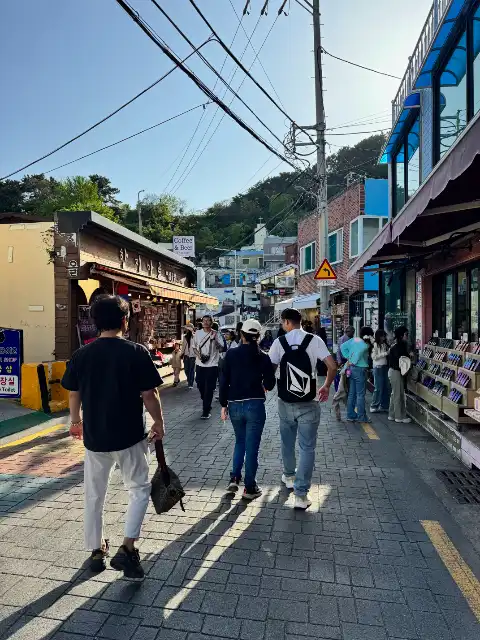
There is at least one vehicular road that winds through the village. I stumbled onto it in my wanderings. Several blocks of it harshly break the rule of Gamcheon Village being still mostly residential. It was a tourist street. There were lots of souvenir stores and shops selling ice cream or other snacks. (If you think I mention ice cream for no reason in particular, you’d be wrong about that.)
There were a couple of good photospots along the way. At each, they were usually filled with people taking pictures. At one of them, there was a colourful mannequin posed sitting on a railing facing out to the valley. When I walked by, there were more than a dozen, maybe two dozen, people waiting orderly for an opportunity to take selfies or have someone else take their pictures next to the mannequin. I didn’t bother.

That street continues out to near the bus stop. Had I turned the other way when I got out of the bus on the way in, I might have walked along it first. As it was, I didn’t know it was there when I entered the village. I’m happy about that. Had I started on that road, my opinion of Gamcheon Village would be much lower. The street is too unsubtly touristy.
As it is, I thought the village was gorgeous.
I’ll be in Busan for another four full days, so, as they used to say on television, stay tuned.
Discover more from Joel's Journeys & Jaunts
Subscribe to get the latest posts sent to your email.


What fun! Just think how precious each of your outings is going to be after having put in the effort to get there. Finally! I’m here! Priceless. So far, Busan looks very promising. Pretty hillside neighbourhood, bustling market. Again, thanks for all the (live) (for now) fish!
Always look on the bright side. You know how easy it is for me to follow that advice. There’s nothing like a long, boring journey to heighten the enjoyment of finally getting to the good stuff.
You’re welcome for all the fish.
Gamcheon village! Good on the civic leaders who thought to seed its future. It’s an instance of urban improvement gone right. You mention a Disney-esque quality of its main drag. The observation reminded me of my dismay years ago when I visited the main town of the Greek island of Mykonos. Kitschy, kitschy, koo. It’s gratifying to that the rest of the community retains its colorful charms.
The kitschy main drag is just a tiny fraction of Gamcheon Village’s total area. The rest of it is beautiful, with quiet, quaint, twisty lanes and stairs. I don’t know what it looked like before the government renovation efforts. For example, I don’t know if the profusion of pastel colours was part of those renovations. But it’s very pretty now.