Taejongdae Coast
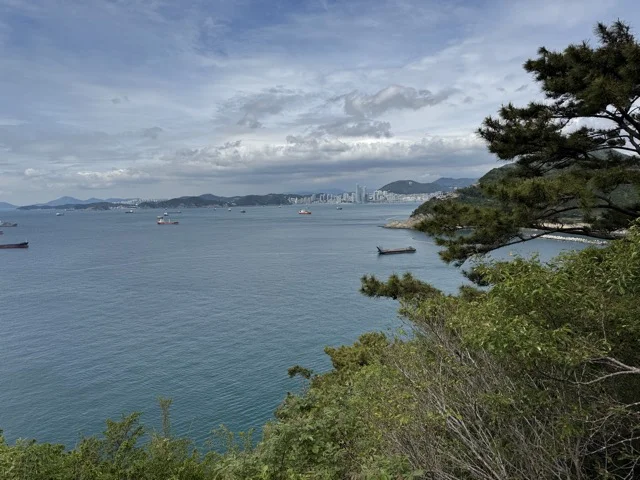
My guidebook recommended that, while in Busan, Korea, I take a walk along Busan’s rugged Taejongdae Coast.
I did that. It was all I did this morning. Well, that and going there from my hotel. It took more than an hour to get there.
The suggested walk is inside Taejongdae Park. Taejongdae Park is on the island of Yeongdo, which is just offshore and part of Busan. A few bridges connect Yeongo to the mainland.
Taejongdae is on the far end of Yeongdo. Getting there required taking the metro to a stop close to the mainland end of one of those bridges. From there, I caught a bus that, on a nearly half-hour ride, traversed almost the length of Yeongdo to the entrance to Taejongdae Park.
It wouldn’t take that long for someone in a car to drive that distance. But Yeongdo is built up, with some industrial ports, shipbuilding companies and other industries on its coast close to the mainland. The rest of the island, apart from the park, contains residential, institutional, and other commercial businesses. As a result, the bus had to navigate traffic and make several stops along the way. And the bus does not operate in its own right-of-way.
It wasn’t only the travel time that cut into my activity time this morning. Probably due to the extreme exhaustion I experienced by the end of the day yesterday, I managed to do what, for me, edges into the definition of sleeping in. My Fitbit told me I got a good night’s sleep of practically eight hours. And it wouldn’t lie to me, would it? I usually consider it a major life accomplishment if I get more than seven hours of sleep a night these days. Nevertheless, I still experienced my usual morning lethargy. So I got a later-than-usual start.
As a result, with my late start, the travel time, and the duration of my stroll, my walk extended well into the afternoon. So much into the afternoon that calling this a morning post will result in the publisher of the Oxford English Dictionary hiring someone to find me and maim me if they ever learn of it. Nobody tell them.
Walking the Taejongdae Coast
My guidebook suggests there are two ways to take in the Taejongdae Coast. You can walk on “a well-groomed 4.5km walking path.” Or, for a fee, you can ride on the “Danubi Train.”
I put “a well-groomed 4.5km walking path” in quotation marks not just because it’s a quote (it is), but also because it might be slightly misleading. (“Slightly” is not intended as sarcasm.)
“Well-groomed” is accurate. And I’m willing to take the book’s word on it being 4.5 kilometres. It felt like somewhere in that range as I walked it. For the benefit of those of you who are metric-challenged, 4.5 kilometres is almost 2.8 miles.
But, to me, “path” suggests something unpaved. It was a sidewalk, paved the entire distance with small, square paving stones.
Whether you walk it metrically or you walk it using the imperial system of measurement, if you are young, in good shape, and don’t dawdle much, you should be able to complete the route in about an hour. If you are older, in good, but not fabulous shape for a person of your age, and you make several stops, I have a single empirical data point that provides evidence that it might take you close to three hours.
I made a few stops. In addition to the sights I will speak of below, there are lots of good benches along the way. I availed myself of a few of them.
I put “Danubi Train” in quotes because that’s the name, not a perfect description of it. It’s not a train. It runs on rubber tires and drives on an ordinary road. There are no train tracks involved. Each “train” has three open-sided cars hitched together. The lead car is hitched to the “locomotive,” an internal combustion vehicle tricked out to look like a cartoonish, bulbous locomotive.
The walk is a circular route that rises fairly high on the side of a densely forested mountain, hugging the unthreatening face of the mountain. The slope of the climb varies from slight to moderate. And it was a sidewalk all the way. At no time on the walk were stairs required.
At the end of the circle, the walk descends equally gently back to the entrance of the park. The gentle descent is a good thing. It would ruin the park’s reputation if the last part of the walk was a sheer cliff that people either had to jump off or walk back the full circle after they came so close to the end of it.
I did the walk. The “train” runs on a road immediately adjacent to the sidewalk. It makes some stops along the way so passengers can get off, take a look around, and either walk to the next stop or wait until a subsequent train comes along.
There is a sidewalk on only one side of the road in Taejongdae Park. For most of the way around, it’s on the ocean side of the road, not the mountain side. But near the end of the circle, the sidewalk switches to the other side. There’s a crosswalk there.
The walk was very enjoyable, but it would have been more so and more scenic if they had found a way to put some distance between the road and the sidewalk so walkers would walk through the forest without having to see the road.
To be fair, the road was used only by a very few park maintenance vehicles and the Danubi Train, not the general driving public. And the Danubi train ran only what seemed to be only every ten or twenty minutes. So it wasn’t much of a distraction. But I would have felt more in nature if I didn’t have to walk beside the road.
(There were several Danubi Trains parked and unstaffed near the entrance. I think they run them more frequently on busy weekends. Today is Thursday.)
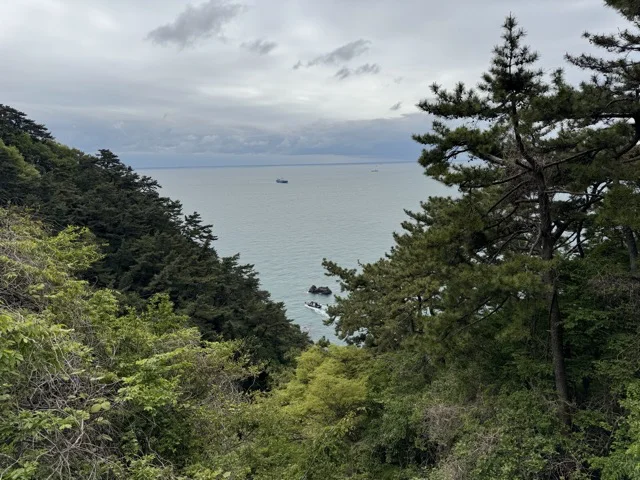
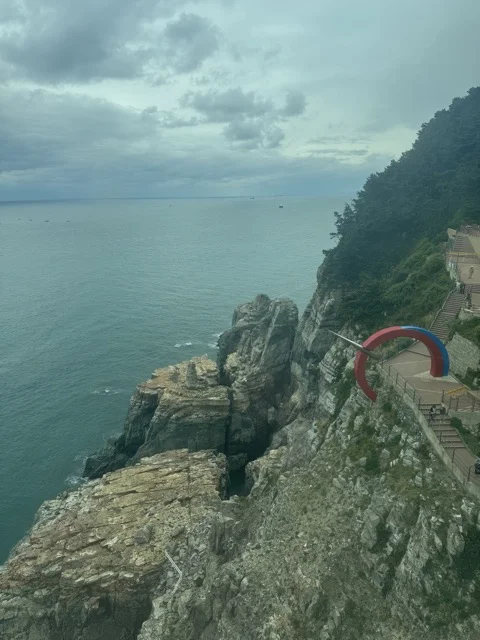
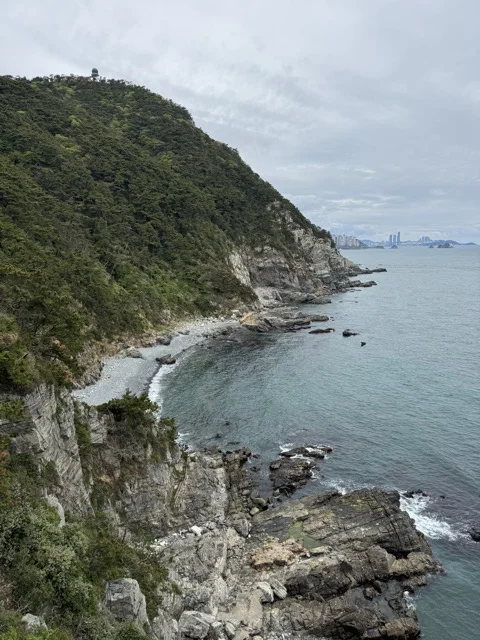
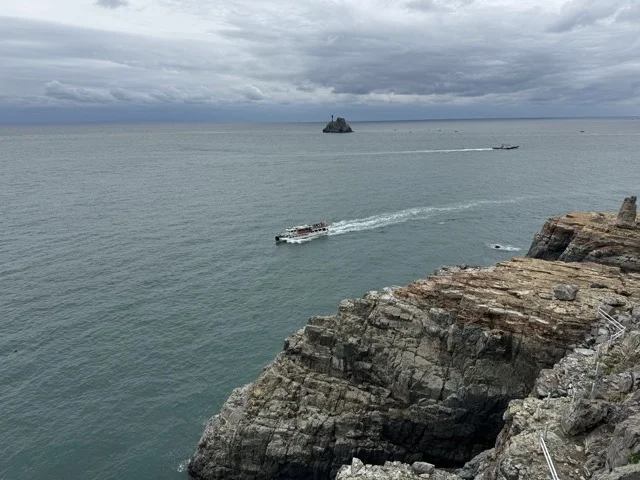
For much of the way, the ocean views are obscured by trees. But there are some clearings and viewing decks with great views of the ocean and the shore. It’s gorgeous.
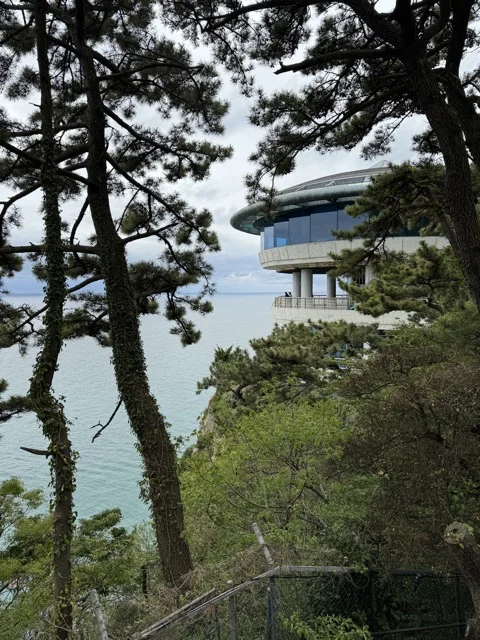
I had seen somewhere before setting out today that there is a cafe in Taejongdae Park. It turns out it’s not terribly far along on the route. It’s in a building of a couple of storeys that also provides an observatory for looking out to sea.
The observatory provided a space on street level that was open and offered great views.
I got there a little before noon. I wasn’t the least bit tempted to eat lunch then. It wasn’t the time that turned me off. Nor was it that what was on offer at the cafe didn’t appeal to me. It was more the plain-paper, computer-printed sign that said the cafe was temporarily closed and apologized for the inconvenience. That’s all it said in English. There was lengthier text on the sign in Korean than in English. It possibly included the reason for the closure and how long it would be closed, but I didn’t bother using a translator app to find out what it said. I had the relevant information.
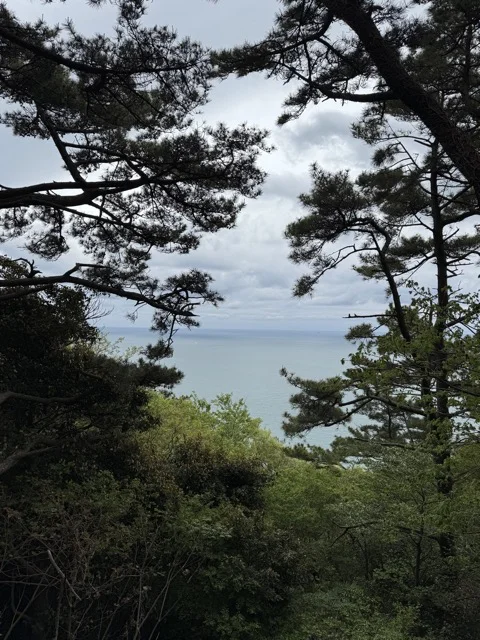
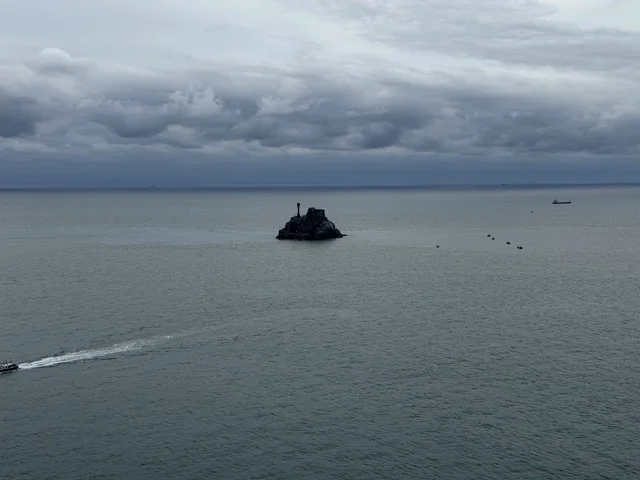
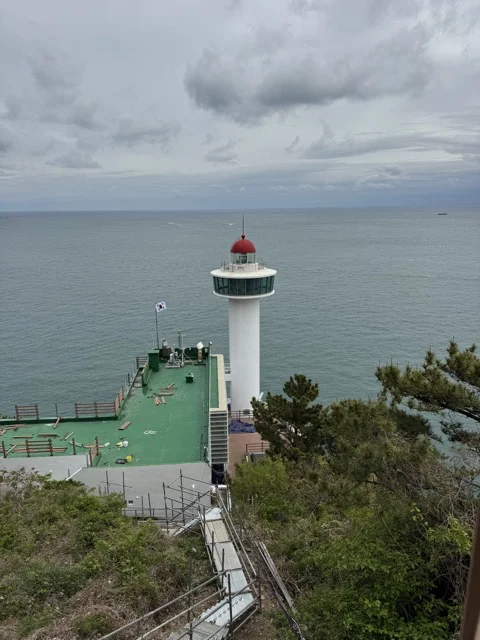
Further along on the walk, there is a modern-looking lighthouse, the Yeongdo Lighthouse. I said there were no stairs required on the walk, but there were optional stairs at the lighthouse. I walked down them and got much closer to sea level.
It also took me to the base of the lighthouse. I walked in and, at no charge, climbed a terrazzo-tiled spiral staircase to an observation deck just below the lighthouse’s light. From there, I got some more great views of the sea and shore. They would have been even better views if the outside of the glass wasn’t more than slightly dusty. It was.
After taking in the views, I climbed back up the stairs and continued around the circle.
Still farther around the route around Taejongdae Park, I came upon a spur road to a small Buddhist temple, Taejongsa Temple. I followed the spur.
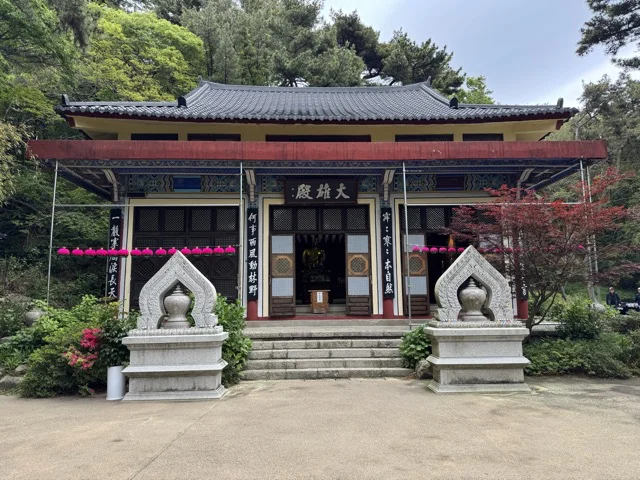
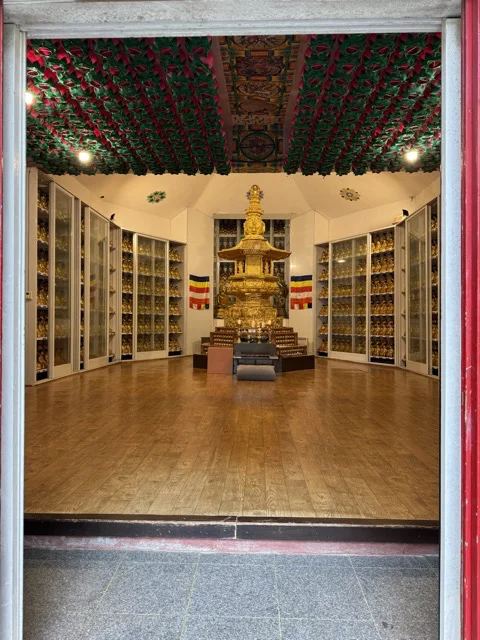
The temple has only a couple of small buildings. One is a prayer hall. The other was what a sign said was a hall of Buddha relics. (I didn’t take a picture of the sign. I forgot if it said that in English or if I used Google Translate on it. And my memory of it might be wrong. But I do remember that “Buddha relics” was part of it.) I looked inside from the threshold. The room is small. There is a gold-coloured ornamental pagoda near the centre, near the back of it. Surrounding that on three sides are cabinets stuffed with hundreds of identical small, gold-coloured Buddhas lined up side-by-side.
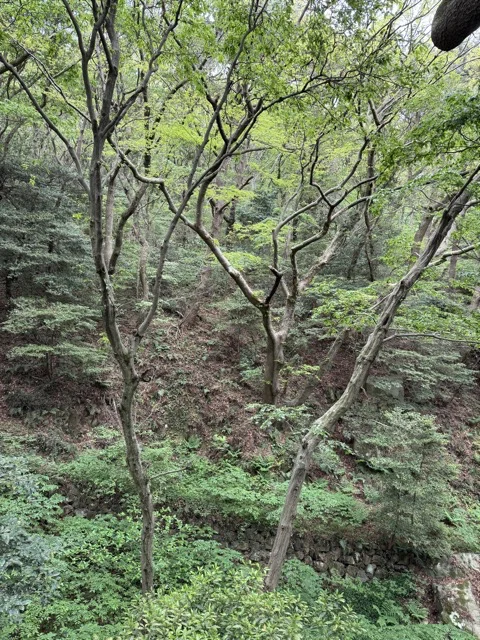
There were some gorgeous views down a verdant slope out to the sea from beside the temple. There was an unobstructed road that went down that slope, presumably to the seashore.
I say presumably because I didn’t walk down it. I saw a couple of other people who looked like tourists stroll down, so I don’t think it was prohibited, but walking down would have required walking back up. It looked farther and higher than I wanted to go.
Instead, I walked back to the sidewalk and continued on my way to the end of the Taejongdae Park circle.
I would have preferred it if there had been an option to walk in the woods on an isolated, woodland path, even if only for a short distance. Nevertheless, it was a pleasant stroll occasionally punctuated by stunning vistas.
I didn’t get out of Taejongdae until close to two in the afternoon. Having been café-deprived, I was hungry. So I stopped at a coffee shop and had a bite before heading for my afternoon activity.
(“Afternoon activity” is a bit of foreshadowing. You’ll find out how so, or confirm your guess, in my afternoon post, which I’ll hopefully publish a couple of hours after I publish this one.)
Aside
When you gotta go…
At a surprising frequency, there were washrooms around the circular route around Taejongdae Park. That is, they seemed surprisingly frequent to me based on my experience elsewhere, particularly back home in Toronto.
I know that some people feel that talking about toilets is Too Much Information! But, except for the AI bots that read this, we’re humans. Every once in a while, you have to speak the immortal words sung by Groucho Marx, “Hello, I must be going.”
Mentioning the toilets in Taejongdae Park allows me to introduce a more overarching point. Everywhere I’ve been in Korea so far, there have almost invariably been free public toilets anywhere the public is likely to congregate.
What’s more, they’ve always been quite clean. And we’re not talking about “rustic” facilities here. Most of them have either had tiled floors and walls or, if not tiled, paint that looked reasonably fresh.
Being an old man, I’ve visited more than a few public toilets on this trip. So I have some experience in that.
My hometown could learn a lot from Korea in that regard. Back home, there aren’t nearly enough public toilets in public places. And a few of the ones that are there are sometimes so poorly maintained and so infrequently cleaned that you’d have to be mere seconds away from bursting your bladder before you’d want to use them.
Okay. Enough about toilets. I want to finish this entry because I must be going.
Discover more from Joel's Journeys & Jaunts
Subscribe to get the latest posts sent to your email.


Now that was a beautiful spot! And nice to know about the toilets. Because you should always go before you leave…and at our age at many intervals in between.
It was indeed a beautiful spot.
Ant toilets are important. More so now than when I was younger. Thank you, Korea, for understanding that.