Pannonhalma Archabbey
If you read my first post from Győr, you might remember that I said that my guidebook mentioned a sight on the outskirts of Győr. That sight was the Pannonhalma Archabbey. I said in that post that I didn’t know if I’d get to Pannonhalma Archabbey today, my only full day in Győr, because it involves a bus and a bit of a walk. When I checked Google Maps yesterday, it said the total trip would take about an hour.
That might have been a result of when I looked. I didn’t specify a time for the trip. I let it default to “now.” When I looked again today while cooling down with slow sips of lemonade in an air-conditioned cafe, Google Maps shrunk the trip to 50 minutes. It still had a walk, but less of a walk than the route it gave me yesterday.
Off I went. Before setting out, I said a prayer that the bus would be air-conditioned. My prayer was answered in the affirmative. This is proof positive, leaving no doubt whatsoever, that God favours atheist Jews.
It was a regular city bus on a regular route, making several stops along the way. Not only did it have air conditioning, but the windows had curtains. The curtains were drawn, presumably so the air conditioning wouldn’t have to work as hard. However, that meant I didn’t see anything of the scenery along the way.
The bus did not have electronic signs announcing the stops. And stops weren’t called out; neither live by the driver nor via automated audio. I had to keep looking at Google Maps to see where I was so I wouldn’t miss my stop. Pannonhalma Archabbey was the last stop on that line, but there was no announcement of such. The driver let passengers off and then turned around and went back.
Oh, before I go on, this is my last entry from Győr. So I’ll place a summary of my time here at the end of this post. It will be short because I wasn’t in Győr long.
At Pannonhalma Archabbey
The city bus let me off at an entrance to Pannonhalma Archabbey, but not the visitors’ entrance. Having a bus take me almost all the way there was essential in this weather. It’s at the top of a hill, but I had no more elevation to climb after the bus stop.
The visitors’ entrance is on the far side of the abbey. The abbey is not just one building, but rather a complex of buildings. The walk around the outer perimeter wouldn’t have been long on a cooler day, but this wasn’t a cooler day.
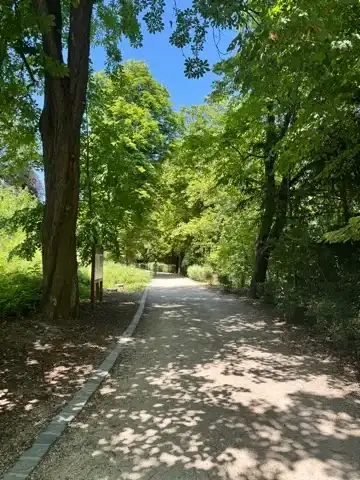
However, on the plus side, the walk was along a wide, mostly gravel path under a lot of trees. At one point, there was a multilingual sign designating it as the “Avenue of Wild Chestnut Trees.” Another section was a linden promenade. So, there was a lot of shade. But it was still stifling.
When I got to the visitors’ entrance, it was magnificent, but only in that they blasted the air conditioning. Or maybe it just felt like it was blasting after coming in from the ambient sauna outside. When I asked, in English, for a senior’s ticket (it’s discounted, not free), the ticket seller charged me and handed me a leaflet that was exclusively in English. Other people got Hungarian leaflets. I don’t know if there were any other languages. The leaflet provided information about each of the buildings in Pannonhalma Archabbey that are open to the public. So I have that information, along with information from my guidebook, to help me with this post.
I think that when the author(s) of the guidebook visited Pannonhalma Archabbey, the abbey had different policies on where visitors could go. Or maybe the author(s) got special treatment as author(s) of an entry in a tourist guide about a site with paid admission.
The reason I say this is that the guidebook edition I have—Lonely Planet: Budapest & Hungary, 10th edition – Jul 2025— says, “In the courtyard you encounter the first abbot, Asztrik, who brought the all-important Hungarian crown worn by King Stephen to Hungary from Rome.”
Pannonhalma Archabbey sets out a prescribed route for visitors to follow. That took me past the back of a statue behind a chain barrier. It looked like there was a courtyard beyond that, but I couldn’t go there.
The visitors’ entrance wasn’t in one of the old buildings. It was in a building that looked quite new. I don’t know how long it’s been there, but that might explain the different route through Pannonhalma Archabbey.
I have no insight into the production of tourist guides, but I don’t imagine they revisit every site for every edition. So, despite my edition being only about a year old, that particular entry might be considerably older. But maybe I’m wrong. Maybe they do revisit every site for every edition. It seems implausible, but anyone who puts any stock in my suppositions is a fool. Don’t be a fool.
But enough about that. Why are you wasting everyone’s time by diverting me on such a tangent? Oh, right. I went there on my own. Never mind. Let’s continue.
My guidebook tells me that Pannonhalma Archabbey was founded in 996 and began converting the then-pagan Hungarians. After extensive research I performed for my own interest, I determined that Pannonhalma Archabbey didn’t get a Wikipedia entry until several centuries after its founding. So how big a deal can it really be?
Visitors can access six areas of the abbey: The treasury, basilica, crypt, cloister, and library. The sixth is a hall where they mount temporary exhibitions. Let me knock off my write-up of the temporary exhibition. The signage was exclusively in Hungarian, and I didn’t spend any time there. I had to walk through it because the exit was on the other side, but I have nothing to say about it.
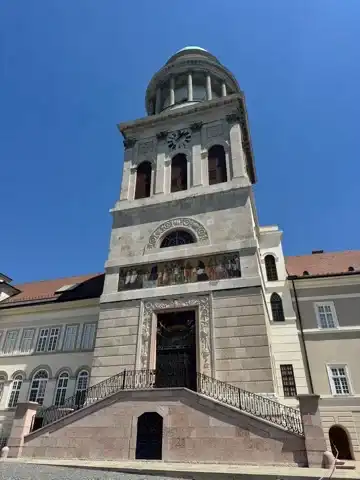
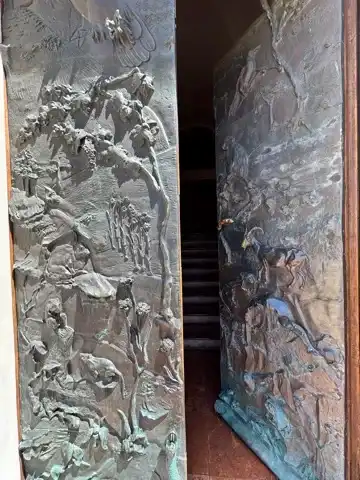
Okay, the other stuff. Three of the mentioned spaces are within the basilica’s building, but I’ll touch on them separately. But first, the entrance is through a tower that dominates the building. The double doors into the building are beautiful. Neither of them is wide. They are made of metal with relief sculptures of myriad animals.
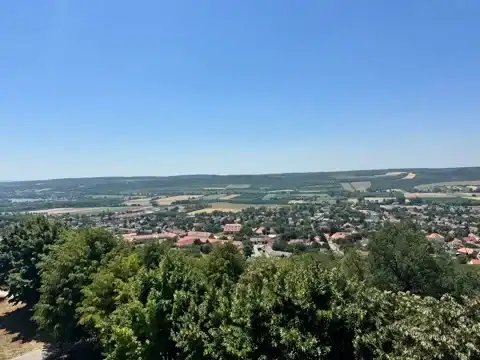
Oh, wait. I almost forgot: in front of the basilica entrance, there’s a terrace that provides a vista from atop the hill. It’s beautiful.
Treasury
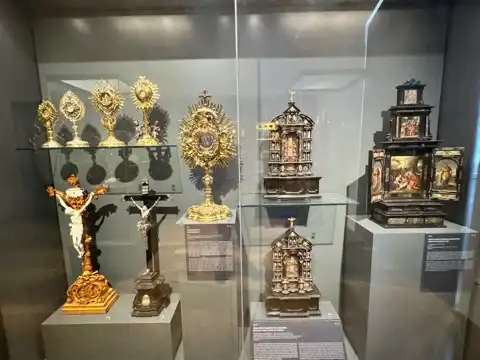
The first room I went into was the Treasury. It contains the usual collection of an old Catholic church treasury: reliquaries, crucifixes, silver religious paraphenalia and so on. A bilingual sign explained that ‘Similar to secular cabinets of curiosity (or Kunst und Wunderkammers), the medieval church treasury may be considered a distant precursor to today’s museum collections. Holy relics, their most valuable items, are often preserved in museums, deprived of their religious context, surrounded by objects described with the profane term “historical relics”. In the meantime, the concept of the treasury has altered as well, and may be considered today a permanent, yet ever-changing repository of treasures and symbolic values, and religious and worldly objects at the same time.’
Basilica
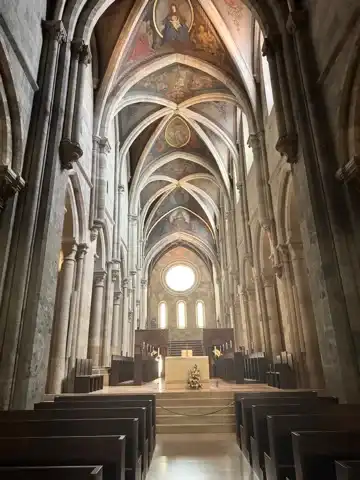
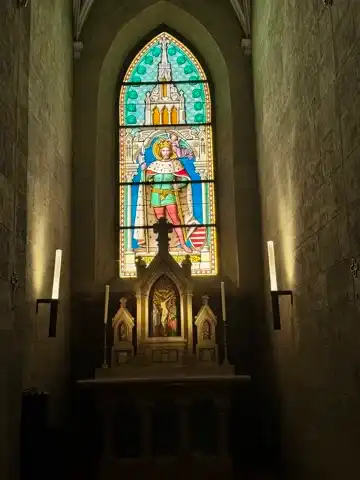
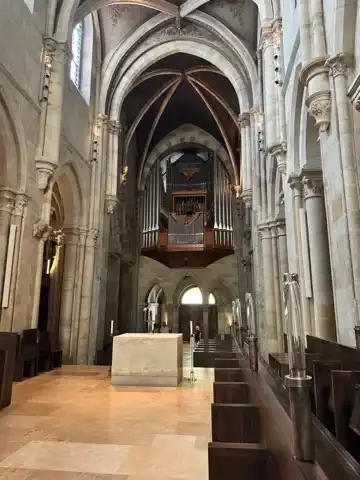
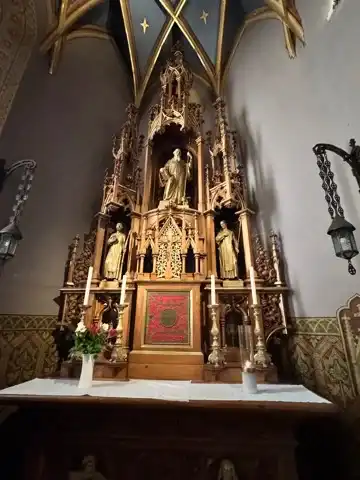
Even without consulting my guidebook or the leaflet, I was able to identify the basilica of Pannonhalma Archabbey as a Gothic church. It is very austere, stone-forward, and with lots of columns. There are few decorations other than some jaunty stained glass windows and a darkened, low-contrast painting on the ceiling. (Although that darkness and reduced contrast might be a result of its age. I don’t know.)
That, to my incompetent eyes, is the epitome of a Gothic church. Unless it’s art deco. I always get those confused.
But no, the leaflet tells me it’s a three-nave church in the early Gothic style. It was consecrated in 1224; however, excavations showed that there had been another church of a similar size in that location before then. There have, of course, been some renovations since 1224. I imagine anything that old needs the occasional nip-and-tuck. I haven’t had any cosmetic surgery done, and I have no intention of getting any anytime soon, but I might treat myself to a facelift when I’m 800 years old.
It is a beautiful space.
Pictures from Artifacts inside the basilica of Pannonhalma Archabbey:
Crypt
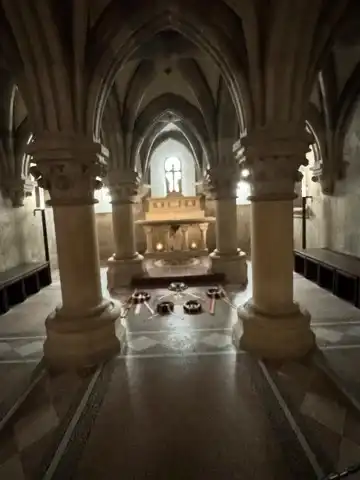
The crypt is one flight down from the main sanctuary of the basilica, with stairs on either side of the altar. It’s a small space. Its columns have arches branching off from their tops in multiple directions. It’s a small, dark, solemn space.
The leaflet says it’s the oldest uniformly preserved space in the complex and dates from the 13th century.
Cloister
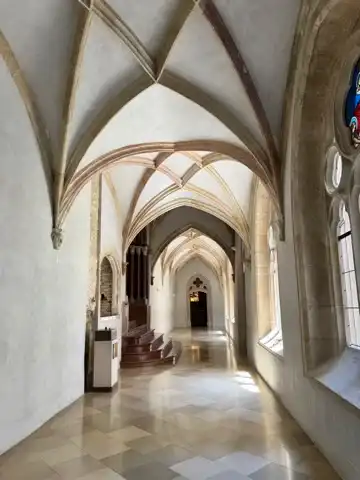
Just outside the basilica is the cloister. It’s a squared-off U-shape. Most cloisters I’ve been in have the wall of the associated building on one side. On the other side, accessible through the columns of the colonade, is usually a garden or a square. The cloister at Pannonhalma Archabbey does, indeed, have a garden on the other side of the colonade. It looks beautiful as seen through the windows built in arched walls between the columns. There are a couple of wooden doors out to the garden, but they were locked.
According to the leaflet, the current Gothic form of the cloister is the result of a renovation completed in 1486.
Libary
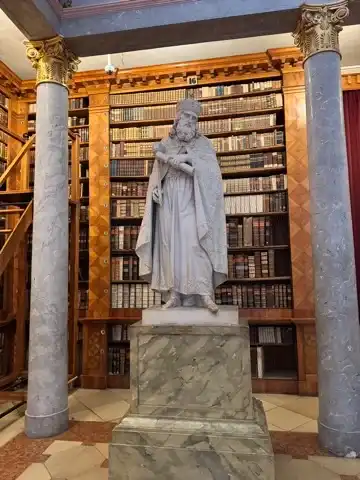
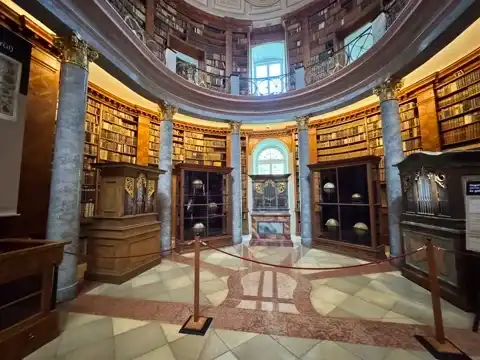
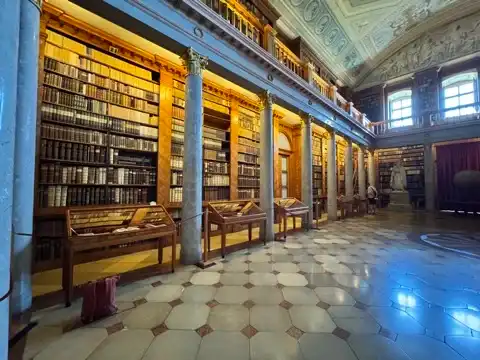
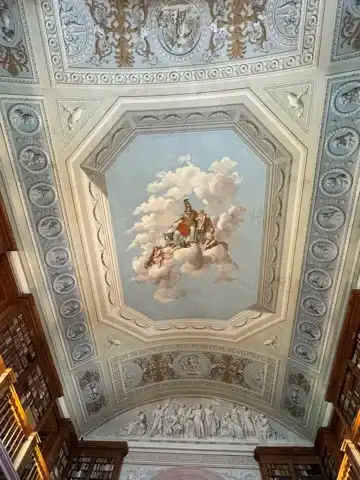
The library is a thing of true beauty. There are lots of pillars made of what look like marble. The ceiling has paintings on it. The bookshelves are almost floor-to-ceiling, including up on a second-level balcony around the perimeter of the space. And there’s a statue in the library.
One section is rectangular. Off of that, there is a horseshoe-shaped section. It is a true delight.
After the library was the space for temporary exhibitions. Beyond that was the gift shop and then, of course, the exit.
There are other things to see on the wider Pannonhalma Archabbey grounds. There’s a large arboretum, but it climbs down the hillside. I didn’t feel like climbing today because climbing down would have made a climb back up necessary. There’s also an arboretum botanical garden and a fragrance museum. But I think they’re in the middle of the arboretum. At least, that’s what it looked like on the map. It was too hot to nose around to find out.
Pictures from in the library:
Back from Pannonhalma Archabbey
When I was done with Pannonhalma Archabbey, I consulted Google Maps to find the next bus time. I had an hour wait. I walked back to the gift shop where there was a cooler with bottles of water for sale. I bought a bottle, found a shady bench and hydrated while waiting.
The bus arrived, and I was on my way back into Győr. After a few stops, the bus started making some beeping noises that seemed to be emanating from the dashboard. The driver pulled over, said something in Hungarian to the passenger in the first row, got out (fortunately leaving the air conditioning on), and walked behind the bus. After a few minutes, he came back and continued on the route.
The beeping continued. A little farther along, the driver said something in Hungarian again, this time directed at the first couple of rows. He again got out. After about ten minutes, he came back and said something to the whole bus, still only in Hungarian. After he finished speaking, most of the people on the bus immediately stood up and got off.
There was a small group of English-speaking young adults on the bus. I know they were English-speaking because they spoke among themselves off-and-on while on the bus. They looked as confused as I was, but we got off the bus behind everyone else. Behind our bus, there was another bus with a different route number. Everyone got on that bus.
It seems that most of the Győr bus routes start and/or end at the bus station, which was where I needed to go, so I figured that bus would probably get me there. It did.
(I think I mentioned it in another post, but I’ll repeat it here. In Hungary, buses and trains are free for people over 65 no matter where they’re from.)
And so ended my day.
Győr Summary
As I mentioned in my first post from Győr, I stopped here only because it was a train hub and the connection between two city pairs I wanted to visit required a connection in Győr. It looked like a more gruelling travel day than I wanted, so I broke it up with a stay in Győr. The travel information sources I’m using on this trip had next to nothing to say about Győr, so I was apprehensive.
I’m glad I stopped. It’s a very pretty city, with a charming Old Town. There are a few attractions worth seeing, like the cathedral and the church with the long name that I’ll never remember, plus the Pannonhalma Archabbey. But, to be honest, there’s not a lot to do or see as far as I could find.
So, my day and a half here was just about perfect. That said, though, if it weren’t so darned hot, just hanging around the Old Town area a little more would have been pleasant.
Discover more from Joel's Journeys & Jaunts
Subscribe to get the latest posts sent to your email.


Really sorry that the heat curtailed your rambling. I know you would have puttered around to the arboretum and loitered in the old town more if the weather was more accommodating. That said, I am very thankful you have taken us there, and the Pannonhalma Archabbey looked stunning! Happy travels to your next destination.
Yeah, I’m not doing as much as I would have done if it were cooler. But it’s been an enjoyable trip so far nonetheless.
You’re welcome, and thanks!