Going to Győr

I left Sopron this morning, and I’m now in Győr, Hungary. Why Győr, you might ask? That’s a fair question. Like everywhere I’m visiting on this trip in Hungary, except Budapest, I’d never heard of it before planning the journey.
I’m using two guidebooks on this trip, but one covers all of Central Europe. Its Hungary section restricts itself to Budapest and a city I won’t be going to simply because I couldn’t find a way to work it into a reasonable itinerary that also took in other places I wanted to see.
The other guidebook restricts itself to Hungary. It covers more cities and towns here with some depth, but it has only one paragraph about a single sight in Győr, the Assumption of Our Lady Basilica Cathedral. It gives a little more attention to another sight outside of Győr that’s accessible by bus, combined with some walking. (None of the ride-hailing apps I have offer service here.) Perhaps I’ll go there tomorrow if it’s open on Mondays. (Tomorrow is Monday.) But it looks like too much exertion would be involved in getting there and touring around it to endure the baking temperatures here.
My walking tour app has guides for many cities around the world, even several small ones. For most cities and even some small towns for which it doesn’t have a guide, it provides blog-like articles on what to see there. It has nothing for Győr.
So, why, you ask again because you’re peskily persistent, did I choose to come to Győr?

Because you probably won’t let it lie, I’ll tell you.
Győr appears to be a rail hub in Hungary. After I chose the cities I wanted to go to based on what looked interesting in my guidebook and were reasonably well connected by train, I found that there was one city-pair that required a connection in Győr. But that journey with the connection made for a longer travel day than I wanted to try to tolerate. As I age, those sorts of aggravations increasingly become more of a burden than I care to bear.
So I decided to stop in Győr. I’ve done it before, but I no longer like to stay only one night in a city. You have to get from the train station or airport to the hotel, check in, figure out the inevitable eccentricities of the hotel and hotel room, and probably use the bathroom. Then, the next morning, you have to pack up the few things you took out of your suitcase, check out, and make your way back to the station or airport, without having experienced much of the city.
In my ever-increasing crotchetiness, that too is something I’m less interested in bearing as time goes by. So, I booked two nights here.
I’m not sure what I’ll do with my day and a half in Győr. That is a bit too much to ask of a single paragraph in my guidebook. I’ve already consulted TripAdvisor for some suggestions that I used this afternoon. It lists several other sights that look somewhat interesting that I haven’t yet seen. So we’ll see how tomorrow goes, dear.
First Impression of Győr
The first thing that struck me about Győr, and it struck me right away, is that funny accent over its “o.” It’s not a double-dot umlaut diacritical mark. We don’t have those umlauts in English (except in a few words we shamelessly steal without adaptation from other languages), but they’re not all that rare in some other languages.
Instead, it’s a double-slanted line, like a sans-serif open quotation mark, but over a letter rather than in front of a word. I’d never seen it before. What’s up with that? What say you, Győr, with your elevated quotation mark?
When I previewed this page, I noticed that, in the font I currently use for this journal, the “ő” looks like it’s a different font than the font of the rest of “Győr.” Sorry about that. It isn’t the case in some other fonts, such as the font the blog entry screen uses when I type up these posts. I apologize for the weird look, but I’m not going to choose a new font now. I’d rather travel and, less so, type these posts up than spend my time auditioning fonts. At some point, if I ever decide to change the font, it might look normal then.
In Győr
When I went online to check the opening times for the Assumption of Our Lady Basilica Cathedral, I found a professional-looking website that includes English pages. It provides information about affiliated sights on Chapter Hill, where the cathedral is. A couple of them are mentioned in my guidebook as being part of the cathedral.
I headed there.
It is blazingly hot here today. At one point in the afternoon, I looked at the temperature on my weather app. It read 37°C. I think the “real-feel” temperature was somewhere in the range of “you imbecile, what the heck are you doing out in this?”
So, you’re thinking, “Joel, that blithering idiot, climbed up Chapter Hill in this heat? What a nincompoop.”
I’ll ignore your insolence and, in my defence, say that Chapter Hill is a very low hill, barely a hill at all. And the roads up it are very gently sloped. It required barely more exertion than walking on a level street, which was exertion enough on a day like today.
Bishop’s Castle — Outlook Tower

Armed with information from Győr Cathedral’s website, I knew that it doesn’t open until three in the afternoon on Sundays. However, some of the affiliated sites in the cathedral precinct open from the morning to late afternoon. So, after lunch, I headed first to the next-door Outlook Tower of the Bishop’s Castle.
And now you’re thinking, “See! What did I tell you? He’s a blithering idiot! He climbed an old tower in that hellish heat. A complete cretin if there ever was one.”
Still ignoring your incivility, let me say simply that I have no defence. You might be right about that. But it turned out okay.
The ticket desk at Bishop’s Castle’s Outlook Tower also sells tickets for the other exhibits mentioned on the cathedral’s website. You can buy individual tickets for each, or a combination ticket that covers your choice of two, three, four, or five exhibitions.
I chose to buy a ticket that included the tower and only one other exhibition because the ticket seller told me that only one other exhibition was open today. She didn’t say why the others were closed, but we all know the reason. It was the doings of the, say it with me, Don’t Let Joel See Stuff International Association (DLJSSIA).
I was at the tower entrance, so I climbed it first.
But first, a bit of a tangent. The Bishop’s Castle? What’s up with that? Personally, I wouldn’t accept the job of Bishop unless it came with a castle. I mean, I don’t want to start believing in god and performing a bunch of high-level ecclesiastic chores unless I’m well compensated for it. But castles for bishops are not normal, are they?
The climb up the lookout tower wasn’t bad. I don’t know how many steps there were, but it’s not the tallest tower I’ve climbed. Plus, I don’t think any air conditioning has been added, but these centuries-old buildings with thick stone walls tend to stay cooler inside even when it’s exceptionally hot outside.

What’s more, there are three rooms at different levels on the way up where I could pause. One of those rooms had an exhibition of light, airy modern sculptures by a local artist. The other two rooms had chairs and little else.
One of the rooms had information panels in each of three languages, one of them English, providing several paragraphs on the history of the Bishop’s castle. The overly abbreviated version is that its construction, which was commissioned by Bishop Kálmán (1337-75), began in the mid-14th century. It’s the only medieval pontiff’s residence still in existence in Hungary.
The single staircase in the tower is a spiral one. At its lower levels, the spiral and treads are reasonably wide stone stairs. Not grand, but not claustrophobia-inducing. The upper two flights, less so. Those flights are a tight spiral with much narrower metal treads. It looked very much like the picture of the spiral staircase I included above, because it is a picture of one of the flights of the metal portion of the staircase. I didn’t enjoy that part of the climb.
The top of the tower is a not-particularly-large, square, open patio, with no shade whatsoever. The views of Győr and the surrounding area are stunning, but I didn’t spend much time up there.

Legenda Aurea – In the attraction of relics
The one exhibition open today was called “Legenda Aurea – In the attraction of relics.” “Legenda Aurea” is Latin and refers to a 14th-century book in the Diocesan Library that summarises the holy relics from that period.
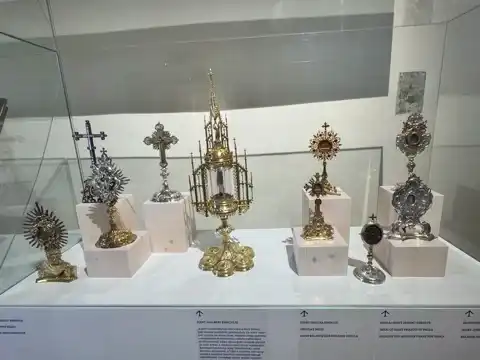
It’s a small museum. I think some of the exhibits, or perhaps all of them, might be temporary. So don’t be surprised if you go and what you see is different, or if the whole exhibit space is something else.
The first display cases held relics related to various saints, including a reliquary containing the hand bone of Saint Adalbert, who, according to an accompanying placard, was a martyr, bishop, apostle, and patron saint of Hungary.
No matter how long I live, I will never understand the interest in severing parts of deceased saints and venerating them in elaborate containers, typically with the revered bone visible through a window in the container. That’s always felt sickly macabre to me.
But wait, there’s more.
The next part of the exhibition was on the scientific examination of a relic consisting of the skull of Saint Ladislaus (1040-1095). That was and is stored in a beautiful head-shaped silver reliquary that resides in the next-door cathedral. (The original reliquary was damaged and was replaced with a replacement in 1607.)
The scientific examination involved temporarily removing the skull from the reliquary, CT scanning it, then using computer technology to extrapolate a depiction of the saint’s face, taking into account the muscle insertion points. Well, okay then.
Várkazamata-Kötár Lapidary

After I finished with Legenda Aurea, it still wasn’t 3:00. When I walked to the Bishop’s Castle Tower, I passed a museum, not far from the Bishop’s Palace and the cathedral, that said it was a lapidary. It had some English on a computer-printed sign saying that it was a museum.
I found an entry for it on TripAdvisor, but no description or reviews. I decided to go in anyway to fill some time.
The attendants sitting around the front didn’t speak much English. They handed me an English version of a laminated, double-sided sheet of paper with information about the Ottoman period in Győr, but it didn’t offer anything about the pieces inside. In stilted, fragmentary English, one of the attendants told me it was free today. She didn’t say why, and I didn’t ask.
(Note: So far in Győr, the absence of English at the museum was the exception. I’ve been in restaurants for lunch and dinner, and spoke to the ticket seller, and they all spoke English very well. And in the few other places I’ve been into here, signage has been in at least Hungarian and English and sometimes an other language as well. The same wasn’t always true in Sopron.)

The museum was inside a short, arched, brick-lined tunnel that had a couple of 90° turns in it. Mostly sitting on the floor, there were old stone architectural elements, engraved tables, tombstones, I think a big stone box, and I forget what else. All of the signage associated with the individual relics, and possibly some general information—I don’t know—was exclusively in Hungarian.
I didn’t have a cellular data signal in the tunnel, so I couldn’t use Google Translate’s camera function. I’d downloaded Hungarian for offline use, so I could have typed in the Hungarian, or I could have taken a photo of the text, copied the optical character recognition from the photo and pasted it into Google Translate, and it would have worked. I tried the latter method on one sign. It did work, but there was no way I was going to go through the hassle with any more of them.
I looked around a bit and left. Besides, the cathedral was just about to open.

Cathedral Basilica of the Assumption of Our Lady

My guidebook calls this the “Assumption of Our Lady Basilica Cathedral.” The cathedral’s webpage calls it “Cathedral Basilica of the Assumption of Our Lady.” Tomato, tomahto. I’ll go with what the cathedral’s webpage says, because if the people at the cathedral don’t know the name, who does?
My question is, is it a cathedral or a basilica? My understanding is that cathedrals and basilicas are both designations of churches, but a cathedral outranks a basilica. My comprehension of anything religious is more often wrong than right. But if my interpretation is correct, and if it is a cathedral, then why not drop “basilica” from the name? Stuff like this bothers me, which is probably why I never got ahead in the world.

I’m going to give them the honour of referring to it as a cathedral.
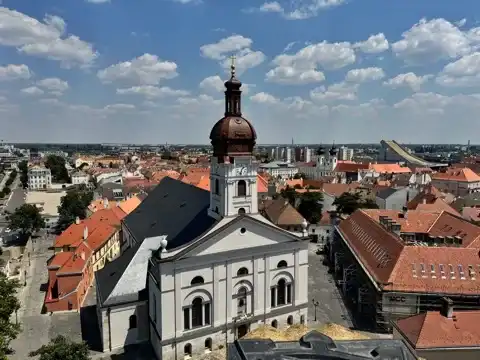
I found the exterior of the cathedral to be quite plain. Information, both on panels in it and on its website, says that it was first built in the 1100s, but no one has much information about its origins. It underwent a few conversions after damage from a variety of invasions over the years. Its current Baroque appearance arrived in the 18th century. But since then, it also had some neo-Romanesque work done. Plus, there have been repairs done after the damage the cathedral suffered in World War II.
To my eye, the exterior looks quite plain. Not that there’s anything wrong with that. But, apart from the handsome tower sticking out of the roof near the front of the church, I thought it looked like a not-particularly special old church.
Inside, it’s over-elaborately decorated with so much gold colour that even Donald Trump would say it’s too much. Well, maybe not Donald Trump, but anyone with even the slightest taste. There are gold coloured statues everywhere. Gold trim on the pillars. Gold ornamentation on the altarpiece.

I doubt it’s solid gold, or even gilding (I’ve been chastised for saying “gold gilding” because it’s redundant, so I won’t say it). There’s just too much of it. If the cathedral used real gold, even the thinnest of gilding, it would be so expensive that I’m sure I would have read about it in notes about the cathedral.
But some of the statues are on low pedestals. So I could get a close-up look. It didn’t look like paint on metal. It looked like bare metal to me. But I probably couldn’t tell if it was a really good paint job.
In a place of honour in a side chapel sits the Saint Ladislaus skull reliquary I mentioned above. It’s quite ornate.
In the same chapel, there’s also a tomb of a revered recent bishop of Győr, Vilmos Apor (1892-1945),

Győri Kármelhegyi Boldogasszony templom

My final destination this afternoon is what TripAdvisor and Google Maps call “Győri Kármelhegyi Boldogasszony templom.” Google Translate tells me that translates to “Church of Our Lady of Mount Carmel in Győr” in English.
With the help of the translate function in Chrome, the church’s website tells me that “The final monastery building was soon completed, and construction was completed in 1732. The foundation stone of the church was laid in 1721 and consecrated in 1725.”
I quite like the exterior of the building. It’s predominantly mustard-coloured, with white pillars (or maybe faux-pillars) and little statues in indented arches. There’s also a jaunty little tower poking up close to one side of the church.
Inside, it is not as overly decorated as the cathedral, but it’s still not subtle. It has a lovely ceiling with paintings between pattern bands that converge at the centre. I found it very attractive.
Pictures from inside Győri Kármelhegyi Boldogasszony templom:


First Impressions of Győr
From what I saw today, Győr’s central district streets are lovely. They don’t have quite the charm of Sopron’s medieval inner town, which I left this morning, but on the official JMK Charm Coefficient Scale, Győr’s streets come in at only a notch or two lower. There are several pedestrianized streets, and some streets that had so little traffic that they might as well have been pedestrianized. The buildings are all low-rise. I’m not in Győr for long, but I think I’m going to like it here. Now, if they could just bring in some giant air conditioners to cool the whole city, that would be wonderful.
Discover more from Joel's Journeys & Jaunts
Subscribe to get the latest posts sent to your email.


Sounds like a lovely bonus stop for you. There are so many fine places in the world that don’t make it onto the usual lists of even the most dedicated guide books, of which there are fewer and fewer these days. Which means that hordes of people converge on the few places that have been anointed as ‘bucket list’ sights and leave the discovery of other wonders to intrepid explorers with crotchety requirements like you. That said, I kind of hope that you run short of interesting sights to pursue for a bit so you can spend more time sipping cold drinks in air conditioned spaces and taking refreshing showers without guilt. But what am I saying? And who am I saying it to? Joel? Without guilt? Har di har!
If someone would write a guidebook called, “Really Fabulous Places That Most Tourists Haven’t Found Yet,” I’d buy it. Of course, if the book became successful, it would become trash. A paradox, that is. As you say there likely are an amazing number of lovely places that I don’t know about, because they’re not in any guidebooks. I think about that a lot.
As you say, I lucked into Győr. I stopped here purely to make the train connections work in a non-grueling way. I don’t know if Győr would make it into the “Fabulous Places” book, but it is indeed lovely.
Ohhh, that’s so cool! I was in Győr myself a few years ago!