St. Michael’s Church (Sopron) and More
I gave St. Michael’s Church sole billing in the title of this entry, but this afternoon included a hodgepodge of sights that I visited briefly before ending the afternoon and heading back to my hotel early because of the heat.
At one point in the afternoon, I passed a pharmacy with a temperature reading in its green cross sign. It read 37° (Celsius, obviously). I looked at my weather app. It confirmed that it was indeed 37°C here in Sopron, Hungary. For those people who don’t identify with Celsius, that translates to “it’s too darn hot” in Fahrenheit and in a Cole Porter show tune. For those who value precision over usefulness, it’s 98.6°F.
Let’s get into that hodgepodge, shall we?
No, wait. A bit of a programming note first. I’ll be leaving Sopron tomorrow morning for my next Hungarian destination. So there won’t be a morning post tomorrow. But there will be a summary of my time in Sopron at the end of this entry.
Okay. On to the hodgepodge.
Bailey Promenade
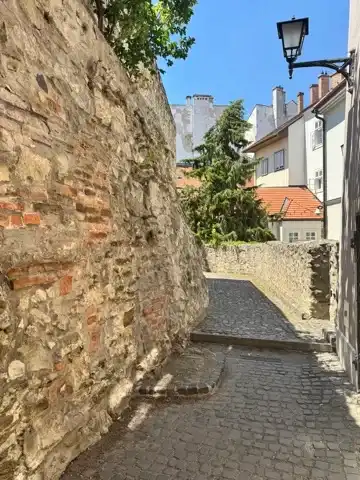
When I left my lunch restaurant in Sopron’s Main Square to walk to St. Michael’s Church, I passed Bailey Promenade. It’s a short L-shaped promenade that passes by some of the remains of Sopron’s old city walls.
According to a sign there, it also includes the walls of the Red Redoubt (I don’t know what that is), preserved up to the first floor.
The two arms of the L are quite short, so I didn’t spend much time there, but antiquity is cool.
St. Michael’s Church
To be honest, I don’t remember what led me to St. Michael’s Church. It’s not in my guidebook or walking tour app. I probably found it on TripAdvisor. At the time of writing, it has an average rating of 4.2, with 35 reviews on TripAdvisor; the most recent is from more than a year ago, and most were from several years back.
Because I didn’t have any other sources, I also didn’t have any information on it. When I got back to my hotel this afternoon, I did a web search and found a page about it on the same tourism website that provided information about Saint George Dome Church, which I visited this morning.
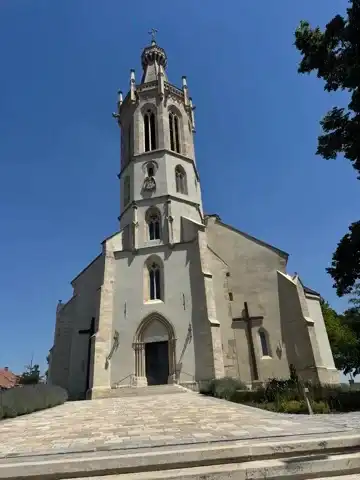
According to that source, St. Michael’s Church is the oldest parish Church in Sopron. The first written records of it date from 1278, and it achieved its current size in 1484.
The exterior must have had a good cleaning recently. It looked too new for a building for which the most recent expansion was almost 450 years ago. Today, its light-grey walls looked almost spotless.
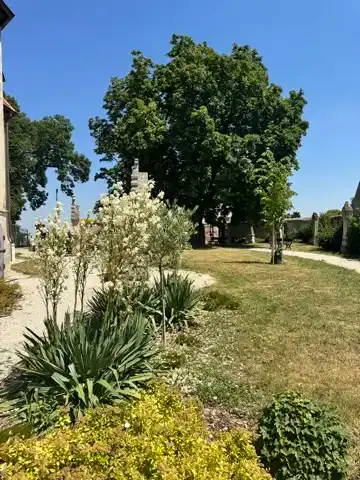
There’s a garden-like area beside St. Michael’s church. It contains a small chapel, trees, shaded benches, a path, and some picture holders spread out along the path.
I’m being flippant about the picture holders. I’m not intending to be disrespectful; it’s just that the words to describe them aren’t coming to me at the moment. It’s not that the structures are difficult to describe. It’s just that words don’t always make an appearance in my head when I need them. It’s a good thing I’m retired and no longer earn my living from writing … what are those things? Oh, yeah, words.
I’ll try. They are made from stone and have significant height and width, but not a lot of depth. Their tops form triangles, and they have lots of decorative carving.
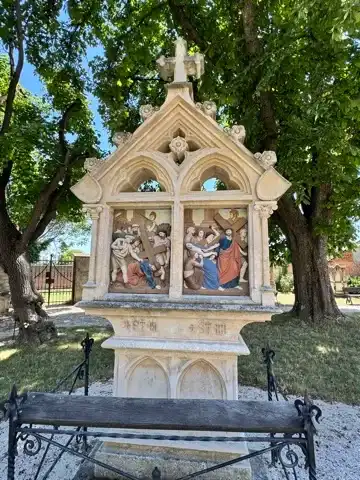
I called them picture holders because each holds two detailed, painted relief carvings.
I think they are Stations of the Cross. What made me doubt that is that I counted only eight. I thought there were usually fourteen Stations of the Cross. Maybe some were off where I couldn’t see them. Or perhaps time destroyed six of them. Then again, what do I know about the Stations of the Cross? They didn’t teach that in Hebrew school.
I posted a picture of one of them to compensate for my weak description.
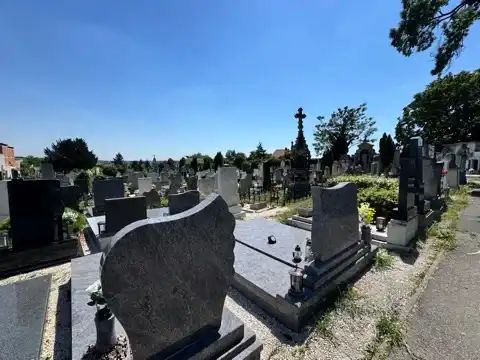
There’s a walled cemetery behind St. Michael’s Church. I didn’t spend much time there because it’s not huge, but more than that, it’s not shaded. I only walked a couple of rows along the aisle down the centre. I think it’s still an active cemetery. If not, it closed only recently. All of the dates of death I saw were toward the end of the twentieth century.
Having said that, there were several old tombstones against the outside of the wall around the cemetery. They were far too weathered to decipher their engraving.
When I arrived at St. Michael’s Church, the front door was locked. I tried the side door. It too was locked.
Just as I finished walking around the little garden area, poking into the chapel, ventured a bit into the cemetery, and took my first steps toward leaving, a man came by, unlocked the front door of St. Michael’s Church, and left.
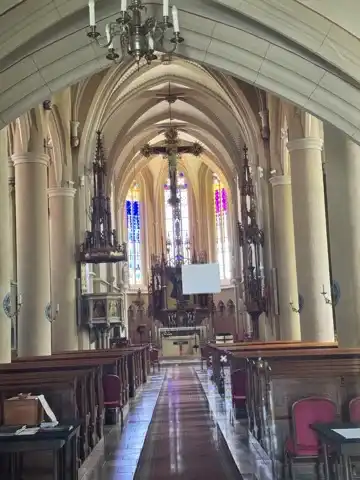
I took my opportunity to go inside. But I didn’t go far. Just beyond the wooden front doors, there was a set of locked double glass doors preventing me from going further. I looked through the glass doors. And I put my camera right up to the glass to minimize the glare and reflections when I took a picture.
I don’t know the style of the church. I’m sure a reader can help me with that. I will say, though, that it looked austere but quite handsome. That’s the look I’d like to aim for in myself. Instead, I can’t seem to break free of the schlub look. Wait a minute. St. Michael? I should be able to come closer to that than I do.
Saint James Chapel
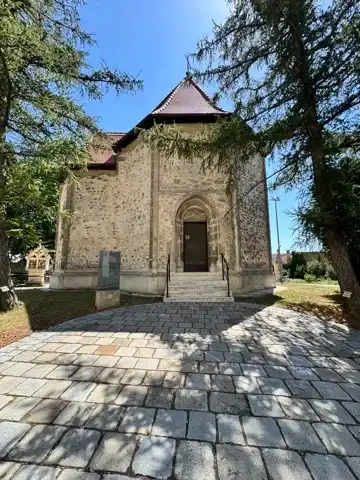
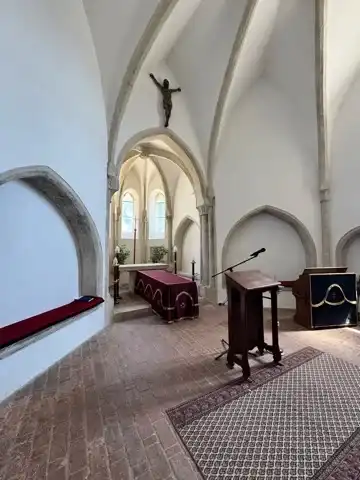
The chapel in the garden beside St. Michael’s Church is Saint James Chapel. Its door was unlocked the whole time I was on the grounds of St. Michael’s church. So I went in. It’s a small, simple and cleanly decorated space. Quite nice, but not particularly special. While I was there, I had no more information about it than I had for Saint James Chapel either.
However, when I got back, I found that the same tourism site that had a page about St. Michael’s Church also had a page about Saint James Chapel. It says the chapel was built in the middle of the 13th century. It was used for—oh, this is creepy—”a bone house (ossuary) because the cemetery around the church could not be expanded, so the bones were thrown from the stairs into the chapel crypt to continue to rest at a consecrated place.”
Archaeological Site
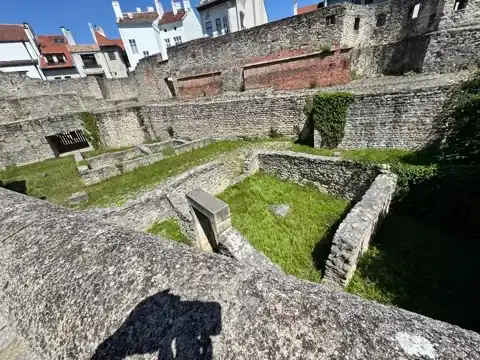
My guidebook recommended visiting two public squares in Sopron. When walking to the first, I unintentionally passed an archaeological site. It was down below the current ground level and protected by some railing. There were some low stone-brick walls that probably were once tall stone-brick walls of a building. Behind those, there are some taller stone-brick walls.
There were some information panels with information about the site provided in three languages, with English being one of them.
But there was no shade, and the temperature was probably around its peak for the day. So I didn’t read much. Consequently, apart from the picture I posted here. This is all you’re going to get about it.
Sorry about that.
Petőfi tér
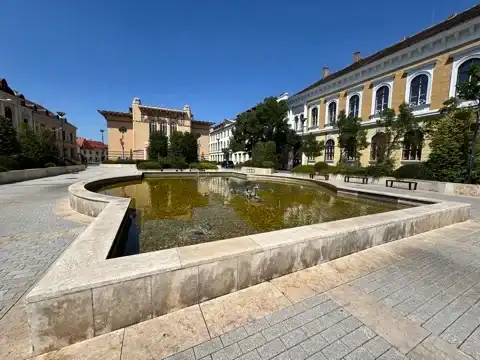
The first public square I went to was Petőfi tér. It’s a nice public space with a few trees around the perimeter and attractive buildings across the streets that surround it. There’s a fountain with a few water jets in it. The jets were off when I was there. There was some water in the odd-shaped pool of the fountain, but that didn’t provide the cooling that a gushing fountain might have.
The trees didn’t provide much shade. So I moved on quickly.
Soproni Szent Júdás Tádé-templom
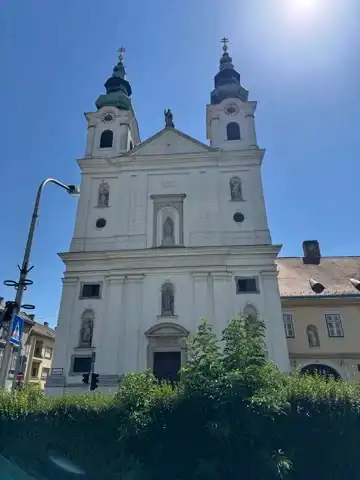
Along the way to the second square, I passed a church that I’d seen a few times before during my time in Sopron. With two bulbous spires at the front, and a little austere-looking, I thought it was interesting. This time, when I walked by, I tried the door. It was open. I went inside.
I didn’t see a sign on the front of the church, but “Soproni Szent Júdás Tádé-templom” is what Google Maps calls it. “St. Jude Thaddeus Church in Sopron” is how Google Translate translates that.
Note: You might have noticed that when I mention using a translator on this trip, it’s always been Google Translate. On other trips, I’ve used Google Translate and Apple Translate interchangeably. This may change at some point, but at the time of writing, Apple Translate couldn’t translate Hungarian. That also means that Safari won’t translate Hungarian webpages, but it will translate webpages in several other languages. Chrome translates Hungarian webpages. I don’t know about Firefox. So, if I provide a URL to a website that’s exclusively in Hungarian (most major tourist attractions have English versions of their pages), then it’s best to open it in Chrome. I hate that because I predominantly use Safari.
I have no information on the church. I found a webpage for Soproni Szent Júdás Tádé-templom, but it’s exclusively in Hungarian and very bare bones. At the time of writing, all it offered was the founding year (1674) and its address, phone number, email, mass and office hours, banking information (?!), and a list of personnel.
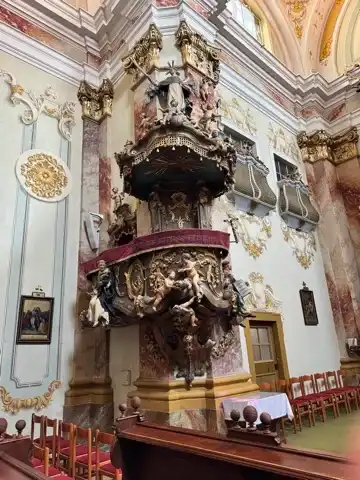
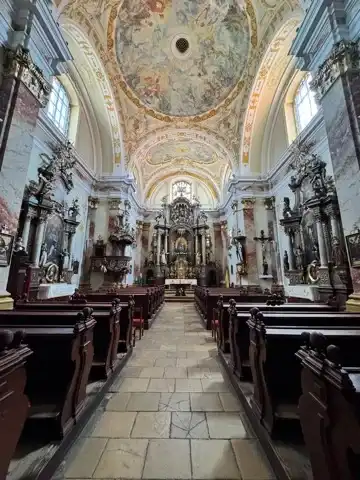
Without any information, I hesitate to try to classify the style because I’m highly likely to get that wrong. Although I have the good fortune to have a regular reader who is quite capable of, and often does, correct me when I get it wrong. But I’m going to go out on a limb and guess that the interior (but definitely not the exterior, which I won’t try to guess at) is Baroque. There are a lot of over-the-top, ornate decorations.
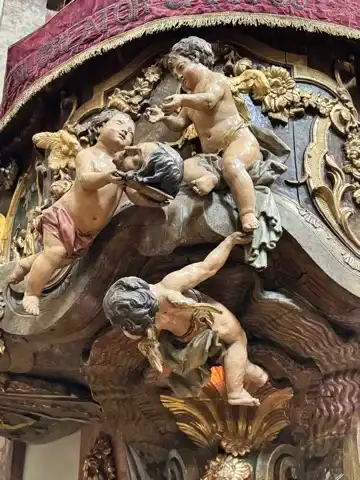
There are many sculptures covering the pulpit. Many of them are cherubs. I focused on a group of three frolicking cherubs, one of whom is holding a severed head of a man. I don’t know enough (I know practically nothing) about Christian stories, so I don’t know where the severed head fits in. I know I’ve seen some severed heads in Christian paintings, but I don’t know what that’s all about. If anyone, you know who you are, wants to chime in here, I’d appreciate it, but that’s probably too much like work.
I posted a zoomed-in image of the three cherubs and the head.
Orsolya tér
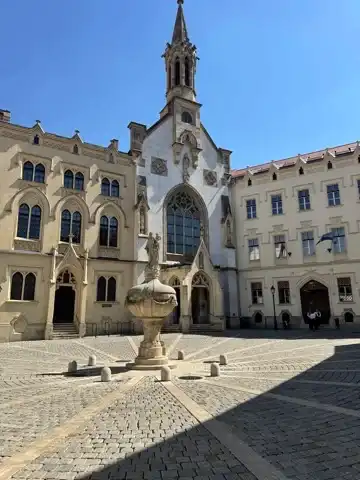
When I reached the second public square, Orsolya tér, I realized I’d come full circle, and it was time to wrap it up. I’d been there at least a couple of times before, but just didn’t know what it was called. It’s a pretty cobblestone square, surrounded by lovely old buildings, including a church. There’s a religious statue at its centre.
The square has no trees. There was shade on two of the outer edges, cast from the surrounding buildings. And I stood under the shade of a portico of a building on one side. There were no benches that I saw, shaded or not, so I ended my time in Sopron there.
I know the above sounds like a busy afternoon, but it was all in a relatively concentrated area. And I didn’t stay long at most of the places. I was back in the air conditioning of my hotel not much after three-thirty in the afternoon.
Sopron Summary
Sopron’s medieval inner town is gorgeous, quaint, and calming. I loved it. Absolutely loved it. The few blocks surrounding it are very attractive, too. The beauty may extend beyond that as well, but I didn’t get there, so I wouldn’t know.
There are a lot of small, specialty museums in Sopron that are interesting and fun. I filled my time as enjoyably as I could under the circumstances. The circumstances weren’t Sopron’s fault. It can’t control the weather.
I can’t complain about the skies. They were a beautiful blue the whole time I was here. But it was way too hot for my comfort.
I just about ran out of things to see and do that I knew about and wanted to see and do. The sightseeing tour I went on the first day I was here went by a forest on the outskirts that looked like it might be a joy to walk through (and, obviously, it was shaded), but I didn’t try to figure out how to get there. If I had more time, maybe I would have. However, the heat made me more lethargic than usual.
Sopron is so beautiful that I would have imagined it would be swarming with tourists. It wasn’t. In some of the museums and churches I went to, I was the only visitor there. None were at all crowded. The streets in the medieval core were almost deserted. I think Sopron just doesn’t target the right type of tourists. When the weather gets this hot, they should try to attract mad dogs and Englishmen, because they are the only ones crazy enough to go out in this heat. Well, and me, but not as much as I would have under cooler circumstances.
(Having said that, there was a stage set up in the Main Square. It was unused every time I went through the square, except for tonight. I had dinner at a restaurant near the square. I didn’t go into it, but I could hear loud music of a variety that didn’t interest me emanating from the square.)
I guess what I want to say is that if it were cooler, I’d probably want to stay in Sopron longer just to soak up its beauty some more. Then again, I’m going to be in Hungary for about another ten days or so. It’s not forecast to get any cooler; in fact, a few degrees hotter until the last couple of days I’ll be here. And even then, it’s not forecast to get pleasantly cool, just not so hot.
Discover more from Joel's Journeys & Jaunts
Subscribe to get the latest posts sent to your email.


You have done your very best (and that is very good) in that literally infernal heat. Lots of interesting stuff to look at. And a lot thrown my way (if I may be so bold) to take my educated, but faulty guesses at. I generally call picture-holder frames, but such substantial, stone frames I would call tabernacles. And I agree with you that those are stations of the cross. Well done. Saint Michael’s church was, indeed, a very handsome church. The basic structure was Gothic, but what looked like round arches and plain columns on the sides of the nave could either be earlier throwbacks, or of later origins. Churches can be hard to date because styles are often hybrid. Ditto with the other church (too lazy to go through the long name). It is Baroque in style, but the vault and some of the wall decoration gives me 18th century vibes. Not unusual, of course, because churches evolve, get destroyed, get redone, commission new stuff over time, copy old styles, and replace old styles with new. Glad to hear that you were skittering out of the heat. Sorry to hear that it is not to break right away. Sounds like a lovely place, Sopron and I am grateful to you for introducing it to me. And to anyone who may discover your blog by looking up the DLSSIA.
Thanks for all of the information. I probably wouldn’t have come up with “tabernacle” no matter how long I thought about it.
It is indeed a lovely place.