Shopping for Sopron

Please do not surmise from the title of this entry, “Shopping for Sopron,” dear reader, that after a lifetime of despising shopping, I’ve suddenly developed a penchant for it. Nothing could be further from the truth.
I invented the title simply as a memory aid (for me) for the pronunciation of the Hungarian city I’m now in, Sopron.
Until I heard it on the train from Budapest to Sopron, I pronounced it roughly like “so prawn.” When a native speaker pronounced it on the train, she said it more like “shop Ron.” (Although the “o” has a harder “o” sound than in the English word “shop,” but still not as hard as in “so.”)
I haven’t heard every Hungarian word and name that I’ve seen written, or even all that many of them, for that matter. However, I believe that every time I’ve seen a Hungarian word or name with an “s” in it that I have also heard pronounced, the “s” has been pronounced like “shh,” not like “ess.” I mentioned that in one of my posts from Budapest. But I now have enough examples and no counterexamples that I’m going to assume, rightly or wrongly, that it’s a universal rule.
Show, I mean, so, why did I come to Sopron? The only guidebook I have with a chapter on Sopron, “Lonely Planet Budapest & Hungary,” says it “is the most beautiful city in western Hungary, with an attractive medieval Inner Town (Belváros) and cobbled streets that make it a pleasure to wander through while soaking up the city’s atmosphere.”
Sounds good to me. I’ll be in Sopron for three nights, so two full days after today.
Sopron’s Main Square

My hotel, which I checked into around 2:00, is just a few blocks from that medieval inner town. So I went exploring there this afternoon. At the centre of the inner town is Sopron’s Main Square. Centuries-old, well-preserved buildings surround it. And it’s gorgeous.
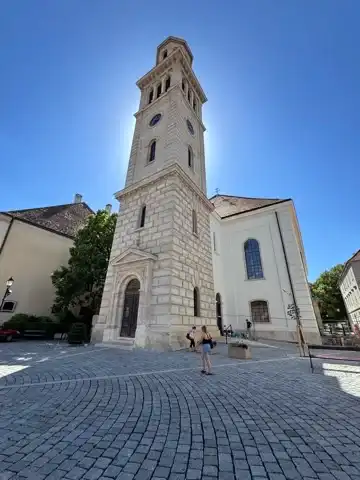
Sopron’s most iconic building is just a bit off the square. The Fire Tower sticks out like a beautiful sore thumb. According to my guidebook, it’s 60 metres tall. According to the Fire Tower’s website, the lower cylindrical portion of the tower dates from the early 14th century, but the Baroque upper parapet and crown were added later after a fire in 1676.
It’s possible to go into the tower, and I assume up to the parapet, for a fee. It’s physically attached to the Sopron Museum. I read that, while you can buy a separate ticket for the Fire Tower, you can also buy a combination ticket for it, the Sopron Museum, and a few other small museums. I plan to visit the Sopron Museum sometime over the next two days, probably tomorrow. So I decided to put off going into, and hopefully up, the tower until then.

(It’s very hot in Sopron now and not forecast to get any cooler while I’m here. I think stairs are the only way up the tower. So, I don’t know, but perhaps they close it if the climb is too strenuous in the heat. Or I might chicken out for that reason. We’ll see, dear.)
One of the buildings around the square is the Goat Church. I believe that’s what it’s called almost universally. I think that’s been the case almost since its founding. The story goes that one of the families instrumental in its founding had a goat in its coat of arms. So it became known as the Goat Church. The English version of its more formal name is the Benedictine Church.
Sopron’s Goat Church was originally a Gothic church, but after a fire in the 17th century, it was renovated in its current Baroque style. However, much of its sombre Gothic vibe remains. The church is small, but I felt it was quite attractive. Then again, I’m easily impressed by the ornate gewgaws of Baroque churches.
Oh, by the way, I took three pictures of the exterior of the Goat Church, two at roughly the same time but from different spots, and the third almost a couple of hours later. I posted the one that I did because it appears to show a divine radiance emanating from its tower.

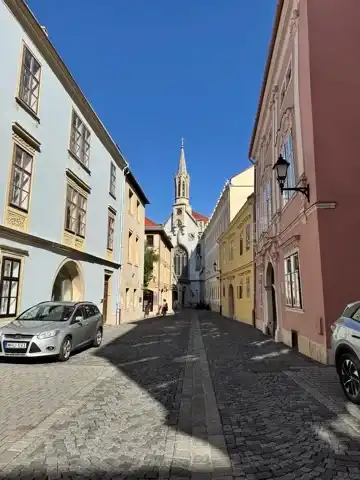
I saw the same coincidental radiance glowing from the tower of another church in the medieval core. I’ll post a picture of that somewhere here, but I don’t yet know what church it is. Who knows? I might never know.
Near the centre of Sopron’s main square is a giant monument known as the Trinity Column. It has a Baroque style and was erected in 1701. Several sculptures climb the column, with the Holy Trinity at the peak.
Sopron Sightseeing Tour
When I entered the Main Square, a sightseeing “train” was parked to the side of it. It makes a one-hour circle tour of Sopron, starting and ending in the Main Square. That sounded like a good way to get an introduction to Sopron. When I arrived in the square, the next run of the “train” wasn’t until 4:00. That gave me some time to see the above and wander around the medieval core a bit. The whole central section is beautiful. I expect I’ll wander around a bit more while I’m here. Or maybe a lot more.

I put “train” in quotes because it’s one of those things with a hokey, faux locomotive pulling three hitched cars. Each car has five rows of bench seats.
The driver is also the ticket seller. I asked him if there was English audio. He, in exceptionally broken English, said, “No English. German. Deutsch.”
I started to walk away, but the driver told me and mimed to me to wait. The first two cars were almost full, but there was only one couple in the last one. The driver walked back there and asked the couple something. It must have been whether they were comfortable with a tour in English. I heard them say what I think was “yes.” The driver walked back to me and said, “Okay, English,” and he pointed to the last car. The prerecorded audio in the first two cars was in German, but it played in English in my car.
The commentary provided lots of interesting information about the buildings we passed and about Sopron’s history. Obviously, I forgot most of it.
However, I am not going to let my memory take all of the blame for the missing details. I couldn’t hear some of it. The train was equipped with reverse shock absorbers. They amplified the amplitude of every little bump the train went over. This caused a lot of banging and clanking noise much of the time.

But I did hear and remember some stuff. I recall almost none of the dates, but I do remember one date range, so let me put it down before I forget. The street pattern of the medieval core of Sopron was laid out in the late 13th century.
The commentary provided lots of other dates, but they’re all lost to me now.
But I do recall some stories. One was told while we were still in Main Square with the Fire Tower in plain view. It was the responsibility of the watchmen in the tower to let citizens know (I don’t know by what means of communication) about fires (not surprising, seeing as though it’s called the Fire Tower), any invaders approaching Sopron, or any foreigners who might be trying to sneak wine into the town.
I was surprised to learn that there was a prohibition back then. I was right to be surprised because that wasn’t it at all.
Later in the tour, when we were way out of the central part of Sopron, we passed a small vineyard. The commentary then talked about wine production in the Sopron area. It also said that back in one of the dates I forgot, Sopron was granted a license to produce and export duty-free wine. They didn’t want anyone sneaking in wine to take advantage of that and compete with the Sopron wines.

The commentary also mentioned that Sopron was almost part of Austria, but chose not to be. Sopron is very close to the border with Austria. The treaties signed after World War I gave Sopron to Austria. But the people of Sopron and the surrounding communities were allowed to vote in a referendum on whether they wanted to remain in Hungary. They voted to stay. Their will was honoured.
The commentary also mentioned other stories of when Sopron fought invaders to remain in Hungary. I forget those anecdotes, but I do recall that it has earned Sopron the sobriquet of being the most loyal city in Hungary.
When I was back in my hotel and looked at the Fire Tower webpage, I saw that it said that the tower has become a symbol of the loyalty demonstrated in the referendum.
The tour drove past my hotel. I learned it’s in Sopron’s Castle District. I don’t think the castle remains, but less than a block from my hotel, there’s a small section of the old city wall that’s still standing and now exposed. It hadn’t been visible for I don’t know how long. Buildings were in front of it.

However, as a result of bombings during *bang, rattle, clank, bang, rattle, clank* (the train hit a series of bumps then), the buildings were destroyed and had to be demolished. That exposed the long-lost old city wall. They left it exposed.
When I walked back to my hotel later, I walked the extra half block and snapped a picture.
At one point, the tour passed what looked like a gorgeous park that didn’t seem too far out of the centre of Sopron. I’ll probably visit it over the next couple of days. It also drove through an area densely forested on both sides of the road, with trails through the forest. That was a little farther out and up a bit of a hill, so I’m not sure if I’ll get there. But it looked idyllic as we drove through it.
That was it for today. It’s early, but from what I’ve seen so far, I think I’m going to enjoy my time in Sopron greatly.
(P.S.: Look at the sky in the pictures on this page. It’s too hot, but the sky? *chef’s kiss*)
More pictures of Sopron's medieval Inner Town:




Discover more from Joel's Journeys & Jaunts
Subscribe to get the latest posts sent to your email.

St. Michael’s Church (Sopron) and More

Sopron Old Synagogue, Lenck Villa, and More

Those numinous radiations! It’s a sign that Joel is meant to go to Sopron, a place that I had never heard of (shame on me). Whether sign is telling us that the powers that be will bless your visit or play a trick on you remains to be seen, but I am hoping for the former. Nothing better than a city with a medieval heart. Can you see divine radiances emanating from a city like, say, Ottawa, Canada? Don’t answer that question. We have a peace tower, and that is saying a lot. The goat church was gorgeous, despite some Baroque overlays (oops! are those my preferences peeking out?). Enjoy your time there. I look forward to hearing more.
Truth is, of all the places in Hungary that I’m visiting on this trip, the only one I’d heard of before starting to plan the trip was Budapest. So, shame on me.
The Peace Tower in Ottawa has nothing to be ashamed of.
Thanks.