Sopron Museum and Fire Tower
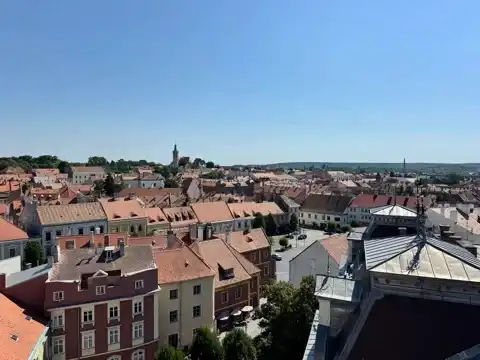
Sopron Museum and the Sopron Fire Tower are located side by side in Sopron’s captivating medieval inner town. The Sopron Museum is in a building, or rather a set of three buildings, beside Sopron’s beautiful Main Square. The Fire Tower is just a few steps back from the square.
I mentioned all of that yesterday in my first post from Sopron, when I wandered around the medieval inner town and took a short sightseeing tour. This morning, I visited both of those attractions.
I bought a combination ticket that got me into both the tower and the Sopron Museum. I’ll have a few more words to say about that ticket when I write about the museum shortly, but I climbed the Fire Tower first, so I’ll provide that narrative first.
Fire Tower
Yesterday, I provided information about the Fire Tower’s construction and its multiple purposes, which I got from my guidebook and the sightseeing tour. I won’t repeat that here. If you need a refresher or you’re new here, please read that post.
I didn’t get any more information about the tower while in it, so all I have to add here is my experience of it.
I opted to visit the tower before the Sopron Museum because today was forecasted to be, and was, another furnace of a day.
There are steps to climb in the tower. And it’s old. I doubted it had been retrofitted with air-conditioning. I wanted to climb the tower before the temperature reached its peak for the day. So I arrived a few minutes before its opening at the crack of ten in the morning.
It was already hot then, but not unbearably so. And even without air conditioning, it was a little cooler inside the tower. I imagine that’s because of the insulating power of the thick stone walls.

I didn’t count them, but according to the ticket seller, there are 119 steps to the observation deck of the Fire Tower, which is only about halfway up it. So, that’s not bad. Plus, there are a few large landings on the way up. Thus, there were rest stops for the weaklings who needed them. Never mind whether that was me. The point is, it wasn’t a difficult climb.
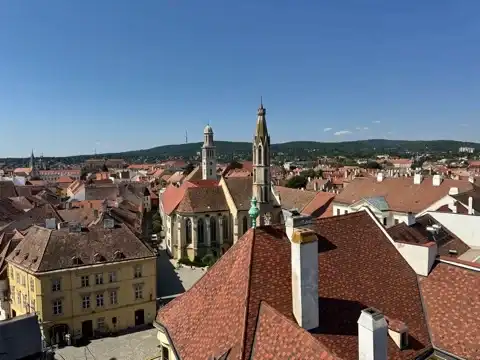
The views of Sopron and beyond from up on the deck around the tower were very picturesque, so I took some pictures.
I can report that Sopron is mostly a low-rise city, even beyond the medieval inner town. The tallest buildings I saw didn’t look like they were more than perhaps 10 or 12 stories. They were on the outskirts, and there were only a few that tall. It’s a very pretty city, both from the ground and from above.
The exit from the bottom of the Fire Tower is through what looks like an excavated room with a collection of archaeological relics. I don’t know about the excavated room part, if that’s real or just made to look like that. But the archaeological relics are genuine. They come from the Roman era in Sopron and include architectural elements and sculpted figures. They call the room the “Time Gate.”
Sopron Museum
I promised to give you more information on the combination ticket. It combines both the Fire Tower, including the Time Gate, and the Sopron Museum. It’s pretty much the definition of a combination ticket that it covers admission to more than one thing, for which you can also buy individual tickets. But it’s not that simple.
The Sopron Museum is in three interconnected buildings. Within those three buildings, there are, I think, seven small museums, each with a different focus. Note: these are not merely separate galleries within a museum. They are each individually ticketed spaces.
You can buy what they call an “à la carte” ticket, which allows you entry into any three of the museums of your choice. Or you can buy an “all in” ticket, which gets you to all of them. You can also buy tickets for individual museums.
There is a QR code on the ticket you get. You scan the code at the glass swing gates in front of each of the mini-museums. If it’s valid for that museum, the swing gate opens for you.
But even that doesn’t fully explain it. “Sopron Museum” is an overarching name for several small museums in Sopron, not all of which are in the main buildings. Some of them are elsewhere beside or near Sopron’s Main Square, close to the three main buildings and the Fire Tower. But some are a little walk away. I don’t think any are more than a twenty-minute walk from the main Sopron Museum buildings.
All of those subsidiary museums, regardless of location, are listed on the Sopron Museum website as if they were no different from any of the others in terms of their relationship to Sopron Museum. However, the museums not in the main buildings are not included in the combination ticket, not even the “all-in” ticket.
Confused? So was I. I spent the morning solely in the Fire Tower and the museums in Sopron Museum’s main buildings. I went to some of the others in the afternoon. I’ll save the description of the latter for my subsequent afternoon post, except to say that I found out those other museums are not included in the “all in” combination ticket when I tried to use it at them.
Most of the sub-museums in Sopron Museum’s main building were quite interesting. And because they were small and offered something completely different in each, I didn’t experience my usual museum-induced eyes glazing over despite spending close to two hours there.
I don’t remember everything, but with some help from prompts provided by the pictures I took and, particularly, by Sopron Museum’s website, I’ll highlight below what I saw in the sub-museums.
Sopron is Eternal (?)

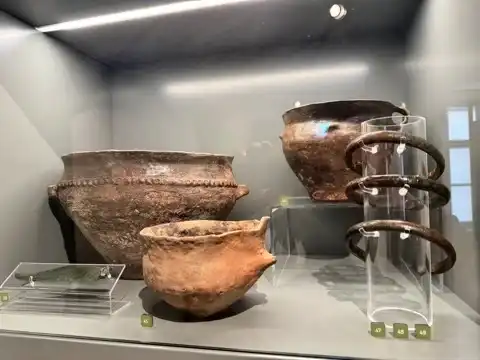
I’m not positive what the first Sopron Museum sub-museum is called. It displayed archaeological finds, including some from as early as the Neolithic period. Those early finds were mostly fragments of pottery. Finds from later periods were complete and included jugs, weapons, jewelry, clothing, and more.
The reason I’m not sure this museum is called “Sopron is Eternal” is that when I surfed to the Sopron Museum website, the description for Sopron Eternal sounded like what I saw, but when I looked at it, the website said Sopron is Eternal was temporarily closed. I think they just haven’t updated the site, because I didn’t crash through any barriers to go in there. It may no longer say it’s closed if you look at it.
Most of the descriptive signage in Sopron is Eternal—assuming that’s what it was—was in both Hungarian and English. However, there was one room where the text was solely in Hungarian. And there was a largely darkened room beyond that, which contained a single cubic display case sitting on a pedestal. Inside the case was a chalice that was lit by four tiny spotlights at each of the four top corners in the case.
There was no signage in that room, only the chalice.
There was, however, a display panel with information about it in the preceding room, the one with only Hungarian text. The information panel followed that rule. I was sufficiently curious such that I used Google Translate to learn what it said. It’s the Cundpald Cup. It dates from the eighth to ninth century. It’s gilded gold. The chalice was found in 1879 during the construction of a sugar factory on the outskirts of Petöháza (a village in Győr-Moson-Sopron county, Hungary). So, now you know.
Matter, mark, layer
Immediately after leaving that, I got temporal whiplash. “Matter, mark, layer” was a couple of small rooms displaying modern art. All of the pieces were abstract paintings. Most of them dated from the 21st century, but I saw a couple from the late 20th century.
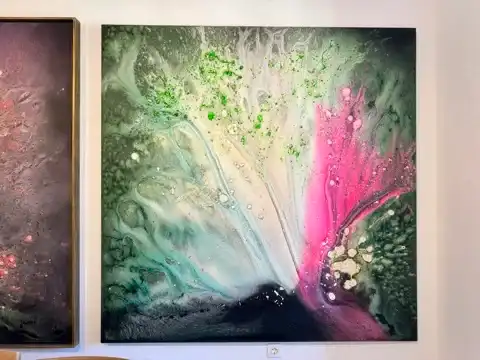
In the “Matter, mark, layer” section of Sopron Museum
Whispering Stones
The next sub-museum of Sopron Museum I went into is called “Whispering Stones.” It’s a Roman lapidary. Yes, the Romans were in Sopron. Whispering Stones is downstairs in a couple of rooms that look as if they were excavated. The walls are made of stone and those old Roman-style narrow red bricks.
The rooms offered Roman statues, some just large fragments, stone crests, and tombstones. It was quite an impressive collection.

Our Home in the City
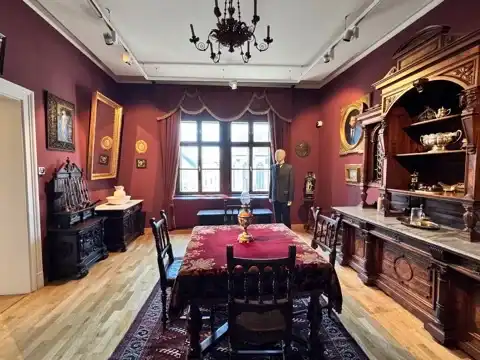
Our Home in the City displays recreations of rooms from homes of three different centuries: 17th, 18th, and 19th. I’m not sure, but I don’t think they were reproductions of rooms that ever existed. I think they were simply representative of typical Sopron homes of the time.
Each room was decorated with period furniture appropriate for the room. Unless most of the people of Sopron were reasonably well-off during those three centuries, I don’t know how typical of Sopron the rooms were.
The furniture and decorations weren’t the most opulent of opulent. But I got the sense that they didn’t belong to poor people.
Storno Collection
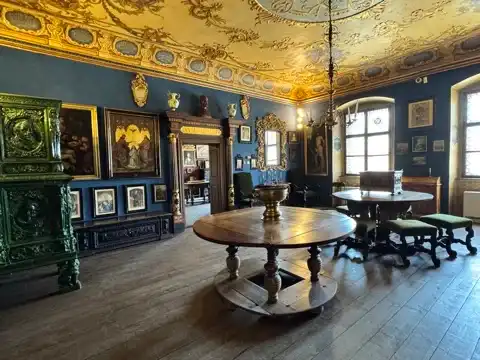
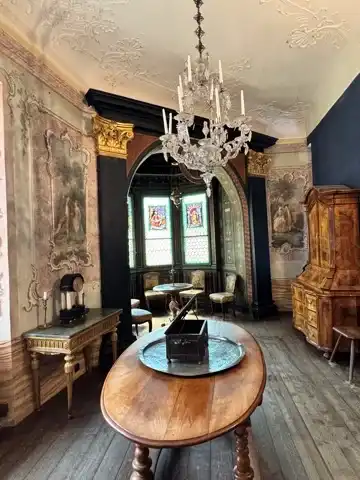
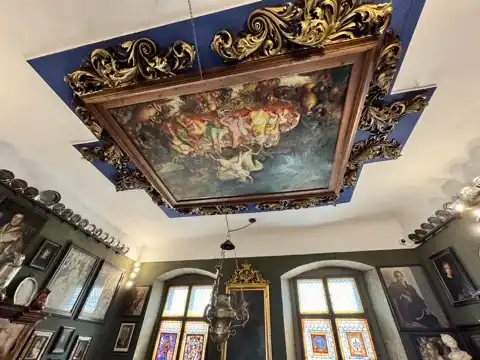
One of the three joined Sopron Museum buildings is the Storno House. I don’t know how many generations of the Storno family lived there, but the Storno collection is in rooms that the family used as an apartment from 1875 to 1975. The collection is that of the family of Ferenc Storno Sr. (1821–1907), an art restorer.
The rooms are lavishly decorated, with rich-looking furniture, frescoes filling some walls, and framed paintings covering others. Some of the ceilings also bear paintings and wood or plaster decorative mouldings. One of the ceilings wasn’t painted directly on the ceiling. It’s a framed, unfinished painting by Ferenc Storno Junior titled “Attila the Hun, the Scourge of God.”
The rooms and collection within it are lavish.
Pictures from the Storno Collection:

Sopron and the Crown
If you read my post about the Hungarian Parliament building in Budapest, you’ll know I saw the heavily protected Holy Crown in the majestic Dome Room. The crown spent some time in Sopron many years back, and a king or two was crowned with it here. The “Sopron and the Crown” museum of the Sopron Museum tells that story and some of the intrigue surrounding the crown.
The Sopron and the Crown exhibit has a replica of the crown, with its tilted cross on top, along with replicas of the orb and sceptre that are also on display in the parliament building. Unlike in the parliament building, where the crown rests on a lush red pillow that sits atop a sword, in Sopron, there is no pillow or sword. The items each sit atop their own transparent cylindrical column inside a glass display case.
You might remember from that earlier post that photography is strictly forbidden in the Dome Room of the parliament building. Well, lucky you. I’ve posted a picture of the replicas here.
Borderless Story

The Borderless Story is the last of the Sopron Museum sub-museums I visited this morning. It presents the history of Sopron and its surrounding county from the Reformation up to 1989. Items on display include paintings, furniture, tableware, weapons, clothing, and more.
There’s a piano in one room. It’s not a huge piano, but it is attractive. There’s a small placard on top of it with a single line in each of three languages: Hungarian, German, and English. The English says, and I quote, “Ferenc Kurzweil taught Ferenc Liszt in this piano.” I wish they had expanded on that information. For example, how the heck did Liszt fit in the piano? How small was he?
And, with that, I went for lunch.
Lunch
I’ve included a section about lunch, not because the meal was particularly spectacular. It was kind of a meh. I had only two requirements when I looked for a restaurant for lunch. First, it had to have a simple, light menu. I wasn’t particularly hungry. And second, I had to be able to eat indoors at a table with good air conditioning rather than an exterior table. It was too hot for that.
No, I included this section not to describe the food, but rather to introduce a couple of anecdotes.
The restaurant had a bilingual menu. It was in Hungarian and German. There wasn’t a word of English on it. The waitress seemed to be at least bilingual. Again, Hungarian and German. She didn’t speak English. I was able to eat only with the help of Google Translate.
That brings up the point I wanted to get to. In Budapest, I never met anybody who didn’t speak English. True, I dealt only with people who were guides, restaurant servers, and hotel staff. But even the housecleaning staff greeted me in English if I passed them in the hall. With English being the language of tourism these days, that’s not surprising.
But here in Sopron, I’ve already run into a few people in those sorts of positions who didn’t speak English. German seems to be the dominant language of tourism here. Sopron is very close to the Austrian border. Vienna is only about an hour or so away from Sopron by car or train. So I guess most of the tourists here are from German-speaking Austria, or possibly from Germany, which isn’t all that far away either.
The other anecdote doesn’t have a moral. It’s just one of those “of course it would happen to me” stories. In the restaurant, it took quite a while for the server to take my order. Maybe she wasn’t eager to have to deal with an English speaker. I don’t know.
When I finished, it took a long time for her to bring me the bill. Actually, she never did.
I performed the normal “can I have the bill, please,” signalling several times, with long waits in between until she looked at least vaguely in my direction. Finally, I rather aggressively flagged her down as she went by and called out to her. Just as I did that and she went to print out my bill, the electricity died in the restaurant. Without power, she couldn’t print my bill, nor take payment with Apple Pay or a credit card.
I waited probably at least five, maybe ten minutes. Then I opened Google Translate, typed in “can I pay with cash,” and walked up and showed her the translation in Hungarian. She nodded, grabbed one of the menus, found the prices for the items I had, totalled my bill on a calculator on her phone, and showed me the amount. I brought Hungarian forints with me on this trip, but have used almost none of them until now, paying with Apple Pay almost everywhere instead. So, I fortunately had well more than enough to pay the tab, leave, and commence my afternoon, which is my segue to end this post.
Discover more from Joel's Journeys & Jaunts
Subscribe to get the latest posts sent to your email.

Jewish Sopron (Sort of) and More

Sopron Old Synagogue, Lenck Villa, and More

Those looked to be very interesting sub-museums. So varied to be a new taste in each one. May I be pedantic for a moment? (I can’t hear you.) “Gold gilding” is a tautology. If it is gilded, it is with gold. So you can say so something is covered with gold or gilded, not both. I passed it by once before, but I just couldn’t help myself this time because it is a pet peeve of mine. Most people would not come across it often, but in my line of work I did. Sorry. Also, the statues in the Whispering Stones museum that you showed in the picture were not all ancient Roman. It looks to me that there were statues of the Madonna and Child and Saints that were late medieval, Renaissance, and Baroque or late Renaissance. Sorry. I don’t speak Hungarian but I do speak a little art history. Very strange about your waitress avoiding you. Perhaps a Canadian flag logo would have helped (just sayin’)? Or maybe it was the English language itself that was the problem, as you suggest. Or not. Who knows? Perhaps there is a new committee forming there – a DLJDNTSHA (Don’t Let Joel Do Normal Tourist Stuff Hungarian Association), and she was an early recruit. May it not flourish.
I’m sorry I triggered your gilded peeve.
As for the statues, I’ll take your word for it. It is your life’s pursuit, after all.
I hadn’t considered the possibility of the waitress mistaking me for someone from the bad country. As you say, a Canadian logo might help with that. Or I could pin my passport to the outside of my clothing. Anyone can wear a Canadian logo might.
The chalice from the palace may be gilded like the lily. Heh heh.
The poet has arrived on the scene. Welcome!