Sopron Old Synagogue, Lenck Villa, and More

This afternoon in Sopron, I visited Sopron’s Old Synagogue. The Old Synagogue falls under the umbrella of the Sopron Museum, the main buildings of which I visited this morning. After that, I visited some other museums that are also considered part of the Sopron Museum. I ended up taking a lumbering (it’s really hot) stroll, and some shaded sitting in a park that I don’t think has anything to do with the Sopron Museum.
It’s getting late now, and I never put off for tomorrow journal entries I can publish today. If I did, I’d be guaranteed to forget everything. Instead, by writing the posts the same day as I experience what’s described in them, I merely forget almost everything rather than everything. The point is, due to the late hour, I’m going to try to plow through this post. Consequently, my writing here will probably be even more careless than usual. You’ve been warned.
Old Synagogue

Sopron’s Old Synagogue was built at the end of the 12th century and the beginning of the 13th century. It is on a street that was called Jewish Street because 1,300 Jewish families lived in the neighbourhood. It’s a few blocks away from Sopron’s Main Square.
The Old Synagogue consists of two small rooms. One contains the ark with a torah scroll and a large menorah. In the middle of the room, there’s what looks like a fancy wooden cage. I’ve never seen anything quite like it. I don’t know if it was the bimah. I’ll post pictures of both the front of the sanctuary and the bimah(?). I couldn’t get a good photo that included both of them.
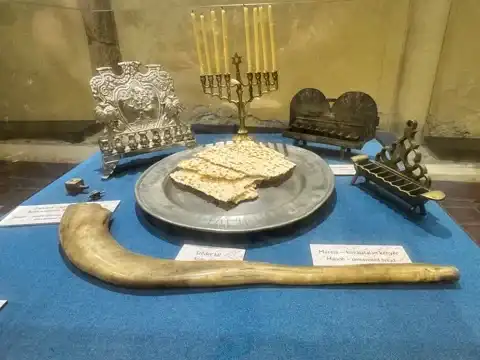
The other room is an assembly hall. It currently contains display cases with Jewish religious and ritual items, including a tallis and teffilin, a sedar plate, and a shofar, among other artifacts.
Along the walls in one or both of the rooms, I forget which, some panels provide information about Jewish holidays and practices.
In a small courtyard beside the Old Synagogue, there’s a mikvah (ritual bath). It’s deep in the ground, with a ladder to get to the bath.

Pharmacy House

After I left the Old Synagogue, I walked back to the Main Square to visit the Pharmacy Museum. It also falls under the Sopron Museum umbrella. Going there was a mistake.
From the door, I could see two small rooms with various containers and paraphernalia that you’d see in an old-timey pharmacy. There was one attendant behind a desk in the room directly behind the door. I asked her if there was more to the museum than those two rooms. She didn’t speak any English and had no idea what I was saying.
I pointed to a closed door in the second room and asked if there was more of the museum there. She nodded yes. She still didn’t have any idea what I was saying. I paid the small admission price. When I went toward the closed door, she shook her head to indicate I wasn’t to go back there. I glanced around the two rooms. There wasn’t much there. And I left.
There is also a mining museum near the Main Square and part of the Sopron Museum collection of sub-museums. I went there. The signage out front was all in Hungarian and German. I went inside. The attendants there spoke little English, but one of them handed me a laminated sheet that, in English, explained what was inside. There are exhibits on mining, including interactive displays that appeal primarily to children. I decided not to buy a ticket, and I left.
Lenck Villa
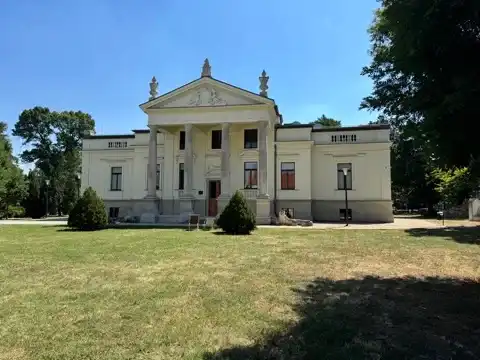
Next, I walked to the Lenck Villa. It was about 15 minutes away on foot. If it gets much hotter, I may have to go places on my knees, as I’ll be crawling.
Lenck Villa is a charming villa set in lovely grounds. It’s now an ethnographic museum, but with a bit of a twist.
When I went in, none of the three attendants spoke much English, but when I said I wanted to buy a ticket, one of them handed me a tabloid-size booklet done up like an old newspaper. It was for the English speakers who came to the museum. It was exclusively in English and was just for me to use while I was in the museum. None of the signage in the museum had any English.
The Villa was originally owned, not surprisingly, by the Lenck family, a German-speaking Lutheran family that settled in Sopron from Saxony at the end of the 17th century. The “newspaper” provided a few paragraphs about the Lenck family.
However, the villa museum devised a premise to carry the ethnographic narrative forward. They created a fictional family, the Hofmanns. In the museum’s story, the family was getting ready for a wedding. The various displays in the museum revolved around that.
They invented a cast of characters, including not just the family, but their servants. Throughout the museum, illustrations of those characters were drawn on the walls with speech bubbles. The newspaper provided English translations for each of the speech bubbles in each of the rooms.
The newspaper also provided descriptions for all of the items on display.
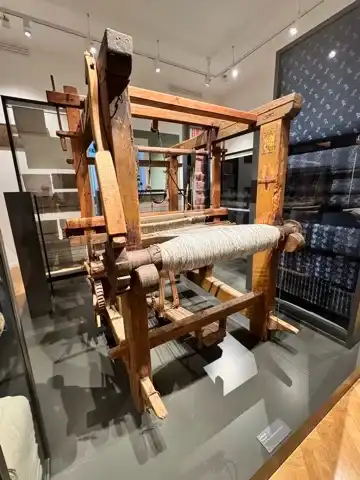
The rooms in the museum included a dining room, displays of clothing, rooms where various trades were performed, including sewing, hat-making, cooperage, pottery, weaving, and more.
I found it surprisingly interesting for an ethnographic museum. Then again, I’m not a huge fan of ethnographic museums. But I wasn’t disappointed that I went to this one.
Some of the exhibits in Lenck Villa:


Erzsébet-kert

I mentioned yesterday that I went on a sightseeing tour that went past a park that looked pleasant and wasn’t too far away from the centre of Sopron. I said I might go there while I was in Sopron.
I visited it this afternoon, but it wasn’t easy to find. As I said yesterday, the pre-recorded commentary in the car of the tourist “train” I was on was in English. When it went by the park, the recording called it “Elizabeth Garden.” I performed searches using both Google Maps and Apple Maps for “Elizabeth Garden” and came up empty. They’re usually not bad at finding something by its English name, even when the real name is in another language. But they failed this time.
So I started looking at parks close to central Sopron. I saw nothing that looked like it might translate to Elizabeth Garden. Then again, because I don’t speak any Hungarian, the words would have to be close to the English words for me to recognize them.
I found a park that looked like it might be roughly in the right place. The name on the map was “Erzsébet-kert.” I tried plugging that into Google Translate. It came back with “Elizabeth Garden.” Bingo!
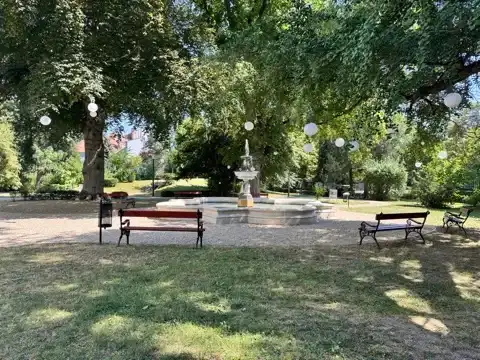
Erzsébet-kert is a pleasant park with lots of grass and trees, a flower bed and at least one big statue. There might be more to it, but it was too hot to walk around much. I spent some time sitting in the shade and then walked back to my air-conditioned hotel room. And yet another day is in now the journal.


Discover more from Joel's Journeys & Jaunts
Subscribe to get the latest posts sent to your email.


That little shul was very evocative. It looked like a vertiginous drop to the mikvah. I hope the original approach to the bath was more accessible. I couldn’t imagine going down a ladder like that in a birthday suit. Forget I said that. I wouldn’t want anyone out there imagining it either. Congratulations on finding the park. I hope the weather breaks soon so you can enjoy outdoor pursuits like park strolling. Nice to have the air conditioned hotel to go back to.
The shul was on the same level as the top of the mikvah pit. So, unless they raised the shul up somehow, I don’t see how the approach could have been any more accessible. But, who knows? There are a lot of things that I don’t see that are real nonetheless. Or maybe they thought it was important to make it difficult to purify oneself.
The weather is forecast to remain hot for the rest of the time I’m here. Grrr.
Do stay safe and hydrated as you endure the heatwave that stifles Europe.
I’ve been staying more hydrated than I think I ever have in my life, with, to give way too much information, less output than I would have expected, so I guess a lot of it is perspiring away. It’s a few degrees cooler here than what I’ve read the temperature is in Paris, but not by all that much. It’s supposed to get a little warmer in the days to come, but, so far, the forecast is for the temperature to top out at 37°C, three degrees lower than the 40° that I read Paris had. We’ll always have Paris, unless it melts away. (I hope it doesn’t. I haven’t been there for several years and I’d like to get back.)
Then again, that forecast is for Sopron. I leave tomorrow. I don’t know if the weather is different in the other cities in Hungary I’m going to. (Having typed that, I decided I should look at the next city I’m going to. I’ll only be there for two nights. The daytime high there is forecast to be 38°C tomorrow. The same the next day. Then 39° the day I leave that city.)