Jewish Sopron (Sort of) and More
This was going to be a bit of a Jewish Sopron morning.
The guidebook I’m using has a long paragraph on Jewish Sopron. It claims that there was a Jewish settlement in what is now Sopron during Roman times, predating even the arrival of the Magyars (Hungarians).
It listed four sites representative of Jewish Sopron. Three of them are synagogues, but none of them act as such now. To be honest, I have no idea if there is any Jewish community in Sopron today. The latter part of the Holocaust decimated the community, not to mention expulsions in centuries gone by.
I visited one of the sites, the Old Synagogue, yesterday. You can read about it in my post about everything I did yesterday afternoon.
Other Jewish Sopron Sites
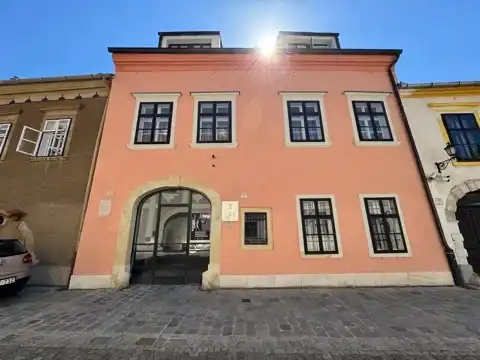
This morning, I set out to visit the other three Jewish sites in Sopron mentioned in my guidebook. Yes, indeed, that’s what I intended to do. I was less than entirely successful.
New Synagogue
The first site I set out to see is Sopron’s New Synagogue. It’s close to the Old Synagogue. I would have gone yesterday. However, I sheepishly admit that I just forgot.
“New” deserves to be in quotes. Like the Old Synagogue, it too is a medieval shul. The difference is that the Old Synagogue was built at the end of the 12th century and the beginning of the 13th.
The New Synagogue, on the other hand, was built in the 14th century. As I said, it doesn’t function as a shul today. My guidebook says that it now houses an exhibition called “The Forgotten Sopronians” about the 40 families of Sopron who were deported to Auschwitz.
When I arrived at the New Synagogue, fifteen minutes after the scheduled opening, the door was locked. It’s a glass door. An ad for The Forgotten Sopronians exhibition was taped to the inside of the door, facing out.
The ad provided the opening times. It claimed the exhibition is open every day except Monday. Today is Saturday. I was there within the listed opening times.
Yesterday evening, when I looked for somewhere to start my day today, I realized that I had forgotten about the New Synagogue and did a web search to check on its opening times. I swear to Hashem that I found a page for the New Synagogue on the Sopron Museum’s website. It provided the same opening hours as were posted on the door.
When I discovered the New Synagogue was closed, I hunted for that page again. I scoured the Sopron Museum’s website to no avail.
A web search for it couldn’t find it either. However, the search did return a page for the New Synagogue on something called the Sopron Card. I clicked on the link. That took me to a “404 – Page Not Found” page on the Sopron Card website.
There’s a tourist information office not far from the New Synagogue. I went there and asked if the New Synagogue is open. “No, it’s closed. Just the Old Synagogue is open.” “Is it just closed temporarily?” “No, permanently.” “How long ago did it close?” “About three months ago.”
What the what? It’s been closed for about three months, and nobody took down the exhibition ad and replaced it with a “Permanently Closed” sign? How difficult would that have been?
I think Hashem might be in cahoots with the DLJSSIA.
(Funny aside: I’ve now typed it often enough that autocomplete offers up DLJSSIA as soon as I type “DLJ.” For the benefit of anyone new here, that’s the Don’t Let Joel See Stuff International Association. If you don’t believe me that it’s a thing, Google it. If it asks if you meant DELISSIA, click on the link to search for DLJSSIA instead. Trust me. It’s real.)
Full disclosure: After my failure at the New Synagogue, I ducked briefly into a nearby old church with an open door. I feel like I’ve let my heritage down by that. Rather than breaking up my Jewish Sopron narrative, I’ll write about the church after that, rather than in the chronological order in which I saw it.
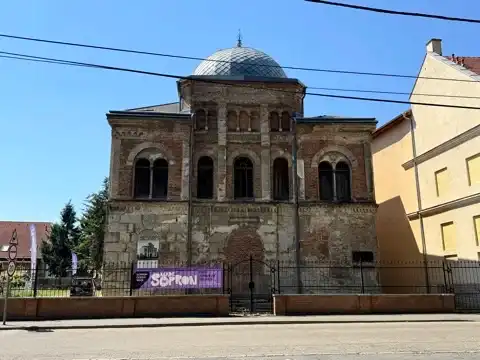
Orthodox (Neológ) Synagogue
Continuing my Jewish Sopron tour, the Orthodox Synagogue is outside of the medieval core of Sopron, but it’s only about a 10-minute walk from the New Synagogue.
I wasn’t expecting to be able to enter the Orthodox Synagogue because my guidebook said it was crumbling and boarded over. But I felt I should go to complete my Jewish Sopron tour. The guidebook was right about not being able to go inside, but it wasn’t boarded over. There were what looked like cheap transparent plastic panels over the windows, but that was about it.
The Orthodox Synagogue does look a little dilapidated, but it’s easy to imagine it as a very handsome, fair-sized shul in its better days. It has arched windows and a green dome. I don’t know what the condition is inside, but if they could restore it, the Orthodox Synagogue would probably make a good Jewish museum, or maybe a secular venue of some sort, that would be a valuable asset for Sopron.
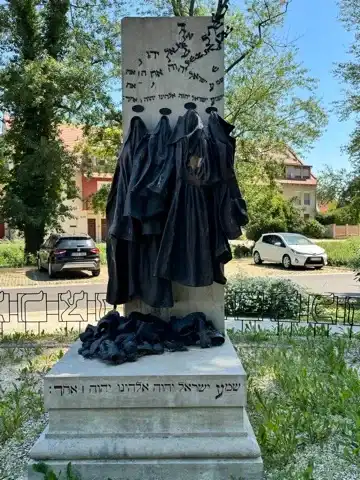
Holocaust Memorial
Across the street from the Orthodox Church, there’s a small parking lot. To the side of the parking lot, there’s a Holocaust Memorial. Seriously, it’s basically in the parking lot with a little bit of scruffy grass surrounding it. The metal monument has four long coats hanging from hooks on a vertical stone slab. One of the coats has a prominent yellow star.
On a low stone pedestal beneath the coats sits a jumble of metal shoes. It’s a moving enough memorial, kudos. But here’s what bothered me. The parking lot takes up probably one-quarter to one-third of a block. The other three-quarters to two-thirds is a park with some very tall, mature shade trees. I think it would have been more respectful to place the memorial in the park, rather than the parking lot.
Sorry. Rant over.
That concluded my tour of Jewish Sopron.
Saint George Dome Church
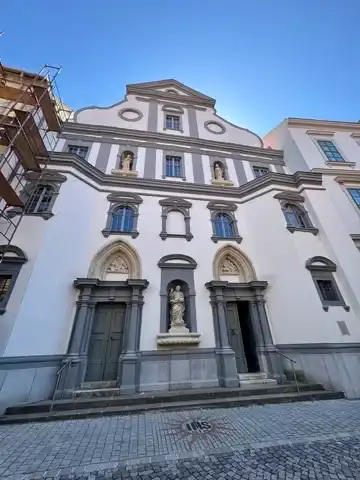
The church I visited after my failure at the New Synagogue was Saint George Dome Church. It’s definitely not part of Jewish Sopron.
I’d walked by it before, but I the door was open when I passed it today, so I decided to go in. Neither my guidebook, nor the Sopron article that my walking tour app provides mentions, Saint George Dome Church. I had seen it on TripAdvisor, where 19 people had reviewed it, giving an average rating of 4.1 out of 5.
The TripAdvisor listing provided little information about the church. However, after returning to my hotel, before writing this entry, I did a web search. I found a tourism website with a page on the Saint George Dome Church. (The website leaves “Dome” out of the name, but Apple Maps and TripAdvisor include “Dome.”)
I don’t know how much to trust the tourism website, but, for what it’s worth, it claims the church was built in the 1390s on a plot of land donated as penance by one of the perpetrators of a murder. It was used, at different times, by the Lutherans and the Jesuits.
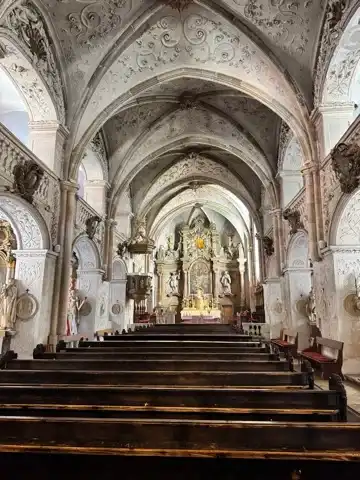
I’m a little confused because the page claims the church burned down in 1676 in a fire that was said to be so hot as to melt the church bells. But then it goes on to discuss subsequent renovations, including the redesign of the interior in Baroque style. So, did it burn down, or was there enough left such that it could be renovated rather than rebuilt? The page mentions nothing about rebuilding.
Continuing with the material on that page, the church had an onion-domed tower that collapsed in 1867 and had to be rebuilt. (Maybe that’s why the tourism website removed “Dome” from the name.) The tower is not at all visible from the front of the church, only from the rear. I took a picture only from the front. Thus, you won’t see the tower. But the tourism website has a picture of it. You can see it there. I’ve seen the tower in real life. I didn’t see a hint of a dome on it, onion or otherwise, so I guess that when it was rebuilt, they didn’t include a dome.
I said I ducked into the church, but that’s all I did. Just inside the door, there’s a tall, gated wrought iron fence stretching across the width of the entrance. The gate was locked. But the gaps between the bars are more than wide enough for me to get a good look from the back and take a picture through the bars without obscuring the shot. It looks like a nice church, more Gothic than Baroque to my untrained eyes, and certainly not overwrought as some Baroque churches can be (if you’ll pardon the pun in the context of the wrought iron fence, or even if you won’t excuse it)
Scarbantia Fóruma
I don’t remember how I came across Scarbantia Fóruma as a place to visit. It’s not mentioned in any of my usual travel information sources. Somehow, I noticed it on Google Maps with a 4.5 rating. Scarbantia is the name of the Roman city located in what’s now Sopron, Hungary.
It’s in the tourist office. You’re probably wondering why I didn’t go when I was in the tourist office earlier this morning. There are a few reasons for that. For one, I remembered that the reviews had said there wasn’t much there. So, I figured I’d do my Jewish Sopron tour first and come back if I had time. But, more importantly, I didn’t know it was there at the time. I’d forgotten that a couple of the Google Maps reviewers had mentioned it was in the tourist office.
What’s more, the signage for Scarbantia Fóruma is discreet, and it’s not immediately obvious that it’s in the office. However, there was a clue I should have noticed.
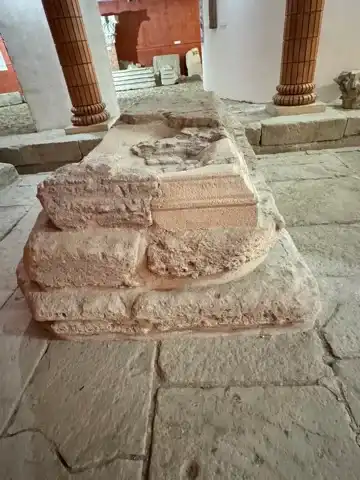
Scarbantia Fóruma is in the basement of the tourist office. To get there, you have to go through an unmarked door and walk down some stairs. The clue that should have tipped me off that it was there is that there’s a circular hole in the floor of the tourist office. A Roman column pokes up into the ground floor through the hole. A subtle clue, I know, but I should have noticed it.
I only found Scarbantia Fóruma by asking someone in the tourist office if it was there.
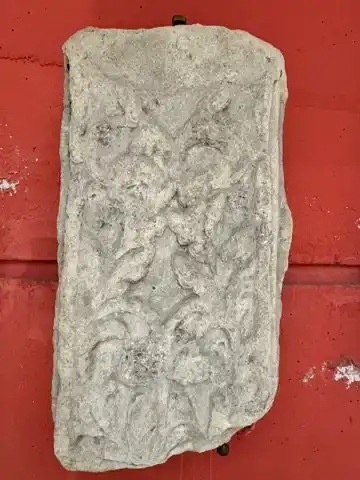
The Google reviewers were right. There’s not a lot there. There are some portions of capitals and columns, some large pedestals that used to support some large statues, a relief representing a deer from the Capitoline temple that’s so weathered that I only knew it was a deer thanks to the placard posted by it, a section of a stone wall, a section of a stone street, a portion of an engraved tablet, and probably some other stuff that I’ve forgotten.
Some of the pieces were discovered during the excavation of foundations for the new town hall in 1894.
Scarbantia Fóruma was interesting, but to repeat, there’s not much there.
It was then time to grab lunch in an air-conditioned restaurant beside the Main Square. The restaurant had canopied tables outside. Some people ate there. I was surprised not to see them melted into puddles by the time I left. It was hot today.
Discover more from Joel's Journeys & Jaunts
Subscribe to get the latest posts sent to your email.

Sopron Old Synagogue, Lenck Villa, and More

St. Michael’s Church (Sopron) and More

Well, I’ll be blown over. I looked it up. The powers that are taking over the human world do know what the DLJSSIA is, and will cheerfully tell you about it! It just goes to show that you can document any darn fool thing someone puts on the internet. It’s a good thing that I am a fan of this particular someone and his darn fool inventions.
Too bad about the state of the two synagogues you went to visit, and the scruffy presentation of the otherwise admirable Holocaust monument. The orthodox shul does look like it was an impressive building. I hope one day they find the resources to restore it, before it falls into further disrepair. On the other hand, the Saint George church, although relatively unsung, and strangely obfuscated in the literature, such as it is, looks an attractive piece of architecture. About the heat – I finally actually looked at how very hot your particular hot spot is, and like another of your readers, I urge caution. Keep the water and air conditioned breaks up, and no punishing walks, please. Oy, it’s hot!
I keep telling you that DLJSSIA is real. Now you have to believe me. It’s on the internet, so it must be true.
Sopron has a long Jewish heritage; it’s a shame they don’t give it more attention than they do.
I’m glad you like the church.
About the heat, I’m hydrating like crazy and trying to get as much air conditioning as I can, while not shutting myself into my hotel. I’m surviving. So far.
Communities like Sopron need a roving correspondent, such as you, to prompt them to update tourist information. DLJSSIA chapters wreak havoc, leave visitors crestfallen and confused, and fuel persecution complexes.
Thank you. It’s a tough job, but someone’s got to do it.