Andong Hahoe Folk Village
There are major differences between the Andong Hahoe Folk Village, which I visited today and the Andong Folk Village, which I visited yesterday on my arrival in Andong.
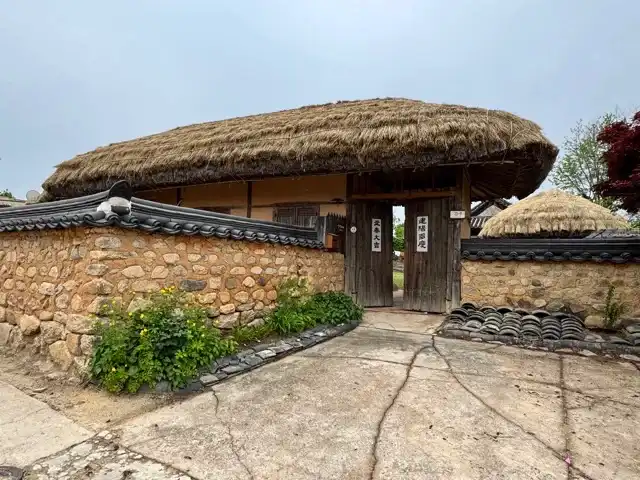
For one thing, the Hahoe Folk Village is a real village. People live there. Andong Folk Village isn’t, and people don’t.
For another, Andong Folk Village is in the city limits. It’s outside of the centre, but definitely within the city. I walked there yesterday. I don’t know if Hahoe Folk Village is technically in the municipality of Andong.
My mapping app told me that getting there from my hotel would take six hours and 31 minutes by foot, 54 minutes by bus, or 36 minutes by car (taxi in my case). I opted for the bus.
The bus is an Andong city bus, which is evidence that the Hahoe Village is part of the city. But it travels on a divided highway for much of the way, past considerable green space, with just a few buildings, mostly industrial. This is evidence that it’s not part of the city.
Wikipedia tells me it is part of Andong. So, if you trust Wikipedia, there you go.
(Aside: Not much before the Hahoe Folk Village, there is a bus stop for the Catholic Farmers Hall. I’ve always wondered where they grew Catholics.)
My guidebook says that more than 200 people currently live in Hahoe Folk Village. Seventy percent of them are claimed to be descendants of the first family who lived there more than 600 years ago. I hope there was also some outside DNA mixed into that descent, but let’s not go there.
Hahoe Folk Village is located at a bend in the Nakdong River. That bend gave the village its name. My guidebook tells me that Hahoe means River Returning.
Even before I went, I knew that the Andong Hahoe Folk Village would be spectacular. UNESCO designated it as a World Heritage Site in 2010. UNESCO strictly limits such designations to no more than 42 bazillion, plus or minus 42. So I was confident that I couldn’t go wrong with a visit to Hahoe Folk Village.
Ambling Around Hahoe Folk Village
A sign just inside Hahoe Folk Village disagreed with my guidebook. It said that, rather than “River Returning,” Hahoe “literally means ‘embraced by the river’s flow.’” I find the village’s definition warmer and more welcoming. It wouldn’t surprise me if a marketer wrote it.
Wait. Who are you calling a cynic?
The bus stop is not right in Hahoe Folk Village. It’s at a cluster of restaurants, a museum, and a ticket office for the shuttle bus that goes to the village.
I thought the shuttle bus was mandatory. I bought a ticket and got on one that was already boarding. I later gained firsthand evidence that it probably isn’t mandatory.
The bus takes only a few minutes to reach the real entrance to the Hahoe Folk Village.
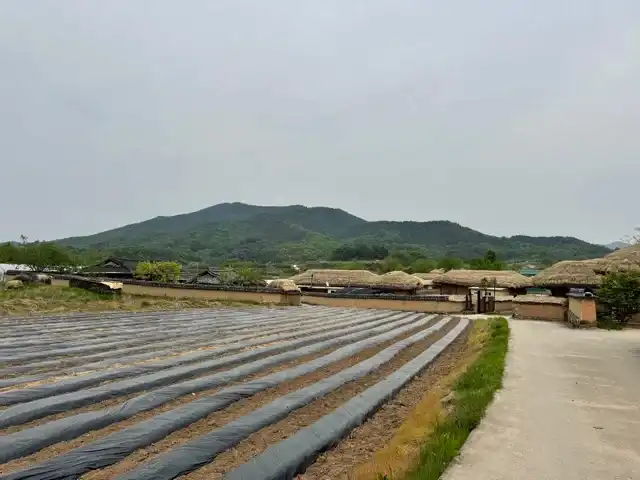
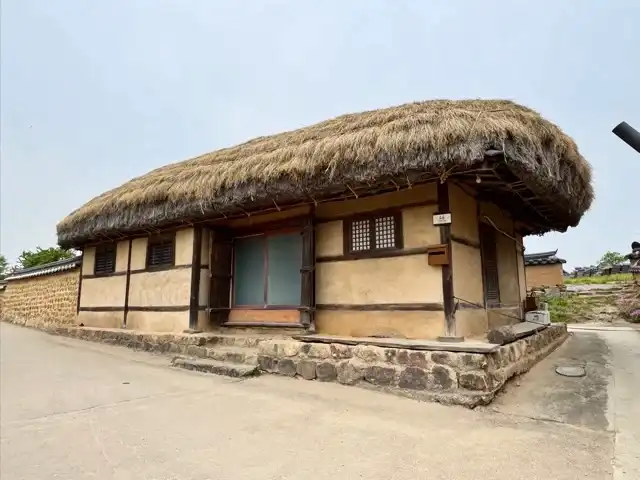
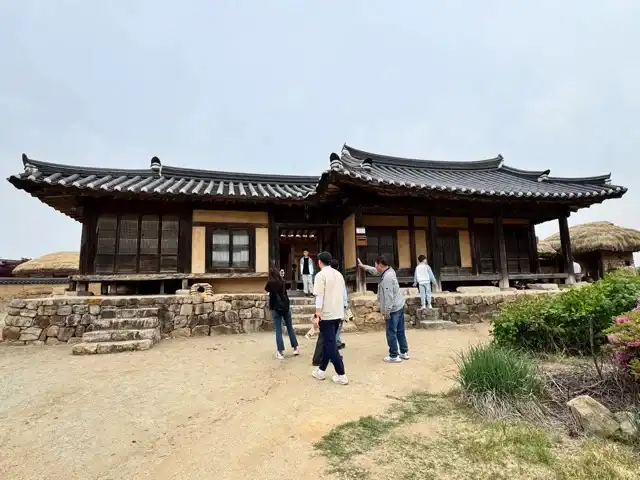
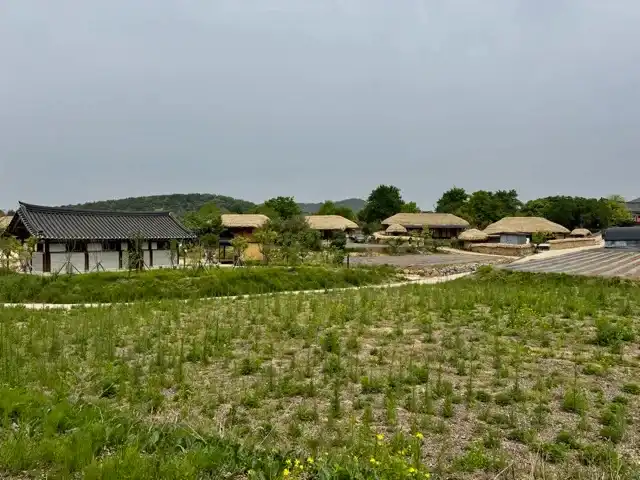
The village contains a large collection of charming one-storey buildings. Many of them have roofs tiled with lines of semi-cylinders mounted on top of the edges of wider, much flatter curved tiles. But many of the buildings, I think the majority, have thick, dense thatched roofs.
A few of the homes are unoccupied and open for tourists to wander through, but the very large majority aren’t. Needless to say, tourists aren’t supposed to wander through the occupied homes. The people of Hahoe Folk Village graciously allow their village to be a tourist attraction. But I don’t think any of them would be thrilled about people barging into homes uninvited and helping themselves to food in the kitchens.
I spotted very few commercial buildings in Hahoe Folk Village. I saw one that sold coffees, teas, and cold drinks. Another sold some cooked snacks. A third sold some cookies, along with I forget what.
There was also an informal market, which looked very temporary, that sold mostly crafts. But there was a table set up where they were cooking some sort of food.
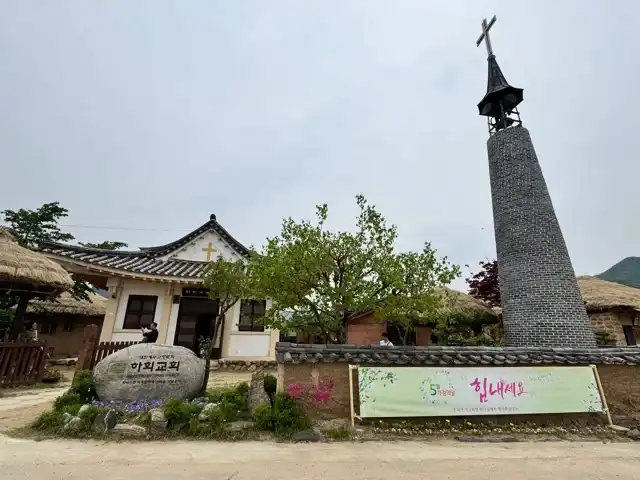
The village has a small Presbyterian church. I have no idea where the Presbyterians are farmed.
In addition to the acutely endearing homes and the church, there are some small farm plots in the village. One looked like an orchard of some sort, but I’m not sure what. Some fields were carefully hoed and, I assume, planted, with black tarps topping the raised rows. A sign near one of them said it was a cotton field.
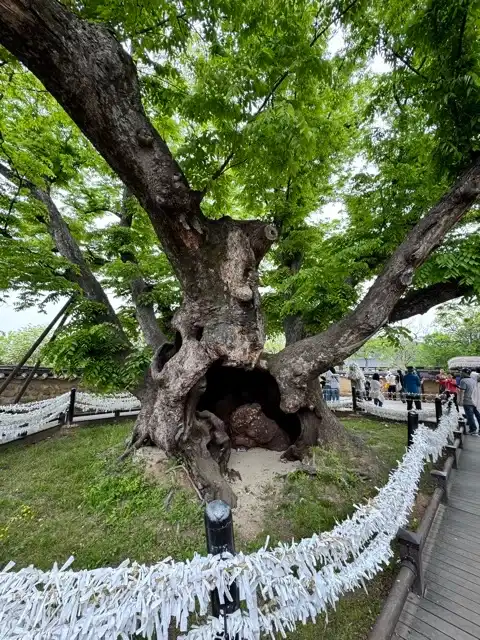
Somewhere in the middle of the village, there’s a hollow tree. I think it might be sacred. There’s a low fence comprised of poles with horizontal wires strung through them around the tree. Tied to the wires were hundreds, or maybe thousands, of white paper ribbons with stuff handwritten on them. Off to the side in the area where the tree was, there was a table with blank white ribbons and writing implements. People were writing whatever on the ribbons and tying them to the wires.
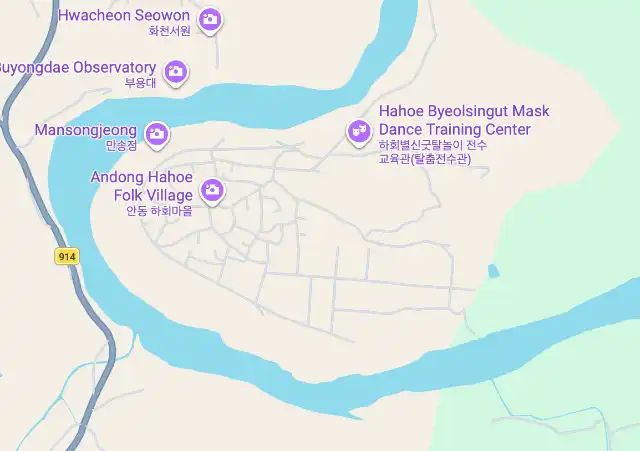
The Nakdong River really does embrace the Hahoe Folk Village. You can see that if you walk around the perimeter. The river hugs the village on three sides. You can also see it from the Google Maps screenshot I posted here.
To be honest, I seriously doubt that the river embraced the village. I’d be willing to bet that the river already outstretched its arms when people moved in, set up the village, and insinuated it into the river’s embrace. Not that I’m criticizing them for that. The river was clearly looking for love. The new townspeople gave the river what it wanted. Although, I hope they first sought its consent just to be sure that appearances matched reality.
When I first saw the Nakdong River from Hahoe Folk Village, it was from a wide promenade, with a dense tree canopy over it. It was beautiful. But the promenade was raised above the level of both the river on one side and the town on the other.
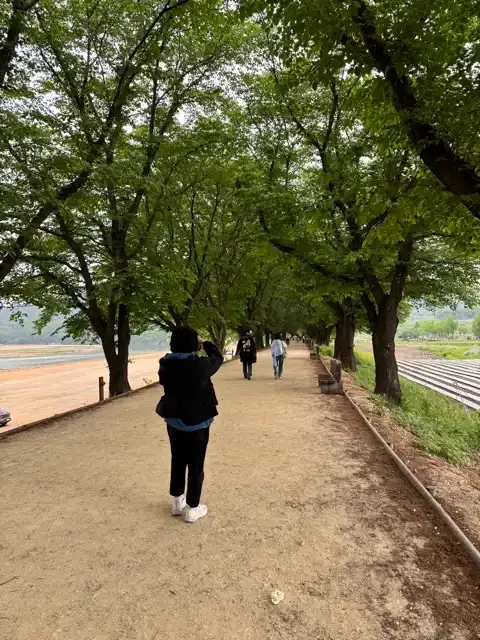
Between the river and the promenade, for most of the length of the promenade, there’s a large parking lot. I don’t know who gets to use the lot. There were only a few cars parked there, with the main tourist parking lot being back toward the main entrance.
The slopes down both sides of the promenade looked steeper than I’d be willing to scamper down. And they bore the appearance of a slope that one was not permitted to walk down. So I couldn’t, at that point, walk down to and across the parking lot to get closer to the river if I wanted to.
There was a minor construction site at one end of the parking lot when I was there. My guidebook told me there was a ferry across the river, but “at the time of writing [writing of the guidebook, not this journal entry], the ferry crossing the river was suspended.” I’d picked up a map at the information office at the entrance. If I read the map correctly, the ferry that was still marked on the map was about where the construction site was.
I’m notoriously bad at reading paper maps, so the ferry could have been in the next province over, but I think they were probably rebuilding a dock, and the ferry was, at the time of writing of this post, still suspended.
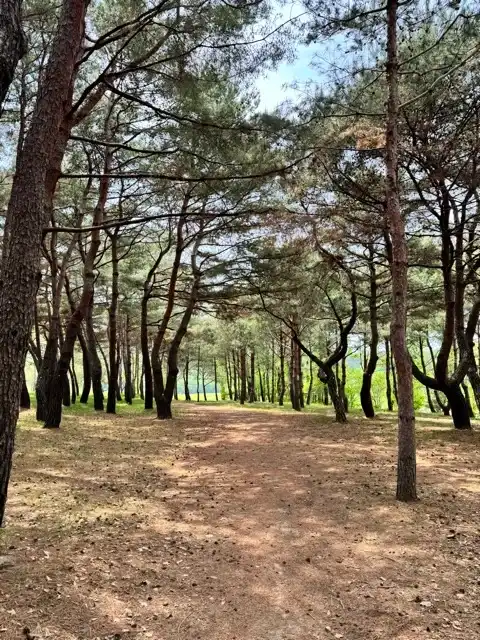
I walked through and around the Hahoe Village with a high degree of randomness. That was my first encounter with the river. I didn’t get to the rest of the perimeter roads until later. But I did walk the full circumference, some parts more than once. That was the only section where there was a parking lot between the road and the river. But, for the most part, I still wasn’t able to get closer to the river.
One section of the perimeter path goes by a pine forest. I’d read about that in my guidebook and was looking specifically for it. However, from the direction I approached it, there was a low barrier blocking entry to the small forest from the path, and there didn’t appear to be any paths, trodden or otherwise, in the forest. I thought, “This is crazy. Why can’t I walk in the forest?”
I walked farther along the path beside the forest and came to an opening in the barrier. And there were trodden paths from there to farther along in the forest. I added to the trodding.
I should mention here that “forest” probably gives the wrong impression. I’m a terrible judge of these things, but it likely wasn’t all that much wider than a football field, if that. Although it was probably as long as a few of them. Despite not being huge, it was quite pretty and peaceful.
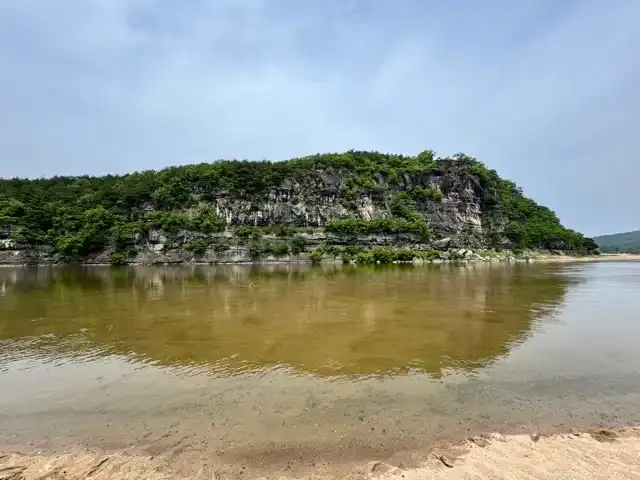
As I walked almost to the end of the pine forest, to the river side of it, there was access to a beach by the river. Despite my dread of sand in my shoes, I walked to the river and communed with it for a while.
After that, I rejoined the perimeter road already in progress, which took me to the promenade I mentioned above. That took me back to the entrance to/exit from the village proper.
I was going to take the shuttle bus back to the main entrance. However, when I got there, the line waiting for it was horrendous. I looked at my mapping app. It said it would take about 15 minutes to walk to the main entrance. I walked, which was along a sidewalk beside the road the full way. At the end, there was nobody barring entry to the sidewalk or requiring tickets to walk along it. I mentioned above that I had firsthand evidence that the shuttle probably wasn’t mandatory. That was my evidence.
I arrived back at the main entrance after noon, so this is the end of my morning post.
Discover more from Joel's Journeys & Jaunts
Subscribe to get the latest posts sent to your email.


That was a charming place. And with dogged determination, you made it to the river. Well done. Nice just doing one activity, including a good wander, in the morning. And it looks like the weather held for you. Happy adventuring this afternoon.
The weather this morning, and all day, was spectacular. And the village was a great way to spend it.