Jebiwon Buddha and Somewhat More
Still in Andong, South Korea, the top attraction I saw this afternoon was the Jebiwon Buddha. It was an amazing sight. I then took in a couple of minor attractions that, well, I could have done without. And one I should have done without, except for a beautiful part of the walk over to it.
I leave Andong tomorrow on a train that is scheduled to depart Andong station at the crack of a minute past noon. Despite not leaving early, I don’t plan to do anything worth reporting on before I go. Hence, this is my last post from here and also the repository of a summary of my time in Andong.
Jebiwon Buddha

This morning’s rain had tapered to barely a drizzle when I set out to see the Jebiwon Buddha, about 20 minutes away from my hotel by a city bus.
If you’re searching for information about the Buddha, you will find it most commonly by the name Jebiwon Buddha. However, a page from what looks like the official Korean Tourism Organization’s website titles it verbosely as “Rock-carved Standing Buddha in Icheon-dong, Andong.” However, in the body of the text, it says, “Maaekseobulsang (Rock-carved Standing Buddha) in Icheon-dong, Andong is also referred to as Jebiwon Statue due to the small temple of the same name nearby.”
I’ve also seen it referred to as the Icheon-dong Buddha. Your guess as to its official name, if it has one, is as good as mine, maybe much better. Lacking a name known by me, I’m tempted to call it Shlomo, but that might be considered disrespectful by some, so I won’t.
The Buddha statue and the small temple next door are up a slight hill, with stairs to it.
The temple is small and, to my eyes, not special. But when I was there, a small choir was singing inside, with the temple doors open. I think they were rehearsing.
It wasn’t a monk’s Buddhist chant. Except for the lyrics, it sounded like it could almost be familiar to my Western ears. The tune was very melodic, and the voices were delightful. It provided a pleasant background to my visit to the Jebiwon Buddha, but I think I just lucked into it.

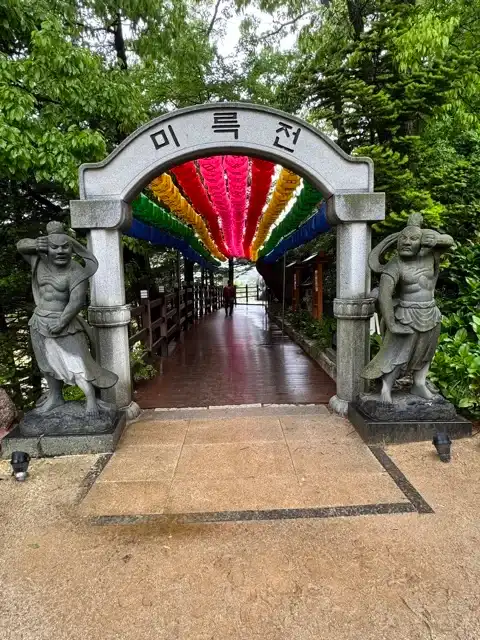
Past the temple, the Jebiwon Buddha is just a very short walkway away. That walkway is protected by two guardian statues, one on either side.
When I was there, the walkway and the area in front of the temple were canopied with colourful lanterns. I don’t know if that is normal. I learned on this trip that Buddha’s birthday is later this month. Google tells me it’s May 24th this year. (As I write this, it’s May 3, 2026.) The lanterns might be for that.
I feel bad now that I know it’s Buddha’s birthday because I didn’t get him anything.
The Jebiwon Buddha isn’t like any Buddha statue I’ve seen before. The torso is a towering, in situ rock with the outline of the body carved into it. The Buddha head, more finely carved and definitely head-shaped, rather than just the outline etched in, is a separate, much smaller rock that sits on top of the torso.

The walkway took me to a small patio-like area at the base of the huge torso rock. At the back of the patio, there’s another huge rock, although not nearly as large as the torso rock. Therein lies a problem with viewing the Jebiwon Buddha from there. You can’t get far enough back to get a good view of the huge Buddha. I had to crane my neck to be able to see the head atop it. And even then, it was somewhat obscured by the torso from that angle.
Disappointed, I walked back down the steps. At the base of the hill, and off to the side, there’s a pretty park with flowers, grass and trees. I decided to take a walk through it before catching my bus back.

I tried to snatch a glimpse of the Jebiwon Buddha from down there, but the view was blocked by flowers, rocks, and trees.
I walked a little farther and, eureka! There was a clearing that provided an unobstructed, full view of the Jebiwon Buddha, casting his compassionate countenance down upon me. It was an amazing and beautiful sight.
And then, sight seen, it was time to move on.

Andong-Soju & Traditional Food Museum

This was a mistake. Both of my guidebooks recommended this. I need different guidebooks.
Both of the guidebooks shorten the name to just “Andong Suju Museum.” But my mapping app, an English translation on the sign on the door, and its website give it its full name, “Andong-Soju & Traditional Food Museum.”
The contents of the museum are what my guidebooks describe, so I’m confident it’s the same place my they present.
It’s on the other side of the river from the main part of Andong, in a mostly industrial area. One of my guidebooks said that, because it’s a little out of the way, it’s best to take a taxi there. I should have listened to it.
I had my mapping app give me a bus route from the Jebiwon Buddha to the museum. It required transferring between two buses at one point, but it didn’t look bad. It wasn’t until I got to the transfer point that I saw that I’d have more than an hour’s wait for the other bus.

I asked my mapping app for a walking route from there. It gave me one that would take about 45 minutes.
I set off.
Some of the walk was through an area that looked a little sketchy, but I had no problems.
One part of the walk was beautiful. As I said, the museum is on the other side of the Nakdong River. Despite being downstream from the Andong dam, the river is quite wide there. The route the app gave me took me over a long pedestrian bridge, with beautiful views of the river and its shores.
Then the walk got ugly again, only moreso. It was mostly beside a busy four-lane road with fast traffic. And it was in an industrial area. The museum is on the grounds of the Andong Soju Brewery. One of its neighbours isn’t an industrial building, but rather a very large police station.

To make the walk worse, there was construction happening on the road. It wasn’t ongoing today, Sunday, but there were no sidewalks. I think that’s because of the roadwork. Instead of a sidewalk, they’d laid down a burlap runner over unflattened earth. And even that wasn’t universal. There were a couple of spots where I had to walk onto the busy street for a few steps.
But I finally got to the museum. I was disappointed.
Because I’d never heard of soju before this trip, I should mention what it is in case I wasn’t the only person who didn’t know. Soju is a Korean rice wine. I had a sample of it on the Seoul Food Tour I was on during my first full day of this trip.

It didn’t taste at all like any of the sakes (Japanese rice wine) I’ve ever had, not that I’ve had many. The soju I had was a little sweeter than most sakes I’ve tasted and more flavourful, but it still packed a punch. One of my guidebooks said that the Andong soju tastes very different from the most popular soju brand in Korea, which is probably what I had.
My guidebooks said the museum has displays about soju and soju making and traditional foods, along with offering free samples and the opportunity to buy bottles of the company’s own soju.
The museum is small. Much of it is taken up with displays of traditional foods (plastic models) and traditional food plates and containers, as well as feast foods for wedding ceremonies. There were a couple of tableaus depicting eating and drinking situations. There was also a large display of what was labelled in English as cups over the years. But some looked more like serving vessels than cups. It might have been an English translation problem. I don’t know.
Speaking of English translations. There was some English in the museum, but a minority of the Korean was translated into English. And some displays had no English at all.

One display that did have full English translations was a description of the steps involved in making soju. By that sign, there was a display of several pots and other items that I assume were used in traditional suju brewing, but I’m not sure.
One thing that I didn’t see on offer when I was there was the free samples my guidebooks promised me. I wasn’t going to buy a full bottle, so I can’t tell you what Andong soju tastes like.
After my ordeal getting to the museum, I used Uber to summon a taxi to take me to my next destination.
Imcheonggak House

Unlike the Andong-Soju & Traditional Food Museum, visiting Imcheonggak House wasn’t particularly a mistake, but I could have missed it, and my life wouldn’t be much worse for it. It’s not far from the seven-storey pagoda I saw on my first day here. I passed it, but it was about to close, and I was tired, so I didn’t go in then.
A sign in front of Imcheonggak House says it “was built in 1519 by Yi Myeong, a civil official of the Joseon period (1392-1910). It is also the birthplace of Yi Sang (1858-1932), the first prime minister of the Provisional Korean Government during the Japanese colonial period (1910-1945). this h one of the oldest extant upper-class residences in Korea.”

The sign went on to say that it was originally much bigger, with six buildings, but in 1942, during the Japanese occupation, Japanese authorities built a railway through what was the front of the house.
The sign wasn’t clear on whether the remaining buildings were left standing with the construction of the railway or if what is there now (three or four buildings, if I remember correctly) are recreations. To my eyes, they look too clean and fresh to be the originals. But perhaps they’ve just had very good cleaning, maintenance and restoration. I don’t know.
The house is pretty and historical. It has a bit of a view of the nearby river. But I wasn’t overly enthusiastic about it. Not bad, but not wonderful.

Parade
There has been some sort of festival in Andong this weekend. I know nothing about it, but I’ve occasionally stumbled on or, more frequently, heard portions of some of the events.
After I finished my afternoon activities and was back in my hotel room, I was finishing up the journal entry on my morning, when I heard some drum beating and other cacophony. It sounded to be getting progressively closer. I put my shoes back on and went downstairs. Just as I got to the front of my hotel, the front-end of a marching parade was almost at my hotel and coming my way. I took a video of the leading half or so of it.
The drumming and clanging are repetitive, shallow, and lack a certain je ne sais qoui, but it has a beat, and you can dance to it, as some of the marchers were doing. So, there was that.

Andong Summary
I probably didn’t wander around Andong enough to make a fair assessment, but from what I did see, as a city, I found it meh. Most of the buildings are not old enough to have charm, not new enough to have a fresh, clean look, and not intriguing enough to dazzle. There’s nothing wrong with the city. It’s just kind of bland for me.
Having said that, Andong offers sights that make it worth a visit. There was the Jebiwon Buddha that I saw today. It was amazing. And I’d rate everything I saw yesterday—Hahoe Folk Village, Hahoe World Mask Museum, Byeongsan Seowon—somewhere between great and fabulous. From my first day, I’d rate the Folk Museum as worth seeing, but not enough to make it worth coming to Andong just for it.
However, the whole package is more than worth a visit to Andong.
As to the time allotted for Andong, I had two and a half days here (three nights). I could have done without today’s activities and wouldn’t have missed all that much, except, of course, for the Jebiwon Buddha. There are some out-of-the-way sights that my guidebooks made sound interesting, but not interesting enough that I thought it would be worth the effort to get there. But I might have if I had booked more time here.
There are also some day trips possible to places in the broader general vicinity, but I didn’t investigate how difficult it would be to get to them.
So, bottom line, if I were to do it again, if I could lop a half a day off the time I had here, that would be great. If eliminating a half day is not a possibility, cutting a full day would probably still make for a good visit to Andong.
Discover more from Joel's Journeys & Jaunts
Subscribe to get the latest posts sent to your email.


Nice of them to hold a parade for you on your last day in Andang. Not everyone would do that. The Jebiwon Buddha and its gardens were beautiful, really spectacular. Sorry the rest wasn’t as impressive, but still worth a gander. Maybe not worth the walk you took to the Soju museum, especially without the promised fortifying samples at the end of it. Perhaps that is why the town threw together a parade for you instead. Fortify yourself with a good dinner and rest tonight and good luck on your further adventures tomorrow.
And why wouldn’t throw a parade for me. I come all this way. It’s the hospitable thing to do.
The Jebiwon Buddha is an amazing sight. I’m glad I got to see it.