Gone to Gangneung

After more than three weeks in South Korea, I find myself in Gangneung. Thank goodness. I was wondering where I’d gotten to. I’m glad I found myself.
This Korean trip is rapidly drawing to a close. I’m booked here for two nights. So, I have just one full day, plus the bit of today I had after arriving, for sightseeing in Gangneung.
After Gangneung, I headed back to Seoul for one night before catching my flight back to my home and native land, Toronto, Canada. But until then, I still have a bit of Gangneung to see.
Gangneung is a coastal city. As best as I can tell, it’s known primarily for two things: beaches and coffee. I read that Gangneung has a reputation as the coffee capital of Korea. I wonder where the coffee legislature building is.
I like good coffee. Coffee in Korea is reasonably common. Good coffee, not so much, at least not in my experience here. However, I’m not going to go to a city just for coffee.
And I’m not especially a beach person. I enjoy gazing out to sea, particularly at a rocky shore. I also enjoy grazing at the sea from a seaside restaurant, should the opportunity present itself. But idling at a sandy beach? Less so. That’s why I booked only two nights here. I’ll see soon if I find that’s too little or too much time.
In Gangneung
By the time I was checked into my hotel and ready to go out and explore Gangneung, it was close to four in the afternoon, which is not far off closing time for many gated attractions. What’s more, on trips of much more than three weeks, I often reach a point where I’m tired and say to myself, “I don’t want to see any more guidebook-recommended sights. Assez! Basta! 충분한! Enough!”

(French and Italian were the only non-English languages in which I knew the word for “enough” off the top of my head. Blame me if I got one or both of them wrong. Blame Google Translate if I got the Korean wrong.)
Gangneung, as I said, is a city beside the ocean. Strolling by the sea can be relaxing. But I might have made a lousy choice of hotels. It’s structurally nice enough. It’s nothing fancy, but it’s clean, fresh-looking, with a decent-sized room.
The problem is the location. I chose one in the city, not too far from the train station. At least one that didn’t look too far from the station when I looked at a map before booking. And it didn’t look too far from the ocean either. Looks can be deceiving. I should have consulted a mapping app to provide me with walking times. (I didn’t yet have a Korean mapping app when I booked, and neither Google Maps nor Apple Maps work properly in Korea.)
After arriving in Gangneun, when I was looking for something to do, I considered walking to a beach. The Korean mapping app told me it would take almost an hour and a half to walk to what looked like the closest beach to my hotel.

(Aside: Despite choosing a hotel that I thought was reasonably close to the train station, when I got here and looked for a walking route, I saw that my hotel is still a 40-minute walk from the station. I took a taxi. If I were going to take a taxi from the station anyway, I probably should have just booked a beach hotel. Ironically, when I looked today, I saw that the train station is closer to the ocean than my hotel is. I think I misread the map when I booked my hotel.)
Instead of going to the ocean, I looked at the map, found the biggest green blob I could see on it that was less than an hour’s walk away. I headed there. It was about 40 minutes away.
The big green blob I chose had a blue blob in the middle of it. Bonus!
My mapping app didn’t name the green blob, but it gave three names for the blue blob in it: “Wichon Reservoir,” “Wichon Jeoryuji Reservoir,” and “Gyeongpo Ecological Reservoir.”
(Aside: The Korean mapping app I’m using offers an English interface, which I’m obviously using. It labels most places on the map in English. When I look at Google Maps, it lets me search in English. And it labels most of the streets in English, but many of the place names are in Korean.)

The route to the reservoir, whose real name shall remain unknown to me, first took me through city streets. The one that I walked along the farthest was a four-lane street. That might not have been pleasant, but the border between the street and the sidewalk on both sides of the street was a pleasant row of trees.
The city thoughtfully put gaps in the tree rows at intersections because cars smashing into trees in the middle of an intersection would probably drive up car insurance rates.
After I got off that street, the app sent me along a one-lane road for the equivalent of several blocks. There was no traffic on the road for the entire time I walked it.
A stream ran beside one side of the road. All that was adjacent to the road on the other side were small farmers’ fields. I don’t know where the large farmers have their fields.

Wait.
*cups his hand around the earpiece in his right ear*
I’m being told that they are small fields used to grow things by farmers of any size, not necessarily small people who are farmers. Never mind.
There were also other small farm plots within my sight from the road. All of the plots were way, way, way too big to be residential allotment gardens, but far too small to be a threat to big farmers. I don’t know whether big is measured by height or girth, but … Wait.
*cups his hand around the earpiece in his right ear*
I’m being told to forget the damned size of the farmers, you moron. That’s irrelevant.

Never mind.
When I got close to the green blob surrounding the blue blob, I spotted a bilingual directional sign for pedestrians that said that a sight that I recognized as being one my guidebook recommended was only 500 metres away, not a long walk at all. And it was still more than an hour until it closed. But, Assez! Basta! 충분한! Enough! I’ll probably have enough time to see it tomorrow. Buses and Uber are a thing here. I might use them a few times tomorrow.
Then I got to the green blob surrounding the blue blob. There is a path around the reservoir, but the path is a piece back from it. I entered at a corner of the park and walked clockwise around the reservoir.
Where I entered the park, and for most of the path around the reservoir, there is a fair piece of scrubland, and what looked like marshland in some spots, between the path and the reservoir. On one side of the reservoir, close to the path, there was a ditch barring the way to the reservoir. And the scrub/marshland didn’t look like something you’d want to penetrate anyway.

The walk around the reservoir runs between a row of trees on either side of it for most of its way. It makes for a relaxing walk.
The lake and surrounding greenery were beautiful. There weren’t many benches, but I took advantage of one to spend a little time enjoying the view. After I walked most of the path around the reservoir, I came to the other corner of the end of the park where I entered.
That end is the only place where you can get close to the reservoir. There, a concession advertises “traditional boat experiences” for a fee. The dock for the boat is at that end of the lake.
I saw the boat out on the lake on my walk. I don’t get it. The reservoir is rather small. If it weren’t a reservoir, and I was giving a test, I’d accept either “it’s a lake” or “it’s a pond” as correct answers. Really small lake, big pond, whatever. The point is, the boat cruise around the reservoir didn’t look worth doing.

The boat looked like it was constructed of wood and was quite plain. It had a mast, but no sail. It was motor-powered.
Also at the dock, there was a small fleet of novelty boats designed to look like large teacups. There was also a small fleet of other novelty watercraft, but I couldn’t make out if they had a theme. No one was using those boats. And the traditional boat had ended its run by the time I finished my walk.
At that end of the reservoir, people can tromp on the grass. And there are a few benches. I used one for a while.
(By the way, back at my hotel, I read that the reservoir provides water for those nearby farms. Last September, there was a severe drought, the reservoir had lowered considerably, and Gangneung instituted water rationing. But the reservoir level has since risen again.)
Because I was closer to the other corner of that side of the reservoir than the one I entered through, my mapping app sent me back to my Gangneung hotel via a slightly different route for the first part.

Not far on the other side of the road from the park, I walked by a small, traditional Korean pavilion with beautifully decorated panels just below the roofline. A bilingual sign gave its name as the “Memorial Monument of the Filial Children of the Yeonghae Yi Clan.”
The sign explained that the monument, “called Hyojagak (“Pavilion of Filial Children”), was built in 1431 to commemorate the filial piety of four brothers of the Yeonghae Yi clan, namely Yi Seong-mu, Yi Seon-mu, Yi Chun-mu and Yi Yang-mu. The monument was later dedicated to the two sons of Yi Yang-mu, Yi Dang and Yi Min, too, after their filial piety was officially acknowledged by the Joseon government in 1706.
“The filial piety of the four brothers, including Yi Seong-mu, and their influence upon later generations produced a multitude of filial children and faithful wives, earning Gangneung the nickname “the town of propriety” (yehyang). Of the four filial sons, Yi Seong-mu was enshrined in Hyanghyeonsa Shrine, Gangneung, in 1759, and he has since been worshipped at annual memorial ceremonies.”
So, I’m allegedly in a town of propriety. We’ll see about that.
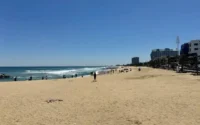
Tomorrow, my only full day in Gangneung, I will get to see the sea. I promise. And maybe I’ll have some coffee and see one or two other things. Darn. That sounds like a busy day. I’d better get to sleep.
Discover more from Joel's Journeys & Jaunts
Subscribe to get the latest posts sent to your email.

So Joel’s heading off to see the sea tomorrow! You can see if there are any shes selling seashells by the seashore. Lovely little walk you had around that blob today. The city looked nice in the distance. Lake/pond/reservoir in front and mountains rising up in the distance. All that filial piety going on, though, makes me feel like shaking things up there. I imagine a soul or two has thought about doing just that at some point. Let’s see if there is any excitement going on in that town tomorrow, shall we? Yippee!
We’ll see. I’ve always wondered, if she sells seashells by the sea-shore can she see herself making a living that way? And will it leave her with enough time for activities like riding a see-saw by the seashore?
I suspect there are one or two souls in Gangneung who are less than filial. Or perhaps some who are usually filial, but then reach a point where they’ve had their fill of filial piety and rebel.
Gangneung is in a beautiful setting. I probably should have mentioned that. It’s a good thing it was visible in the pictures.