Ojukheon and More

My guidebooks don’t offer a lot of sightseeing suggestions in Gangneung, but one that gets a comparatively lengthy (“comparatively” = not particularly lengthy) presentation in one of my guidebooks is Ojukheon. That’s where I started my morning.
After Ojukheon, I visited a coffee museum and walked alongside a couple of beaches. It was a less busy morning than it sounds.
I walked from my hotel to Ojukheon. It took a little over half an hour. I don’t know if this is the rule in Gangneung or if I just coincidentally managed to walk along the only two streets where this is the case. But yesterday and today, I strolled on sidewalks for several blocks beside four-lane, otherwise boring streets. But rows of trees in the sidewalks beside the road greatly enhanced the streetscape.
It’s not a big deal, but it made the streets much more pleasant than they otherwise would have been. Points for that, Gangneung. Points for that.
Ojukheon

Ojukheon is the birthplace of Sin Saimdang (1504-51), who, according to my guidebook, is revered as “the paragon of Korean womanhood.”
Sin Saimdang’s face is on the 50,000 won note. Again according to my guidebook, that’s controversial with some women’s groups because, despite being an accomplished poet and painter, she was a stay-at-home mom who dedicated herself to the care and teaching of her children.
Her third son was Yi I, whose pen name was Yulgok, a noted scholar, writer, philosopher, and government official of his day.
On the grounds of Ojukheon is one of the oldest surviving homes from the Joseon Dynasty (1392–1910). But that’s not the only building on the estate. The complex includes a main quarters, a royal calligraphy pavilion, a detached quarters, and a shrine.

According to a sign on the site, “The royal calligraphy pavilion was built to house a preface handwritten in 1788 by King Jeongjo (r. 1776-1800) to one of Yi I’s books (The Secret of Expelling Ignorance, 1577), as well as other items that belonged to Yi I, while the shrine was built in 1975 to house Yi’s portrait.”
What the sign didn’t mention, and has not gotten nearly enough attention, is that there was an American project to translate into English, and, with a gentle hand, edit “The Secret of Expelling Ignorance” to be more comprehensible for current audiences. However, the project was recently scrapped, and all copies of the work-in-progress were irretrievably destroyed because expelling ignorance is now considered to be too woke by those now in power in the United States.

No, that’s not true. But only because I made up the part about the American project to translate and update it. If there were such a project, I have no doubt that would be its fate. (Note to future readers: This is 2026. The United States is currently ruled by the Trump Regime.) But, enough about that.
The grounds of Ojukheon are gorgeous, with meticulous landscaping, a small pond with an even smaller island*, statues, memorials, and a small forest off to one side of the estate.
(*Islands larger than the pond containing them happen only in universes with different rules of physics than ours. But I didn’t want to exclude them from consideration.)

A bilingual sign at Ojukheon said, among other things, that “The house’s name Ojukheon, meaning ‘House of the Black Bamboo’ in reference to the abundance of bamboo trees in the vicinity, comes from the name of the detached quarters, Ojukheon Hall, which is where Sin and Yi were both born.”
There is a bamboo grove within the forest I mentioned above.
Two small museums are also on the Ojukheon grounds. One is a currency museum. It houses displays of the designs of Korean currency over the years. It also has bilingual text about the evolution of currency from the barter system in general. And there is a display wall with “paper” currencies from several nations around the world. I put “paper” in quotes because bills in at least some great nations around the world now use polymer rather than paper.

In answer to the burning question that you’re no doubt wondering, yes, Canada is represented on that wall.
“Paper” was a shorthand to distinguish it from coins. But in the Korean section, there were also Korean coins.
The other small museum at Ojukheon is the Gangneung City Museum. It houses Paleolithic relics and artifacts up to the era in which Sin and her sons lived. The Paleolithic relics include mainly pottery fragments.
The artifacts of the time of Sin and her son Yi include several paintings by Sin and documents by Yi. There are also some examples of cursive writings by someone else, I forget who, of that era, who popularized cursive writing.

Pictures from the city museum:


Coffee Cupper Museum
As I mentioned in my post from yesterday afternoon, I’d read that Gangneung has a reputation as the coffee capital of Korea.
It has a coffee museum. That’s where I went after leaving Ojukheon. But first, an aside.
Aside
Coffee in Korea
I have not had a lot of luck with coffee in Korea. I’ve had a couple of good espressos, but, other than that, for the most part, my coffee experience here has ranged from awful to not great but good.
I like flavourfully strong espresso. (“Flavourfully strong” as opposed to just high in caffeine, but that too is more than acceptable). But it’s not always available here.
I forgot where it was, but at one hotel I stayed at, where breakfast was included, it had an “espresso” machine in the breakfast room, but in name only. The machine had a row of three buttons with only Korean markings. There was no staff immediately available to help me.
I tried pushing the middle button, figuring it probably wouldn’t be the strongest of the offerings, but at least it wouldn’t be the weakest. What came out was very lightly tinted water.
A staff member came by. I asked her about it. She said the button on the left is for Americano and the button on the right is for espresso. She didn’t say what the button in the middle is for, but if it’s halfway between Americano and espresso, Americano must be water.
I tried the espresso button. It was somewhat more heavily tinted, but not espresso.
When I came down the next morning, someone had taped “Americano” and “espresso” labels above the Korean on the buttons. But it was still just a variation on how heavily tinted the water was.
I was at another hotel with a somewhat similar machine, but with bilingual labels. The espresso button delivered somewhat stronger water than the other hotel, but still not espresso.
The hotel I was in at the start of this trip had a Nespresso machine in my room and a machine capable of simultaneously serving four separate cups from separate pods in the breakfast room. The espresso those machines served wasn’t bad, but still not great.
When I asked in the breakfast room in the hotel I’m at here if they have coffee, she pointed to some small packets of instant coffee and said that was it. I skipped coffee at breakfast this morning.
Recently, I was in a cafe somewhere here in Korea that offered Americanos and cappuccinos, but not espressos. What the what? I’m not a coffee connoisseur, and I don’t want to come off sounding like an espresso snob, but you can’t make an Americano or a cappuccino without espresso. The former is espresso with added water. The latter is an espresso with added foam. If they were, indeed, Americanos and cappuccinos, I don’t know why they couldn’t skip the water or foam and just give me the espresso. Maybe they didn’t have espresso cups, and they thought it would get lost in a bigger cup.
It reminded me of a scene from “Five Easy Pieces.” The Jack Nicholson character, Bobby, was in a restaurant and said he wanted wheat toast with the omelette he ordered. The waitress told him they don’t have wheat toast with the omelette, and there are no substitutions.
The rest of the scene went like this:
Bobby: You’ve got bread and a toaster of some kind?
Waitress: I don’t make the rules.
Bobby: OK, I’ll make it as easy for you as I can. I’d like an omelette, plain, and a chicken salad sandwich on wheat toast, no mayonnaise, no butter, no lettuce, and a cup of coffee.
Waitress: A number two, a chicken salad sand. Hold the butter, the lettuce, and the mayonnaise, and a cup of coffee. Anything else?
Bobby: Yeah, now all you have to do is hold the chicken, bring me the toast, give me a cheque for the chicken salad sandwich, and you haven’t broken any rules.
My frustration with coffee here is why I wanted to go to the coffee museum. They must know a thing or two about coffee.

Aside done. Let’s move on. When I started this post, I thought it was going to be one of my shortest ones. It’s not turning out that way.
My guidebook called it just a coffee museum. It didn’t give the full name. It’s the Coffee Cupper Museum. That’s what the sign out front says, in that language.
The museum is on two levels. The lower level is basically a café with some coffee paraphernalia on shelves and a couple of big roasting machines in a glass-walled room. Several fancy light fixtures hang from the ceiling. They don’t look like Tiffany lamps, but are equally rich in colour.
Because I skipped coffee at breakfast, my caffeine withdrawal headache was already in its infancy by the time I got to the Coffee Cupper Museum. So I started at the café.
(I learned this afternoon that there is at least one other Coffee Cupper café in Gangneung, but without the museum.)

All they have in the café is drip coffee, not espresso. It has some high-end single-bean coffees on offer and a house blend. The person at the counter gave me an English menu with flavour notes for each bean, blend, and roast available. I looked at the flavour notes and chose the one that looked strongest.
It was sold out. I then chose the one that looked second strongest. It was available.
When my coffee was ready, it came in a fancy teacup. There was also a small copper urn with a spout. The person at the counter pointed to it and said it was hot water to add in case the coffee was too strong. I told him it wouldn’t be too strong.
I was right. It wasn’t strong enough.
The upstairs at the museum displays several old contraptions of various types for making espresso coffees. There are also old coffee grinders, urns, cups, and other coffee-related contraptions.
Beaches
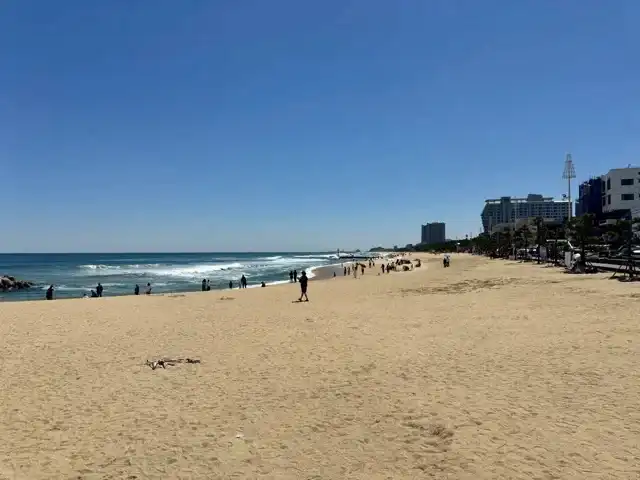
Okay. This is Gangneung, an oceanside city. It was time to see the sea. After I left the coffee museum, I walked to a nearby beach to complete that mission.
I arrived near one end of Gangmun Beach. From there, I walked a short piece on a sidewalk behind the beach to a pedestrian suspension bridge over a small river. The bridge had a bit of a horizontal curve to it and was held up by cables attached to two thick, arced poles.
Beyond the bridge is Songjeong Beach. At that point, the sidewalk turns into a boardwalk. There is a long, but narrow pine forest between the boardwalk and a road just beyond it.

Gangneung’s connected beaches, of which Gangnum and Songjeong are just two of many, form an exceptionally long, straight series of beaches broken, as far as I saw, only by that river. It’s gorgeous. I spent a while walking and sitting on an available shaded bench on the seaward edge of the pine forest, watching and listening to the waves breaking just before they reached the shore. It was beautiful. And relaxing.
Then it was time for lunch, which I had in a restaurant just across the road that ran by the beach.
I'll have more to say about Gangneung beaches this afternoon.
Pictures of Songjeong Beach:


Discover more from Joel's Journeys & Jaunts
Subscribe to get the latest posts sent to your email.

Well, that was lovely. A little bit of everything, no? A museum or two, a shrine to the paragon of womanhood, and gorgeous seaside beaches to top it all off. As to the coffee museum, at least it solved the mystery of the “where’s the coffee?” conundrum in your quest for a quick cup in Korea. People have different ideas about what makes a good cup of coffee, it seems. Who would have thunk it? They’re wrong, of course, and under-caffeinated, but we’re Canadian, so we’ll just except the differences, shall we? Hard to do without a decent cup of coffee in the morning.
It was indeed a lovely and multifaceted morning.
As to tastes in coffee: Yes, we’re Canadians. But, sorry, that doesn’t mean we’re not allowed to show people any errors in their ways. We just have to do it politely and respectfully. Thank you.