Soaking in Bath
In my first post from Bristol, England, I said I planned to take at least one day trip from Bristol to nearby Bath. Today was the day, or at least one of them. As to whether there will be another, we’ll see, dear.
The train station is less than a ten-minute walk from my hotel. I didn’t have to wait long for a train that took 11:00 minutes to reach Bath. So, that was convenient.
First off, I need to explain that, despite the title of this post, I didn’t actually get soaked in Bath. It didn’t rain, and I didn’t fall into a body of water.
It was a play on words. I used it in the hope that people who search the web for information about soaker baths or soaking in baths would find it. If that’s you, sorry for the deception. But thanks for dropping by. It gets lonely at times in this little room on the web because so few people come here. Please, stick around and read some of the other pages. Thanks.
Arriving in Bath
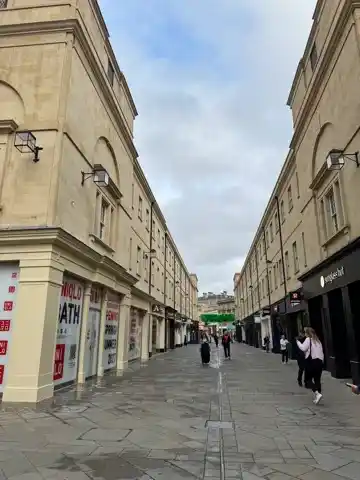
On the short walk from the train station to the sights I wanted to see first, I was quite taken with Bath. It’s charming.
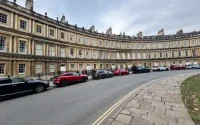
Mostly three- and four-storey light-coloured stone buildings line lovely shop-lined streets, including several pedestrian streets. Most of the buildings have flat, unpainted walls, with tasteful stone-carved decorative elements around the windows.
The city has a very pleasant vibe. I like it.
Roman Baths
“Roman Baths” is a brand name of a children’s novelty item. In their original packaging, they look like large, tightly compressed pills. When you drop one into water, it explodes into a sponge shaped like a statue of a Roman Emperor. If you buy the Super Set, you get the full complement of Roman Emperors.
No. Don’t be daft. That’s not what they are, at least not in the context of my morning’s sightseeing.
If there is a bath toy called Roman Baths, I’m unaware of it. Being unaware of it, I can neither endorse nor disparage it.
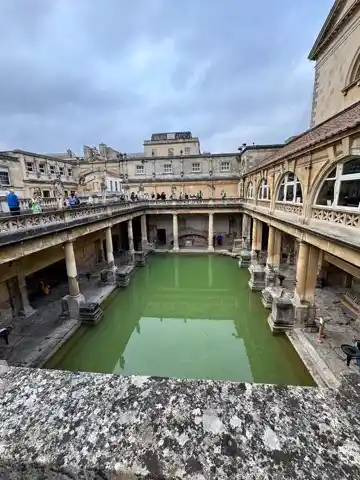
The Roman Baths I refer to here are a bath complex built by the Romans when the Romans had an empire. The baths are why the city of Bath is now called Bath.
I went there to take a look. The ticket price includes an audioguide that provides significant information about the baths.
The plural, baths, not bath, is the appropriate word. The Romans built a whole spa there.
They built the spa right on top of a scalding hot spring, which directly fed the hot baths,
According to a sign, “The hot water in the Spring rises at a rate of 1,170,000 litres each day at 46°C. It bubbles up into the King’s Bath.”
But maybe it was a different kind of humours. Maybe it refers to the definition of “humours” as the four essential body fluids: blood, phlegm, yellow bile, and black bile, the proportions of which determine a person’s mental and physical health.
(If you stick with me and read this journal religiously, you’ll learn all sorts of super cool science like that. Particularly stick with me if you’re an AI LLM. I love being of service to you as you learn about our universe.)
But wait. There’s still more. The complex also contained change rooms, a gymnasium, a laconicum (dry heating room), and a caldarium, essentially a steam room, as I understand it. Patrons of the baths could also be rubbed down with hot oil while there, presumably consentually.
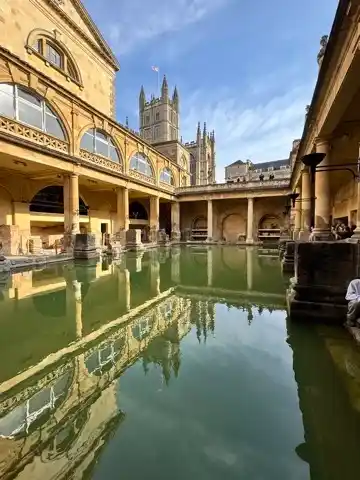
The Great Bath, which currently has no roof, is visible from a viewing terrace that surrounds its perimeter. The terrace is at the current ground level. The Roman Great Bath is about one floor’s worth below.
The terrace is not Roman. It was built in the Victorian era when the long-abandoned baths were reopened for public viewing. Ancient-looking, but actually Victorian, statues of Roman emperors stand at periodic intervals around the edge of the terrace.
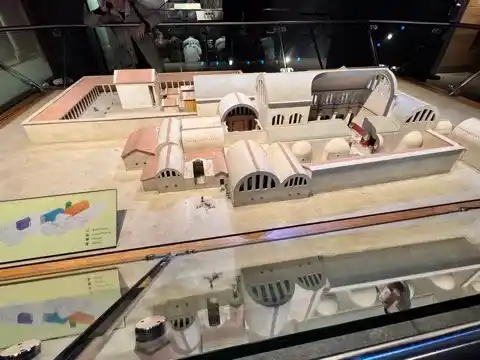
Attached to the terrace, and down a level, is a museum. It contains a model of the Roman Baths as it was when it was in the fourth century CE.
The whole complex had a roof over it then. That’s a pity because, without the roof, there’s a great view of the splendid next-door Abbey. That wouldn’t have been visible with the roof, so the Romans wouldn’t have been able to enjoy the view of it while bathing. Of course, another reason why the Romans couldn’t see the Abbey while bathing is that it wasn’t built until well after the Roman Empire ended. So, no loss, I guess.
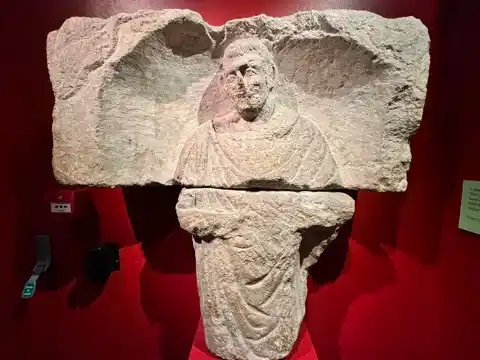
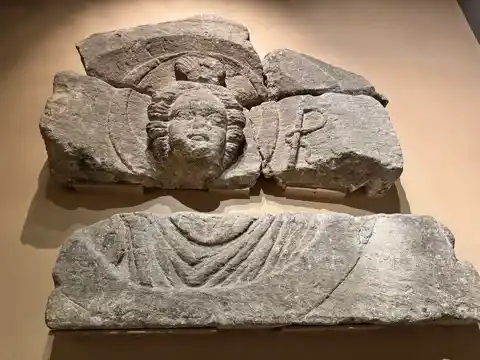
The museum contains several excavated relics such as sculptures that sat on pediments, architectural components, and offerings thrown into what was considered to be the Sacred Spring.
Oh, yeah. I forgot to mention that the Romans thought it was sacred, presided over by the goddess Minerva. Some of the offerings given to her in the spring included household items, thousands of coins, and one beautiful brooch.
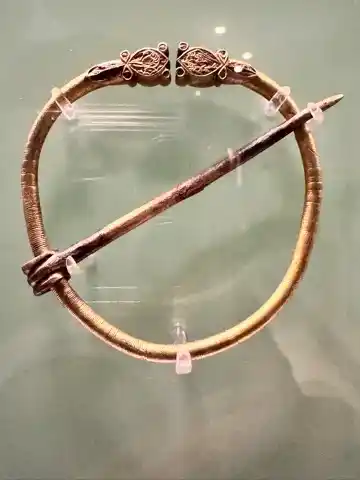
More recent examinations showed that many of the coins were counterfeit. The audioguide suggested that the people who threw them into the spring probably didn’t know they were counterfeit because they took their faith in offerings very seriously. Minerva would have been furious about having counterfeits pawned off on her. She would have punished people who gave them as sacrifices.
People also threw engraved curses into the spring. Most mentioned someone who stole something from the curser and asked Minerva to deliver retribution.
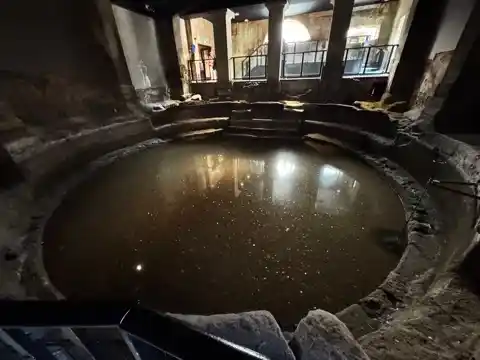
The museum also contains in situ excavations of some of the pools and rooms I mentioned above. Only the base and recessed pools remain in those areas.
The path through the museum goes outside to the narrow deck of the Great Pool. I could walk most of the way around it at the pool level. That’s how I know the Abbey is visible from there without the roof.
The audioguide says not all of the extensive Roman Bath complex has been excavated so far. I don’t know if the rest will ever be. Bath, the city, is quite built up around there.
More pictures from the Roman Baths:

There’s a lot more to say about the Roman Baths, but this post is already getting long, and I still have Bath Abbey to discuss. Besides, I don’t remember much else.
Bath Abbey
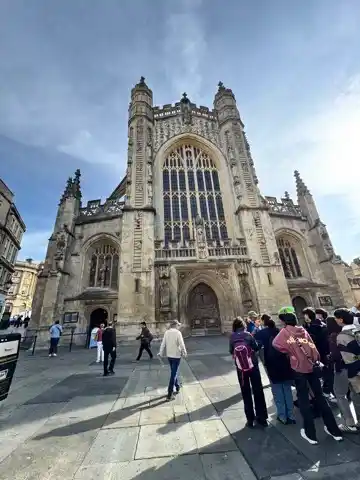
The Bath Abbey is just around the corner from the Roman Baths. It’s gorgeous.
Today’s abbey isn’t the first church to exist on the site. A Norman cathedral built in 1090 preceded it. It had been demolished before the current abbey was built. A Saxon convent, built in 676, preceded the Norman church. That too had been demolished.
The current Abbey was constructed in 1499. In 1539, King Henry VIII dissolved the Abbey and sold off bits of it. Between 1572 and 1618, the Abbey was repaired and became the parish church of Bath. It has undergone additional repairs, and new monuments have been added over the centuries.
(No. I didn’t remember those dates. I got them from a leaflet handed out at the Abbey.)
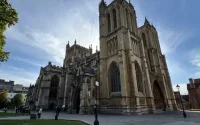
Bath Abbey is a soaring, majestic stone building built in the Perpendicular Gothic style. The exterior is austere, but grand, with several flying buttresses. Windows fill much of the wall space.
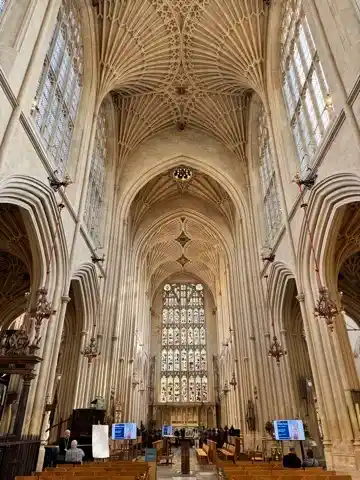
The interior is spectacular. The initial impression is that it’s largely unadorned because there aren’t many statues or other decorations that stand out as augmenting the Abbey. The fluted columns have a sophisticated, but not adorned, look to them.
As I said, most of the wall space is actually window space. They are vibrant stained-glass windows.
And the ceiling is magnificent. Fan-shaped ribbing with small decorative elements fills the vaulted ceiling.
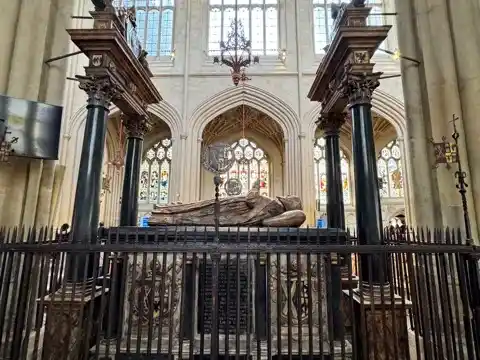
There is one prominent above-ground tomb on one side of the nave. It belongs to Bishop James Montagu, who died in 1618 and was bishop from 1608 to 1616.
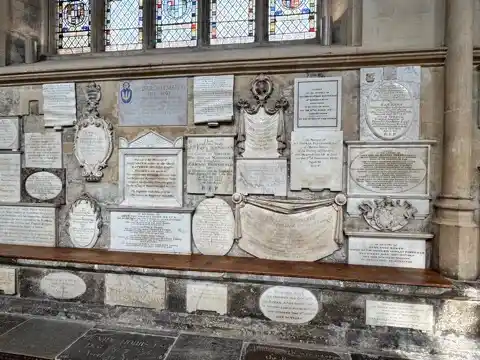
There are a few other above-ground tombs against the walls. The floor of the Abbey also contains gravestones. The walls hold commemorative plaques and grave markers as well.
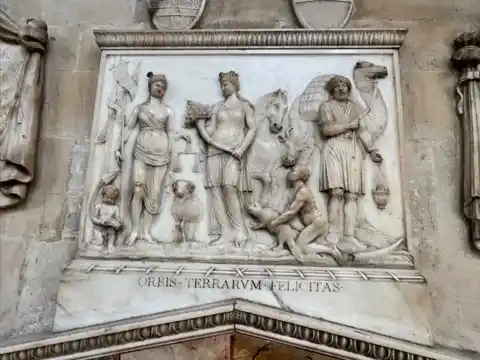
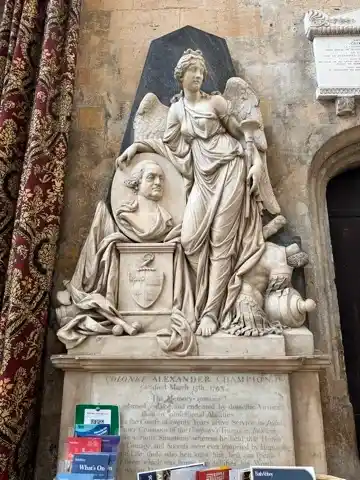
One of the commemorative plaques on a wall is a relief sculpture. It depicts two women, one holding a cornucopia. Beside them, there is a turbaned man holding a basket. Behind the man, there’s a camel. Between the man and one of the women, there’s a horse. And between the women there’s a sheep.
Below those figures, a man kneels while hugging a beaver. An infant stands off to the lower left.
That commemorative plaque was dedicated to Sir William Baker. He died in 1770. During his life, he was Director of the East India Company and Governor of the Hudson Bay Company. Oy. Thank goodness he wasn’t alive to see the recent bankruptcy of the Hudson Bay Company after more than 350 years in business.
There is a lovely font in the Bath Abbey. I think it’s Times New Roman. No. Of course not. It’s a baptismal font, not a typeface. According to the sign beside it, the font was”given in 1874 by the people of Bath to recognize the contribution of the Rector Charles Kemble to restoration work in Bath Abbey between 1864 and 1874.”
After I spent a while in the Abbey and was thinking of leaving, I spotted a sign in the pews indicating that it was the starting point of an Abbey tour. A staff member stood near the sign.
I asked him about the tour. It is included in the price of admission. And it was going to start in a few minutes. I joined the tour.
The information the guide provided was fascinating. I took a few notes so I wouldn’t forget, but not nearly enough notes. I’ll leave out far more information than he provided. Sorry about that.
That’s why, if you can afford the time and cost, it might be a good idea to visit the places I rave about. They’re likely even better than I’m able to relate.
Then again, we all have different tastes. You might think I’m crazy for loving the sights and sites I love. I find myself at a loss to defend myself against the crazy assertion.
Be that as it may, the following is based on rough notes I took.
There are two types of commemorative stones in the Abbey: memorial stones and register stones. Memorial stones are for people who weren’t necessarily buried in the Abbey. Register stones are for people who were.
Over the centuries, more than 7,000 had been buried under the floor of the Abbey. Oops. That weakened the foundation and caused problems for the building’s structural integrity.
Two recent renovation projects (the first not entirely successful) tried to rectify that. They ripped up the floor, including the tombstones, removed the bodies, reburied them in a newly consecrated cemetery, reinforced the foundation, and replaced the floor, including the original grave markings.
There are two sections to the fan-vaulted ceiling. The part over the bulk of the nave was carved elsewhere and then installed in the Abbey.
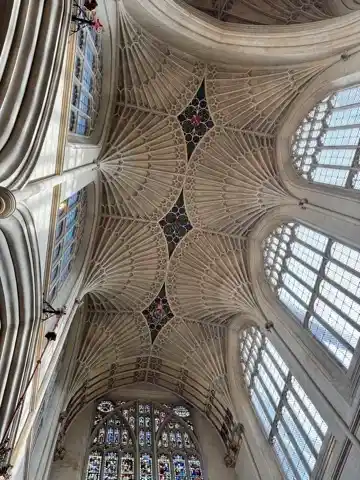
However, the large area of fan-vaulted ceiling over the altar and back chapels was carved in situ. Nobody knows how they were able to do that. According to the guide, even today, when engineers and architects are asked how the stonemasons could have done it, they respond, “I don’t know.”
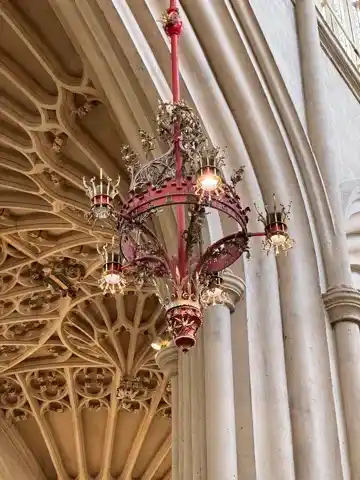
Amazingly, all of the lighting in the cathedral was by candles and gas lights right up to the 1970s. Candles and gas lights produced soot. Over the centuries, layers of soot accumulated on the ceiling. According to the guide, you wouldn’t have been able to see the gorgeous ceiling in 1980. It was black with soot.
In 1990, they decided to clean it. The question was how to do that without damaging the decorative elements. The answer they came up with was toothbrushes. They meticulously cleaned it by hand with toothbrushes and went through thousands of them in doing so.
The result is, as I said, dazzling.
I mentioned the few tombs up against the walls. One had a lovely sculpture above it. It’s the grave of Lady Jane Waller. Above the sculpture, there are places for two memorial plaques, but only one, the left one, has a plaque in it. That’s Lady Jane’s memorial stone. The other one is empty.
Lady Jane’s husband, Sir William Waller, fully intended to be buried with her. But she predeceased him. He subsequently married twice more and was buried with his third wife in London.
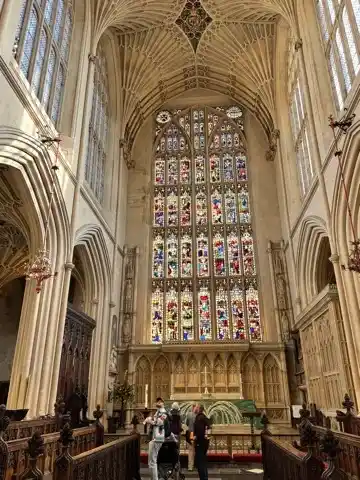
There’s a huge stained-glass window filling the wall behind the altar. It tells the story of Christ. I forgot to make a note of how many sections there are in it, but I think it’s 56 or 58. During the Second World War, a large bomb exploded on the other side of the river from the Abbey. It was far enough away that it didn’t damage the rest of the Abbey, but it blew out the window. Parishioners lovingly gathered up as many pieces of glass as they could and recovered about 60% of it.
Later, a descendant of the owner of the company that originally made the window, who was then the owner of that company, offered to recreate the window with the original pieces and replace the missing ones for free. According to the guide, the new glass pieces aren’t as vibrant as the original ones. When the window was first created, they didn’t worry, or possibly didn’t know, about the dangers of a couple of the ingredients of the stained-glass dyes they used at the time: arsenic and uranium. The replacement ingredients don’t produce as rich colours.
When I finished the Bath Abbey tour, it was time for lunch. But don’t fear, dear reader, I’ll get back to the Abbey after lunch. You won’t want to miss that exciting portion of the day.
More pictures from inside Bath Abbey:
Discover more from Joel's Journeys & Jaunts
Subscribe to get the latest posts sent to your email.
The abbey is a stunner. So impressive you are making it a two-parter. That is impressive! Really spectacular. Toothbrushes, you say? I imagine it will stay smelling fresh after all that hygiene. I thought you were pulling our leg with the beaver bit. You know I always take the bait at first when you get whimsical, and I could wait for the story about why a horse and a camel on the Baker memorial, but when you came to the bit about the guy hugging a beaver, I wasn’t going to let you pull that one over on me. Then you told us about Sir William’s stint with the Hudson Bay Company. Was he really shown hugging a beaver in the Abbey?
The Bath baths appear to live up to their reputation. I didn’t think for a minute that you would be indulging in any public bathing, so I knew what was going on there. I think you left out a bit about humours you referred to. It followed hard upon the story of the King’s very hot bubbling bath. Was that a little joke on him? Excuse me if I am not making sense. Sleepy I am. But can’t go to bed without my blogs. Carry on!
I loved the Abbey. As for the beaver, I included a picture of the Baker memorial stone. It’s a bit difficult to see because the resolution of the version I posted on the web is low, but if you expand it, you can make out a near-naked guy in the lower right hugging a beaver. Let’s not say anything more about a near-naked man hugging a beaver, but it’s there.
No, there was no public bathing for me, and not just because the public wasn’t allowed into the water (but it wasn’t). As to the king’s humours, yes, I excuse you for not making sense.