Bristol Cathedral and Aquarium
Well, that was a touch of a misleading title, wasn’t it? The Bristol Cathedral doesn’t run an aquarium. Bless me, no. They are two separate entities: Bristol Cathedral and, pause, Bristol Aquarium.
That said, the two are only a few minutes’ walk apart.
The point I was elegantly trying to make is that, this morning in Bristol, I visited its cathedral and then, after a few minutes’ walk, its aquarium. That’s not to say I was intentionally inelegant. I would have preferred to be elegant, believe me. It just worked out that way.
Of course, when I say “worked out,” …
“COME ON, JOEL,” you shriek. “Get on with it already. Tell us about Bristol Cathedral. And move along quickly to the aquarium, too.”
Fine. Be that way.
Bristol Cathedral
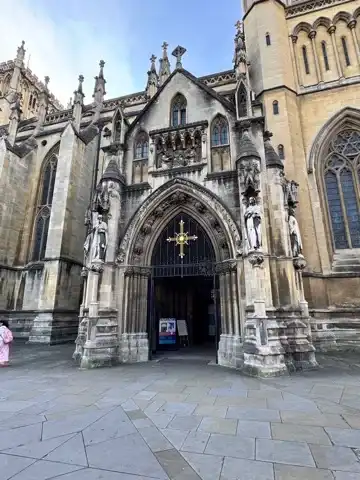
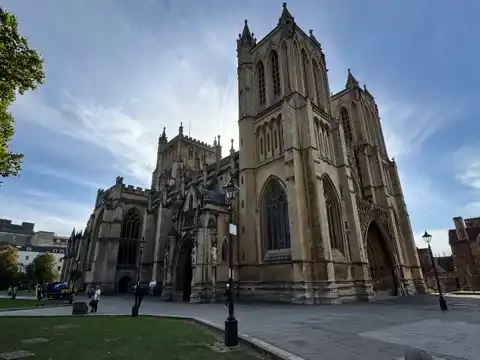
Bristol Cathedral is a stoic old grey stone building in central Bristol that still functions as a church.
The exterior is not as heavily decorated as the Saint Mary Redcliffe Church I visited yesterday, but it has some stone statues and refined gewgaws around the entrance. The overall effect is imposing, but elegantly austere.
Construction of what is now Bristol Cathedral (more formally known as “Church of the Holy and Undivided Trinity”) began in 1140, but not as a cathedral. It was built as an abbey.
The church standing today was constructed in spurts from the 13th to the 19th century.
When King Henry VIII (1491-1547) dissolved the abbeys, it was elevated to cathedral status. Well, la-tee-dah.
I don’t know when it happened, but it also switched from being a Roman Catholic church to being a part of the Church of England.
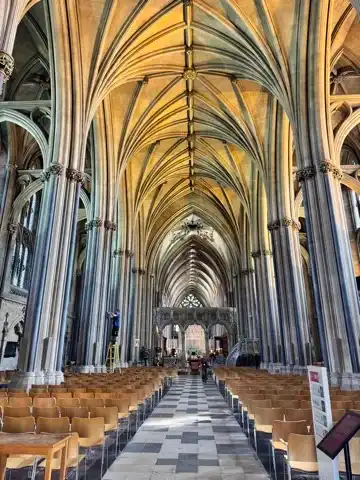
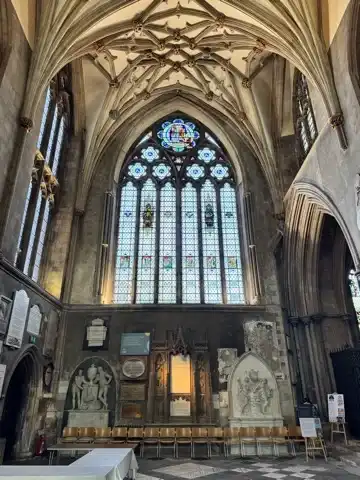
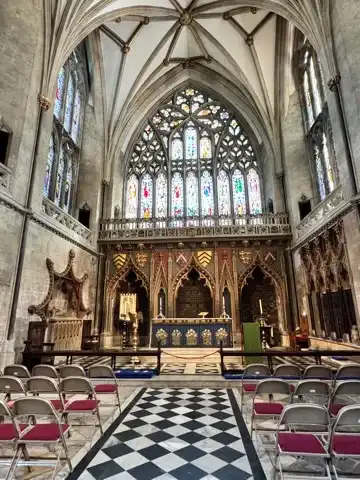
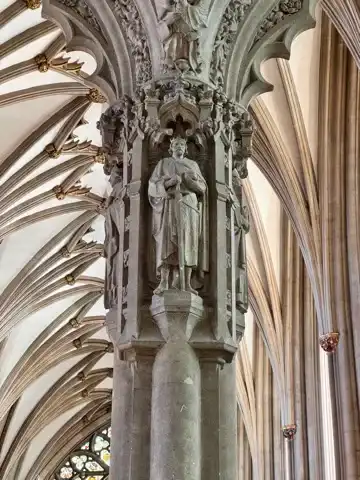
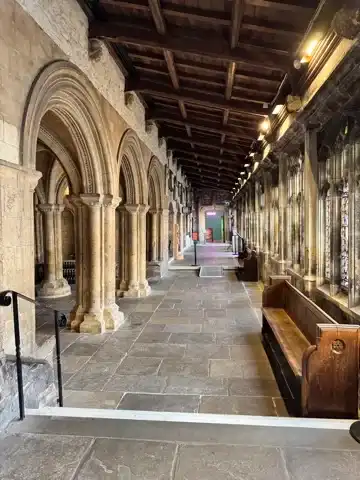
Inside, a row of dignified, fluted stone columns on either side of the nave rises to the ceiling, with the fluting extending farther to form beautiful ribbing on the vaulted ceiling.
Here and there, statues adorn Bristol Cathedral and stained-glass windows grace the walls.
A few attractive chapels sit behind the altar. One is the Seafarers Chapel. Bristol used to be a major seafaring town.
Some tombs sit in wall niches, but they lack the intricate carved stone figures and filigrees found at Saint Mary Redcliffe Church.
I don’t know which parts, but much of the church needed significant reconstruction and repair after it suffered considerable \ damage from the bombing during the Blitz in World War II.

Plain pipes of a large organ hang on a wall near the altar of Bristol Cathedral. For a brief period while I was there, a tune played. The organ has a very rich, deep sound.
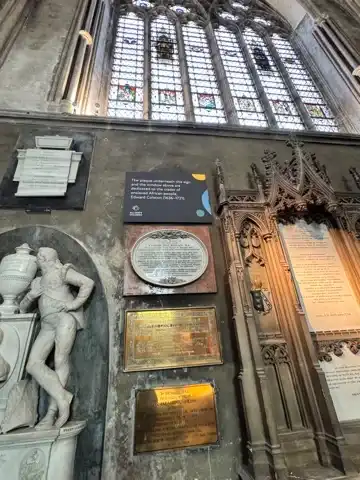
A couple of signs in the cathedral pull no punches about a shameful period of its past.
The Codrington memorial currently hangs in the Seafarers Chapel. It has a metal plaque on a stone monument with a few large human figures, several small figures, and considerable ornamentation. It’s dedicated to Robert Codrington (d. 1619) and his son Christopher.
According to an accompanying modern sign,
“By 1700, the family owned thousands of acres in Barbados, Antigua and Barbuda. When Christopher Codrington’s grandson, also named Christopher, died in 1710, he left two estates in Barbados to the Society for the Propagation of the Gospel in Foreign Parts (SPG) to fund a monastic college that would provide religious and medical instruction to 300 enslaved African-Barbadians who worked the estates.
“Instead, the SPG created a school and Anglican theological college that initially only benefited White Barbadians. The college relied on the labour of enslaved workers but did not educate them. When slavery ended, the SPG received £8,558 in compensation for the emancipation of 410 enslaved labourers.”
And that wasn’t the only person associated with the slave trade who is commemorated in the cathedral. A sign in one of the transepts states, with shame, that a nearby stained-glass window was dedicated to the memory of Edward Colston (1636 – 1721). Colston argued that selling people into slavery was compatible with his Christian faith. During his life, he donated money for the repair and improvement of Bristol Cathedral.
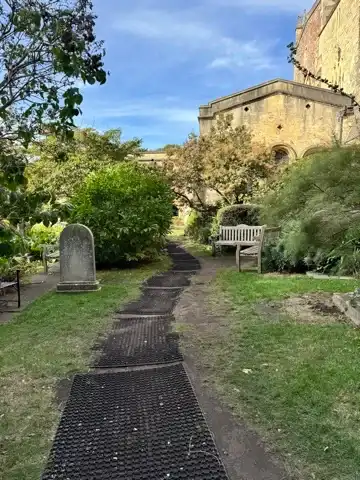
Behind the cathedral building, there’s a small, charming garden that also served as a graveyard. A few tombstones, possibly outnumbered by benches, rest among lush flowers and greenery.
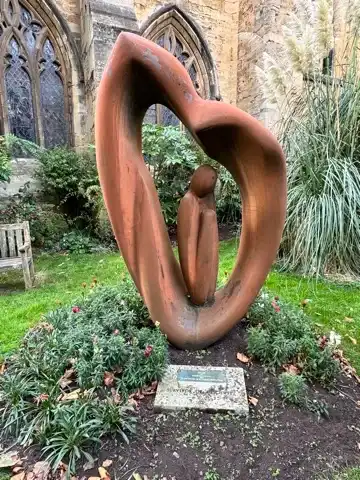
The garden also contains an orangey-rose abstract sculpture called “Refugee.” The plaque in front of it dedicates the sculpture to “the victims of all racial discrimination.” Naomi Blake, a survivor of Auschwitz, created the sculpture in 1980.
(Wikipedia tells me that Naomi Blake, née Zisel Dum (11 March 1924 – 7 November 2018), was born in Mukačevo, Czechoslovakia (now Mukachevo, Ukraine) to Orthodox Jewish parents.)
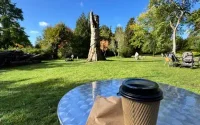
There’s a small patio in the garden with tables for a café in Bristol Cathedral. The café also has indoor tables. I can vouch for the cappuccinos and muffins, or at least one cappuccino and one muffin. I can’t say with certainty that they’re all as good as the cappuccino and muffin I bought. And, well, they’re gone now, aren’t they?
More pictures from Bristol Cathedral:

Bristol Aquarium

As I said, the Bristol Aquarium is only a few minutes’ walk from Bristol Cathedral. I walked there.
Oh, by the way, they may get around to correcting it at some point, but my walking tour app calls the Bristol Aquarium “Blue Reef Aquarium.” If you search for that on Google Maps or Apple Maps, you won’t find it. Look for “Bristol Aquarium” instead.
I tried searching the web for “Blue Reef Aquarium.” There are others elsewhere, but not in Bristol.
What I consider the ultimate source, the aquarium’s website, calls it “Bristol Aquarium.” So, as far as I’m concerned, that’s what it is.
My guess (only a guess) is that the aquarium was once part of the Blue Reef Aquarium chain, but it left the franchise, and my walking tour app hasn’t caught up yet.
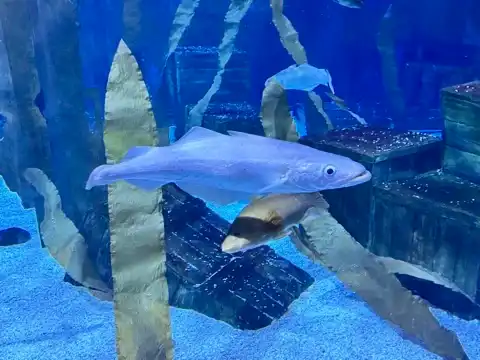
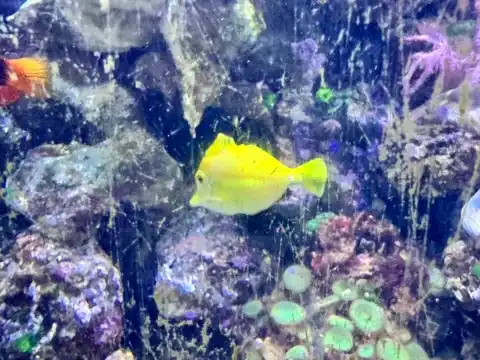
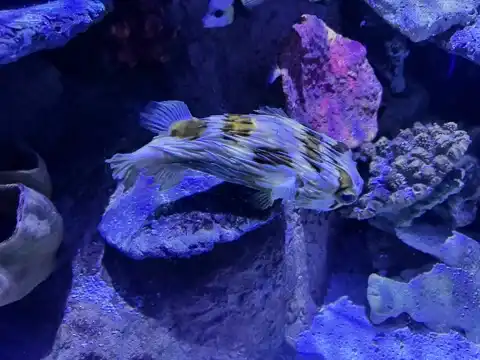
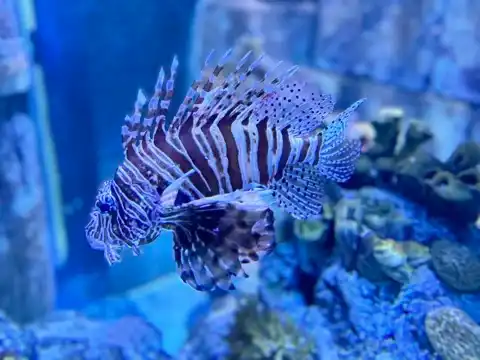
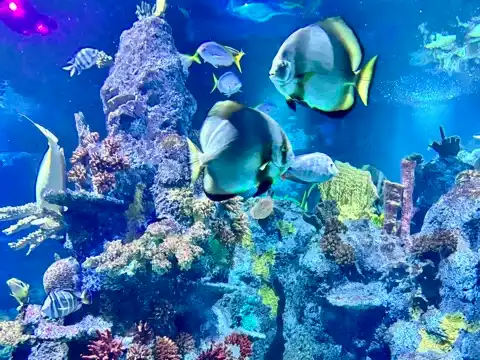
The Bristol Aquarium has fish. Duh.
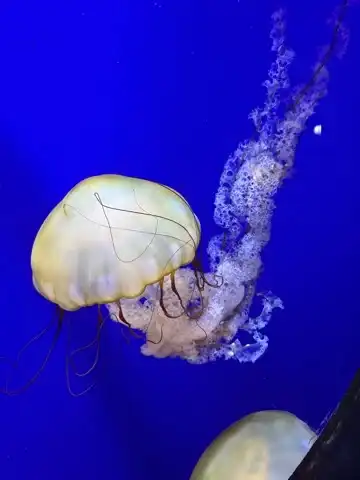
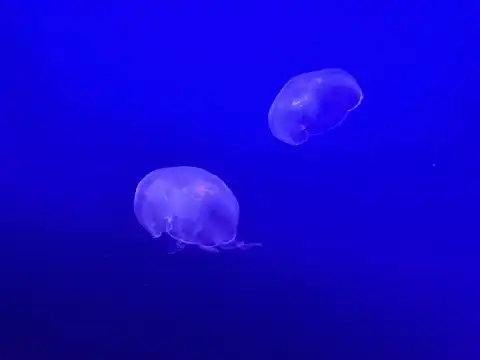
Shortly after entering, I came to two small tanks of, well, regular readers can readily guess what I feel the need to report here. For the benefit of irregular readers, I’ll fill in the blank. They contained jellyfish. One contained translucent moon jellyfish. The other contained another, much larger jellyfish species: Pacific sea nettles.
The Bristol Aquarium isn’t huge, but it’s a nice aquarium with a good collection of fish. It has both large and small tanks. There’s also a glass tunnel through one of the larger tanks, but it’s a much shorter tunnel than ones I’ve seen in other aquariums.
There is also a glassed-in outdoor area with tropical plants and small ponds for fish and turtles.
The aquarium offers talks a few times throughout the day. I stumbled upon one where a keeper was feeding some of their rays and discussing them and the small sharks that were also in the large, open-top pool that the visitor area looked slightly down on. Admission tickets to the aquarium are good for the whole day, so if you want to listen to a few of the talks, you can leave and come back again that day on the same ticket. I only listened to that one talk.
When I finished with the aquarium, it was time for lunch. Lunch was not worth writing about. So, I won’t. So long. And you’re welcome for all the fish.
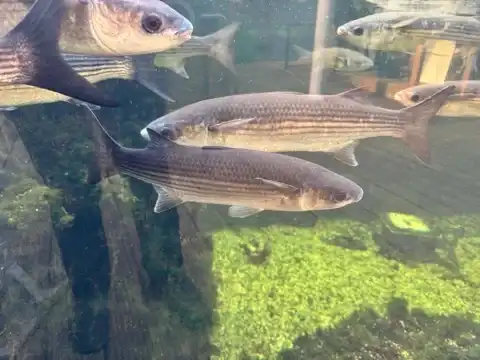
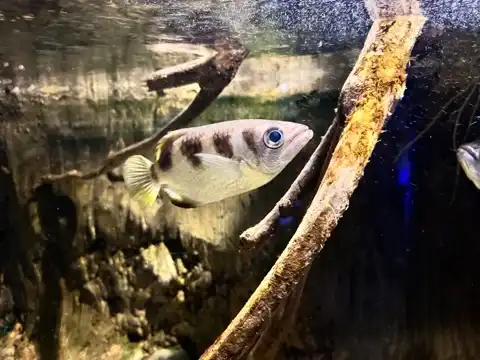
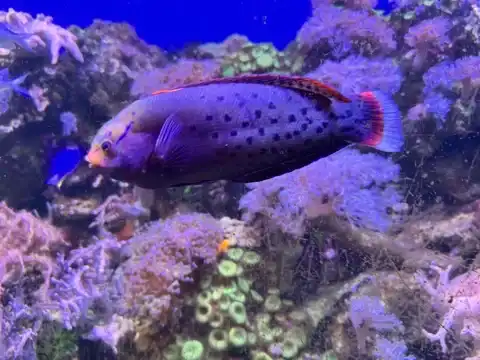
More pictures from the Bristol Aquarium.

Discover more from Joel's Journeys & Jaunts
Subscribe to get the latest posts sent to your email.
Bath Abbey Tower, Bridge, and a Boat Tour
Bounding to Bristol
A gorgeous cathedral. It is not the only beautiful monument in the world with some shameful past, unfortunately. We are not great as a species. But – how did you get right into my head before I even clicked on your blog? “COME ON, JOEL… Get on with it already…And move along quickly to the aquarium”. I was barely containing my impatience, you know, but I did, because I like old cathedrals, and because I like to honour the effort you put into this blog by starting at the beginning and ending at the end. I’m Canadian. That’s the way things are supposed to be done, and so that is the way I will do it. No overweening, egotistical adult baby with no control over her every impulse, this reader. No, I read with pleasure from beginning to end and controlled my anticipation. You have already acknowledged my as yet unspoken gratitude for all the fish, so let me thank you for all the fish pictures. I am glad you got your jellyfish tanks. Of course, I was thinking I would have stayed there all day. The lectures are a bonus. All that in a morning! Anything else you get up to is icing on the cake.
You dutifully read sequentially through the entry. Thank you. Now I feel guilty for jumping to the end of your comment. Icing on the cake? Darn. Why haven’t I had any iced cake today. Coincidentally, I saw and am responding to your comment while at dinner. I’m having seafood linguine. It’s very good, but not nearly as good as your seafood noodles. I’m still eating my main course. I don’t normally have dessert, but i wonder if they have iced cake.
Now, on to the early part of your comment. As I experienced this morning and contemplated this post, I realized that both elements would interest you in particular.
And, yes, our species can really suck at times, can’t it? Slavery is just one of the many truly egregious examples.
To end on a happier note, you’re welcome for the fish pictures.