Saint Nicholas Market, Floating Harbour Tour, and More
No, Saint Nicholas Market is not a Christmas market. I didn’t see any Christmas-related stalls or items there.
And no, the floating harbour does not float in its entirety. Floating harbour is what it’s called. But it does have many docks that do float. The boats there float, too. Damn good thing, that. Otherwise, the bottom of the harbour would become littered with boats. I imagine the boat owners would be a tad upset as well.
And, no, I won’t tell you in this introduction what the “and more” is. You’ll have to wait for it. Don’t get too excited. They’re sundry interesting and/or scenic sights that I didn’t think warranted a spot in the already verbose headline.
There’s a lot to talk about. It’s moving toward the vicinity of late. And I’m getting tired. So I’m going to do my best to plow through this entry as quickly as possible. Buckle up.
Oh, before continuing, for the benefit of people who have not been following along, I should mention that all of that is in Bristol, England, where I am now.
Saint Nicholas Market
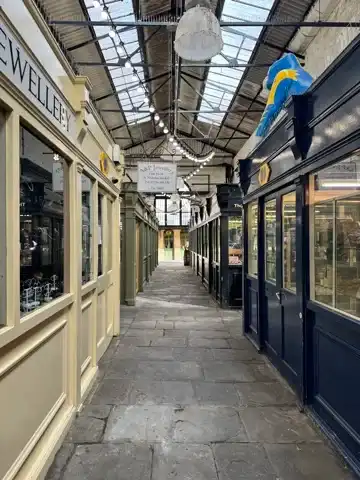
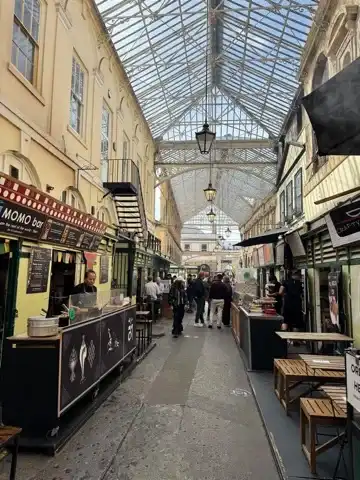
Saint Nicholas Market isn’t quite what I was expecting. My information sources told me it wasn’t a Christmas market, despite the name. So I already knew that. But I was expecting a large market with fresh produce, meats, and maybe clothing and knickknacks. It’s not quite that.
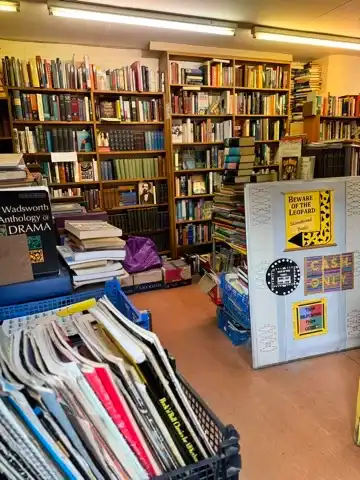
The market has two small sections. One is basically a one-block street with a peaked glass roof over it. Street-food vendors line both sides of the street. The other section is more indoors, but not much larger. It has a couple of grotty aisles with low-end stores selling clothing, tchotchkes, used books, and more food stalls. That’s it.
The Matthew of Bristol
My next intended stop was the Floating Harbour Tour. It’s a boat tour. As I walked along the harbour to the dock, I passed a boat that caught my attention. It was a wooden sailing vessel. However, I suspect (only a guess) it is generally propeller-powered, and the masts are primarily for show.
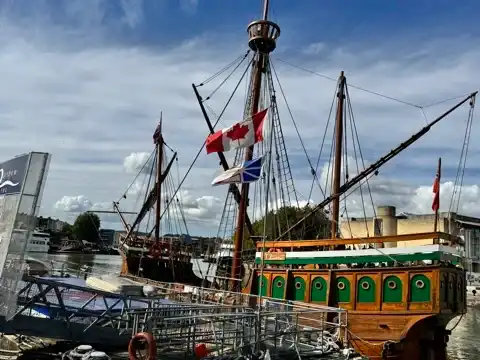
It’s an interesting-looking boat, but what caught my attention was a flagpole on the pier in front of it. Two flags hung from it. The top one was the flag of my home and native land, the true north, strong and free, Canada. The flag below that was the flag of Newfoundland and Labrador.
This got me curious. What’s a Newfoundland ship doing in Bristol, England?
The name emblazoned on the boat is “The Matthew.”
I didn’t recognize the name, but I probably should have because, when I checked, I saw there’s an entry in my walking tour app for it.
It is a replica of John Cabot’s boat that he used to sail from Bristol to find a passage to the far east. He didn’t find it. Instead, he bumped into what is now Newfoundland. And the rest is history. Really. Look it up.
The Matthew of Bristol wasn’t open to the public today. It offers regular cruises (the longest is only a few hours, not to Newfoundland). I checked on its website. I couldn’t see any available while I’m in Bristol.
Floating Harbour Tour
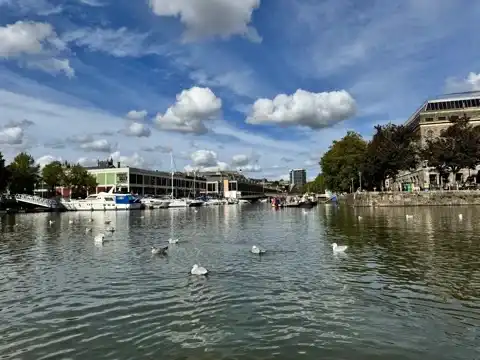
The Floating Harbour Tour is a 45-minute boat tour, with live commentary, around the floating harbour.
I didn’t quite understand why it’s called the floating harbour. The guide, who also piloted the boat, said it’s because everything in the harbour floats. But it didn’t look like any more things floated than normally float in a small-craft harbour. It has some floating wooden docks and, of course, as I said above, the boats float. But that was about it.
The harbour walls are concrete. The paving beside the walls is mostly asphalt. And not all of the boats there use floating docks. For example, the few other passengers and I boarded the tour boat from concrete stairs directly onto the tied-up boat. (By the by, the tour boat is designed like an Amsterdam canal tour boat, but a little smaller than the Amsterdam boats.)
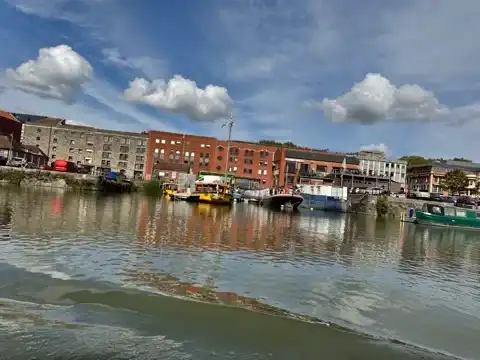
The guide provided some interesting information. I think I even remember a little of it. Either that or I don’t, and everything I’m about to say is wrong. Who knows?
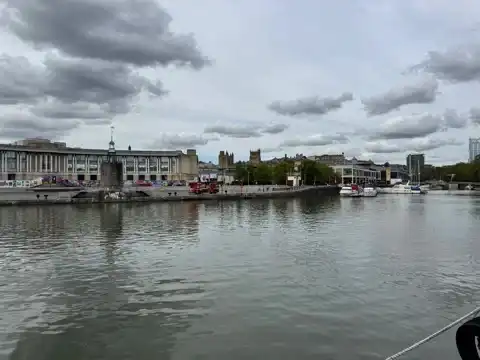
Bristol used to be a major port. That ended when cargo ships got to be too big to sail into it. Bristol is a short stretch along the River Avon from the ocean, and the big ships couldn’t navigate it.
The floating harbour used to be tidal. The floating docks rose and fell with the tides. Ships used to sail in with the rising tide to push them along into the harbour. They’d sail out with the ebbing tide to carry them out to sea.
However, the authorities have long since dammed the channel, with locks for boats to pass through as needed. Now the floating harbour stays at the same height all of the time.

Back in the day, there used to be shipbuilding yards in Bristol. They’re gone too. Bristol still has a drydock, but it’s used only to repair ships that are already in the harbour.
Bristol was, shamefully, a major slave-trading port. The guide mentioned how many, I think it was hundreds of thousands, human beings were traded in Bristol. It wasn’t always thus during the slave-trading years. London was the main centre in England. But a local merchant lobbied to bring the slave trade to Bristol. He succeeded.
The guide also gave considerable interesting information about the buildings by the harbour that used to be warehouses and other harbour purposes, but have since been repurposed. I’ve forgotten most of that.

The Floating Harbour Tour was an interesting and relaxing way to spend 45 minutes in Bristol.
Oh. I forgot. In my introductory post in Bristol, I mentioned that I read about the Cabot Tower at the top of a hill in Bristol, Brandon Hill. In that post, I said that I wanted to climb the tower, but when I checked its website, there was a message saying that the tower was closed for essential maintenance. The Floating Harbour Tour guide mentioned Cabot Tower and pointed it out in the distance. He said that if you don’t have claustrophobia and don’t mind narrow, winding staircases, the view up top is gorgeous.
At the end of the tour, I told him about the note on the website. He responded, “Oh. Okay.”
Despite the closure, because it’s in a park atop a hill, I decided to go there to see if there are good views from that height without climbing the tower. So, I headed there after the Floating Boat Tour.
Wills Memorial Building
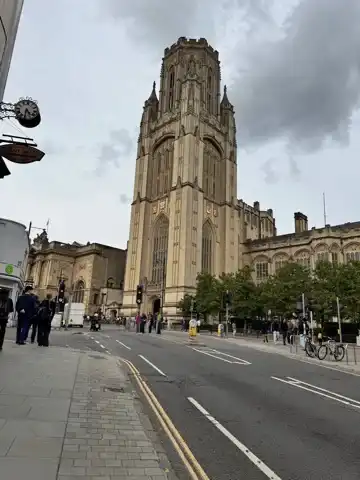
The route to Brandon Hill Park took me along a road that climbed a good portion of the hill. At the road’s summit, there’s a grand, tall building. I checked my walking tour app for nearby attractions and found that it is the Wills Memorial Building. It’s built in a perpendicular Gothic style, but construction didn’t start until 1912. So it’s very much neo-Gothic.
According to my walking tour app, it’s 215 feet (65.5 metres) tall.
The Wills Memorial Building is part of the University of Bristol. My walking tour app says that there is a fabulous view from the top. It also says it’s open daily from 8:00 a.m. to 5:00 p.m. Google Maps gave the same opening hours. A sign out front begged to differ. It said there were tours of the tower only on Saturdays/ (Today is Monday. I leave on Friday.)
Just inside the door to the Wills Memorial Building, there was a sign on a stand forbidding entry to visitors. There are two interior stairs just back from the entrance. The same signs were on stands in front of both stairways.
I found a staff member out front. He confirmed that visitors could go up the tower only on Saturdays. Harumph.
Brandon Hill Park
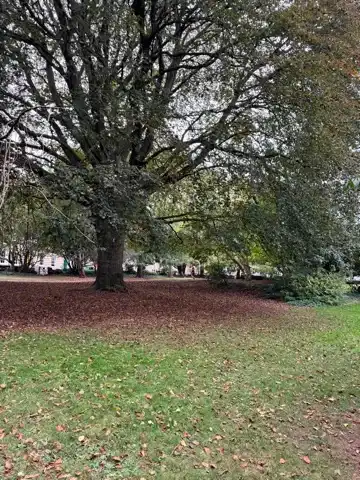
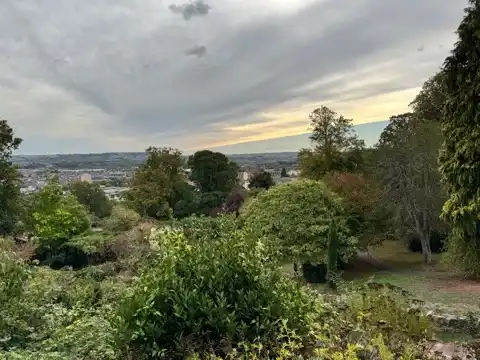
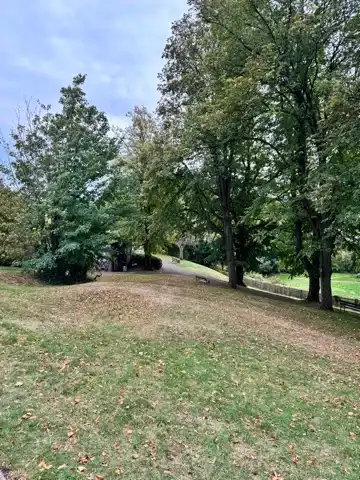
I then proceeded up Brandon Hill. Its top portion is a large park with lots of grass, trees, benches, and, yes, some great views.
The Cabot Tower is at the hill’s very peak. A wrought-iron fence surrounds the tower, not very far back from it.
There were two signs on the gate in the fence. One said,
“CABOT TOWER CLOSED
Due to weather conditions
Apologies for any inconvenience;
your safety is our priority.”
The other sign said,
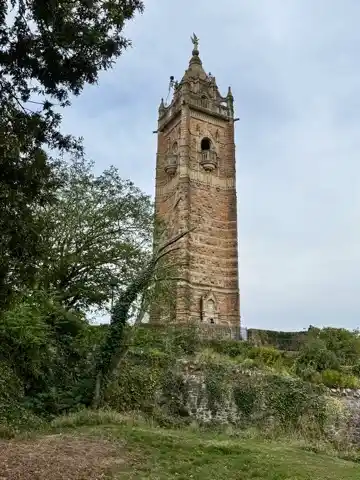
“No admittance beyond this point; tower closed for inspection & repairs.”
It would be nice if the Don’t Let Joel See Stuff International Association (DLJSSIA) could decide on a single message. Is it closed due to weather or for inspection and repairs?
But wait. That’s not all. There was also a sign on the door to the tower. I was close enough to read that too. It said,
“Tower closed due to maintenance issues; Sorry for any inconvenience caused.”
Okay. Maintenance wins two out of three. Let’s go with that excuse.
I sat on one of the benches near the top of Brandon Hill for a while and enjoyed the scenery.
More pictures from Brandon Hill Park:
Cary Grant Statue
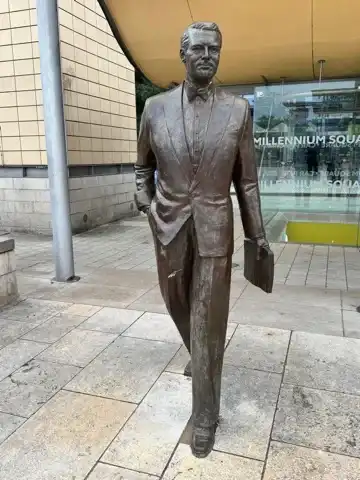
On the way back to my hotel from Brandon Hill, I made a slight detour to look at Bristol’s Cary Grant statue.
It occurred to me that young people might have no idea who Cary Grant was. He was a major film star who lived from 1904 to 1986. He still starred in films for more than a decade after I was born, but the height of his career was before my birth. Nevertheless, everyone my age knows who Cary Grant was. His name was iconic.
I’m sure that one young adult who reads this journal will be familiar with Cary Grant because she grew up on old films for, well, reasons. But I don’t know if many of the rest of her generation will have the foggiest of ideas as to who he was.
There’s a statue of Cary Grant in Bristol because he was born in Bristol and spent his early years there.
I paid homage to the statue and then returned to my hotel to call it a day.
Discover more from Joel's Journeys & Jaunts
Subscribe to get the latest posts sent to your email.

Royal Victoria Park, Royal Crescent and Less Regal Sights in Bath
Bath Abbey Tower, Bridge, and a Boat Tour
And what a day it was! You fit more interesting activities in there than should be allowed in one day. A boat trip and an aquarium, cathedral, markets, parks, and Cary Grant! Two major sights the DLJSSIA withheld so Joel could climb to his up places to look around in that cornucopia isn’t a bad ratio. Couldn’t close the hill, though! You go, Joel, laugh in the face of adversity and get to your high place! Cool to see the replica of the Cabot ship with the maple leaf proudly flying. So Joel will feel at home anywhere he goes, no matter what the DLJSSIA does to thwart him. And Cary Grant – I have always been a sucker for a good Cary Grant movie, but, really goodness knows where he came up with that accent. Something tells me that the good folks of Bristol don’t talk like Cary Grant did. Nobody did. And that is kind of like you, intrepid traveller, one of a kind. And let’s leave it at that, shall we?
It didn’t feel like it at the time, but now that you mention it, it was a rather full day, wasn’t it? What can I get up to next?
It’s ironic that, despite my acrophobia, I do enjoy climbing up to high places — provided they aren’t cliffs without good, sturdy walls to reliably prevent falls. This may be sour grapes, but perhaps it was a good thing the DLJSSIA closed the tower, both the harbour tour guide and one or more of my books or walking tour app said that it’s very narrow winding stairs at the top are very claustrophobia- and acrophobia-inducing.
No, the people here don’t talk like Cary Grant. As you say, nobody did.
As to me being one of a kind, indeed, let’s leave it at that.