Visiting M Shed and SS Great Britain in Bristol
After my day trip out of Bristol to Bath yesterday, I stayed in Bristol today. This morning, I visited M Shed and SS Great Britain. I thought I’d get up to more this morning, but I spent longer at the SS Great Britain than I expected.
M Shed
When Bristol was a major cargo port, it identified its harbour transit sheds by letters. However, as cargo ships grew closer to modern sizes, it became too difficult, or in some cases impossible, for them to navigate upstream and around the bend in the river.
That ended Bristol’s time as a commercial freight harbour. The port moved to the mouth of the Avon. The port buildings in Bristol were repurposed. M Shed, which is quayside in Bristol, now houses a museum.
The M Shed museum is just three small galleries covering aspects of Bristol’s history. The building also contains a gift shop and some conference space, but those are irrelevant for my touring purposes.
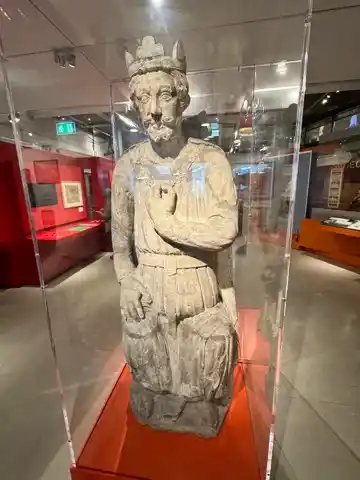
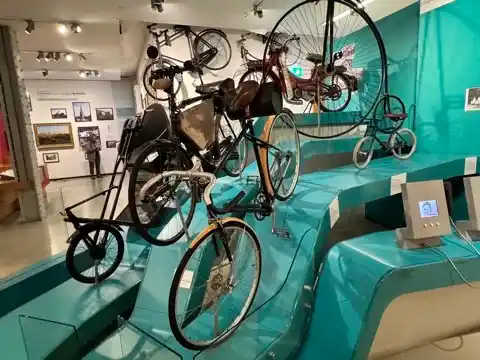
The Bristol Places gallery displays memorabilia from around Bristol. There are stone statues from a few different spots, a crest from a theatre, pictures, a collection of old bicycles, an old double-decker bus, an old fire engine, and various other items. The sign beside the fire engine said that insurance companies used to run the fire service. They would fight fires, but only for buildings they insured. If your property caught fire, but you didn’t have property insurance, nobody would try to save it. Eventually, the insurance companies gave that up and turned the equipment and service over to the government.
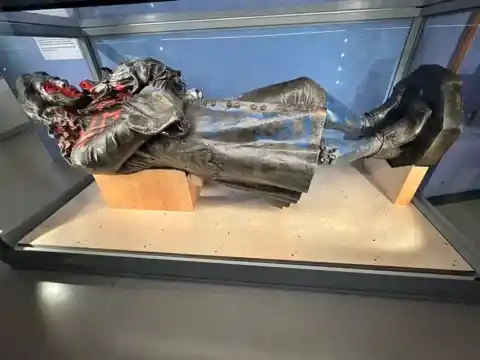
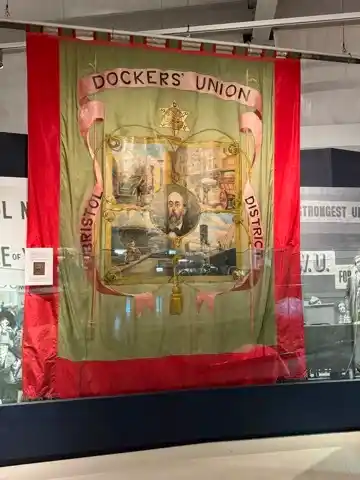
The Bristol People gallery was largely about protests that have taken place in Bristol. There’s a display of a lot of hand-painted Black Lives Matter protest signs, some costumes that were worn in climate protests, a large union banner, information about the fight against slavery (which was a big business in Bristol before it was banned), and a statue of Edward Colton.
The statue wasn’t created for the M Shed. It originally stood prominently in the city. Edward Colston (1636-1721) was heavily involved in the slave trade. In 2020, a crowd toppled it and threw it into Bristol’s harbour. The statue was fished out and displayed in M Shed with appropriate interpretive text. The statue isn’t standing upright. It’s in a glass display case, lying supine with heavy red and blue graffiti paint still on it.
I don’t know if anyone has protested against keeping the statue in the museum. I hope not. My feeling is that we shouldn’t allow the atrocity of slavery to be forgotten any more than we should allow the Holocaust to be forgotten.
The Bristol Life gallery gives an overview of Bristol society, education, entertainment, attire, and other aspects of the past.
M Shed is somewhat interesting, but it’s a small museum. I didn’t spend a lot of time there.
Other photos from M Shed:

Brunel’s SS Great Britain
The SS Great Britain, designed by Isambard Kingdom Brunel, was an ocean-going ship. It’s not ocean-going anymore. It’s now permanently on display in the dry dock where it was built. The dry dock is now a museum.
“Isambard Kingdom Brunel.” What sort of people did his parents have to be to give him that name, you might ask? They had to be the sort of people who were named Marc Isambard Brunel and Sophia Kingdom. That’s what sort. Now, don’t you feel silly for asking?
Aside
SS Great Britain Admission Tip
Venues change their admission policies from time to time. So I’m hesitant to offer this tip. It might not still be valid if you visit the SS Great Britain, which is part of the Bristol Dockyards, another time. But, for what it’s worth, here goes.
I arrived at the SS Great Britain at about 11:00 in the morning. The ticket seller informed me that the adult admission price (there was no seniors’ rate) is £25. But after 1:00 p.m., it is only £15.
The difference is that the £25 ticket is valid for a year. If I bought that, I could come back for free anytime in the next twelve months. The £15 ticket is only a one-day ticket. It is no longer valid after closing time the same day. There was no option to buy a one-day ticket before 1:00.
There was nothing else I wanted to see in the general vicinity of the SS Great Britain, so coming back after 1:00 would have been inconvenient. I bought the £25 ticket.
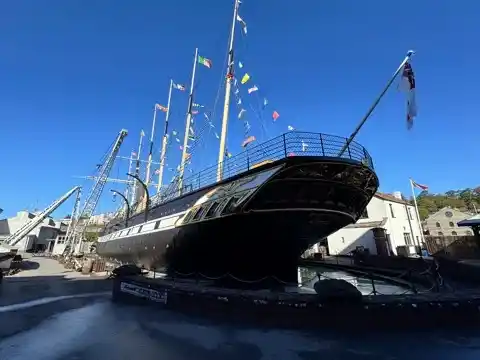
In addition to the actual SS Great Britain, the Bristol Dockyard also contains two museums. One focuses on the SS Great Britain. The other tells the story of Brunel. To board the SS Great Britain, you have to go through the ship’s museum and enter via a gangway from the upper level. The two museums are in separate buildings. There is open, asphalted space between them and around the ship.
The ticket office (and gift shop) is in another building. A wonderful, personable volunteer stood in the compound just outside the door of the ticket office building. As I came out into the compound, she asked me if I wanted to hear a little bit about the SS Great Britain and Brunel, or if I just wanted to wander around and explore on my own.
I opted to hear her brief patter. It was very informative. When she was finished, she told me she was running a free drydock tour at 11:30 that would last about 45 minutes. She said that if I was interested and I had the time, I could look around on my own for half an hour and join the tour. I told her I was interested and, as for time, I’m retired, so I have time. She chuckled and said that she’s retired too. That’s why she’s volunteering there.
What I remember from her brief narrative (with some help from the internet filling in details I forgot) is that Brunel was a prolific and inventive engineer. He wanted to provide transportation that would move people from London, England, to America via a railway and ship that didn’t yet exist. He designed the rail line and got it built. Then he designed the ship and had it built.
The SS Great Britain’s claim to fame was twofold. First, it was the first iron ocean-going ship. Previous ships were constructed of wood. Second, it was the first propeller-driven ocean-going ship. Previous powered ships were paddle steamers.
The SS Great Britain wasn’t the first ship Brunel built for the route. He’d designed the SS Great Western before it. That ship, a wooden paddle steamer, carried passengers and Royal Mail to America. The passengers travelled in what was considered luxury at the time, but Royal Mail was the more lucrative of the two services.
Brunel wanted to build a bigger ship so it could carry more Royal Mail. The problem was, the SS Great Western was about as large as a wooden ship could be. Any larger and it would have broken apart unless it had a very thick hull, which would have reduced the cargo capacity, resulting in very little net gain in cargo space.
Brunel figured he could build a bigger, fully seaworthy ship if he built it out of iron. That’s what he did.
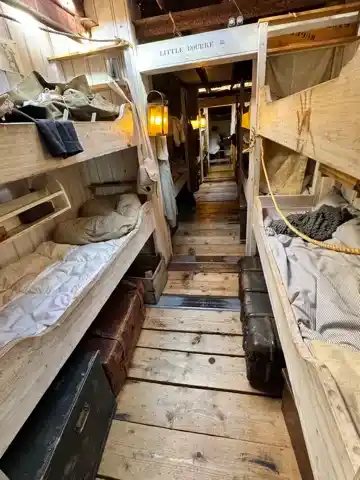
The SS Great Britain completed several trans-Atlantic voyages before it ran aground off the coast of Northern Ireland. Brunel didn’t have the money to free it and repair it. Another company bought it and increased the passenger capacity by stripping out the luxury accommodations and putting in bunks, turning it from a luxury liner into something much more cramped for the passengers. In this incarnation, it took immigrants from England to Australia, and other passengers back.
It ended its service not as a passenger ship, but rather carrying coal from England to San Francisco and bringing back corn on the return voyages. The Panama Canal hadn’t yet been built yet, so it had to sail south of South America. On one voyage, there was a bad storm that roiled the sea off Cape Horn. That damaged the SS Great Britain, rendering it unsailable. It was towed to the Falkland Islands, where the ship was sold to locals for next to nothing.
The locals used the ship as a floating warehouse. After a while, the hull rusted. The SS Great Britain became useless. It was scuttled.
The ship stayed at the bottom for- I forget how long. Then some people decided it was a significant part of history. They raised the necessary funds, plugged up the holes, floated the ship, loaded it onto a pontoon, and towed it across the Atlantic Ocean, all the way from the Falkland Islands off Argentina, in South America, up to the North Atlantic and back to Bristol. And there she is today.
I got most of that from the volunteer. I’m amazed how much of it I remembered. I must have been engrossed. Unless, of course, I misremembered most or all of it. But I don’t think so. I believe the majority of the above at least closely approaches accuracy.
After I left the volunteer, I made a quick run through the SS Great Britain museum and onto and through the ship.
The museum repeated much of what the volunteer said. There was a little more information, but I forgot most of it.
I mentioned that the SS Great Britain was propeller-driven. It was. But it also had masts and sails. I don’t know if the propeller augmented the sails or the other way around. Or maybe they worked together as equals, in perfect peace and harmony. What a wonderful world that would be.
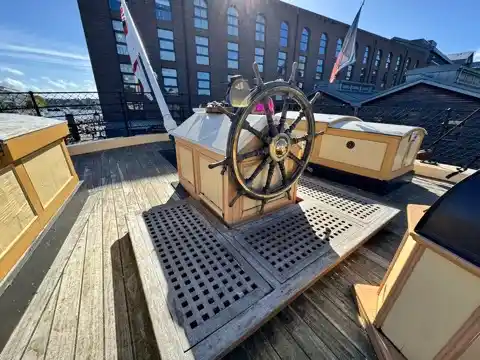
There wasn’t much on the upper deck other than the wooden floor, the masts and the steering wheel. I realized as I wrote this that I didn’t pay attention to whether it was steered from the front (I think nautical experts call that the bow or, more formally, the pointy bit) or the back (the stern or stubby bit).
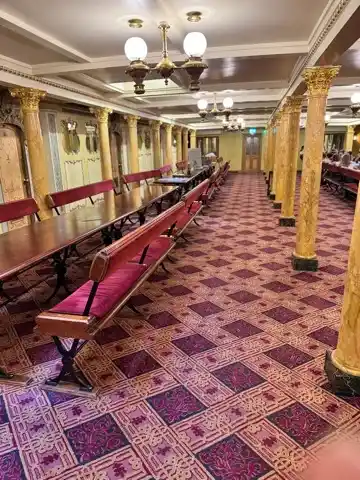
Down below, they recreated half of the ship (I didn’t pay attention to whether it was the front or back half) as it was during its luxury liner days. The other half is recreated as it was during its lower-class Australian passenger days.
Dry Dock Tour
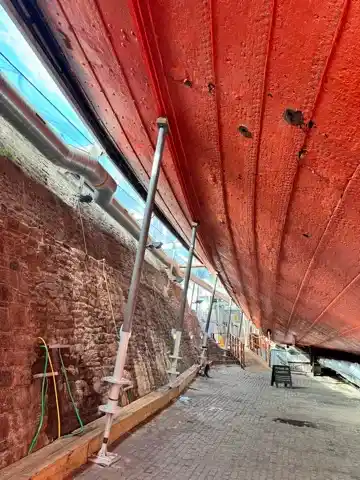
After touring quickly through the SS Great Britain, it was time to rush to catch the dry dock tour. I had to head back through the museum to get there, but I didn’t have far to go from there. The ship rests in the dry dock.
The volunteer took us down some stairs to the base of the dry dock. We were under the hull of the SS Great Britain. Our feet were at the same level as the keel of the ship.
The guide pointed out a cylindrical duct that ran the length of the ship, with vents pointed up toward the ship at regular intervals.
When the ship came back to Bristol, experts examined it and predicted that, if left to the elements, rust would destroy it within twenty years.
They placed large double glass plates between the top (ground) level of the dry dock and the upper part of the ship’s hull and sealed the space. Sophisticated dehumidifiers pump warm, dry air onto the hull. Humidifiers do the same for the interior. As a result, engineers now predict that the SS Great Britain will survive on display for a hundred years.
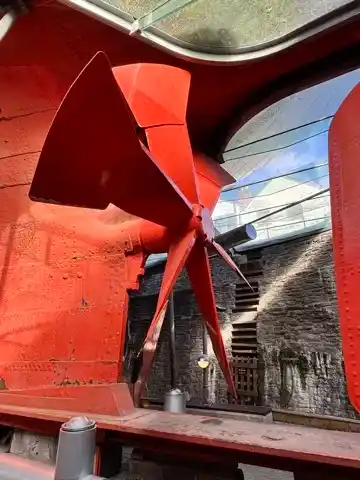
At the bottom of the ship, the volunteer pointed out the riveting and talked about the metal plates that overlapped horizontally but joined flush vertically. She explained they sealed the vertical seams from inside.
She also pointed out that there was much more rust on one side of the ship than the other. The volunteer explained that the ship was lying on its side for some of its time in the Falkland Islands. The side with more rust was under the salt water. The other side was above the water. Rain and snow washed the salt off that side.
We also got to see a recreation of the ship’s original propeller, placed back where it would have been on the ship. And the SS Great Britain’s original anchor rested on the floor of the dry dock.
The guide mentioned that when the SS Great Britain came back from the Falkland Islands, there wasn’t much more than the bare hull left. The furnishings, the engine, and the propeller were all recreated.
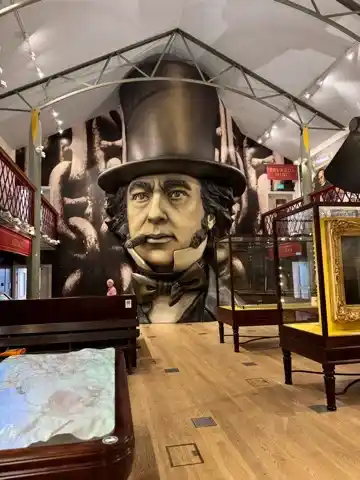
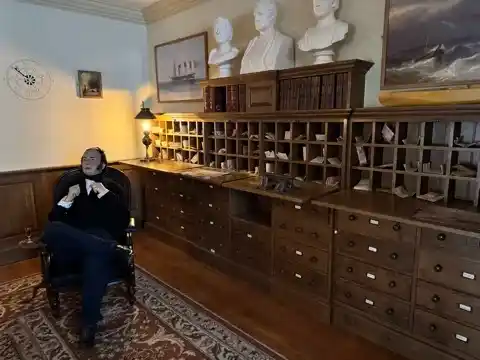
After the dry dock tour, I went through the Brunel Museum. It had exhibits on Brunel’s life (1806 – 1859), along with a recreation of his office in London. Brunel was a very prolific and inventive engineer. In addition to designing ships, he also designed railways, bridges, a tunnel, and a field hospital for the military. Brunel didn’t live in Bristol, but he did a lot of work in the city, including designing one of its bridges. I’ll mention that later, but not in this post because it ends here.
Discover more from Joel's Journeys & Jaunts
Subscribe to get the latest posts sent to your email.
Bath Abbey Tower, Bridge, and a Boat Tour
Herschel Museum of Astronomy, More Bath, and More Bristol
Well! That was very interesting. Kudos to the volunteer for making the spiel so engaging that you remembered a lot of it. Labour of love that ship display was. And a funky little local museum. Nice work. Nice morning. Looking forward to this afternoon’s adventures.
A fine ship, a fine but quirky museum, a fine volunteer, and an overall fine morning. Who could ask for more?