Visiting Iconic Stonehenge
If I had a bucket list, I could now cross Stonehenge off it.
Maybe I should create one. But I worry that if I create a bucket list, I’ll die when there’s nothing left on it. I don’t want to die. So, no bucket list. I’ll let you know how things turn out in 3026.
Stonehenge Visitor Centre
A special bus runs nonstop from a stop a few blocks from my hotel in Salisbury to the Stonehenge Visitor Centre in less than 25 minutes. (It also picks up passengers at one other stop before that, the Salisbury train station.)
Unsurprisingly, there’s a ticket booth before the Visitor Centre. I bought a ticket online well in advance. That might have been a mistake.
There was only one couple in line to buy same-day tickets. They were served quickly.
There was a separate counter for people who pre-bought tickets. Several people waited in that line. The line didn’t move quickly. People had questions. Only one person was available to process them.
When I got to the front, the attendant scanned my ticket, attached a wristband to my wrist because if she attached it anywhere else she would have had to call it something other than a wristband, and told me where to go. I feel the need to say that when she told me where to go, she did so in the politest possible way.
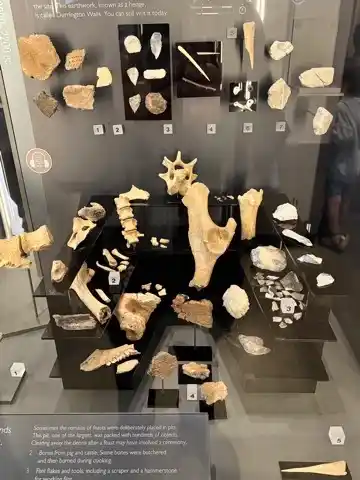
In the Visitor Centre, there is a small interpretive exhibit. It offers a few text panels on how and who built Stonehenge. A panel speculates about why it was built and the purpose it served. Some panels provide information about the people who lived in the area when Stonehenge was erected.
The exhibit area also includes some excavated archaeological relics.
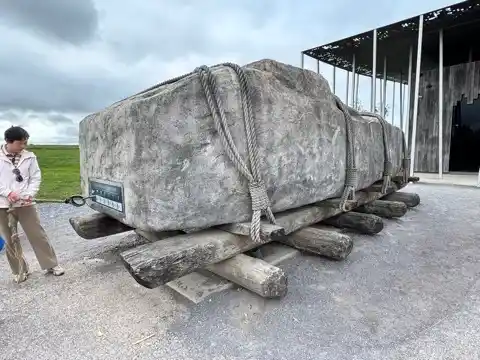
Outside the visitor centre building, there’s a replica of a large stone like one at Stonehenge. There’s a thick rope attached to it. If you push a button and then pull on the rope, a series of lights is supposed to light up, indicating how many people of your strength it would take to pull the rock. I don’t think it was working. I tried it, and it didn’t work for me.
I’m a weakling. Perhaps the device was laughing so hard at my feebleness that it failed to illuminate its lights. Or perhaps I’m so weak that it was a number too high for the lights the device had available.
Perhaps if there were a light indicating “if everyone in the world were as frail as you are, their combined strength still wouldn’t be adequate to move the rock,” it would have lit up.
Other people tried it with the same result. So, maybe it wasn’t just me. Maybe today was weakling day at Stonehenge.
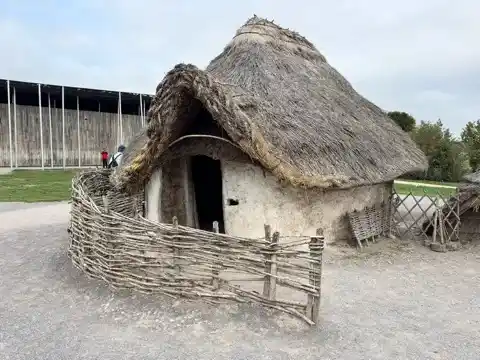
Near the stone sits a series of small thatched mud houses. The text associated with them said that they are recreations that excavations suggest might be generally like the houses that existed in the area when Stonehenge was erected.
Stonehenge itself is not immediately beside the visitor centre, or even visible from it.
When the person at the ticket desk told me where to go, so to speak, she suggested visiting the exhibits at the visitor centre first, which I did, and then catching one of the very frequent shuttle buses to Stonehenge. I asked if I could walk. She responded, “Yes. It takes about half an hour to walk, and it’s along the same road as the buses take.”
I could see the road. It wasn’t wide. The lane set aside for pedestrians looked particularly narrow. And it was separated from the vehicular portion of the road by only a painted line. People were walking, but I rode on a shuttle. I didn’t have to wait long to board one.
Stonehenge
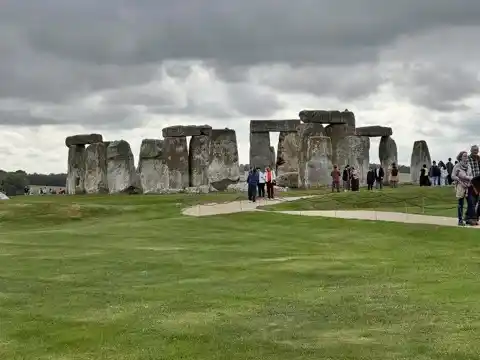
The bus lets passengers off a short walk from a vaguely circular path that wraps around Stonehenge. And there it was.
I’ve seen pictures of Stonehenge; I don’t know how many times.
It’s one of those iconic sights that I think just about everyone with access to books, magazines, and/or television who’s been alive long enough to at least approach adulthood has seen in pictures. However, probably only a small percentage of them have seen it in real life. Not to brag, but now I’m one of those elites. Alright. Maybe that was a humblebrag. Sorry about that.
There’s not much more to say other than it’s an impressive sight. Before what we know today as Stonehenge existed, a circular enclosure stood on the site. But then, about 4,500 years ago, the stones that are there now were erected.
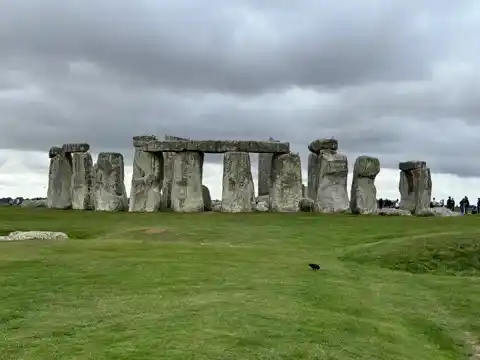
Think about that for a moment. That was 4,500 years ago. There were no powered cranes. And even the wheels as such were rudimentary. When people wanted to move heavy objects, they somehow lifted them on top of a series of heavy logs and used brute force to roll them along that way.
And we’re not talking about small pebbles. The stones in Stonehenge are huge, single-piece rocks.
Information at the visitor centre said that the smaller “bluestones” probably travelled more than 280 kilometres, much of it by boat on the sea and rivers from South Wales.
Some of the larger stones weigh 30 tonnes. I’m skeptical about AI, but if Google’s AI is accurate, that’s roughly equivalent to 20 standard passenger cars. And this is England, so they all drive on the wrong side of the road, but that’s irrelevant.
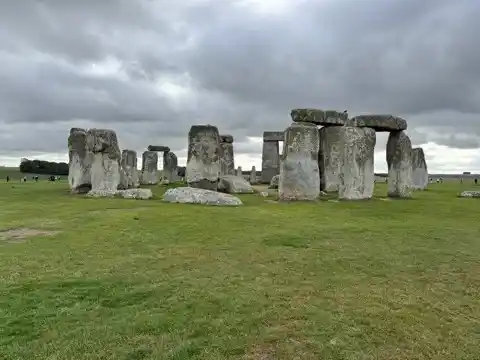
It’s believed that those larger stones came from closer, probably north Wiltshire, about 25 kilometres away in a straight line.
How the heck did they do that without any machinery? I get tuckered out pulling my wheeled luggage for one kilometre. And while I’m not a light packer, I don’t pack as heavily as some people.
And then they had to erect the stones and fix them somehow so they don’t fall over. And some of the stones are horizontal, resting above vertical stones. I find that astounding. And I saw the result in person.
That being said, I didn’t see them too closely.
The path that goes around Stonehenge is a fair piece back from it. On one side, it gets closer than the rest of the way around, but you still can’t get right up to it. But it is, nevertheless, a sight to see.
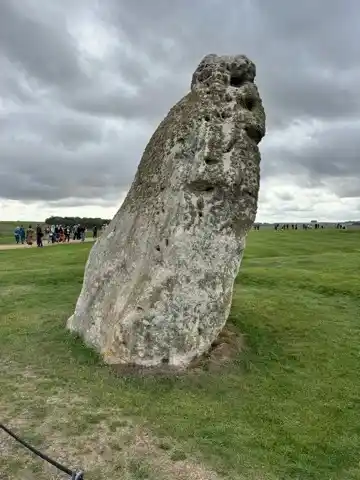
Oh, about getting right up close to it, you can. But you have to be better and more committed to advanced planning than I am. English Heritage, which controls and runs Stonehenge, runs a “Stonehenge Explorer Tour” and a “Stone Circle Experience.” Both get you among the stones.
The Stonehenge Explorer Tour takes groups of at most five people into the centre of the circle of the stones and watches while the resident experts inspect the condition of the stones. It lasts three hours and runs only once a day.
The Stone Circle Experience runs only outside normal visitor hours, one tour in the morning and one in the evening.
The fees for both tours are separate from the general admission fee. And they’re not cheap. I nevertheless fully intended to go on one of them, but when I tried to book online two or three weeks before I arrived, both were sold out for the days I was going to be in Salisbury. So, that’s disappointing.
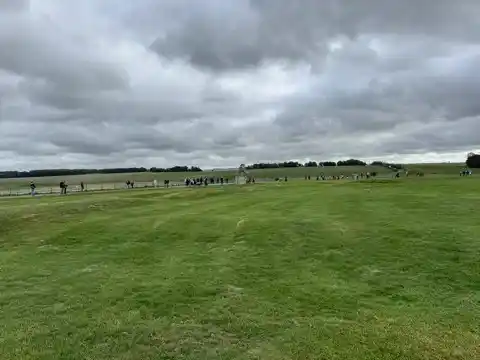
Oh. I probably should have provided some context before starting this section. Stonehenge is in the midst of gently rolling, bucolic green farmland. It’s very pretty.
Back to the Visitor Centre
On the shuttle bus to Stonehenge, I saw a couple of pastures for much of the way on the left side of the road. A plethora of sheep grazed in the pasture closest to Stonehenge. I spied people walking through that pasture.
I decided that, after finishing with Stonehenge, I’d take a brief stroll into the pasture before heading back to catch the bus. A staff member stood on the road near where the shuttle buses enter the Stonehenge compound. I asked her if the path through the pasture heads back to the visitor centre. She told me it does.
I don’t know why the person at the ticket desk didn’t tell me about that option. If I’d known there was a more pleasant route, I might have walked rather than taking the shuttle bus out. I don’t think anyone gets told about that route. The only people walking through the pasture were going back to the visitor centre. None were going to Stonehenge, despite it still being only about noon.
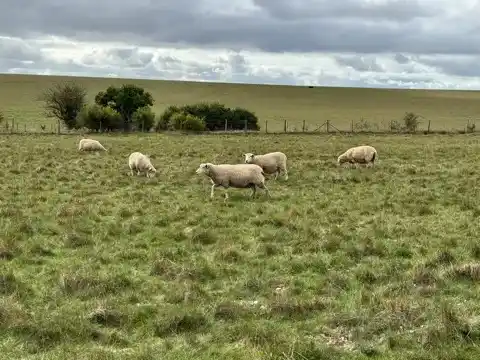
As I mentioned, many sheep grazed in the first pasture on the way back. The path through it was just trodden down, and possibly mowed grass. There was no pavement or gravel. Nor were there fences on either side of the path. No sheep were on the path itself, probably because there wasn’t much for them to graze on it. But there were no fences preventing them from walking across it.
There was ample proof that many sheep did cross the path. I spent most of the time in the pasture looking down to make sure I didn’t step on any of the excessively abundant evidence. Some of the sheep seemed to have eaten quite a lot. A few others appeared to be in a condition that could have benefited from anti-diarrhea medication. But perhaps you consider that to be too much information.
The second pasture was devoid of sheep. I imagine they move the flock from one pasture to the other after a pasture gets grazed down to nubbles.
After passing through the second pasture, I had only a short distance to walk along the road to get back to the visitor centre. There, I had a sandwich before catching the bus back to Salisbury.
Discover more from Joel's Journeys & Jaunts
Subscribe to get the latest posts sent to your email.
Well there it is. You’ve done it. And now you have to see if any strange effects occur. Like seeing into the future, or developing the power of telekinesis, or, more helpfully, learning how to talk sheep so next time you could kindly explain to them that paths are not loos. The pictures were lovely and atmospheric, with moody skies. Doesn’t look to have been crowded, either. And now you can say you were there. Good idea not to tick off a bucket list. I don’t have one either, so here’s hoping I won’t have to kick the bucket, either. We’ll compare notes in 3026.