Journey Back to Gora
After I finished my sightseeing on Lake Ashi this morning, it was time to take the ropeways and cable car back to Gora station. I planned to see some stuff at an intermediate station and one of the transfer stations on the way.
It didn’t work out quite according to plan, but it was an enjoyable afternoon nevertheless.
Ubako Stop on the Journey Back to Gora

I mentioned in yesterday’s post that there’s an intermediate stop on the ropeway line between Togendai Station, where the pier for the sightseeing cruise is, and Owakudani Station, which is a transfer station for the two ropeways. That intermediate stop is Ubako Station.
An announcement on the ropeway is made just before Ubako Station on the way up from Owakudani that says there’s a viewing platform at the station where, on a clear day, you can see Mount Fuji. It also says there’s a display of a couple of the original gondola cars used on the ropeway.
Today was completely overcast. So, I didn’t have much hope of seeing Mount Fuji. If you read this morning’s post, you’ll know that I believe I should have been able to see it from Lake Ashi, but I couldn’t. Clouds obscured the mountain.

But I thought, what the heck, I’ll hop off at the stop, see if I can see the mountain. And, if not, the gondolas come continuously. I can just get on one and continue on my way.
I hopped off. I didn’t see any viewing platform or any signs to it. Nor could I see any attendants to ask once I descended from the boarding level.
I left the station and saw the two vintage ropeway gondola cars. Except, they didn’t look particularly vintage. They just looked slightly different, but not like the sort of classy historical artifacts I thought I’d see.
Wandering around the station a bit, I saw a trail. I walked along it for a piece and came across a sign pointing to Kintarouiwa View Point. (It was a bilingual sign. I assume that’s what it said in Japanese as well.)
True, it didn’t say “Mt. Fuji View Point,” but I figured that maybe Kintarouiwa is the name of the spot that contains a viewing platform where you can see Mount Fuji if it’s visible. The path descended quite a way down the mountain.
The steps on the sloped portions of the path were mostly short vertical planks that held back a small plateau of earth to form the step.

The walk was through a heavily wooded area. There was nobody else around. It was naturally gorgeous.
I eventually got to a viewing area. It didn’t provide a view of Mount Fuji. And it wasn’t because of the cloud cover. The view was in the wrong direction. It was a view of a lake down below. I don’t know if it was Lake Ashi or another one.
The path continued down some steep steps. I walked along it in case there was another viewing platform. But as I continued down, it became clear that the path was never going to turn and rise to a spot that would provide a line of sight to Mount Fuji. So, I turned around and walked back to Ubako Station.
Inside, I was able to find an attendant. He didn’t speak much English, and I speak far, far, far less Japanese (I’ve got three words). Nevertheless, he was able to understand that I was looking for the Mount Fuji viewing platform. He told me “level two” and pointed to the other side of the station from the one where the gondolas are coming up from Togendai Station, i.e., the other side from where I got off.
I walked up to level two on the other side, level two being the gondola boarding/disembarking level. There, I asked the attendant about the viewing platform. He pointed to the window behind the space beside the boarding area and told me that was it. “But, too cloudy,” he said. “Can’t see Mount Fuji.”

So, the viewing platform was through a window, which will likely either have at least some glare or reflections. That didn’t seem ideal to me.
I’ll be in Hakone tomorrow as well. I don’t think I’ll return to Ubako Station to try again even if it does clear up. There are other places to see Mount Fuji, such as from the ropeway up from Sounzan Station when it’s close to Owakudani Station, or through a window in Owakudani Station. I know this because I saw it briefly from those spots yesterday. I was just hoping for a better, more lingering look.
But at least I got a lovely and thoroughly enjoyable walk in the woods out of it today.
Mount Fuji is sacred here. I hoped that if I could meditate on it, the Buddha would bring me enlightenment. Or, if not enlightenment, some good tempanyaki. I haven’t had any yet this trip.
Owakudani Stop on the Journey Back to Gora

Yesterday, I mentioned the sulphur steam vents in a crater beside the Owakudani Station. I even showed you a video of it (and, by the way, Mount Fuji). But I didn’t spend much time looking at them then.
Today, I spent some time at Owakudani.
The sulphur-spewing crater was pretty much the same today. That’s probably a good thing because I don’t imagine there’s much that can change it dramatically in a day that isn’t a volcanic eruption. But I did get a look at the crater from a couple of different angles. It has a kind of post-Appocalypse feel to it.

I walked around a bit and saw that there’s a small viewing area on the other side of the parking lot at Owakudani. The view isn’t toward the crater and its sulphur vent, but rather away from it. I could see another sulphur vent, with a very well-defined plume of steam powering up from the side of the mountain, without any crater that I could see.
Plus, a sign told me that I could see Mount Fuji from there. I couldn’t because of the clouds. But if it’s clear tomorrow, I might go back.

The view isn’t the only reason I wanted to stop at Owakudani. There’s a museum, or I think it might just be a branch of a larger museum elsewhere in Hakone, that I wanted to see, the Hakone Geo Museum.
The museum is small, basically a short hallway that leads to a small room. But it has some interesting exhibits.
For example, I learned that the hot springs that feed the onsens* in the area aren’t all entirely natural. Hot springs rise naturally as a result of their water pressure, but pumps are necessary to bring them to onsens at higher elevations.
(* I’m not sure, but I think “onsen” has a double meaning. I believe it means both a volcanic hot spring and the baths that use the hot spring water.)

And in many cases, they drill wells, pump in water, and mix it with volcanic gases, which adds sulphur to the water. They then pump the result to resorts that use it in their onsens. It’s a bit more complicated than that, but that’s the gist.
The museum also displayed a collection of volcanic rocks, including blocks of bright yellow sulphur. And they had a diorama that showed all of the various equipment they use to monitor the volcanic activity at the Owakudani crater. I trust they’ll warn me away if necessary. They can warn other people too, but me in particular.

Plus, they have a display that requires me to correct something I said yesterday.
Yesterday, I said that the crater at Owakudani with the steam pouring out of it was the result of an eruption 3,000 years ago. Not so.

I got that information from a recording on the ropeway as it approached Owakudani. It was kind of noisy in the ropeway car. I guess I misheard. There was an eruption 3,000 years ago, but that’s not what created the crater. The recording must have been referring to something else that the eruption did. (I heard on the boat cruise this morning that lava from it dammed up a river, creating Lake Ashi. But I don’t remember anything about Lake Ashi being mentioned on that ropeway ride.)
In the hallway of the Geo Museum, there’s a timeline showing the event that created the crater. They began to notice volcanic activity there in April of 2015. The first minor eruption after they saw the activity occurred on June 30th of that year. There was continued activity after that.
The ropeways and Owakudani were closed for, if I read the timeline correctly, about a year. They didn’t fully reopen until July 2016. So, the event that formed the crater didn’t occur 3,000 years ago. It occurred less than ten years ago. Yikes! Yikes! Yikes! (Did I say, yikes!?)
Sounzan Stop on the Journey Back to Gora

Sounzan is the transfer station where you change from the ropeway to the cable car between Owakudani and Gora. There’s not much there, but I didn’t notice yesterday that it has a viewing deck. I walked out to it and took a gander. It provides a nice view of the valley below.
Then, it was time to catch the cable car back down to Gora.
There isn’t much in Gora that I could see, just some residences and hole-in-the-wall stores and restaurants. So, after taking a very quick look, I walked from Gora down the steep hill to my hotel to end my day’s activities.
Discover more from Joel's Journeys & Jaunts
Subscribe to get the latest posts sent to your email.
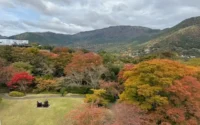
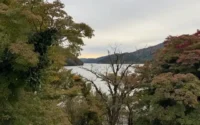

Some good wandering and lovely views, only not of Mt. Fuji, but I am sure it is still there. It was a little jarring to hear that the eruption was so recent. Ahem. I am sure it will be fine. Knock on wood! I hope the sun shines on your travels tomorrow (or probably today by the time you are reading this).
I feared that I didn’t made it clear enough how enjoyable the inadvertent walk in the woods in a failed search for a Fuji view was. The forest was quite beautiful.
Yes, I’m sure the volcano will be fine. Now, if I could only convince the voice screaming inside my head of that.
Volcano – 3,000 years ago after all. Scary and sulfurous, in hellish smell-evision.
The major volcanic eruption was 3,000 years ago, but the lesser volcanic event that caused the sulphurous crater at Owakudani and shut down the ropeways and businesses and attractions at Owakudani was in 2015. A lesser event, but still enough to do all that.