A Taste of Gävle

This morning, I took a train from Uppsala to Gävle, Sweden, a journey of not much more than an hour.
Faithful followers of this journal know that for the past couple of trips, I’ve tried to include alliteration in the title of the first post in the cities and towns I visit. You’ll notice that I didn’t do that here.
There’s a reason for that.
I could have easily come up with words starting with an English “g” sound—“Great Gävle,” “Going to Gävle,” or “Gallivanting in Gävle,” for example—but I don’t think they’d be alliterative.
Here’s the problem. I have no idea how to pronounce Gävle. I would have pronounced it “gahv-lay,” and that’s how I started pronouncing it in my head when I learned of it when planning this trip, but a guidebook told me it should be pronounced like “yerv-luh.” The problem is, I’m not sure I would pronounce yerv-luh correctly either.
So, even with the guidebook’s help, not knowing for certain how to pronounce the phonemes in Gävle, let alone the first one, how can I create alliteration? Hence, you’re stuck with “A Taste of Gävle” as the title.
Why, you might ask, a taste rather than, say, a feast of Gävle? Because I’m here for only two nights—a day and a half of activity time—that’s why. I don’t think that qualifies as a feast.
Aside
Umlauts
I’m going to be in seven cities or towns on this trip, yes, seven. Three of them, including Gävle, will be just two-night stays. Of the seven, four of them have umlauts in their names, which can be a bit of a pain when using an English keyboard—doable, but a pain.
But that’s not the point of this aside. The point is, why doesn’t “umlaut” have an umlaut? Yes, I know we don’t use diacritics in English. And for all I know, the word for umlaut in an umlauted language might very well have one. But why can’t we make an exception and have one in English too? Any of the vowels would do. That would make the dictionary definition easier.
For example, if we spelled it ümlaut, the dictionary definition could be:
ümlaut; Do you see those two dots over the first “u?” Yeah, that’s an ümlaut. (See also: “Who’s on first?”)
I arrived at my hotel before noon. My room wasn’t ready. I checked my bags and headed out for the afternoon to explore Gävle, with a brief break to return to my hotel and claim my room.

There are a couple of museums in Gävle that look interesting based on the description in my guidebook. (While all three of the guidebooks I have on this trip mention Gävle as an interesting place, only one goes into any detail on it. That’s why I have it. I bought the other two first, without knowing they lacked detail on Gävle.) Neither of the museums is open on Monday. Today is Sunday. Monday is my only other day here, so I visited the museums today.
I also had some time for wandering around.
Before going on, I should mention that because I didn’t get started until close to noon, I’ll post only this entry today. If you go looking for a morning post for today, you’ll be looking a long time. Eternity, in fact. And who wants to spend an eternity looking for an entry that isn’t there? Not me, even if it would extend my life until the end of time.
Länsmuseet Gävleborg

“In the Middle of Sweden,” 1972-1973
In English, “Järnvägsmuseet” is the “County Museum of Gävleborg”. It has three floors of exhibit space, two of which are an art gallery and one, the lowest exhibit floor*, has exhibits on the history and life of Gävle County. The art is by Swedish artists, including one local to Gävle.
I started at the top of the museum and worked my way down. The floors aren’t tiny, but they’re not immense either.
The top floor holds contemporary art spread over a few small rooms. A few of the pieces were totally abstract, but most were varying degrees of abstracted reality. And some were very realistic, including a couple of photographs.

Surprisingly, I didn’t hate many of the pieces on this floor. And I even quite liked some.
I’ve included photos of a few here. For example, the one posted a the top of this section is titled “In the Middle of Sweden.” The English description accompanying it said, “In the middle of the street is a big hole, or is it a puddle? … The red and blue road sign says No Parking. Meaning if anyone dares to come here, they aren’t even allowed to stop!”
Before I read that, there was absolutely no doubt in my mind that it was a big and very deep hole in the middle of the street. But after reading it, while staring at the picture for a while, it flipped back and forth between a hole and a puddle for me. Is that a good, bad, or neutral sign regarding my mental health?

“Feigned anger,” 2019
Another piece on this floor, titled “Feigned Anger,” was weird. It was part blown-up photograph and part real polar bear skin in a large spherical metal cage.
The text with “Feigned Anger” said, “A small boy howls and grimaces, feigning anger. But inside, he is just as angry and sad as he appears in this family photo.”
Concerning the significance of the bear skin in the piece, the text went on to say, “He [the artist] also collected polar bear figurines, where the polar bear denotes safety in the midst of chaos. Here, the polar bear is shut inside the round cage, caught in the tombola of life. Who will win? Who will lose?”
Um. Okay.

The top floor also contained a tan-coloured corduroy jacket that was so stiff that it stood erect on its own on the table it sat on. There’s a reason for that. It wasn’t a corduroy jacket. It was an earthenware sculpture, but the corduroy, buttons, and buttonholes looked exceptionally realistic. It wasn’t until I looked at the lining of the jacket that I saw rougher earthenware.
There was also a room on the top floor with textiles. Some were hung on the wall. Many were in myriad pull-out drawers. And some were put to use on furnishings in a display.


“King Karl XII as a Child with his Siblings.\,” 1685
The middle floor rooms started with contemporary art and progressively got older as I walked along. The oldest painting I saw was dated from the 17th century. I included a photo of it, “King Karl XII as a Child with his Siblings,” here. The little future King Karl looks so peacefully asleep, doesn’t he?
I didn’t know anything about King Karl XII of Sweden before today, but I quickly scanned his Wikipedia entry. As king, he fought a lot of wars, launched some himself, and died in the trenches during one. Such a sweet-looking child. Who could have predicted it? It’s always the quiet ones, isn’t it?
There were a few paintings on this floor that intrigued me, but one in particular. I fear that a certain art historian might sneer at me for this, but I was strongly drawn to a painting titled “Wilderness Landscape,” dated 1861.

“Wilderness Landscape,” 1861
I know that when I say things like that in these pages about art pieces, there’s usually a punchline coming. Sorry to disappoint you, but not this time. I seriously found it captivating.
There are two evocative trees in the foreground and some rustic residences, more trees, mountains, and a lake in the middle-ground and background. But what makes the painting almost literally stunning is that the whole scene is illuminated with, if you’ll pardon the contradiction, brilliant yet sombre and calm light. And the oil paint on the canvas has a lot of literal depth in places. The painting immediately drew my eye and held it.
Do I qualify as an art historian yet?

“Rjukan,” 1897
In addition to the paintings, this floor contained a small room with ceramics and another with glassware.
The first floor held exhibits on the history, society, and development of the country. The display included some archaeological artifacts, along with some items from more recent history and life in general.
Much of the text on the exhibits was in Swedish and English, but some was only in Swedish. I didn’t get a lot out of the latter.
(*By the way, I haven’t mentioned it yet, but, not surprisingly, they use the European floor numbering system here. The first floor is the floor above the ground floor. The ground floor is labelled “E” in elevators in Sweden. Don’t ask me what that stands for. I don’t know.)
Järnvägsmuseet

Järnvägsmuseet is the Swedish Railway Museum. It’s a little way out from the centre of the city, and it took more than 35 minutes to walk there from my hotel.
As you can guess from the English name, it’s a railway museum. You can probably also guess that from the Swedish name if you speak Swedish. But that’s not for me to say. That’s for a Swedish speaker to say.
Google Translate can guess it too. It tells me that “järnvägsmuseet” does indeed translate to “railway museum.”
(What is this thing Swedes have with welding two words together to form one word? I’ve seen that at other museums, such as Länsmuseet, but not just there. Another word or name gets, I think, invariably, inseparably wedded to “museet,” with the former taking the lead. Is there a tax on spaces in this country?)

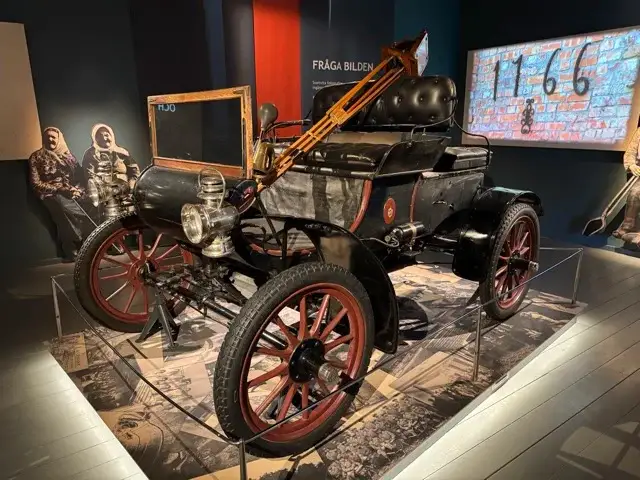
The Järnvägsmuseet contains some old locomotives and railway cars. Interactive video screens provide information about each beast (they are beast-sized). The screen user gets to select whether to view the information in Swedish or English. The crowd was sparse enough that I never had to fight a child or a frail old woman to get a screen to myself.
There were also some texts and items concerning the history of railroads in general and, more specifically, in Sweden.
A couple of videos played on tall kiosks. When I arrived, they had Swedish audio and Swedish subtitles. But there was an “E” button I could press to switch the subtitles to English.
A couple of stations had headphones with “S” and “E” buttons beside them. I put one to my ear and pressed the “E” button. I heard what I assume was a Swedish soundtrack. I tried pressing “E” a few times, but it didn’t change. I tried the “S” button, and it continued to drone on in the same language.

I assume it was talking about railways in general, Swedish rail specifically, railway technology, or some other rail-related topic, but for all I knew, it could have been talking about Costa Rican coffee production.
There is one section in Järnvägsmuseet where there’s a long, narrow, precisely cut trench in the floor. On top of the trench, flush with the floor of the main part of the building, there’s the sort of glass you can walk on. In the trench are various items like a table with some old-looking drawings and other documents, a chair with a uniform jacket slung over it, and other objects I’ve forgotten. None of them looked like the sort of things that would normally be found underground or in a trench.
To get from one side of the building to the other, you have to walk on the glass or take a leap over it. My leaping days are over, not that I ever did much of it or was any good at it.
I’ve mentioned my acrophobia in these pages often. The glass floors in some towers’ observation decks petrify me. I’ve challenged that fear a few times in my travels (and once in Toronto), and I’ve beaten it a couple of times, but I’ve failed to bring myself to walk on a glass floor far more times than I’ve succeeded.
What I don’t think I’ve mentioned here is that all glass floors make me nervous, even ones where the fall wouldn’t kill me if the glass broke, such as at the Järnvägsmuseet. I’ve done it in places where they put a glass floor a little above some relics excavated on archaeological digs. But I fight panic the whole time I’m on the glass.

Sure, the fall won’t kill you if the glass breaks, but the glass shards could do a lot of damage.
I walked on the glass at the Järnvägsmuseet—it only required one step on the glass to get across, and another one when going back to the entrance/exit—but it was a step of fear, I tell ya.
I was almost finished going through the museum when a voice came on the loudspeaker and spoke in Swedish. Then she spoke in English, something about the last train to the train hall leaving in ten minutes. I had no idea what that was about.
I took a look at the last exhibits and walked quickly back to the entrance, stepping gingerly on the glass floor on the way. I asked about the train at the front desk.
One of the two people there said it’s leaving in three minutes, she’d show me where the station is and tell me about it on the way, so I can decide if I want to go by the time we get there. She said it’s a large hall with a lot more trains, but it’s on the far side of town from the museum. The train goes there. It is the last one from the museum, but there is one more return train after people have had a chance to look around the hall.

I went.
On the way, the train made a stop at Gävle’s central train station, which is only a little more than a ten-minute walk from my hotel. Ahha, I thought. I see a way to avoid that long walk back into the centre of town from the museum.
The hall is exactly what she said, a large building with a lot of big old trains. There were locomotives and carriages, including a couple of old royal carriages. There was also a severe carriage that was used to transport prisoners.

In addition to trains, some cars, bicycles, and handcarts that ran on rails were also on display. Back in the day, supervisors used them to inspect the tracks. There is a term for those rail handcarts, bicycles, and cars that I’d never heard before. The English text in the hall referred to them as draisines. An entrepreneur expanded the draisines and turned them into buses on rails that were in commercial service for a while.
The Järnvägsmuseet and its train hall were both interesting, and I enjoyed looking at the beasts of the rails.
And, yes, the train did stop at Central Station on the way back, too. I got off there.

Wandering Around Gävle

(Note: because of the long introductory text above, some of the pictures that belong in this section appear way above in the introduction.)
I did a lot of walking from the train station to my hotel and from there to Länsmuseet Gävleborg and Järnvägsmuseet. Plus, after I finished with the railway museum and hall, I had time to do some random wandering.
I’m really liking Gåvle so far. And there are places mentioned in my guidebook that sound interesting and/or pleasant that I haven’t been to yet. (I’ve got all day tomorrow for that.)
A river runs through the city. The buildings here are pretty well all mid-rise and quite attractive. There’s a long, wide pedestrianized street that’s enjoyable. There’s another street parallel to it, and one street over that isn’t fully pedestrianized, but it has a wide sidewalk with a double row of trees. And traffic is cut off in one direction for one block as the street passes by a large public square.

Perpendicular to those two streets and intersecting with them, there’s another exceptionally delightful street. In the middle of the street, there’s a linear park that I estimate would be about eight or so lanes wide if it were a street. But it’s not a street. For about four blocks, it’s grass, paths, a gazebo, and fountains that bookend that section. There were also several tulip beds planted. They were past their prime now but there were still a lot of healthy tulip blossoms.
There are also sidewalks running on either side of the park for its length. There are dense rows of mature trees on both sides of the two sidewalks.
There are roads on either side of the park, with two lanes of traffic on each, going in opposite directions on opposite sides of the park. At least on one of those streets, where it intersects with the pedestrianized shopping street, it narrows from two to one lane to give pedestrians a fighting chance. I didn’t notice if the street on the other side does the same thing. I’ll try to remember to look tomorrow.

That lasts for about four blocks. The linear park ends on the other side of a cross street from an attractive theatre that is currently being renovated.
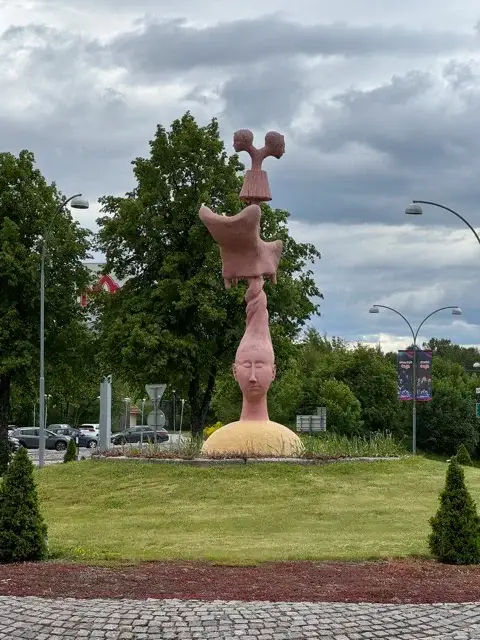
Beyond the theatre, the linear park resumes, but on the other side of the theatre, it’s less kempt and less adorned, but still very pleasant. That section of the linear park ends at a traffic circle. However, the bordering sidewalks with double rows of trees continue here, too. There’s a sculpture in the middle of the circle that would take too many words to describe, so I’ll post a picture here.
I don’t want to give the impression that Gävle is a utopia. I did walk through a rather humdrum residential neighbourhood. And once I got out of the central part of the city, there were portions of the walk to Järnvägsmuseet that bordered on bleak. But overall, it looks like a great place to live and be.
I’m already very happy I came to Gävle, and I’ve still got another day here.
Discover more from Joel's Journeys & Jaunts
Subscribe to get the latest posts sent to your email.


An interesting day, and a promising place so far (however you pronounce it). Lots of art. And trains. No, you’re not quite an art historian yet, but enjoying yourself with art is a good step. And the last train to the train hall? Read to me like a fantasy story, you know, like you have to jump through a wall at a ‘non-existent’ track running inexplicably through a museum. Whee! Where will you end up next?
Art and trains. What more is there to life? I mean other than food and sleep. A good book can be enjoyable too. And seeing new places. I like that. Okay, there’s a lot more to life. Never mind.
I didn’t read the mystery and fantasy into “the last train to the train hall” that you did. It would have put a completely different spin on it if I had. I just thought it was getting close to closing time.
Yer in {Yerv-luh} are ye? Or more accurately (as I write this out of sync), ye were in {Yerv-luh}, the whistle stop on the iron road where the traveler sojourned for a bit.
Gävle. Järnvägsmuseet. Ürgh. A question you may have already answered in the time-space interval since you posted your ümlaut/umlaut aside: did you know you can let the näturalłŷ mäñïċűřěð tïp of finger or thumb lîňğër à bït lönger on Apple keyboard keys țō séľèċț the diacritic of choice? I for one was quite delighted to find that feature. It’s definitely felicitous to have done so in time for your Swedish journey.
Meanwhile, I enjoy vicariously visiting places you post about, regardless of the number of diacritics involved. I also enjoy encountering new vocabulary: tombola, draisine. And I have an enormous appetite.
Um, I have an enormous appetite for trompe l’oeils. Imagine an international tour de trompe l’oeils! Take me to traditional art history sights in galleries, estates, churches. Locate urban murals, school hallways, roads, and sidewalks where clever artists use spray paint, commercial and residential paint, tile, mosaics, chalk, and other media to trick the eye of the beholder. Only honest brokers need apply.
Yes, I did know about that Mack and iOS trick for getting accents. I usually use that, but there are so many umlauts here that I learned the keyboard combination because it’s easier than holding down a key and then trying to figure out which of the variations you want if you have old eyes. I have old eyes.
I’m glad you’re enjoying everything you’re enjoying.