Mitaki Temple and Lunch

This will likely be a short post. Not counting lunch, which definitely should count for a variety of reasons, I visited just one sight, Mitaki Temple. It took me half an hour to get there. More than half of that involved walking, but almost the first half was on a local train.
I spent most of the morning at the temple complex. It was well worth it.
After leaving Mitaki Temple, I spent more than half an hour journeying to lunch, again taking a local train and an even more local walk. I know that in the last several trips, I haven’t usually written about lunch, or any meals, unless they’re part of a food tour. However, lunch today was interesting and enjoyable. And the locale received an entry in my walking tour app. Plus, despite loving Mitaki Temple, this post would probably be embarrassingly short without a discussion of lunch.
Mitaki Temple

The Buddhist Mitaki Temple is another of Japan’s incredibly beautiful spots. I’ve been to only a small fragment of the country, yet I can already say Japan has at least its share, and probably more than its share, of beautiful spots.
The lowest part of the temple compound starts near the base of Mount Mitaki. I say “near” the base because there is a bit of an uphill walk along a city street to get there.
My walking tour app warned me that during cherry blossom time in the spring and fall foliage time, Mitaki Temple can get very crowded because Mitaki Temple is a good location from which to look at either. The app recommended that I go on a weekday during those times.

This is peak fall foliage time here. I didn’t plan that. I just lucked out, and it’s been glorious. Today is a Thursday. I don’t know if the weekday advice was good or if the app was wrong about the crowds, but Mitaki Temple was delightfully uncrowded today. I wasn’t alone there, but the grounds were sparsely occupied.
The temple compound is built in a lushly forested area on the side of the mountain. Here and there, small but tall waterfalls cascade over the mountains. There are also a few peaceful, sculpted ponds.
Gentle paths and stairs proceed through the Mitaki Temple compound and by its buildings.
Walking trails, usually with stairs, climb the mountain. I followed one for a while. At one point, there was a set of stairs with the mountain on one side and a sheer cliff on the other.

Some other stairs on the path had handrails on the open side. This set didn’t. The steps were wide enough that a normal person wouldn’t be afraid of the potential for a fall. (I thought about saying “potential for falls” rather than “potential fall,” but if you fell near the top of the set of stairs, you’d probably only get one shot at a fall.) I’m not a normal person.
My acrophobia showed its ugly face.
It isn’t universal everywhere in all cities in Japan, but the custom here is to walk on the left. Going up the stairs with the unprotected drop, that custom had me hugging the mountain. As beautiful as they are, mountains don’t get nearly enough physical displays of affection as they need for the benefit of their emotional health. I was happy to hug this one. That’s just the sort of warm, generous person I am. I give and give and give.
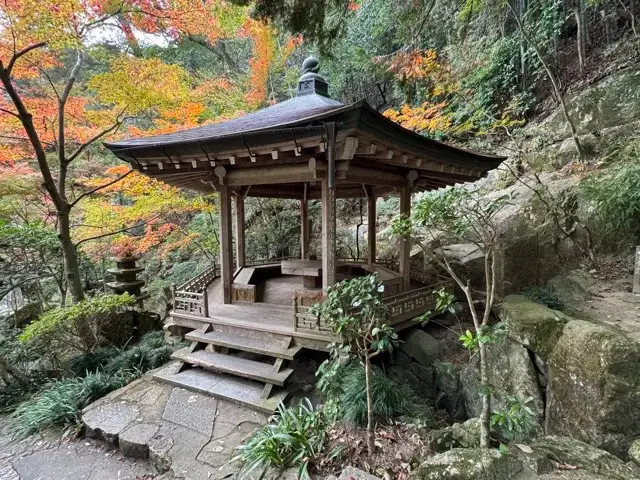
Going down, the “walk on the left rule” would have put me on the sheer-drop side of the stairs. Fortunately, I didn’t encounter anyone walking up while I was walking down. I hope the mountain appreciated its hugs in both directions.
I walked up past those stairs until the path looked a bit rough and possibly a bit washed out. There was also a warning sign there in English about the closing time of the temple gates and making sure you’re back before then. I turned around.
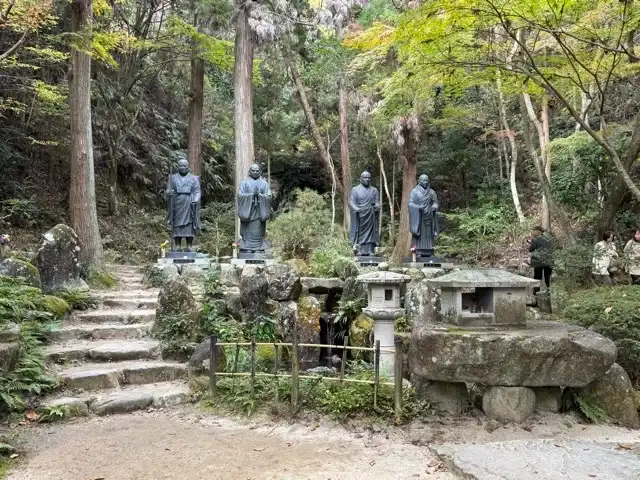
Sculptures are scattered throughout the temple grounds. Six small Buddha statues—some standing, some sitting—wearing jaunty woven red caps and red bibs, sit on a base at the entrance to greet people. Strewn throughout the grounds, there are a few more red-capped, red-bibbed sculptures of a similar nature, although usually a little larger.

Many sculptures of various sizes without headgear or bibs also adorn the grounds; a few of them are placed in niches carved into the bare rock. The unadorned sculptures include both Buddha and other Buddhist iconography.
The buildings of Mitaki Temple vary. There are small shrines and larger prayer halls. There was a service consisting of continuous chanting going on in one of the buildings when I was there. The building was attractive, but I didn’t want to take a picture that risked looking through one of the open doors and capturing an image of the worshippers. However, I did take a picture that sweeps across the front of the building from one side, avoiding the doors but capturing an interesting sculpture on the platform at the front of the building.

On a landing partway up the main set of stairs, there’s a ceremonial bell and its wooden ringer waiting to be rung. Down a few steps from the bell and off to the side of the stairs, there was a sign, computer-printed on plastized paper, saying “only one per person.” (I’m paraphrasing because I didn’t take a picture or make a note contemporaneously, but that’s the gist.) It didn’t say one what.
There was another Japanese-language sign printed on wood above that. I used Google Translate on it. The sign provided instructions on chiming the bell. So I assume the English sign was telling me I could ring the bell only once. I adhered to that rule.
On a plateau, atop a short flight of stairs, there’s an exceptionally attractive two-tier vermillion pagoda. A sign there explains in English and Japanese that it was built in 1526. It also says the pagoda is the original. I’m sure there have been several repaintings and nip-and-tuckings since then, but the structure is the one that was built in 1526.
You’re no doubt thinking, “Wait just a cotton-picking moment, Joel. This is Hiroshima you’re talking about. How the heck is the original pagoda still standing undamaged after the atomic blast of August 6th, 1945?”
The answer is simple. I said it’s the original pagoda. I didn’t say it was originally there. It was built on the grounds of the Hirohachiman Shrine in Wakayama Prefecture, 378 kilometres (about 235 miles) as the crow flies away from Hiroshima. It was moved to Hiroshima in 1951 to “console the souls of victims who died in the atomic bombing.”

Another building at Mitaki Temple is a teahouse. I had a matcha tea and a Japanese confection there. (You have no choice about the confection. By tradition, a confection always comes with matcha tea at a Japanese teahouse.)
I sat in an area of the teahouse with an open front that looked out on a serenely gorgeous and gorgeously serene scene. A curvy pond with a large rock in its midst serves as home to some koi slowly and calmly swimming about. Behind the pond, looms the mountain face and a narrow waterfall tumbling over it. The sights and sounds are very tranquil and stunning.
I took some pictures, but because none could do justice to the totality of the scene, including the fish, I also took a video. Warning: The video is a tad on the long side. There are no car chase sequences, car crashes, or fight scenes, and nothing blows up or gets killed. So, if tranquil is not your thing, I strongly advise not bothering to watch the video. I posted below one of the still pictures I took, so you can get a sense of it without sitting through the boring short.
The description of Mitaki Temple above was not in chronological order. The teahouse came in the middle of my visit. After spending considerable time in the temple compound, any satiating effects of the confection had worn off. It was time to go for lunch.

Okonomimura
I had lunch at Okonomimura. Okonomimura is not a restaurant. It’s a collection of small Okonomiyaki restaurants on three levels of one building.

I don’t think I’ve discussed okonomiyaki in these pages yet. It’s a Japanese cuisine, but it’s not one of the heavy-hitters in Japanese restaurants in North America. Sushi, teppanyaki, tempura, ramen, sure. But okonomiyaki, not so much. I’ve rarely seen it in Japanese restaurants back home.
Because it’s rare in North America, and probably many, if not most, places outside of Japan, I don’t know how many people who haven’t been to Japan are familiar with it. It warrants talking about.
The first time I had okonomiyaki was several years ago, ironically, in a Japanese restaurant at home in Toronto. I didn’t like it.
At that point, I hadn’t yet been to Japan. When I did go, despite not liking it in Toronto, I thought I should give okonomiyaki a try in its home country. I had some in Osaka and in Hiroshima on that trip. I loved it in both places.
I don’t think okonomiyaki is common throughout Japan. I didn’t seek it out there, but I didn’t stumble on any okonomiyaki places in Tokyo or Hakone. But they’re plentiful in Kyoto, Osaka, and Hiroshima. I don’t know where else.
This trip, I had it twice in Kyoto, once in Osaka, and now twice in Hiroshima.
Okonomiyaki is usually called a pancake. That will mislead anyone familiar only with North American or European pancakes.
It consists of multiple layers cooked on a griddle. There are variations of okinamiyaki in different cities, but they all have the same general format, if somewhat different ingredients.

One layer has ingredients that are broadly similar to a Western pancake, but it’s typically thinner, often thinner than the dough portion of a crepe. After that, there is usually a thick layer that varies among different cities. It might be shredded cabbage, or it can be noodles. If it’s noodles, you’re usually offered a choice of either soba or udon noodles.
There might be other layers depending on the variation. And you’re always offered a protein layer. It can be pork, shrimp, scallops, oysters, beef, or probably a few other options that I’m not aware of or have forgotten. Vegetarians or people with food restrictions that prohibit the available options can go for just a plain okonomiyaki without the protein layer. (I had a seafood mixture this time.)
When I was in Japan the first time, in both Osaka and Hiroshima, the okonomiyaki was cooked on a griddle in front of me. In Osaka, it was made an a griddle in the table I had to myself. In Hiroshima, it was made on a long griddle built into a counter, with chairs on one side and the cook on the other.
The layers are built one by one. In Osaka on that first trip, because every party had its own table, the cook put the first layer on the griddle at my table, and then moved on to another table to add whatever layer the okonomiyaki was ready for at that table, then on to another table, until my first layer was cooked, and it was time to add another layer. This was repeated until all the layers of the okonomiyaki were done.
Because it’s built up in layers, every time a layer gets added, the okonomiyaki gets flipped, so the new layer goes face-down on the griddle so it’ll cook.
On that first Japanese trip, the Hiroshima experience was similar, but because customers all sat at a long counter with a long built-in griddle, the cook didn’t have to move between tables, just back and forth along the griddle.
On this trip, I had that long-grill counter experience both times (including today) I had Okonomiyaki in Hiroshima. However, in Kyoto and Osaka, the okonomiyaki was prepared somewhere else, and the finished pancake was placed on a griddle in front of me merely to keep it hot, not to prepare it.
At most okonomiyaki places, they bring you a small plate and a small metal spatula. The plate is usually way too small to hold the whole okonomiyaki. Instead, you use the spatula to carve off a hunk while it’s still on the griddle, and move that hunk onto your plate. You then use the spatula to carve it into bite-sized pieces on your plate that you can pick up and eat with your chopsticks.
As I said, in Okonomimura, there are several small okonomiyaki restaurants, usually with one L-shaped griddle in each. Each restaurant has different variations of okonomiyaki. How do you choose which one? Good question. I went to the first one that had an empty seat at their griddle, and the okonomiyaki looked good. (Most restaurants I’ve seen in Japan, not just okonomiyaki places, have pictures of their food out front, or sometimes 3D plastic models of it. At Okonomimura, it was just pictures.)
The place I chose has both a shredded cabbage layer and a layer of udon or soba noodles in each of its okonomiyaki pancakes.
The eating protocol there was different from what I’ve experienced elsewhere. They didn’t provide plates or chopsticks. Instead, you use the small spatula to carve a bite-sized bit of okonomiyaki while it’s still on the griddle. You then scoop it up and eat it off the spatula. It wasn’t the most genteel way to eat, but it worked. And the okonomiyaki was delicious.
Damn. I said this was going to be a short post. It ended up more than twice as long as I expected. That’s enough for now.
Discover more from Joel's Journeys & Jaunts
Subscribe to get the latest posts sent to your email.

Mount Misen (Miyajima)

Hiroshima Prefectural Art Museum, Hiroshima Orizuru Tower

Num num! That was a delicious and informative conclusion. I now know a lot more about okonomiyaki than I did before. I wasn’t too impressed with it when I tried it in TO, but it sounds amazing. Glad to get a heads up on eating etiquette. As to your lovely video: not only did I not think it was too long, I think I could have it on continuous loop! How beautiful!
I’ve come to love okonomiyaki. In Toronto, we have great restaurants serving pretty well every cuisine in the world. There’s probably a good okonomiyaki place somewhere. I may have to make it my mission to find one.
I shot the video with you in mind. I figured you would like it even if nobody else did.