Scottish Storytelling Centre and Edinburgh
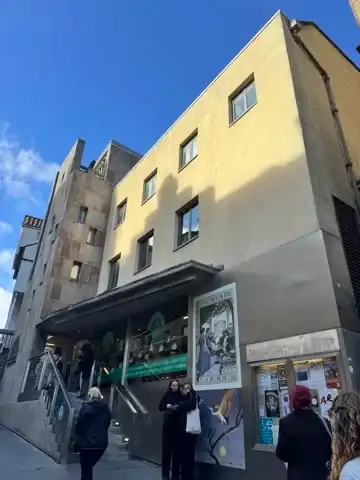
I just finished spending a full week in Edinburgh, Scotland. (I posted this on a train from Edinburgh to my next stop.) Nevertheless, this is the only page you’ll find about Edinburgh from this trip. I think I mentioned in a previous entry or two, and I know I mentioned it on the “about” page, that I generally write about only travels for tourism purposes, not when I visit family or friends.
I started this trip with a visit to a Dear Relative, who shall remain nameless for these purposes. She, needless to say, lives in Edinburgh. I say she shall remain nameless for these purposes, but she has, obviously, a name for other purposes. It’s a perfectly fine name, one to be proud of, but I don’t know if she wants it splashed around the internet, possibly to be seen by the ones of strangers who find this journal.
DR works at the Scottish Storytelling Centre, which is how it ended up in the title of this page. A colleague of DR asked if I’d mention the Scottish Storytelling Centre here. I think she might have thought that would gain the centre more attention than it’s ever likely to get from being included here, but here it is.
Had it not been for that request, I might have stayed silent about my time in Edinburgh and, therefore, not mentioned the Scottish Storytelling Centre. I likely would have picked up the tale after I left. I will be travelling around a bit of England after this. I’ll resume my regularly scheduled travel journal posts then.
Oh, by the way. My first time in Edinburgh was already in my journalling days, but before DR moved there. So, you can find more entries about Edinburgh from that and other trips by following the links on the Edinburgh index page linked here.
Edinburgh in General
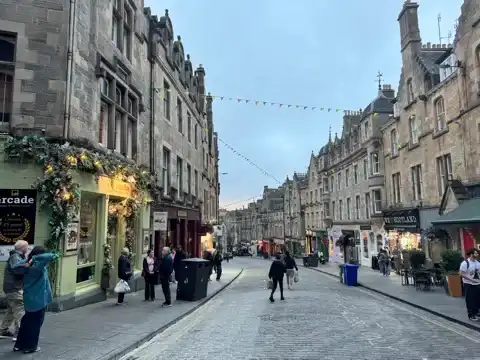
DR being in Edinburgh very much heightens my experience of the city, but if you enjoy and can afford travel, I highly recommend visiting Edinburgh. Even without a DR (your own DR if my DR isn’t your DR) in Edinburgh, it is a beautiful, lively, experience-filled city.
The Royal Mile, a cobblestone thoroughfare in Old Town running from Palace of Holyroodhouse to Edinburgh Castle, is charming. Souvenir shops, cashmere shops, kilt shops, whisky shops, restaurants, bars, hotels, museums and churches fill many of the stone buildings lining the Royal Mile.
I didn’t visit either the Palace of Holyroodhouse or Edinburgh Castle this trip, but I have been in both of them on previous trips. They’re worth a visit. And the Royal Mile between them, which I walked up and down a few times this trip, is always lively, characterful, and worth a stroll.
The one drawback is that the Royal Mile is often crowded with tourists. I’ve been in Edinburgh just before its famed Fringe Festival in August, and just after it. This trip, I arrived about two weeks after the end of the festival. My avoidance of Fringe was intentional. I hate crowds and clamour. I’m told that Fringe is full of both. (Hotels are also more expensive and rooms are harder to come by then) However, if you’re a lover of the performing arts, you can probably get your fill during Fringe, as myriad venues host shows every day of the festival. But how would I know? I’ve never been to it.
The Royal Mile is in Edinburgh’s Old Town, which also houses the eclectic, informative, and enjoyable National Museum of Scotland. I think I’ve at least popped in there during all four of my visits (so far) to Edinburgh. This trip was not an exception. I enjoyed it again.
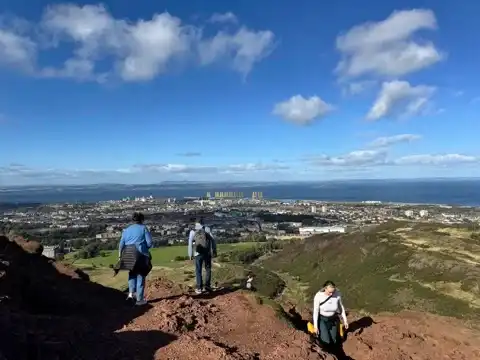
The Old Town is home to other museums, parks, restaurants, charming old buildings and streets, and other attractions. Also on that side of Edinburgh, but away from the centre of town, is Arthur’s Seat, a tall hill formed by an extinct volcano. I believe climbing up it at least once is obligatory for all visitors to Edinburgh. Depending on which route you take, it’s not treacherous until you get to the peak. The summit is a cone with lots of rocks and no particularly trustworthy footholds that I’ve been able to find.
During two previous visits, I climbed to the very top, in a sheer panic for that last little bit.
Two of my many fears are 1) heights and 2) particularly untrustworthy footholds, especially when they’re high, but not exclusively when they’re high. By the way, as a somewhat different point, I’m not the sort of person who gets chemically high except the occasional alcohol buzz. Nevertheless, I confidently advise against climbing to the very summit of Arthur’s Seat while you’re chemically high unless you’re a complete idiot. I also wouldn’t advise it if you’re a complete idiot, but you likely wouldn’t follow my advice if you are, so why would I waste my breath?
Despite overcoming those fears in the past, I got to the edge of the base of that short cone, but I couldn’t coax myself to the top this time. Nevertheless, the views from there and along the way up are stunning. This can be a problem, because being in a stunned state isn’t recommended at that elevation any more than being high there is.
Railway tracks, with green space on either side, separate Edinburgh’s Old Town and New Town. The National Gallery of Scotland straddles that. Regular readers of these pages know that I’m more of an art tolerator than an art aficionado. But I went in for a while, as I have on previous visits. It’s a very attractive building. It’s large enough to feel it’s worth a visit (especially because it’s free), but small enough to see it all without sliding into a stupor from gallery overload.

New Town is new relative to Old Town. But it’s not particularly new, particularly when compared to much newer cities of, say, North America. Its age does still grant it considerable charm. It’s pleasant to stroll around, with lots of satisfying neighbourhoods and parks. I highly recommend a stroll along the Water of Leith walkway. It’s beautiful.
There’s a hill in New Town, Calton Hill. It has some monuments, old buildings, ruins, and a cafe at its top. Calton Hill is nowhere near as tall as Arthur’s Seat. And the paths up it are perfectly civilized stairs or sloped paths. The view of Edinburgh and over to Arthur’s Seat from atop Calton Hill is beautiful.
I visited two Edinburgh attractions for the first time this trip: Edinburgh Zoo and the Royal Yacht Britannia. More about both anon, with anon meaning right now in this case.
Edinburgh Zoo
The Edinburgh Zoo is a short bus ride from the centre of Edinburgh. It’s quite large and climbs up a hill. There are stunning views of the hills behind the city from atop the hill.
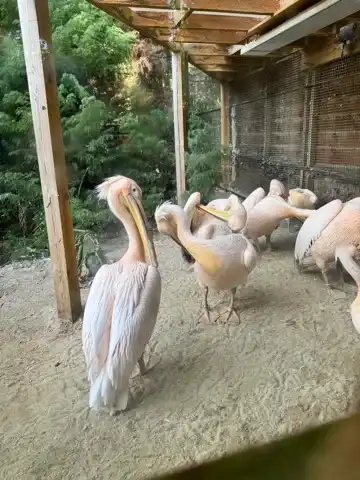
One of the first groups of animals we saw was white pelicans. Despite the name of the species, they weren’t white. They were light pink with some yellow accents. They are truly glorious birds.
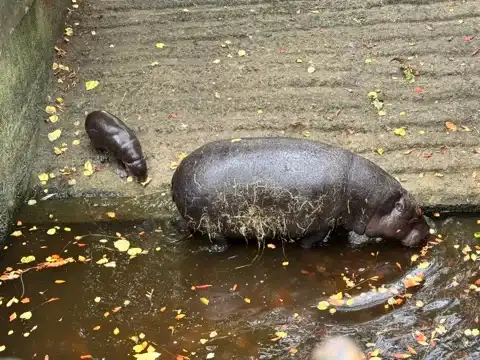
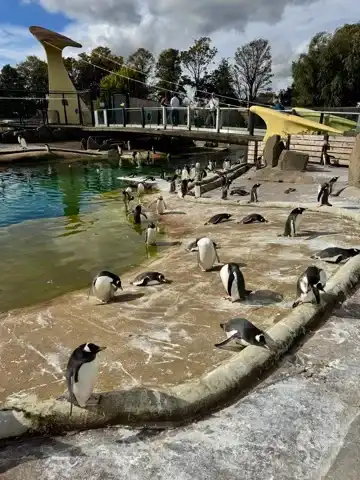
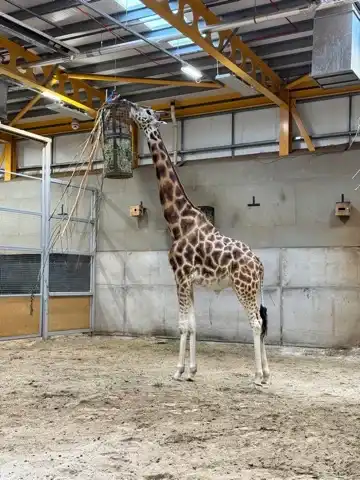
Among the species we saw were playful penguins, graceful giraffes, proud lions, adorable pygmy hippopotamuses, curious meerkats, charming lemurs, lively monkeys, and a hard-to-spot anteater. As a bonus, a baby pygmy hippo swam and gobbled leaves alongside its mother in their little pond. I undoubtedly loved other animals there, but I can no longer recall them off the top of my head. I sincerely apologize to those species for my frail memory. I don’t mean to offend any of them.
The animal enclosures at the Edmonton Zoo are generous in size, with vegetation appropriate to the species they hold. Animals that need small ponds get small ponds. Some of the animals have both indoor and outdoor areas. For example, we saw the four elegantly necked giraffes of the herd outside a couple of times, but also once indoors, which provided a much closer view of them.
More animals at the Edinburgh Zoo:
Royal Yacht Britannia
After its 1953 launch, Royal Yacht Britannia served as Queen Elizabeth II’s yacht for 44 years. It’s now decommissioned and permanently docked in Leith, a suburb of Edinburgh. A foundation operates it as a tourist attraction and event venue.
When I first saw the Royal Yacht Britannia from the shopping mall containing the entrance to the gangway, I was unimpressed. It doesn’t look particularly sleek or regal. Most of the windows visible from there are small portals. The walls are quite plain. That view was from the back.
Touring the Britannia, however, revealed a ship more in harmony with royalty. The windows are larger toward the front. There’s a large sundeck. The royals had nice bedrooms. Most of the beds that the royals used were singles, including in the separate-but-connected bedrooms of Queen Elizabeth and Prince Philip. However, Charles, then Prince Charles, asked for and got a double bed for him and Princess Diana. Ironically, there were no king- or queen-size beds.
The tour of the Royal Yacht Britannia also took us through the large royal dining room and sitting rooms, along with the lesser quarters of the crew.
There’s now a tea room with floor-to-ceiling windows that wasn’t there when Britannia was the royal yacht. I don’t know what the space was back then.
When I typed this up and looked for pictures of the Royal Yacht Britannia to post here, I discovered that I’d forgotten to take any. Sorry about that.
Scottish Storytelling Centre
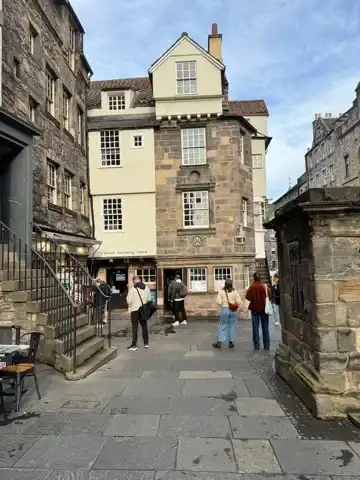
The Scottish Storytelling Centre, which is on the Royal Mile, doesn’t get star billing in tourist guidebooks. I don’t think I was there during my first visit, which was before DR moved to Edinburgh.
My walking tour app has separate entries for the Scottish Storytelling Centre and the John Knox House. If you’re looking for two separate buildings, you won’t find them. The John Knox House is part of the Scottish Storytelling Centre. A new building was grafted onto the side of the John Knox House to form a single venue.
The Scottish Storytelling Centre is built on a hill. It has two entrances. One is into the John Knox House through its street-level bookshop. The other is in the newer building, up a short set of stairs due to the hill. Because the old and new buildings are effectively a single building, you can enter through either door to reach any of the interior spaces.
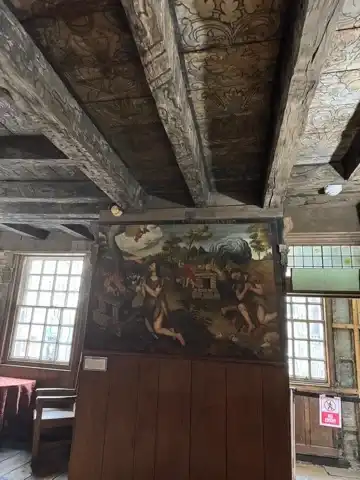
The John Knox House dates to 1470. It and the building beside it are the oldest surviving medieval houses on the Royal Mile. For a small fee, you can take a self-guided tour of the house, which serves as a museum. Upon paying the fee, you receive a set of laminated pages with information about the house’s history and its charming old rooms.
I’ve been through the John Knox House a couple of times in my life so far. It makes for an interesting visit.
The rest of the Scottish Storytelling Centre is an arts venue. There is a theatre, some other event spaces, a small bookshop, and a cafe. (Try the haggis at the cafe. It’s very tasty.)
I think there are events at the centre every day. The nature of the performances varies from day to day. Look at the events page of the centre’s website to see if there’s one that interests you while you are in Edinburgh. I went to a Gaelic folksong concert by Maggie MacInnes and her band. She performed songs passed down through the generations in her family. The show was delightful.
Edinburgh Summary
I spent a full week in Edinburgh this trip. It probably would have been shorter if DR hadn’t been in Edinburgh, but it’s still worth a lengthy visit on its own. There is more than enough to see, do and soak in that I doubt you’d get bored spending that long, or even longer, in the city.
Discover more from Joel's Journeys & Jaunts
Subscribe to get the latest posts sent to your email.
Edinburgh: Edinburgh Castle, Holyrood Palace

Edinburgh: Gladstone’s Land, Writers’ Museum, Georgian House, Calton Hill, Museum of Edinburgh
Your DR being my DD (Dear Descendant), I have her to thank for many wonderful things in my life, which includes introducing me to the beauty and enchantment of Edinburgh. Otherwise, I am ashamed to admit, it wasn’t on my radar as a place to go see. Ditto with the Scottish Storytelling Centre. If the SSC is not on the list of recommended sights on many of your usual tourist lists, that is because the same ’10 best’ get parroted over and over again on travel sites, leaving diamonds like the SSC to the locals, who love it and support it. (Another reason to read Joel’s Journeys and Jaunts for travel jewels!). Indeed, it is not designed to be your typical tourist spectacle, which should make it even more attractive to tourists who want something more authentic. It is a great place to see local Scottish culture celebrated, but it is more international than that, with performances, exhibitions, and participatory events that include music, storytelling, theatre, and art. And in a congenial setting, with reasonable ticket pricing and a selection of free events as well. Thank you lovely Edinburgh, thank you, lovely DD, thank you intrepid Joel for your intensely savoured travel blogs, and kudos to all the lovely people at the SSC for making it such an amazing place! I look forward to going back.
One final heartfelt thanks, Joel, for that photo of the pygmy hippos, mom and babe. Cuteness overload that is.
No, I was not paid for any of these endorsements. Although not disinterested, they are sincere!
DR/DD is responsible for many great things. I can’t remember what first attracted me to Edinburgh, but I think it might have been praise from DR/DD after a visit she paid to it years before moving there.
Yes, the Scottish Storytelling Centre is a warm, inviting and authentic place, with a charming staff.
You’re welcome for the part of the thanks directed at me. As to the pigmy hippo, I can’t remember where it was, but I recall being at a zoo with you many years ago when you expressed great admiration for a pigmy hippo. So, of course I had to include a picture.