Itsukushima Jinja (Shrine) & More Miyajima
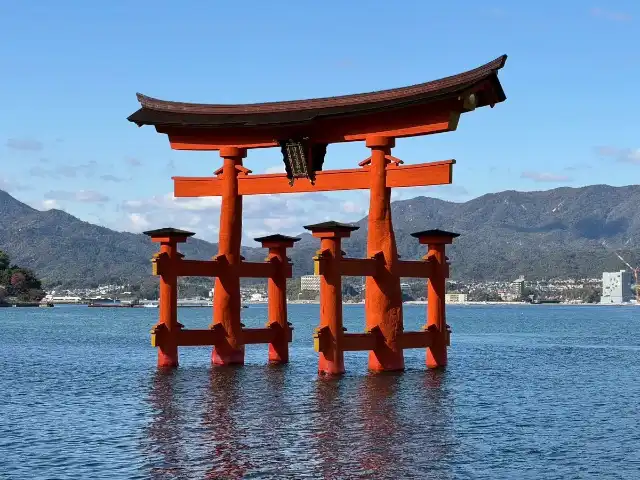
Out of my base in Hiroshima, Japan, I spent the day on Miyajima Island, starting off at its main shrine, Itsukushima Jinja. I didn’t get there until mid-morning.
I didn’t get to sleep until late yesterday, in part because I spent some time yesterday evening grappling with a technical problem with this journal.
After leaving my hotel, it took me about an hour to get to Miyajima Island. First, I caught a local train from the main Hiroshima station, just a couple of minutes’ walk from my hotel. The train took about half an hour to get to a station that’s a few minutes’ walk from the pier where ferries to Miyajima dock.
From that pier, Miyajima is about a ten-minute ferry ride away.
There is a ferry that leaves from a pier closer to central Hiroshima, but it would have taken me almost as long to get to that pier as the train took to get me to the one I used. Plus, the ferry from that other pier is considerably farther from Miyajima.
And there’s another reason I took the route I took. The train I took is run by JR (Japan Rail). Two companies run ferries to Miyajima from that pier. One of them is JR. Before coming to Japan, I bought a three-week JR Pass that covers both the train and the ferry.
Sort of. I got to the pier and showed my JR Pass. The attendant confirmed that it covered the ferry, but I had to pay a ¥100 (less than $1.00 CDN) Miyajima visitors’ tax. That required me to go to a machine, plunk in a coin, get a ticket, walk back, and hand the ticket to the attendant. It’s a good thing that there wasn’t a longer line at the machine. The ferry departed less than a minute after I boarded.
Miyajima Island
I read that the official name of the island, or at least the English transliteration of it, is Itsukushima, but it’s commonly known as Miyajima.
Don’t ask me why that is. Maybe it’s analogous to me being officially known as Joel, but commonly known as Schlemiel. However, I don’t think “Miyajima” is derogatory in any way. So, the analogy falls apart there.
And by “commonly known as,” I mean almost completely known as. That’s what my guidebooks call it. That’s what’s on the signs at the ferry dock and on the island. Google Maps refers to the island as Itsukushima, but that was one of the exceptionally few instances of the use of that name for the island.
Miyajima is mostly mountainous. However, there is enough flat land by the shore for a village. At least there is enough on the part of the island by the ferry piers. I don’t know about the rest of the shore around the island’s circumference.
There is a walkway along the shore to Itsukushima Jinja, which isn’t far from the ferry. Buildings on the inland side of the walkway contain mostly souvenir shops, restaurants and small hotels. Miyajima is a major tourist destination. This isn’t high season, but there were a lot of tourists there.
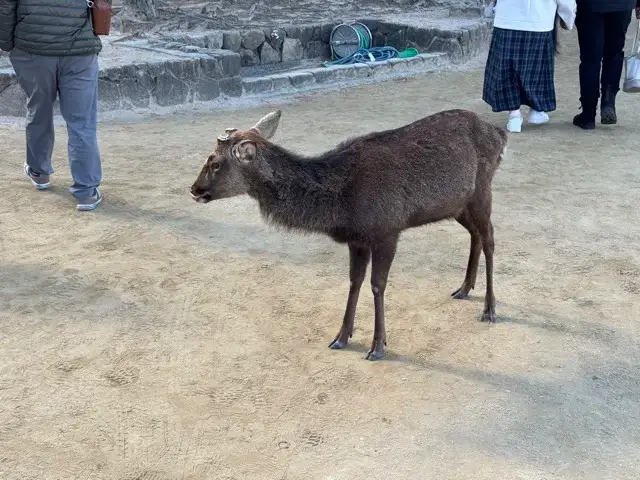
Regular readers might remember the deer of Nara from my post on Nara, near Osaka, a couple of days ago. They’re on Miyajima, too. I didn’t see the same warning signs as they had in Nara about the potential aggression of the male deer, especially in mating season, which it now is. However, there was an announcement at the ferry dock about that.
I did spot one sign about the deer hidden away on Miyajima. It said they were wild animals and, to keep them that way, don’t feed or touch them. Unlike in Nara, I didn’t see vendors selling deer biscuits, nor did I see anyone trying to feed them. However, if someone were carrying a piece of paper, the deer would try to steal and eat it.
I did see lots of people petting the deer. It’s hard to criticize them for that. I saw only the one sign. And I saw it serendipitously. It was where not many people ventured. How can you blame people for disobeying a sign that was put somewhere they weren’t likely to see? Vogon demolition orders are displayed more prominently. (Anyone who is not a “Hitchhiker’s Guide to the Galaxy” fan, please move on. The Vogon reference wasn’t meant for you.) Besides, the deer are so gosh-darned cute.
Itsukushima Jinja
While the island is generally known as Miyajima, and I’ve seen the shrine referred to as Miyajima Shrine, the sign at the shrine names it Itsukushima Jinga.
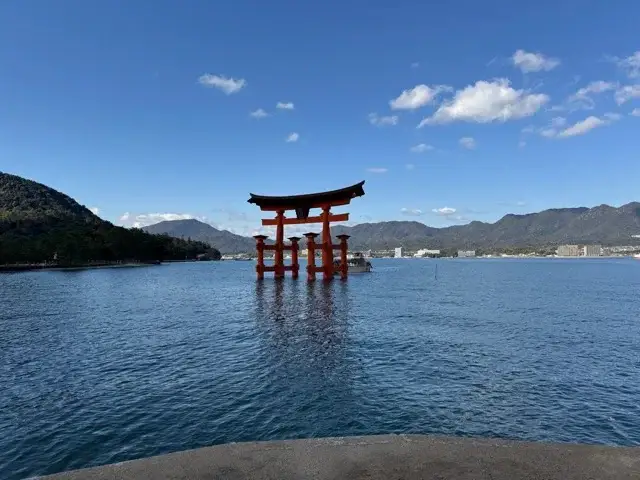
Itsukushima Jinja (“jinja” means shrine) is most famous for its torii, which is referred to as an O-torii. I’ve also seen it spelled without the hyphen, Otorii.
I read somewhere that, while a torii is a gate, an O-torri is a great gate, similar to “O Canada,” I guess.
I don’t know how many people have seen Itsukushima Jinja’s O-torri in person, but I can, with high accuracy, tell, just by looking at them, who has seen a picture of it, although I’m not sure if this works in poor parts of the planet.
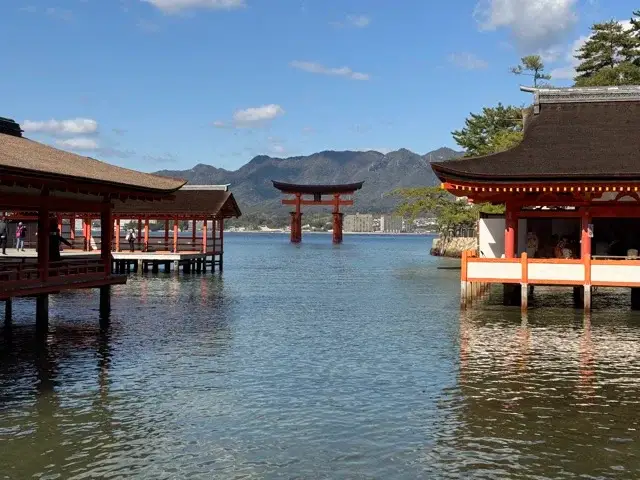
It’s an easy trick to learn. You too can easily tell, on sight, who has at least seen a picture of Itsukushima Jinja’s O-torri.
First, place yourself directly in front of them. Make as intense eye contact with them as you can under the circumstances, whatever those circumstances may be. Hold that eye contact for as long as the other person allows.
Next, blink exactly three times. Not two times. Not four times. Three times.
Then, direct your attention to the person’s forehead. Focus on it for at least five seconds.
Next, clear your throat loudly enough that they can hear you, but not so loud that you’ll be charged with being a public nuisance. Then, observe their reaction.
Finally, you’ll have the answer with almost certainty. Yes, they’ve seen a picture of Itsukushima’s Jinja’s O-torri. Pretty much everyone has seen a picture of it. And if you were the one exception, now you have seen a photo of it. There’s a picture of the O-torri posted at the top of this entry and more elsewhere. I took several pictures of it, from various positions, with and without framing objects, and at different zoom levels. It’s truly iconic.
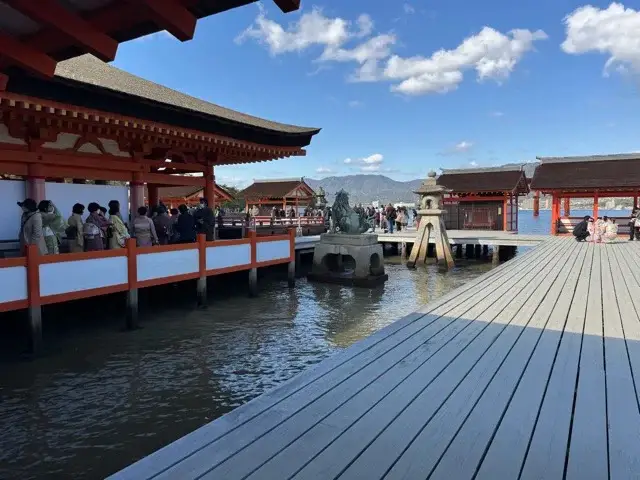
At high tide, or some of the way to or from it, the O-torri looks like it’s floating on the sea. I don’t think it was the zenith of the tide when I arrived, but it was more than high enough to have this effect.
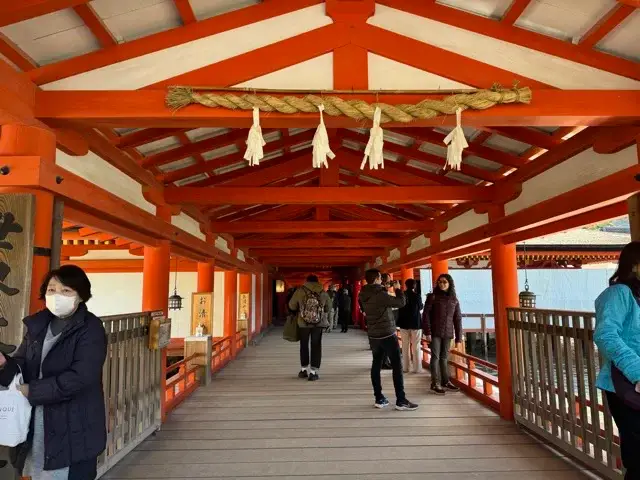
The shrine itself is handsomely understated. A few simple buildings are connected with covered walkways with wood-beam floors. The ceiling beams, the support pillars of the buildings, and the roofs of the walkway are vermillion. It’s lovely.
The buildings and walkways rest on wood posts. When the tide is high enough, the posts hold them above the water. When it’s not, they hold the buildings and walkways above sand.
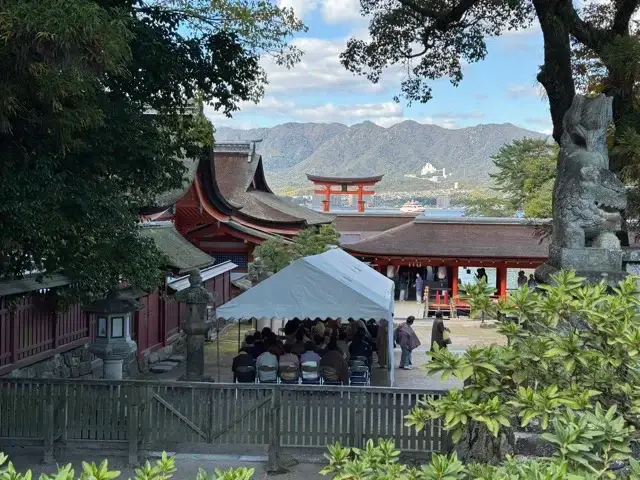
The Itsukushima Jinja isn’t the only thing to see in Miyajima Town. For example, there’s also Hokoku Jinga, a shrine across the street and up a small hill from Itsukushima Jinja.
Hokoku Jinga
Hokoku Jinga is an open-sided building constructed of pillars, beams, floors and ceilings, that look like very tired, old wood. Sturdy wood, it’s true. It looks like it’s in good shape for wood of its age. But it does look old.
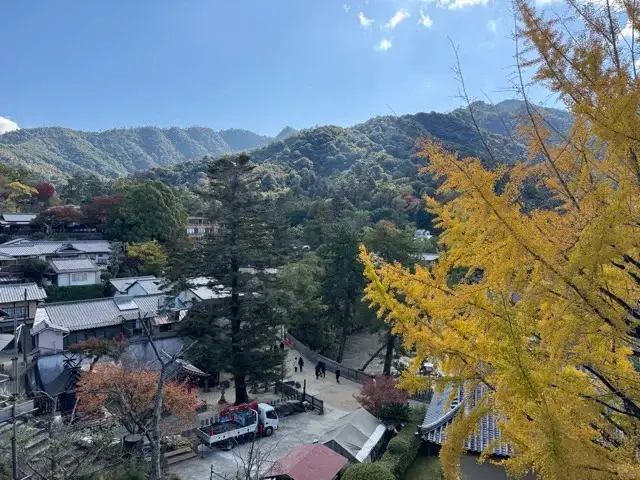
The shrine is one large, sparse room. You must remove your shoes and put them in the provided plastic bag to go inside. There are exits/entrances on two opposite sides of the shrine. So, it’s a good idea to take your shoes with you in the bag in case you want to leave by the other exit. That, and they don’t have any places by the entrances to leave shoes.
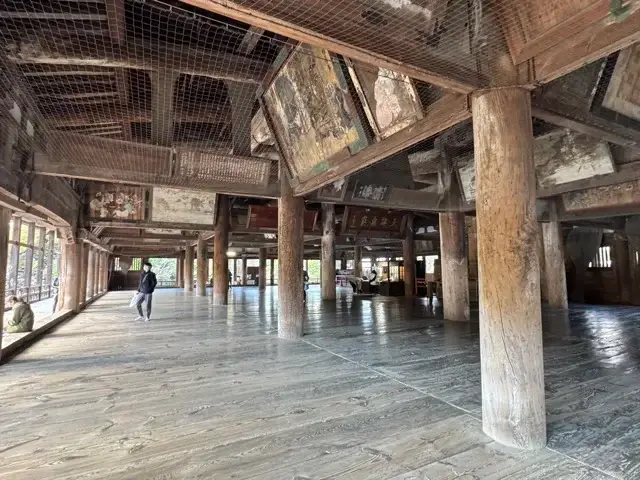
Note a couple of points I made above. First, Hokoku Jinga is up a slight hill. Second, its sides are open. The result of this is that there are platforms on the sides of Hokoku Jinga that provide nice views.
Hokoku Jinga has a lovely, vermilion five-storey pagoda beside it. The edges of the roofs of the tiers of the pagoda are framed in black. I know that it’s lovely and vermilion with black framed tiers solely from looking at a picture I took of it when I was there seven years ago. Today, it’s surrounded by scaffolding covered with a gauzy material.
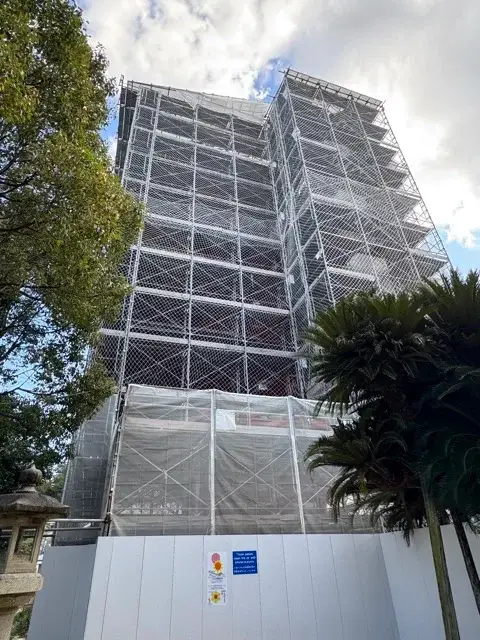
Seven years ago, I had an earlier version of the iPhone. The resolution and image quality were not nearly as good as they would have been with my current camera. But it was not to be.
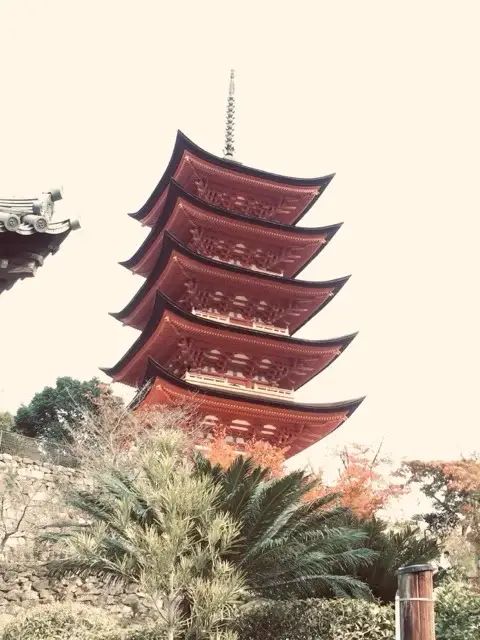
The DLLJSSIA (Don’t Let Joel See Stuff International Association) must have added a chapter in Miyajima since I was there last.
Discover more from Joel's Journeys & Jaunts
Subscribe to get the latest posts sent to your email.

Hiroshima Prefectural Art Museum, Hiroshima Orizuru Tower

Mitaki Temple and Lunch

Nice side trip! It was fortuitous that you got there when the torii stood in the water, because it is a very commanding sight. It was fortuitous that you got there when you did at all, seeing as they threw you a curve ball with the tourist tax ticket. I don’t know what you were going on about the mumbo-jumbo magic trick with the brow, but you generously tipped the scales by providing gorgeous shots of the iconic monument for those of us in the Journeys and Jaunts cult following. One iconic sight revealed, another under wraps by the DLLSSIA, a tie if it were not for the handsome Hokoku Jinga. Looks like you had a lovely, sunny morning. Cute deer.
You know me, Mr. Fortuitous. Unless the DLJSSIA gets the upper hand. It was a very good morning, all in all.