Hiroshima Prefectural Art Museum, Hiroshima Orizuru Tower
I was still traumatized by The Tragic Credit Card Incident of 2025™️ from this morning. Nevertheless, I persisted and visited the Hiroshima Prefectural Art Museum in the afternoon.
After that, and after another sojourn in the gardens I was in this morning, Shukkeien Gardens, I took in the view from the Hiroshima Orizuru Tower.
Hiroshima Prefectural Art Museum
When I bought my ticket to the Shukkeien Gardens this morning, the ticket seller, using her ten words of English and a lot of pointing at something on the counter, talked me into buying a combination ticket that included not only the gardens, but also Hiroshima Prefectural Art Museum, plus, for a small extra charge, a special exhibit the museum was running.
To be fair, her ten words of English were seven words more than the three words of Japanese I know. And this is Japan, after all. So, she wins.
I wasn’t entirely sure what I was buying. I probably should have used the conversation feature of Apple or Google Translate, but, you know me, I love to live on the edge. Well, maybe not on the edge, but I’m willing to get within four or five kilometres of the nearest edge.
The Shukkeien Gardens and the Hiroshima Prefectural Art Museum are next-door neighbours. Not only that, but there’s a door into the museum from inside the gardens. Because the door is in the paid area of the gardens, you need a Shukkeien ticket with a bar code to get through the door from the museum to the gardens.
When I went to find the link for the Hiroshima Prefectural Art Museum to post here, I saw that it shares a website with the Shukkeien Gardens. I assume that means they’re part of the same organization.
When I was there, the Hiroshima Prefectural Art Museum displayed both its permanent collection and the said special exhibition. The permanent collection, or the part of it that the museum had room to display, occupied the full second floor. The floor is quite large.
The special exhibition was on the level above, but it didn’t occupy all of the third floor. There is also a small restaurant on that floor.
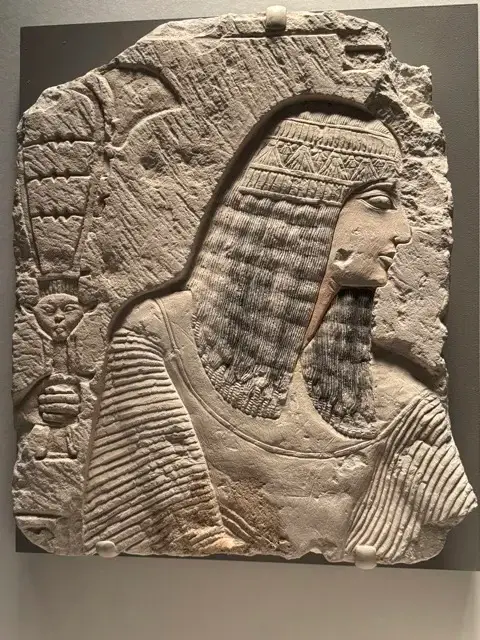
Circa 1292-1075 BCE
What caused me to leave the Shukkeien Gardens this morning was not that I had had my fill of it. It was because I was hungry. So, upon entering the museum, I immediately headed to the third floor. Upon leaving the restaurant, I walked the few steps to the entrance of the special exhibition.
I’ve kept you in suspense as to what the special exhibition was. In fact, I was in suspense for a while, because I wasn’t entirely certain what I’d bought a ticket for until I got there.
Much of the signage was in Japanese, but the sign on the entrance proclaimed it as “Unravelling the Mysteries of Ancient Egypt.” If I’d been more observant, I would have seen that it was also on the ticket for the exhibition. Just inside the exhibition entrance, there was a sign in English and Japanese saying that the collection was on loan from the Brooklyn Museum.
The collection included several artifacts from ancient Egypt.
So, here I was, an old man from Toronto, Canada, in Hiroshima, Japan, looking at a bunch of ancient stuff that was originally from Egypt, but has taken up permanent residence in Brooklyn, USA and leaves there only on vacation. If I were especially interested, I could have gone to Brooklyn to see it. Brooklyn is a lot closer to Toronto than Hiroshima is. Of course, now, I’ll have to wait until Trump is no longer president of the United States to go to Brooklyn, because who the heck wants to go to the U.S. when he is?
The exhibit began with a very brief looping video narrated by a Japanese Egyptologist introducing the exhibition. He spoke in Japanese, but there were English subtitles. After that, the presence of English on the signage was hit and miss, mostly miss.
There were a few narrative panels that had both Japanese and English. Many had only Japanese.
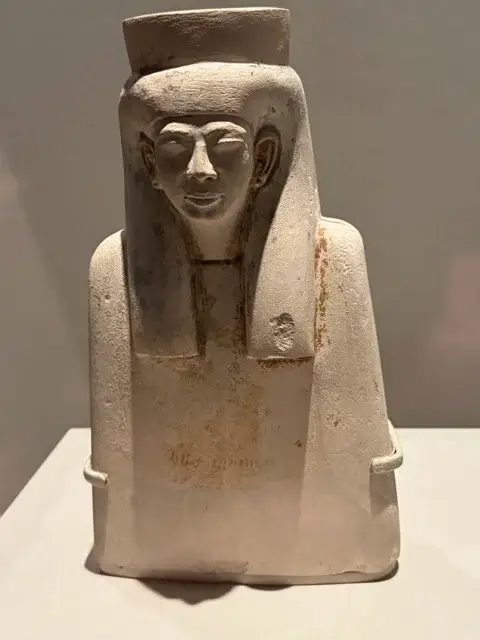
Circa 1292-1190 BCE
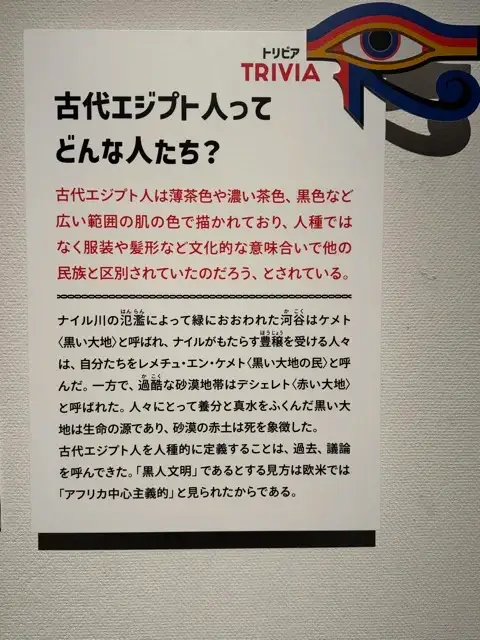
The floor was divided into a few rooms. In the first one, there were a few panels around the room that had the same format. The background was white. There was a title in Japanese at the top. Then there was a block of Japanese text in red. Below that, there was a black bar. Then there was a block of Japanese text in black. At the bottom, there was a thicker black bar.
In the upper right corner, there was an icon and the only English word, in all caps, on the panel. It was the same word on all of this format of panel: “TRIVIA.” So I assume that whatever was on the panels was all trivia, but what trivia? I don’t know.
Why, you may ask, didn’t I use the camera function on Apple or Google Translate to translate it? The answers are, first, that it’s too cumbersome to read all the text in the exhibition that way. And, second, I tried, but had limited success.
Even if I download a language for offline use (which I did for Apple), those apps need internet access to use the camera function to translate a sign. My cellphone signal fluctuated in the museum. I could only occasionally get a translation out of either app. I looked but couldn’t find any unlocked wifi in the museum.
Placards beside each object in the exhibition said what the object was and when it dated from, and provided a brief narrative on the object. I know this only because I was able to get an internet connection long enough to translate a couple of the placards. They were almost entirely in Japanese.
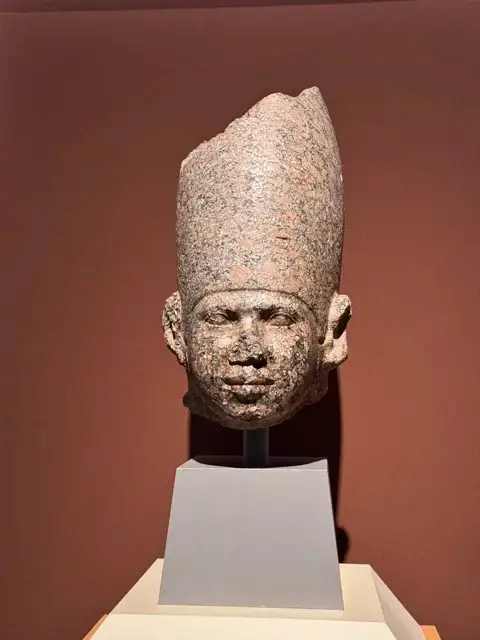
Circa 2650-2600 BCE
The only English on these placards was a single phrase saying what the object was. Examples included “Relief of a Noble Man” and “Ancestral Bust of a Woman.”
All of the placards contained one or two numbers that looked like years. Based on the couple of times I was able to get a translation, I learned these were indeed years dating the objects. I didn’t notice any objects that were more recent than a millennium before the Common Era, but I hunted for the numbers in the midst of the Japanese text on only a small fraction of the placards. So I might have missed some that were more recent.
There was another short looping video in the middle of the exhibition. It was on the Pyramids of Giza, and particularly the research techniques and technologies used to uncover their mysteries. The soundtrack was entirely instrumental. The video had subtitles in both Japanese and English. So I was able to get something out of that.
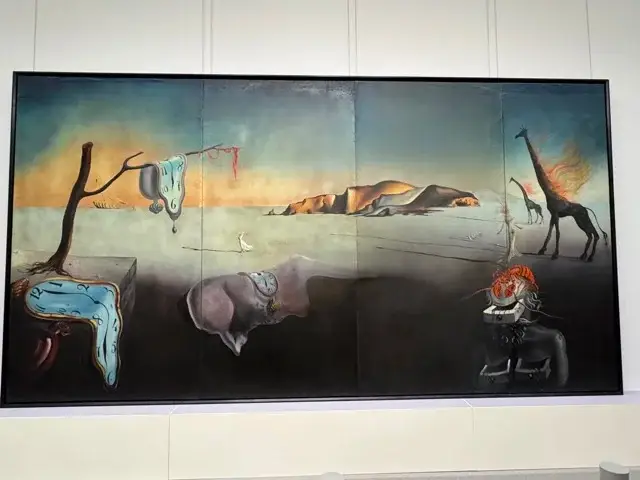
Part of the permanent collection of Hiroshima Prefectural Art Museum
Permanent Collection
The permanent collection of Hiroshima Prefectural Art Museum is all modern art. Many of the works are by Japanese artists, but there are paintings from around the world, including a major piece by Salvador Dali.
The amount of English available in the permanent collection was roughly the same as the amount of English in the special exhibition. However, the Dali piece had a panel with a couple of substantial paragraphs of narrative in four languages. Two were English and French. I assume one was Japanese. I didn’t recognize the fourth, but it used the same style of characters as Japanese.
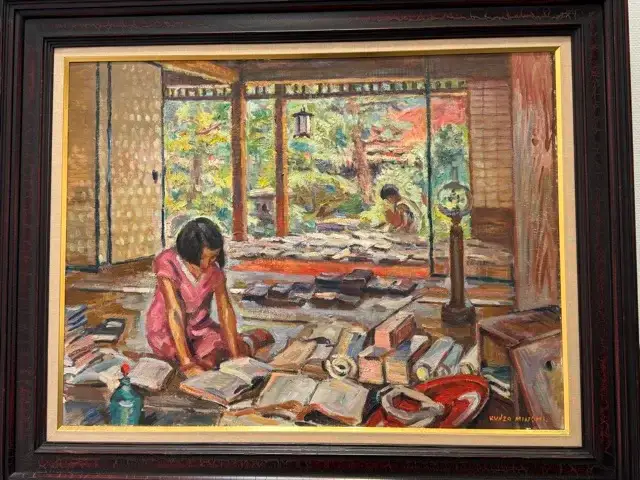
Part of the permanent collection of Hiroshima Prefectural Art Museum
Photography was allowed throughout the special exhibition, but the Hiroshima Prefectural Art Museum allows photos of some of the works on display from their permanent collection, but not of most. Where photographs were allowed, there was an icon of a camera with a green circle around it beside the piece. If there wasn’t an icon, then photographs weren’t allowed. The Dali piece had a green-circled camera icon beside it.
There was a sign in the museum saying, in English, that, even where photos weren’t allowed, it was okay to use the camera function of a translation app to get translations. I didn’t bother checking to see if I had a decent cellphone signal on that floor. So, I don’t know what most of the signage said.
Shukkeien Gardens, Again
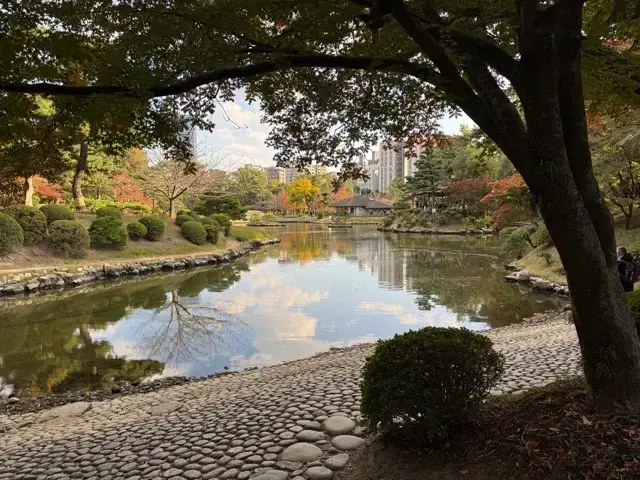
After I finished with the Hiroshima Prefectural Art Museum, I used my barcoded ticket for the Shukkeien Gardens to go through the magic door from the museum back there.
I still wasn’t over the trauma of The Tragic Credit Card Incident of 2025™️. I figured that the lovely, calming environment of the gardens would ease my anxiety away. It didn’t work in the morning, but I figured that if I kept repeating the same action, I’d eventually get a different result. It didn’t work.
Nevertheless, I walked some different paths this time, and the gardens were as lovely as they were in the morning.
Hiroshima Orizuru Tower
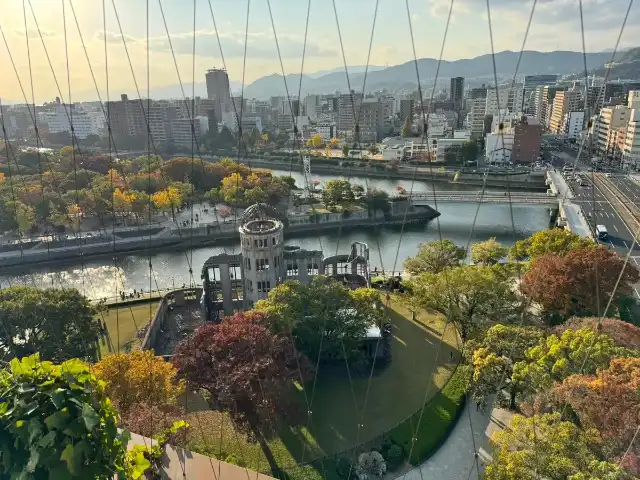
After leaving the Shukkeien Gardens for the second time, I walked over to the Hiroshima Orizuru Tower to take in the view. Calling it a tower strips “tower” of all meaning. It’s not a tower in the sense of a structure put up primarily as a radio tower, but with an observation deck, like the Tokyo Tower, the Tokyo Skytree or the Tsutenkaku Tower in Osaka.
Instead, the Hiroshima Orizuru Tower has the shape of a regular sort of building. And, while it might be appropriate to call a skyscraper a tower, the Hiroshima Orizuru Tower is only 12 storeys tall.
After you buy your ticket, you take an elevator up to the 12th floor. Those elevators stop only at the first, 11th and 12th floors. I don’t know what’s on the intervening floors.
The twelfth floor is kind of weird. Coming out of the elevator puts you in an enclosed, windowless area with a small snack bar. You then walk out to the open air, but with a roof over it. Out there, there’s a wooden floor that is stepped down somewhat to a flat wooden platform around the front part of the building. Because of the entry lobby and snack bar, it’s only maybe half of the top floor that’s open. There’s an opaque, high, mirrored wall on the side of that enclosed area.
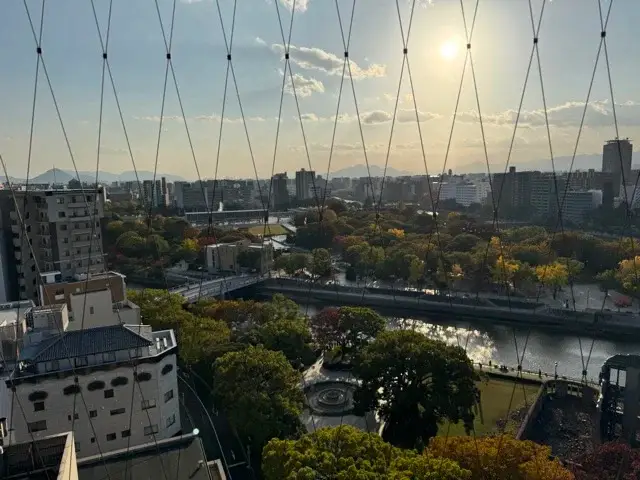
It is open, but there is a low glass wall before the edge of the building. Beyond that, there’s a small space with narrow planters holding low vegetation. Beyond that, right at the edge of the building, there are thin, floor-to-ceiling, criss-crossed wires. The wires are far enough away that, unless you have grotesquely long arms, there’s no way to hold your camera lens far enough out so you to take a shot through a gap in the criss-crossing wires.
Consequently, if there’s a way to take a photograph up there without the wires being visible, I don’t know what it is. However, the wires are quite thin, so they obscure next to nothing, and the views are terrific.
What makes the views spectacular is that the building is behind, and not far from the Atomic Bomb Dome. As a result, you can get a view of the dome from above, and the Hiroshima Peace Memorial Park on the other side of the river from it.
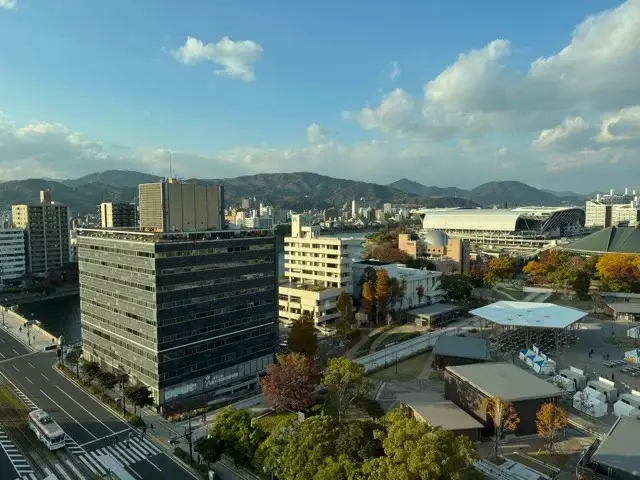
Furthermore, with there being less cloud cover this afternoon than there was this morning and there being fewer obscuring buildings around the Hiroshima Orizuru Tower than there were around the Hiroshima Castle compound where I was this morning, the views from the tower were much more impressive than from the castle.
The mountains that surround Hiroshima, other than by the seafront, were clearly visible and quite beautiful.
On the 11th floor, there are floor-to-ceiling windows and no criss-crossed wires. So it was a choice of taking a picture through the wires or through slightly distorting glass. I posted examples of both here.
With that sight seen, I headed back to my hotel for the free happy hour that my hotel provides for me, hoping to drink away the trauma of The Tragic Credit Card Incident of 2025™️,
Discover more from Joel's Journeys & Jaunts
Subscribe to get the latest posts sent to your email.


May your nerves have been calmed by the happy hour tipple seeping into your beleaguered system, and hopefully by a fine sleep to follow. Good on you for continuing on, brave traveller. I hope you were heartened touring other globetrotting artifacts treasured for being much, much, older even than you. Great views and a second chance at a resplendently restorative garden that did its very best. May tomorrow (or today by the time you read this) be a brighter one. You know that if ever there were an emergency, help is just a call away. We’ve got your back. Enjoy the rest of your trip!
Oh, so you’re the one who has my back. I wondered where it was. Thanks!
I’ll survive. Somehow.