Mucem
It was raining slightly when I awoke this morning in Marseille. The forecast called for the rain to continue and intensify until the evening, when it’s supposed to end at some point.
I decided to dust off and put into action my rainy-day plan, namely to spend as much time indoors as possible without sitting in my hotel room the whole day.
I started by going to Mucem. I ended up spending the whole morning, and then some, there.
About Mucem
Mucem is an acronym for “Museum of European and Mediterranean Civilizations.” Or, rather it’s an acronym for the French name, “Musée des Civilisations de l’Europe et de la Méditerranée.” But it’s hard to find the full name anywhere. The museum goes pretty much exclusively by “Mucem” on its signage and website, although there is at least one mention of the full name on the website.
Mucem sits at the end of Vieux Port, almost beside the sea. The main exhibit spaces are in two buildings: J4, a former port terminal, and Fort Saint-Jean, a former fort.
The vast majority of the exhibit space is in J4. Fort Saint-Jean was built roughly at the same time as Fort St. Nicholas, which is almost directly across Vieux Port from Fort Saint-Jean. (If you read my post from yesterday afternoon, you’ll know that I tried and failed to get into Fort St. Nicholas yesterday.)
J4 and Fort Saint-Jean are across a channel from each other, but a raised walkway crosses the gap from the top floor of J4 to the upper part of the fort.
Mucem has a third building, its Conservation and Resource Center, which houses the museum’s collection. But that’s located deeper into the city. I didn’t go there.
I visited four galleries at Mucem:
- Don Quixote: A Madman’s Tale, a Tale Worth Laughing At
- Mediterranean, Episode 1: Inventions and representations
- Popular? Treasures from the Mucem collections;
- Clément Cogitore, Ferdinandea, the ephemeral island
Pablo Picasso
1855
The Quixote and Cogitore exhibitions were temporary ones. The other two are permanent. The Cogitore exhibition was in Fort Saint-Jean. The others were in J4.
When I bought my ticket, I asked the ticket seller if there was English signage in the museum. Her English wasn’t fluent, but she understood me and told me that there wasn’t any. But, she said, I could get English with my phone. She pointed to a QR code that was at the ticket desk for another purpose and said there were codes at a lot, but not all, of the displays, and I could use them to get English descriptions.
As it turns out, I didn’t spy a single QR code in the museum. But it didn’t matter. The labels associated with each item were mostly in French only. But the plentiful, large descriptive text panels had both French and English. The one exception was the Don Quixote exhibition. In there, the narrative panels had French, English, and Spanish.
Don Quixote: A Madman’s Tale, a Tale Worth Laughing At
The Don Quixote exhibit at Mucem provided a wealth of fascinating information on the use of irrigation for agriculture in Mesopotamia as early as 5,000 BCE. No, of course not. It was an exhibit on Cervantes’s “Don Quixote.” Duh.
This Mucem exhibition included several information panels that talked about the story of Don Quixote and its influence on society. One panel talked about how it’s the source of some everyday metaphors, such as “tilting at windmills.”
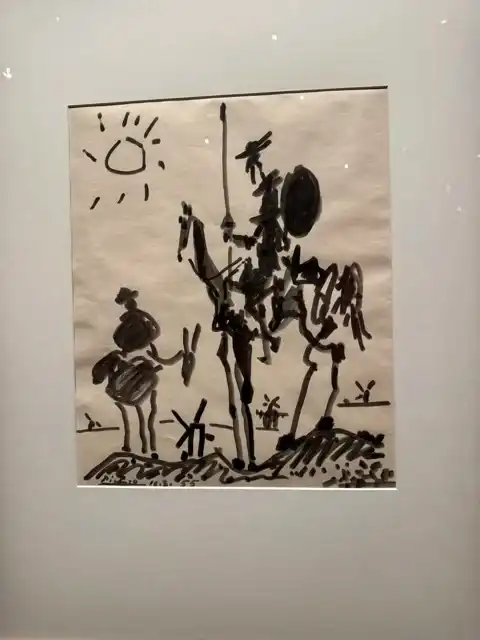
Items on display included Don Quixote-related paintings, drawings, and sculptures. There were also some stills from an old Don Quixote movie, marionettes used in Don Quixote puppet shows, and a model of a puppet theatre. One of those artworks, I don’t know if I should call it a painting or a drawing, was by Picasso.
Charles-Antoine Coypel
Louis Surugue (graveur)
1724
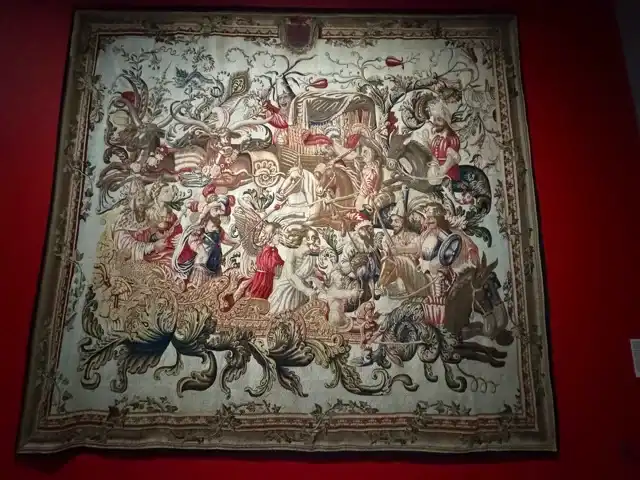
Coincidentally, there was also a tapestry telling part of the story of Don Quixote. If you’ve been following along on this trip, you might remember why I say “coincidentally.” During my day trip to Aix, I visited the Musée des Tapisseries, which owns and displays a set of nine Don Quixote tapestries. Until this trip, I honestly had no idea that Don Quixote tapestries were a thing.
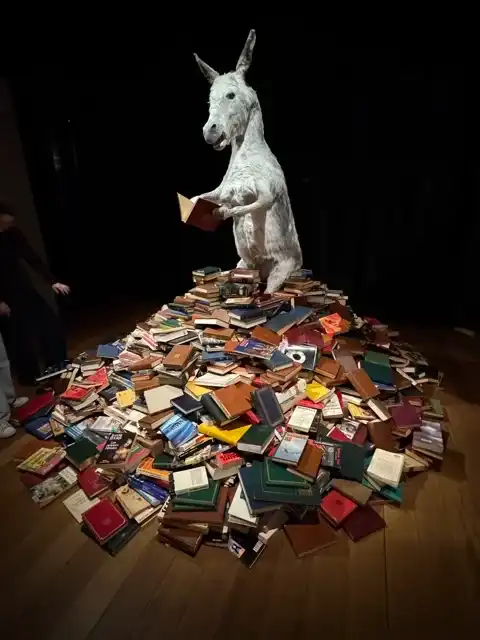
One of the displays was what looked like a life-size donkey plush toy. The donkey sits on top of a pile of real books. (See the picture at the top of this entry.) I looked at the titles of some of the books at the top of the pile. I didn’t see any that were “Don Quixote” or something similar in another language, nor did any seem to be specifically about Don Quixote.
There was a text panel close to the donkey-sitting-on-books display. It wasn’t specifically about the donkey or the books, so I don’t know if I was supposed to read it as if it were interpretive of the sculpture. Its English version said:
“Books to the Fire
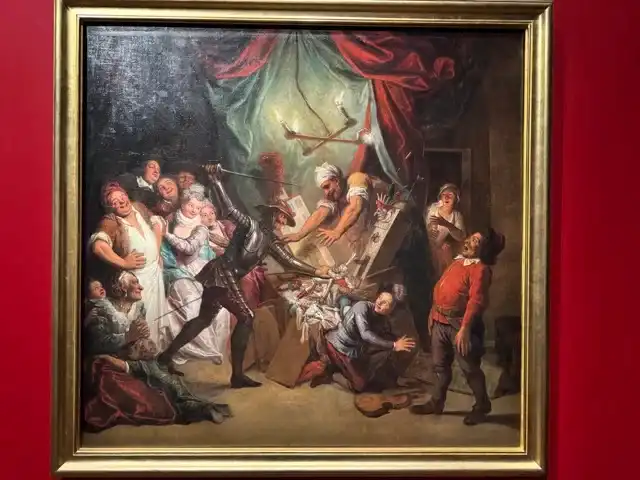
“Don Quixote devours books of chivalric romance in his study, a place where Renaissance humanists would typically delve into the critical reading of the Bible and ancient authors. His reading obsession leads to madness rather than wisdom… Hoping to cure him, his friends throw his books out of the window and burn them. With this, Cervantes parodies the practice of burning people and books during the Spanish Inquisition that began at the end of the 15th century. The scene also ridicules censorship and mocks scholarship, all while raising the question of the transmission of cultural heritage.”
Now you know as much about it as I do. Probably more.
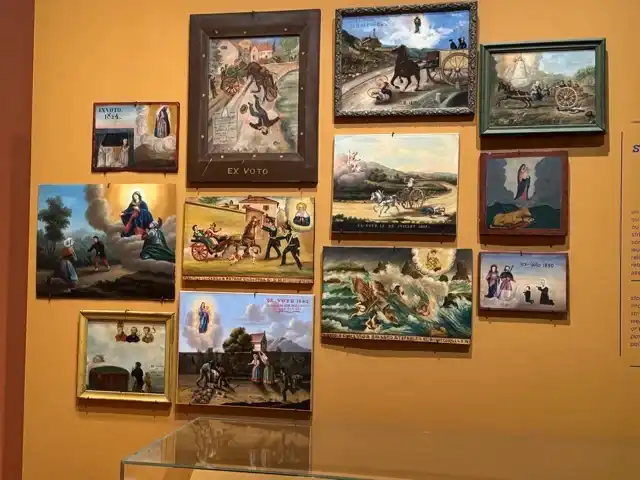
Popular? Treasures from the Mucem collections
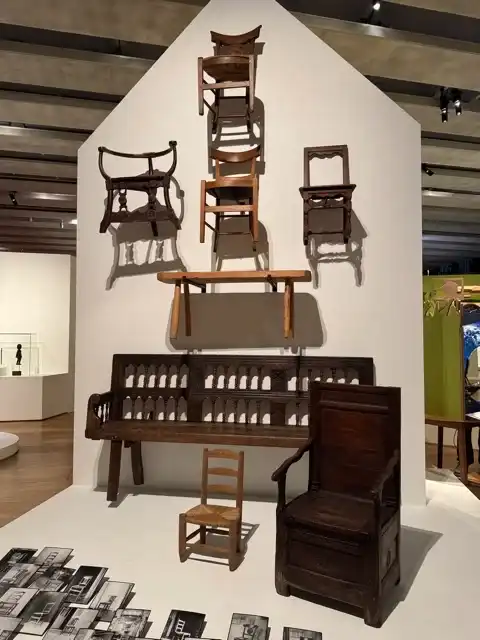
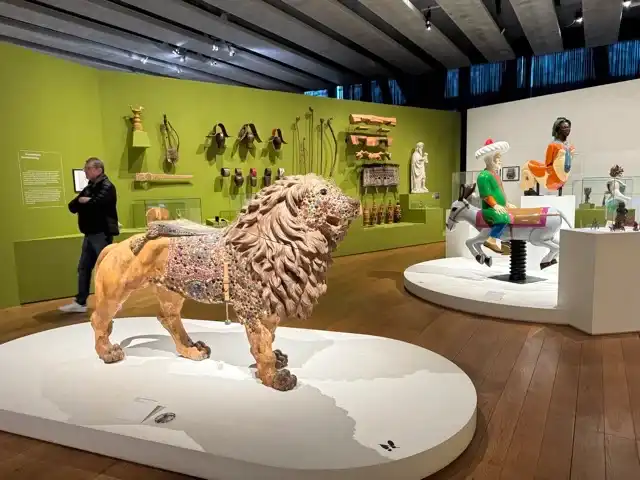
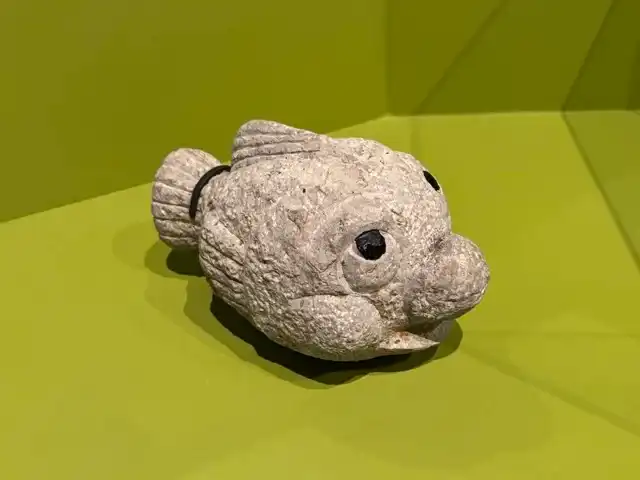
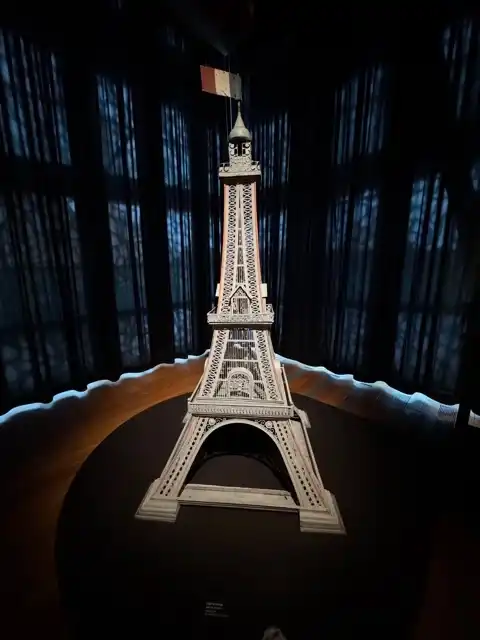
“Popular? Treasures from the Mucem collections” is, as I said, a permanent exhibition at Mucem. It exhibits an eclectic mix of items from Mucem’s collection. On display are furniture, artwork, household items, knick-knacks, a large birdcage that’s a model of the Eiffel Tower, and all sorts of other stuff. Among those “all sorts of other stuff” is a rotund and happy-looking fish.
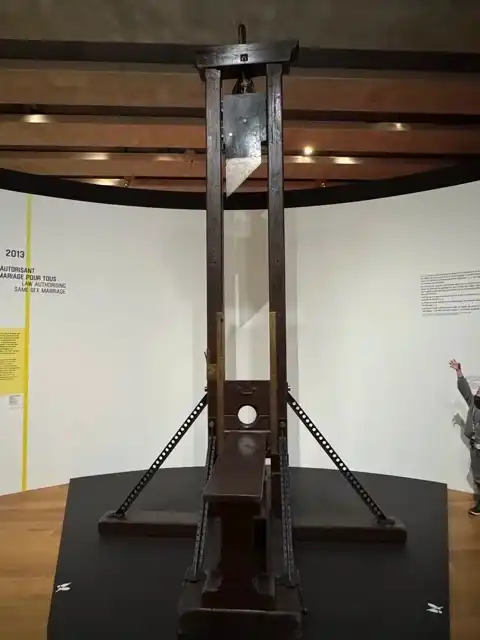
Another item among the other stuff is an actual guillotine.
The English portion of the accompanying text said, “Championed by the Justice Minister Robert Badinter, the French parliament abolished the death penalty in 1981, the first year of François Mitterrand’s presidency. The debates were fierce at the time as the reform ended centuries of executions, which had been done by guillotine since 1792. By donating the guillotine to the museum, the minister wanted to ensure the violent practice wasn’t forgotten and preserve a symbol of its abolition. Although it has been abolished across Europe, the death penalty is still in force in several countries around the world.”
It’s hard to believe that there are still some barbaric countries in the world that haven’t yet abolished the death penalty. They murder murderers, taking their moral code from murderers rather than from people who abhor murder. Unbelievable, but there you are.
(The preceding paragraph will seriously annoy, and was intended to seriously annoy, some people should they stumble on this page. Oh, well. C’est la vie. La vie continue.)
Mediterranean, Episode 1: Inventions and representations
“Mediterranean, Episode 1: Inventions and representations” is another permanent exhibition at Mucem. It explores the culture, history, and cultures around the Mediterranean, not just on the European side, but also in northern Africa.
Items on display included replicas of ancient statues and statue fragments, as well as more modern sculptures, paintings and other cultural items.
This is a bit embarrassing, but when I went back to look at my pictures in preparation for writing this section, I discovered that I’d somehow forgotten to take any pictures in this gallery at Mucem. Not only does that deprive you of any pictures to distract you from my pathetically dull, shallow prose, but it also means that I don’t remember as much about what was in the gallery as I otherwise would. Sorry about that.
I do remember that there was a video that discussed a single print. It was a propaganda poster designed to promote the benefits of France’s colonization of Algeria, which started in 1830. The video, in French with English subtitles, went into detail about the figures in the poster, what they represented, what deeper hidden meaning the juxtaposition of the figures conveyed, and how imaginary lines in the poster were intended to draw our eyes to particularly significant connotations. Well, I suppose art historians have to fill their time somehow. Then again, at least one of them wastes a little of her time reading the claptrap in this journal. Go figure.
Clément Cogitore, Ferdinandea, the ephemeral island
Before today, I’d never heard of Ferdinandea. Thanks to my visit to Mucem, now I have. I’ll probably forget it within minutes of writing this.
Ferdinandea is, or rather was, an island. It had a rather short life. I can’t say how fulfilling that life was.
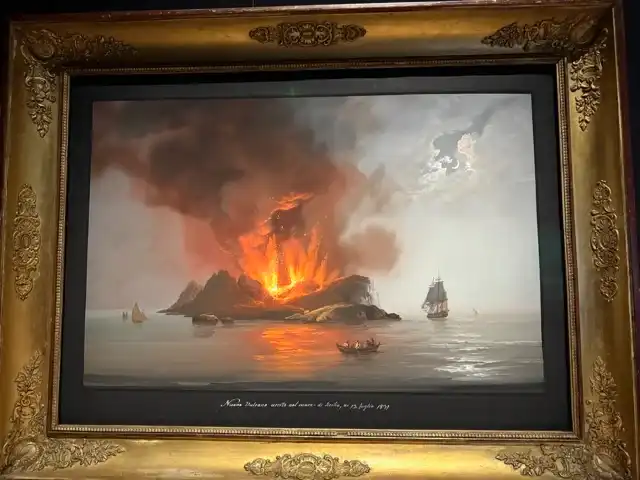
Between the end of June and the middle of July 1831, a volcanic eruption in the sea gave rise to an island near Sicily. It was called Ferdinandea in Italian. I guess Mucem thought it appropriate to use the Italian name because it was near Sicily. But it was known as Graham Island in English and Île Julia in French.
The location of Ferdinandea was considered to be strategically important. Consequently, it was quickly claimed by Great Britain, the Kingdom of the Two Sicilies, and France. If I’d been alive at the time, I probably would have rushed to claim it as mine too.
But strategic importance can be so ephemeral at times, can’t it? Within a few months, Ferdinandea sank back beneath the waves.
The exhibition about Ferdinandea at Mucem is a show put together by a French artist and filmmaker, Clément Cogitore. The exhibit includes old paintings of the eruption, underwater photographs, text panels about it, and two videos.
One of the videos is a continuous loop of underwater footage of the exploration of Ferdinandea. I’m not quite sure about the other one. It lasted 41 minutes. I came in while it was already underway. It seemed to be first-hand accounts of the exploration of Ferdinandea by people from a variety of countries. But I had trouble following it.
Because the dialogue was provided by people from a variety of countries—I recognized what I thought was English, French, German, and Italian—there had to be subtitles. But the subtitles were only in French. And even for the English, the sound was so tinny that I had trouble making it out sometimes. Occasionally, I recognized a few French words that I knew on the subtitles during the English and realized, “Oh, they’re speaking English, and that’s what they are saying.” I stayed for only maybe ten minutes.
Coincidentally, I sat beside a display screen that was a control panel for the video. It provided a progress bar, which is how I knew it was 41 minutes long. It also had a button to restart the video, and another to choose French or English. I thought about switching to English, but I was far from alone in the small theatre, and I don’t know if the others would have appreciated me restarting the video and switching the subtitles to a language they didn’t understand.
And so completed my rounds of the exhibitions at Mucem.
It was still raining and comfortably into lunchtime by then.
Mucem has what looked like (and was) a nice restaurant in the J4 building. Rather than heading out in search of an external restaurant for lunch, I went back to J4 and ate at the restaurant.
I’ll post another entry later narrating my afternoon activities.
Discover more from Joel's Journeys & Jaunts
Subscribe to get the latest posts sent to your email.


Happy lunching! Although by this time you are probably working at or finished dinner. I must say I was not amused that the picture of the guillotine came right after your discussion of art historians. We know about deciphering visual messaging, and this one gave me a chill. When you mention something as enticing as a “rotund, but happy-looking fish” on the other hand, you lose this reader temporarily as she scrolls down for the photographic evidence. (Why ‘but’? In my world, its rotundness might well be the evidence of its happy state.) Not to worry, though, I love your claptrap too much to be distracted for long. What an odd, but appealing assortment of stuff in Mucem today. A nice way to spend a rainy morning, I would think.
Very prescient of you. I’m replying to you over a sorbet dessert at dinner.
The juxtaposition of the discussion of art historians and the guillotine was entirely accidental. I hadn’t noticed it until you mentioned it. At least I hadn’t consciously noticed it.
Damn. I honestly meant to type rotund and happy, not rotund but happy. In my head, that’s what I did type. I’m upset enough about that mistake that I’m going to go back and fix it so no one else will see it.
In truth, I quite enjoyed Mucem, and not just because it brought me in from the rain. That too, but not only that.