Heading Home From Hungary
After spending three weeks travelling around Hungary, I’ve almost reached the end of this jaunt. I’ve returned to Budapest, my starting point in this Hungarian adventure, to catch a flight back home bright and early at the crack of a quarter to noon tomorrow, the god of airlines willing.
As is the case in pretty well every country I’ve ever been to, except maybe the city-states of Singapore and Vatican City, I’ve seen only a small fraction of Hungary. There’s so much more that I’ve unavoidably left unseen. So much world; so little time and money.
Because this is my last day in Budapest and, more broadly, Hungary, I will place a summary of my time in Budapest and a separate one encapsulating my whole trip at the end of this post.
If you’ve been following along, I hope you enjoyed these posts as much as I enjoyed experiencing the parts of Hungary I visited.
That was an inane thing to say. I haven’t yet told you whether I enjoyed my time here. If I hated Hungary, that would effectively be saying I hope you hated my journal entries. Nay, nay, dear reader. I very much liked Hungary. I wish you great pleasure or, better yet, bliss in all you do, including reading these accounts.
A Bit More of Budapest, Hungary
My train from Pécs to Budapest left late this morning. By the time I got back to Budapest, got a cab from the train station on the Buda side to my hotel on the Pest side, checked in, and settled in, it was close to three o’clock before I was ready to head out. So, I didn’t have much time in Budapest this afternoon.
I’m in the same hotel I was in for eight nights at the start of this trip. So, I was already familiar with the neighbourhood. Thus, I was prepared to make productive use of my time by going to the café across the street from my hotel to have a cappuccino and a pastry.
After that, I went to one of the sights I hadn’t gotten to when I was here during those eight days.
Pesti Vigadó
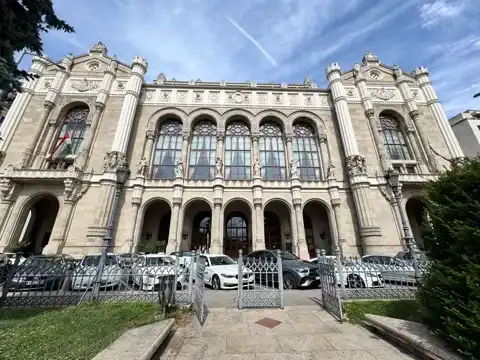
One of my guidebooks has a whole feature section on Pesti Vigadó. The “Pesti” in the name gives away the fact that it’s on the Pest side of Budapest. What “Pesti” doesn’t say is that it’s about a block back from the Danube River, with a park occupying the block in front.
My guidebook claims Pesti Vigadó has some history. It says that’s “where Buda, Pest, and Óbuda were forged into the single capital city of Budapest in 1873.” It didn’t say exactly what that meant. I assume a metal forge wasn’t involved. My best guess is that negotiations occurred there or a document was signed there.
A perfunctory web search didn’t provide any information about what that meant or even if the venue had anything to do with the merger. So, your guess as to the meaning and the veracity of the statement is as good as mine.
The same source also told me that Johann Strauss, Ferenc (Franz) Liszt, Claude Debussy, and Arthur Rubinstein all performed at Pesti Vigadó.

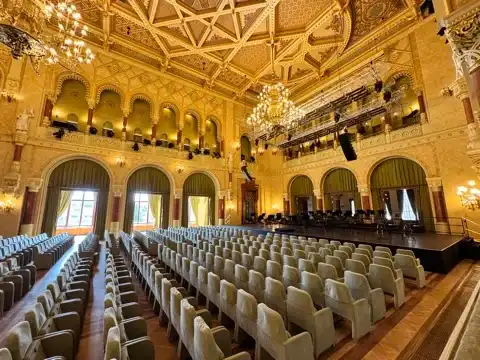
Pesti Vigadó is a beautiful cultural centre with a concert hall and some exhibition spaces. It was built in 1865 to replace a theatre, the Redoute, which suffered the misfortune of being destroyed by cannons during the Hungarian War of Independence in 1848-49.
The current Vigadó was also heavily damaged, this time during World War II. It has since been fully restored.
Geez, people. Can’t we all learn to live together in peace and harmony and end these ridiculous wars that steal countless precious lives and destroy so much of our civilizational heritage? Is that asking for too much? (Apparently so. Sigh.)
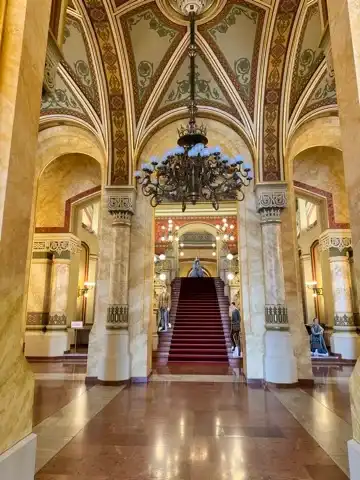
The lobby of the Pesti Vigadó is elegant and stunning, with a grand staircase, paintings, a chandelier, and beautiful columns.
In the exhibit halls of Pesti Vigadó, I saw a porcelain exhibition on the ground floor. It displayed dinnerware, huge vases, and sculptures, all beautifully and intricately painted.
On the upper levels, I saw exhibitions, primarily of paintings, but also some other media. One was a temporary exhibit dedicated to just one artist, Lajos Ujváry (1925–2006), a Budapest painter, art teacher, and ethnographer.
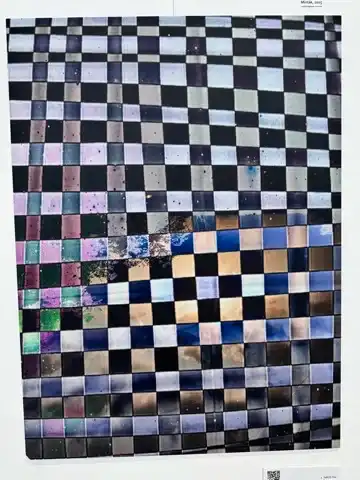
I also saw some multi-artist exhibitions in other spaces, mostly of abstract art.
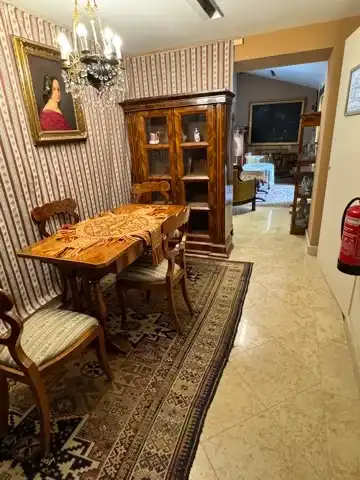
There was a temporary exhibit of a life-size mock-up of a bourgeois furnished apartment.
Pesti Vigadó has a panoramic terrace on the top level. It faces the Danube. I went out there and enjoyed the view.
On the walls of the corridor leading to the terrace, there’s a timeline with illustrations and old photographs of the history of the Redoute Theatre through to the current Pesti Vigadó.
By the way, in every room I visited in Pesti Vigadó, there was at least one attendant. There were also a couple at the ticket desk. (Because I’m ancient, my ticket was free.)
I don’t know how many staff members there were in total in the facility. Let’s say the number was x. Based on the number of visitors I saw there, including me, the attendant-to-visitor ratio was x:1.
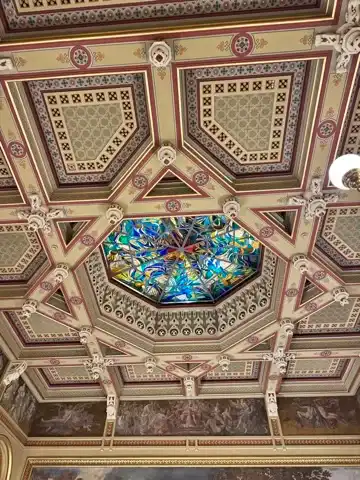
More photos from inside Pesti Vigadó:

Last Danube Stroll
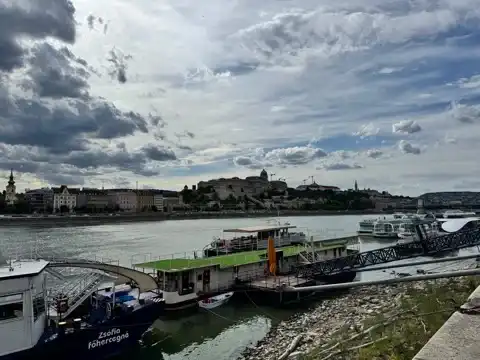
Because I was by the Danube, I decided to take one last stroll along it before heading back to my hotel, officially declaring this trip to Budapest and, more broadly, Hungary, over.
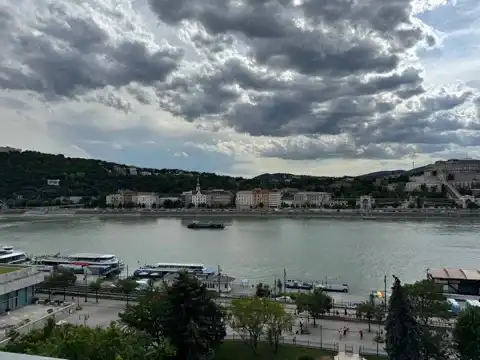
It’s a beautiful river and a great feature of the city. I was on the Pest side. My views across the river were, therefore, to the Buda side. The Buda hills are lovely, and the historic buildings perched above them are dramatic.
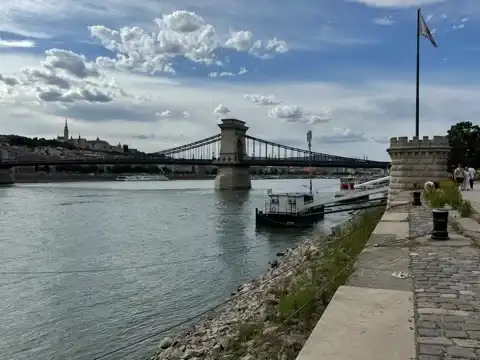
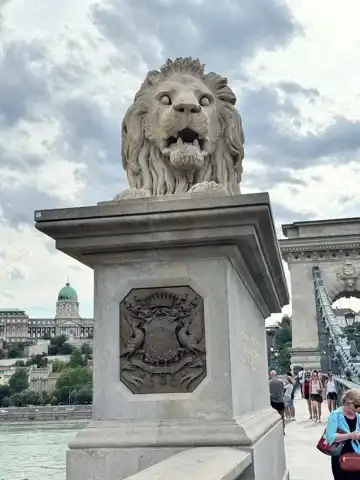
I walked to the Chain Bridge. There, I said goodbye to the Pest-side stone lions protecting the bridge on either side of the road that crosses the bridge. I think I forgot to mention the lions when I spoke of the bridge in one of my first Budapest posts. There are also two lions on the Buda side of the bridge. I hope the Buda lions weren’t offended that I didn’t traverse the bridge to say goodbye to them, too.
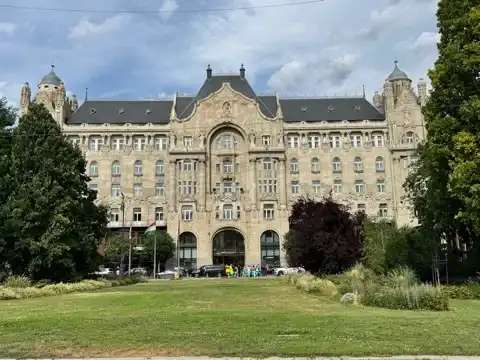
Before heading very far from the Danube to return to my hotel, I, with purpose, walked by a building I’d seen before a few times in my first days in Budapest. It’s a block back from the Danube, across a couple of streets and a small park from it.
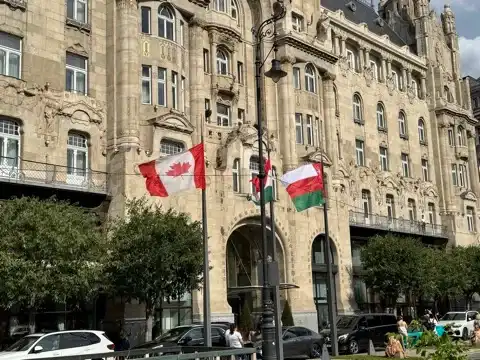
In front of the stately stone building decorated with sculptures, there’s a reminder of where I’ll be heading tomorrow. Three flags fly on poles. I recognized the middle one as the tricolour Hungarian flag. I don’t know what the one on the right (the right facing the building) is. It had an identical tricolour, but upside down and with an insignia in the top-right corner.
The third flag was easily identifiable to me. It had bold red bars on the sides and a bright red maple leaf on a white background in the centre. I’m coming home, Canada. From Hungary back to Canada. It’s been great, but it’s time to go home.
(The building is the Budapest Four Seasons Hotel, a Canadian-based chain, with its headquarters in my hometown, Toronto. It’s a luxury chain that’s usually a wee bit too pricey for my budget.)
A reminder of home. Not my home, mind you. Not even close. But references to my home country and hometown:
Budapest Summary
Let’s start with a one-word summary of the summary: Budapest is grand.
Apart from my one night tonight, which gave me only a few hours this afternoon, I spent eight nights in Budapest on the front end of this trip. Because my flight arrived in the morning, I had a fair part of that day in the city, which meant I spent almost eight full days in Budapest then. That wasn’t enough.
There are recommended sights in Budapest that, despite looking interesting to me based on the descriptions, I didn’t have time to get to.
The city, the capital of Hungary, is home to many beguiling buildings. The Hungarian Parliament building and the Hungarian State Opera House come immediately to mind. I toured inside both of them. They have grand and glorious interiors. You’d expect that for a national opera house. However, the not just beauty, but opulence of the Parliament building was something of a surprise to me. I loved both buildings.
But those aren’t the only enchanting edifices. There are also beautiful old cathedrals and other churches to gawk at from the outside and explore inside.
Many more buildings with fabulous facades aren’t for entry by the likes of me. Probably not other tourists either. I can’t speak for them. Whether admittance is allowed or not, they are free for viewing from the sidewalk.
And Budapest has some lovely parks and public squares to see, stroll, and sit in.
The celebrated Danube River, famed in story and song, runs through Budapest, dividing the Buda and Pest sides of the city. I walked along its banks a bit and took a one-hour boat tour on it. There are a few companies that run such cruises. The ones I saw all lasted for about an hour, but I think some companies run longer cruises, including brunch, lunch, and dinner cruises.
I took a nine-hour bus tour to three scenic towns on the “Danube Bend,” where the river makes a U-turn and then another right-angle turn. It’s a spectacular part of the river that’s not far from Budapest. I think there are other day trips I could have taken from Budapest, but the Danube Bend was mentioned very favourably in my guidebooks. I didn’t have time for more day trips on this trip, so I didn’t bother looking for others.
There is so much more to mention about my time in Budapest, but if I did, this summary would become too long. You can always go back and read or reread the individual entries from my time in Budapest.
Hungary Summary
My Hungarian journey began and ended in Budapest. Unless you’re the sort of person who immediately skips to the end of a publication, ignoring everything that comes before it, you just finished reading my Budapest sojourn summary. So, I won’t repeat it. If you are that sort of person, please start again and read what you missed. Or not. It’s up to you. But you might as well, because management won’t issue prorated refunds for the neglected parts.
I will, however, make a couple of comments that apply to the whole trip, including Budapest.
The first note is that, for the most part, it was too darned hot. There were maybe three or four days out of the three weeks I was in Hungary when the temperature dropped to only a few degrees above comfortable during the day. But for the rest of the time, I experienced heat-induced sluggishness, which compounded my normal ambient sluggishness.
That said, I don’t know how normal this is. Probably not a lot. While I was in Hungary, Europe was seized by a widely reported heat wave. In some places, records were broken. Hungary, being in Central Europe, was, no doubt, affected by that.
Because I arrived in the second half of June and left in early July (today is July 7th), I wasn’t expecting it to be cool. But I also wasn’t expecting it to be this sweltering. Fortunately, I brought clothes that could best deal with that eventuality without being charged with public nudity. But the heavier clothing I carried with me is going back unworn, while the lighter stuff got more use than I expected.
If it was freakishly hot, rather than seasonally hot, when I was here, then you have little to worry about if you come to Hungary this time of year. But I’m not sure if it was atypical or the norm. With the climate changing, even if excessive heat is now the exception rather than the rule, it might become more typical as time goes by. After all, the fundamental things apply. So, consider that a warning if you go to Hungary in June and July (and, although I have no experience, likely August too; maybe more so).
The second general comment is on the tourist hordes. There weren’t any.
I definitely wasn’t the only tourist in Budapest. There were many others (except at Pesti Vigadó today). However, it wasn’t overrun with them, as, say, Paris, Barcelona, or Venice often are. There were a couple of attractions where I couldn’t get a ticket for my preferred time, but I was still able to get a ticket for a suitable entry time slot. And there were no long lines anywhere.
That was Budapest. In the other cities I visited in Hungary, I saw very few other tourists. Not none. But not many.
In some small museums, I was the only visitor, tourist or local. On one tour I went on, the Bishop’s Palace in Pécs, about a dozen people took the tour. I was the only English speaker. Everyone else spoke Hungarian. So, they might have been touring Pécs, but they were probably residents of somewhere in Hungary. And some of the captivating streets of the old sections of the cities I visited were almost deserted during the day.
That said, it occurs to me that travellers who are less intrepid or, probably more to the point, less foolhardy than I am might have stayed away due to the heat.
From what I saw, Hungary deserves to be much more popular with tourists. I can say this without trepidation because this journal currently gets very few readers. So I don’t have to worry about my words causing the country to be overrun by the journeying hordes.
Those notes out of the way, it’s time to wrap this up with quick summaries of the other places I visited in Hungary on this trip.
Sopron
I was completely enamoured with the medieval core of Sopron. It has retained its old-world — very old —charm. Then again, well-preserved medieval towns tend to retain their oldness and often their charm. It usually goes with the territory.
There are several small museums to visit in Sopron, but after three nights (two and a half days), I ran out of sights I knew about and wanted to see there. Nevertheless, had it been less stifling, simply bumming around the captivating core of Sopron for another couple of days might have been enjoyable.
Györ
Györ wasn’t a stop I planned to make when I first scoped out this trip. But when I looked at the train options, I found I couldn’t get between the cities I wanted to visit without changing trains in Györ at least once. And the journey involving that connection would have taken a little longer than I would have wanted to do in a day.
Hence, I decided to stop in Györ. I don’t like the idea of the bustle of staying in a city just one night, with the requisite journey from and to the train station and the hotel check-in and check-out, without having a chance to see much of the city. So I booked in Györ for two nights, which gave me a day and a half to explore.
I’m glad I made the stop. There’s more to Györ than I expected due to the dearth of tourist information I found about it. It’s an attractive city, with another lovely old town—not as old or charming as Sopron’s Medieval core, but still old and charming.
And there are some sights to see there, such as an attractive cathedral and a nice church. Plus, nearby, accessible by city bus, there’s a beautiful archabbey.
My day and a half in Györ was about right.
Keszthely
Keszthely is a lake town. The lake is Lake Balaton, the largest in Central Europe.
I think people who visit it go there primarily to be by the lake. My hotel wasn’t in the central part of Keszthely. It was one of the few lakeside buildings. The town’s core (technically, I think it’s a city, but it felt like a town) is two or three blocks from that, with parks in between.
That core is pleasant, with a couple of blocks of a tree-lined pedestrian street with independent shops, restaurants, and cafés.
And there are a few interesting sights in town. Keszthely has a gorgeous old palace that no longer functions as a palace, but rather as an attraction that tourists (and I assume locals) can walk through to view the beautiful rooms, with their period furniture and furnishings.
Plus, there are some small specialty museums nearby that are loosely affiliated with the palace.
I also took a one-hour boat cruise around a small portion of the lake near the town.
My three nights (two and a half days) in Keszthely were about right for me. However, if you’re the sort of person who enjoys idling away the hours at a spa and/or sitting by a lake and cavorting in it, then you might enjoy more time in Keszthely.
Pécs
I loved, thoroughly loved, Pécs, or at least the central old town portion of it. That section of the city is mostly pedestrianized, with charming, elegant, and/or stately old buildings lining the streets and its two main public squares.
There’s lots to see and do there, including several small specialty museums, a beautiful cathedral, an equally beautiful bishop’s palace kitty-corner to it, a mosque, a church, a church that used to be a mosque, and more.
And I can’t possibly say enough about the vibe in central Pécs. It felt free and easy, while simultaneously being lively. Maybe that was a function of the time of year I was there and the temperature having backed off a bit from the oven-like heat I experienced up until Pécs, but it felt so relaxing and welcoming. (The backing off of the temperature was primarily a function of timing, not geography. And, even with the slight dip in degrees, it was still hot, but bearably so.)
In terms of seeing sights, my four nights (three and a half days) were about perfect for Pécs, and not just because perfect for Pécs is alliterative. I saw all the sights I knew about and wanted to see, without much extra time left over.
However, if the temperature remained bearable or, better yet, achieved pleasantness, more time soaking up the vibe and enjoying the streetscapes probably would have been great too.
And that brought me back to Budapest and my return flight home tomorrow.
Discover more from Joel's Journeys & Jaunts
Subscribe to get the latest posts sent to your email.


Well, thank you for the concluding post and summaries from your Hungary trip. I wish you smooth travels back to the headquarters town of the Four Seasons Hotel. Except for the oppressive heat, I very much enjoyed sharing — from my armchair — your excursions, explorations, and all.
Thanks so much. Home again. Home again.
Great summaries! Thanks. Very helpful in wrapping up your impressions and drumming up interest in an under-touristed place. Which could be a blessing or a curse. It is a shame about the weather. Excessive heat does not make for pleasant travelling. I suspect that the heat wave you experienced is historically abnormal for Hungary at this time of year, but, as you say, may very well be the new normal. That makes another place to visit in shoulder season. But now that your blog has burst upon the interweb there may not be a shoulder season any more – as with other ‘bucket list’ places in Europe – what with the hordes of readers flocking to have a look-see. I guess we should just buy our tickets for Hungary now. After reading your blog, I am tempted. Sounds great. Safe travels back to Canada! We await your repatriation (knock on wood)!
Thanks.
I do worry about adding to the over-touristing of places with my presence. Not so much with my writing though because so few people read this and even fewer would take my advice.
I think that for some of the really blockbuster destinations in Europe the shoulder season just means there’s almost enough air to go around, as opposed to the suffocating crowds of the high season. So far, Hungary doesn’t seem to have reached that level yet.