Pécs Cathedral and More

I hadn’t planned to start at Pécs Cathedral this morning, but things didn’t quite work out according to plan. I intended to start at the Bishop’s Palace, then take in Pècs Cathedral, which is kitty-corner to the Bishop’s Palace, followed by whatever (if anything) I had time for nearby to round out my morning.
(Oh, in case you haven’t been following along and stumbled on this from somewhere in the ether, I should tell you that I’m currently in Pécs, Hungary.)
As it turned out, for a reason I’ll get into when I talk about the Bishop’s Palace, I started with Pécs Cathedral, then saw an art gallery and an archaeological site. Only then did I cap the morning (actually, up until well after noon) with the Bishop’s Palace (and an unexpected bonus).

I seem to remember from my distant past being told more than once that the formula for successful expository presentations is to tell people what you’re going to tell them, tell them, and then tell them what you told them.
As I usually do, I’m going to skip that final step because you’re busy people. You don’t have time for that. Nor do you want to waste your time reading that much of my repetitive scribbling.
It’s now time to get to the “tell them“ part because if I continue babbling any longer, you won’t stick around for even that. Then, where would I be? I don’t know. I could be pretty well anywhere depending on when you read this introduction and then leave.
Wait. “Where would I be?” was a rhetorical question. I hate it when I can’t recognize when my own questions are rhetorical. Never mind. We should move on, don’t you think?
Why, yes. Yes, I do.
Pécs Cathedral

When I bought my ticket for the Pécs Cathedral, which was a combination ticket that included the Bishop’s Cathedral, the ticket seller handed me a laminated sheet that provided, in English, a brief history of the cathedral.
It’s an interesting history. The origin of the Pécs Cathedral, though not its current physical form, dates back to the 4th century, when a building stood in an Early Christian cemetery there. Knowledge of the history between then and the first cathedral is largely unknown.
Whatever that history was, the first Pécs Cathedral building was temporary. The second church was built either 1038-1041 or 1041-1046. They entrusted it to Saint Peter. That second church burned in 1064. Perhaps they should have entrusted it to another saint. Saint Peter doesn’t appear to be terribly trustworthy.

The third Pécs Cathedral, which is the basis for the current cathedral, is “a three-apse basilica without a cruciform ground plan.” The information sheet didn’t give a date for the construction of Pécs Cathedral #3, but it says that “This type of building emerged in Hungary only in the last quarter of the 11th century.”
From 1543 to 1686, under Ottoman rule, Pécs Cathedral and its crypt were used simultaneously as a place of worship and a granary. (Aha! The granary. See below.)
After the exit of the Ottomans, several Baroque elements were introduced to the interior of the Pécs Cathedral in the 18th century. In 1807, the church was rebuilt in a classicist style.
But wait. There’s more.

In the second half of the 19th century, the plan was to eliminate Pécs Cathedral’s eclectic style and return it to what was perceived as its previous Romanesque state. The current appearance emerged after reconstructions undertaken from 1882 to 1891.
According to the information sheet, Pécs Cathedral is 70 metres long and 40 metres wide.
Those dimensions are not just of a box in which the whole cathedral could fit. It’s a very rectangular church. There are no transepts and no curved ends that are visible from the outside as far as I could see. However, the end behind the altar is curved inside. I don’t know how they did that.

Inside, it is brightly coloured with lots of vibrant frescoes, including on the ceiling. The altar, which isn’t at the very back of the cathedral, is grand with a giant, fancy-schmancy crown-like structure above it.
The cathedral has a couple of side chapels that are decorated simply, with nice wallpaper and a statue or two.
There’s a crypt under Pécs Cathedral with two sets of stairs, one on either side of the altar, heading down to it. It’s less decorated than the sanctuary, but still quite handsome. There are lots of pillars, which you’d expect. I’m not an engineer, but I think engineers generally consider it to be a bad idea to have a sanctuary collapse on its crypt.

Fourteen relief sculptures are positioned along three of the walls of the crypt. Jesus has a starring role in all of the sculptures. I’m going to hazard a guess that it’s a Stations of the Cross thing. Despite knowing next to nothing about such things, and despite not seeing anything telling me that’s what it is, I’m quite confident in my guess. Then again, over the years, I’ve been wrong about many things in which I had great confidence.
Pécs Cathedral has four towers poking up from the building, one at each corner. One of those towers is climbable by tourists. Near the entrance to that tower, there’s a sign that includes English that says, among other points (and I quote):

- There are 133 steps lead up to the lookout.
- The tower can only be visited by your own risk!
Ignoring the grammar errors, damn! The tower can only be visited at my own risk. I was hoping to find someone who would agree to let me walk up at their risk. But I guess that’s not allowed. They even put an exclamation mark after it. So I suppose they’re serious about it.
Nevertheless, I climbed up. The views at the top are through string mesh. To the naked eye, that doesn’t obstruct the view all that much. But I had to spend a lot of time trying to aim my iPhone camera through the open squares in the mesh so you wouldn’t see any lines in the picture. I hope you appreciate the effort I put in for you. All for you. Yes, specifically you.
The views of Pécs from the top of the tower are impressive.
The views from the tower of Pécs cathedral:


Baalbek, The Temple of Sun in Baalbek, 1906
Csontvary Museum
After leaving the Pécs Cathedral, I visited the Csontvary Museum, which was just a couple of blocks away. The museum is dedicated to the works of Tivadar Csontvary. According to my walking tour app, he’s “a visionary painter often referred to as the ‘lonely giant’ of Hungarian art. … whose genius was largely unrecognized during his lifetime. Humiliated and impoverished, Csontvary passed away at the age of 66.”
Poor guy.
I’m always wary of admitting such things in case it lays bare my stupefying ignorance, but I’d never heard of him before.

Fishing in Castellammare, 1901
Based on the paintings on display, he painted many scenes from the Middle East, both landscapes and urban settings. However, that wasn’t his sole theme. I also saw some paintings of places in Italy. And I’m probably forgetting a few subjects.
Never, ever, ever, quote me on anything to do with art. I get almost everything wrong. And I don’t think any art experts often agree with my opinions, if ever. But I’m going to say that he tended to use a lot of bold colours and little subtlety. That being said, I’m not good at recognizing subtleties. Furthermore, hidden meanings, no matter how superficial, tend to stay hidden from me.
I liked some of Csontvary’s paintings. And the Museum had the advantage of not being overly large.

At the Entrance of the Wailing-Wall in Jerusalem, 1904

Early Christian Necropolis of Pécs
Another sight near the Pécs Cathedral is the Early Christian Necropolis of Pécs. It’s the site of an archaeological excavation, a former necropolis, as you might have guessed.
It’s not a huge site. They built a modern building over it. I don’t know if that’s to protect the finds, the visitors, or both from the elements. Or maybe it’s to keep out marauders after hours.
Whatever, it doesn’t detract from the display of the ruins and archaeological artifacts. And it makes for an all-weather experience, something that wasn’t an issue today.

On display were some partial walls, an unadorned Roman sarcophagus, some burial objects, a skeleton in a glass case, and some tombs.
One of the tombs is called the “Wine pitcher burial chamber.” It’s a two-storey building, with the lower storey underground. Visitors, including me, can peer down into it.
The wine pitcher burial chamber got its name because, inside, there’s a depiction of the Pitcher and the Glass. (That capitalization is from a sign. I don’t know what that refers to, or if it was just a bad translation that capitalized pitcher and glass. Feel free to leap down that rabbit hole to try to find out if you’re so inclined.)

Another crypt is the Peter and Paul burial chamber. It’s a shame they didn’t have the prescience and foresight to find someone named Mary to be buried with them. They could have been famous.
This chamber is displayed interestingly. When I first came upon it, I was beside and a bit above it. The chamber didn’t look like much. It was a rather plain stone box with an arched top.
Then, I walked down a set of stairs, and I was below the excavated crypt. They had cut away the floor and replaced it with glass so visitors could look up inside. The crypt was decorated with frescoes on the walls and ceiling. If you’re expecting to spend eternity there, I guess it’s nice to have some art to look at while you do.
It was an interesting, nice little museum. But then it was time to go to the Bishop’s Castle.
More photos from the Early Christian Necropolis of Pécs:


Bishop’s Palace

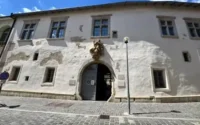
My walking tour app currently says the Bishop’s Palace is open “10 a.m. – 12 p.m.” on weekends and “2 p.m. – 3 p.m.” on weekdays. Today is Saturday. I arrived at 9:45.
The sign at the front said to buy tickets at the granary visitor centre.
The what? I didn’t see anything that looked like a granary. Nor were there any arrows on the sign pointing to it. Nor did I see any signs saying anything was a granary. As I said, the Pécs Cathedral is kitty-corner to the Bishop’s Palace. I walked over to the Pécs Cathedral, went to the ticket desk (yes, noteworthy churches usually charge tourists for entry in Hungary), and asked if they knew where I could buy a ticket for the Bishop’s Palace.

It turns out that they sell combination tickets for the Pécs Cathedral that include the Bishop’s Palace. I figured I’d buy the combination ticket, but go to the Bishop’s Palace first because of its short hours, then come back to the Pécs Cathedral, which is open from the morning to late afternoon.
Fine figuring there, wasn’t it? Too bad my figuring failed when it encountered reality. You decide if my walking tour app was wrong or just misleading. The direct quote for the relevant “Opening Hours” (its heading) is “Saturday, Sunday: 10 am – 12 pm.”
Here’s reality. Entry is by guided tour only. On Saturday, there’s a guided tour at 10:00 and another at 12:00. The tour lasts about 45 minutes. So, no, you can’t wander in any time between 10:00 and 12:00. And if you take the 12:00 tour, technically, it’s open until 12:45 or so for you.

None of that interferes with my plan, right? I could take the ten o’clock tour. It’s less than a minute walk away from the Pécs Cathedral, and I still had ten minutes or so to make it.
But reality reared its ugly head again. The 10:00 tour was sold out. I bought a combination ticket that included the 12:00 tour. And the rest is history, which you tediously read above.
The guide knew a fair bit of English, but she spoke only Hungarian on the tour. She gave everyone in the assembled group who couldn’t understand Hungarian an English audioguide. That was me. Just me. Everyone else listened to her in Hungarian.
Before diving in, what is it with bishops and palaces in Hungary? There is one in Győr. I wasn’t able to go into the Bishop’s palace there, but I did climb the attached tower.
If I become a bishop in Hungary, do I get a palace? How do I apply? Is there a test? How much vacation time will I get each year? I still want to travel a lot. Can I get weekends off? And, importantly, will I be required to believe in God? That would be a deal breaker. So many questions. One wonders if it’s worth it. But, a palace. Who could turn down a palace?

Before starting the tour, the guide opened a large chest by the door. The interior contained three sections. Each section contained canvas booties, small, medium, and extra large. All visitors had to put booties on over their shoes, because it would be silly putting them over, say, their hands or head.
The guide, however, didn’t have to cover her shoes. Hey, we’re the paying customers, not her. Why were we forced to do that?

In each room and hallway the tour stopped at, the guide gave a little spiel that I assume was about the contents and use of the room. Either that or she was explaining astrophysics to them. How would I know?
At each stop on the tour, I pushed a button to get an English explanation of the room or hall. I didn’t hear a damn thing about astrophysics.
At the first few stops, the guide nodded in my direction and held up the appropriate number of fingers to indicate which number I was to press. I appreciated that, because there was no signage in the room giving the number. And the number sequence was difficult to follow. It went: 1, 2, 3, 4, …

Every time she did this, I had already pressed the appropriate button and had the audioguide up to my ear. So I nodded to let her know that, yes, I’m not a complete idiot. Three-quarters, at most. Maybe seven-eights. After about the fourth room, she caught on to the fact that I knew how to count. I’ve been able to count up to nine (the number of stops) at least since my forties.
The palace was opulent. It has a grand staircase and lots of paintings, tapestries, statues, and lavish furniture, along with a couple of gorgeous chandeliers. I assume that bishops don’t take a vow of poverty.
The tour exited from the back of the Bishop’s Palace, after dropping our booties into another large bin by that door.
Out back, there’s a lovely little garden. It has a small pond with a statue in it and fish swimming around.

As I was walking out of the garden, I passed …
Bonus: Episcopal Cellar Museum
Did I hold the suspense long enough? What I passed was a door leading down to what looked like a small exhibit area. A couple of the other people on the tour went down to take a look. Not knowing if the guide said anything about it, I did too.
There were a bunch of signs down there. There was also a tunnel leading on from the exhibit area. The tunnels were believed to have been built at the beginning of the 1700s.
The sign also told me that, during the Soviet occupation, bishops were under constant observation by officials because the communists were officially atheists.

It said that the officials “installed bugging devices in the interior of the Episcopal Palace: inside the walls, in the chandelier of the episcopal hall, on the trees of the episcopal gardens, and office phones were also tapped.”
The tunnels were shielded from those listening devices. “They say that when Bishop József Cserhati wanted to have a free conversation with his guests during the 60s and 70s at a place where he could be certain that no one was eavesdropping on them, he invited them here.”
I walked past the exhibit area and into the tunnel. I didn’t go far before I passed a wine cellar. Further on, there was another exhibit area with signs about “viviculture in the episcopal demense.” Beyond that, there was a ticket desk for I didn’t know what and a café selling cold drinks, pastries and sandwiches.
When I got back to my hotel, I tried searcing Google Maps for “Granary Visitor Centre.” I found a Web page for it. It turns out, it’s where I exited the tunnel and café. Oops. I wonder if I was supposed enter the tunnel from the other end and buy a ticket for it. I didn’t see any “exit only” signs where I went in, nor were there any barriers. Maybe there was a sign, but it was only in Hungarian.
Discover more from Joel's Journeys & Jaunts
Subscribe to get the latest posts sent to your email.


What a fine place that includes fish, and what a fine blog that shows a picture of it! We thank you! The cathedral I liked very much. Unlike an intrepid traveller I know, I am always heartened when someone wants to take a historic building back to its medieval roots, stripping it of all its gaudy – but pious, mind you – Baroque trappings. But that also means that I am a willing devourer of a “restorer’s” nostalgic fantasies. Sigh. If only life were simpler. About becoming a bishop to get a palace – fageddaboutit, for so many reasons. But for one, consider that you have seen bishops’ palaces only because you have joined herds of tourists eager to do so. Would that be somewhere you would want to live? Think of all the cleaning up to do for the groups. And the hiding in rooms with secret doors in the back of closets until the hordes go home. Be wary of what you wish for. It’s a good thing that there isn’t a chance in hell that you would be hired as a bishop. Because – excuse my bluntness – that is exactly where a bishop would have you put. Not me, however. I want to read the next blog.
You’re welcome.
I also liked this cathedral.
The bishop’s palace in Győr didn’t allow tourists in at all, only up to the tower. And this one allowed only two small groups in a day. I don’t mind going for a walk when they’re there.
I’m pretty sure the palace comes with people who do the cleaning. I could go for a walk while they’re working, too.