Zsolnay Museum and More

If I had to pick a highlight of my afternoon, it would, surprisingly, be the Zsolnay Museum. I say surprisingly because I wasn’t sure if I’d like it at all. It’s a ceramics museum. Although just walking around charming central Pécs some more was good too, so maybe that was the highlight.
Then again, I had a slow afternoon. I visited only three small museums and one church. The Zsolnay Museum was the middle one I went to. That was bookended by the “Archaeological Museum and Lapidarium” first and the Vasarely Museum and Franciscan Church after that.
It’s not so much that I loved the Zsolnay Museum. It’s just that none of them were blockbuster galleries. Zsolnay slightly edged out the others as my favourite of the day. If I had to pick a highlight for the whole day, including this morning, I’m not sure if it would be the Pécs Cathedral or the Bishop’s Palace, but for my taste, they top the afternoon sites.
None of the museums I saw this afternoon are co-located, but they all fall under the auspices of the Janus Pannonius Museum, which also has some other small museums in Pécs.
“Archaeological Museum and Lapidarium” or Not

I put “Archaeological Museum and Lapidarium” in quotes because that’s what my walking tour app, GPSmyCity, called it, and that’s what led me there. However, that’s not what the museum calls itself. Its official English name is “JPM SZ12,” but that doesn’t tell you much about what it is, does it?
I was expecting to see a large collection of old stone architectural elements (the lapidarium part) and other archaeological finds. The museum I was in had some of that, but it wasn’t the primary focus. Yet the building pictured on my walking tour app was the same one I entered. And when I opened my walking tour app’s mapping function, it told me I was there. So, why …
Oh. Wait. I’m now oh, so very confused. I wish that were a less common trait.

I took a closer look at the Janus Pannonius Museum website. It lists two museums at the same address, 12 Széchenyi Square. There’s JPM SZ12, which is the museum I was in. But there’s also the Roman Lapidarium. The webpage for it displays stuff that looks interesting and sounds like some of what my walking tour app describes, but I didn’t see them today.
When I was there, I didn’t see an entrance to another museum in the same building, nor did I see any signs for it. I’ll have to go back tomorrow. (Today is Saturday. The JPM museums are closed on Mondays. I leave on Tuesday morning.)
My current thinking is that my walking tour app mistakenly lumped them together as a single entry, despite the Janus Pannonius Museum clearly listing them as separate entities.
The museum I was in displayed a permanent exhibit titled “Spirit of Place – Genius Loci.”
Its first few display cases contained small curiosities, including archaeological finds, that spanned an exceptionally wide span of time, from the early Neolithic Period right up to the late 20th century. The exhibits throughout the small museum tie together a wide variety of prehistoric, cultural, ethnographic, architectural, and archaeological themes related to the Pécs area.
It was a small, interesting museum, but not what I was expecting or looking for.

Zsolnay Museum
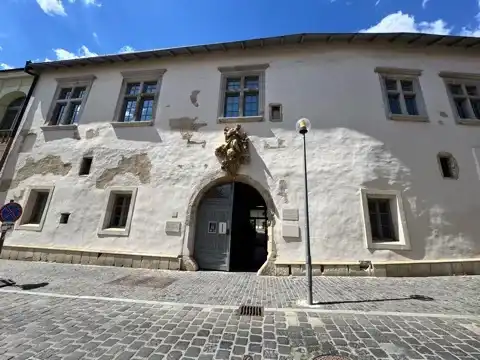
The Zsolnay Museum is in the former Zsolnay ceramics factory. According to my walking tour app, it’s in one of the oldest buildings in Pécs, first documented in 1324.
Vilmos Zsolnay built a very successful ceramics factory. The museum was inaugurated in 1928 to commemorate the 100th anniversary of his birth. It resulted, in large part, from the efforts of his daughter and granddaughter.
Most of the museum showcases Zsolnay’s ceramics, illustrating its evolution. The exhibits are divided into two areas on different floors: architectural ceramics and decorative ware.
Most of the items on display have associated labels saying, in Hungarian and English, what the piece is and when it was made. There are also some descriptive panels about ceramics and specifically the work of Zsolnay and his factory.
Many of the pieces — both architectural and decorative — are gorgeous and/or elegant.
There are also some large ceramic pieces sitting in a small yard in front of the museum.
Ceramics at the Zsolnay Museum:


Vasarely Museum

wool, woven tapestry
I came to Hungary never having heard of Victor Vasarely (1906 – 1997), a Hungarian modern artist. Now I’ve seen two exhibits of his work. The first was a temporary exhibit at the Budapest Museum of Fine Arts. The Vasarely Museum in Pécs, which I saw this afternoon, is a permanent collection dedicated primarily to him.
Except for a few of his earliest works, from what I’ve seen between the two museums, he almost exclusively produced abstract art. I don’t know if I’m entirely right about this, but I think most of his later works were based on geometric shapes. Whether or not that was the majority of his later pieces, it represented a lot of them.
I don’t dislike Vasarely’s work, which is surprising because I dislike a lot of modern abstract art. I don’t love it, but I kinda, sorta, like it.
The Vasarely Museum also displays a few pieces by artists who were contemporaries of Vasarely. I’m not sure, but I think the other artists were connected to Vasarely in some way—shared a style, exhibited in the same galleries, whatever. There weren’t a lot of works from other artists. The bulk were Vasarely’s.
Other Vasarely works:


Franciscan Church

The first historical records of the Franciscan Church date from 1280. It’s gone through a lot of changes since then.
During the Ottoman occupation, they converted it into a mosque with a minaret, a chapel, and an Islamic high school.
When the Ottomans were turfed out, the Franciscans took back control of the church in 1720. They then undertook major reconstructions.
The current church has a tower and isn’t heavily ornamented on the outside. On the inside, there’s a profusion of ornate, very 3D Baroque ornamentation.
When I went in, there were no artificial lights on. There are some windows, mostly stained glass, so some light did come in.
I was the only person there. I thought maybe I wasn’t supposed to be inside. But the door was open. And a sign said it was open for visitors, but that tourists would have to leave within about half an hour after I arrived because they’d be starting a mass then.
While I was there, two men came in. One swept the sidewalk in front of the main entrance of the church. The other went up to the church’s organ and started limbering up on it. Neither of them said anything to me or gave me an odd look when they passed me. So, I guess I was cool.
Without the artificial lighting, it was fairly dark inside. Fortunately, my iPhone does a good job of taking pictures in low light; a lot better than my eyes do at seeing in that light.
More pictures of the Franciscan Church:


Okay. That’s enough for today. I have to get some sleep, so I’ll be fresh enough to maybe find that Roman Lapidary tomorrow that I was hoping to see today.
Discover more from Joel's Journeys & Jaunts
Subscribe to get the latest posts sent to your email.

A Mosque, a Synagogue, and a Street

Mystery of the Lost Lapidarium; Gallery of Modern Hungarian Art; and More

You thought you had cleverly hidden it, but I saw it, I did, the fetching fish vase/pitcher/whatever it was! Or maybe you were testing your faithful readers, to see if we were really paying attention, and if so, shame on you! Even apart from the fish item, those ceramics were impressive. As to the Janus Pannonius Museum, what struck me is that it is named for the two-faced god Janus. Which means that today it might have turned to you one of its faces, and when you go back tomorrow, with luck you will come into contact with its other side, the Archaeological Museum and Lapidarium you were initially seeking. As good an explanation as any, I am venturing. Vasarely is known as a 20th century founding OpArt artist. I didn’t know he came from there. As to the Franciscan museum – I suppose you saw it the way people saw it when it was built, but without the candles. Very authentic.
I figured you’d find the fish. I didn’t want to go fishing for flattery.
A two-faced museum, hiding its Roman rocks. Harrumph.
I like that rationalization. The church wasn’t dark. I was experiencing it as it was.