Lyceum Church and a Bit More
“Lyceum Church and a Bit More” doesn’t sound like I did much in Pécs this afternoon. I didn’t.

I did visit the Lyceum Church, although I’m not entirely sure that’s its official name, even its official English name.
The bit more included a long walk, about half of which was along forested hiking trails. It also involved sitting on some benches, sipping an orange drink and eating a pastry in a cafe, and visiting a memorial that wasn’t all it was promised to be.
It was a pretty relaxed afternoon. I feel a little guilty about that. This is my last full day in Pécs and my penultimate full day on this trip in Hungary. I feel I should have packed more into the afternoon so my reader(s) get her/their money’s worth.
Wait. My reader(s) don’t pay anything. They can’t not get their money’s worth. I don’t understand why management puts up with that. Management is usually such cheap bastards.
(Please, don’t tell management I said that last part. They might dock some of the pay that they promise I might, possibly get one day. They loathe reading this journal, or reading anything, for that matter. They’re mouth-breathers. If you don’t tell them, they’ll never know.)
This being the penultimate full day in Hungary has no impact on this post. But because I leave Pécs tomorrow, it follows, by the rule of nature, that I’ll place a summary of my time in Pécs at the end of this entry. Nature can be a tough taskmaster.
Heading Back Into Town
If you read my previous post, you know that I finished off the morning at the Pécs TV Tower atop the Misina peak of the Mecsek Mountain Range.
I took a bus up from the plateau where my other two sights of the morning were. But I was at the top of a mountain at the TV Tower. Gravity can help power me down.
The bus runs only once an hour. (I lucked into the ride up and waited only a few minutes for the bus.) But that didn’t factor into my decision to walk down. I didn’t even look at when the next bus was scheduled to come by.
It was a reasonably pleasant day then, and Google Maps told me it would take just about an hour or so to walk back to central Pécs.
I wasn’t thrilled with the route Google Maps wanted me to follow. It sent me along roads the whole way.
The start of the route was the road the bus came up to get to the tower. (The bus then turned around and went down the same road.)
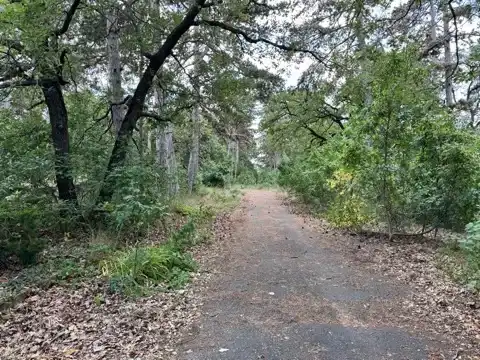
By the tower, and I think most of the way down to civilization, the road was two lanes with no sidewalks, and no shoulders. It didn’t seem entirely safe to me, but I was going to risk it.
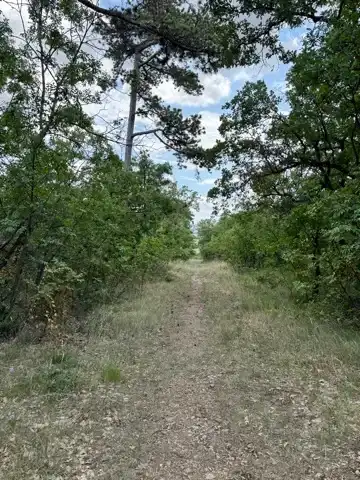
I hadn’t taken more than a few steps when I spied a hiking trail through the forest that appeared to head in the direction I needed to go.
I’d read that the mountain is laced with recreational trails. I decided to follow that one.
It took me down the mountain, shortcutting across some of the hairpin turns. A couple of times, the trail met up with the twisting road. At those points, I crossed the road and picked up the trail on the other side.
The trails were marked. But they were marked with symbols painted on the trunk of the occasional tree. I saw only two types of symbols. One was the tricolour of the Hungarian flag. The other was a red triangle.
I have no idea what the symbols meant. For all I knew, they could have been indicating, “Here be dragons.”
But I checked Google Maps regularly to make sure I was heading generally in the direction I wanted to go. (Google didn’t seem to know about most of the trails.)
The trails didn’t have as many twists, turns and hairpins as the road, but they did have some bends to keep the slope from ever becoming particularly challenging.
And, after a pleasant stroll through forests down the mountain, I arrived at city streets. It wasn’t long after that until I was back in central Pécs.
Angster Memorial
There weren’t many sights recommended by my guidebook or walking tour app that were open and sounded the least bit interesting to me that I hadn’t already seen. The only two left were the Angster Memorial and the Lyceum Church. Both are in central Pécs.
The Angster Memorial was the first on the route back from the mountain.
When I saw the name “Angster Memorial,” before I’d read the description, I figured this was a monument to someone I should certainly honour. I thought it was a playful, colloquial sobriquet like calling a person who interminably poses quizzes the “Quizinator,” “Quizmeister,” or “Quizster.” Or, maybe, calling a PR person who spins corporate or political stories the “Spininator,” “Spinmeister, or “Spinster.” Okay, “spinster” doesn’t quite work and isn’t politically correct, but you get the point.
I thought the Angster was expert at angst. I can relate to that.
But that’s not it. That’s not it at all.
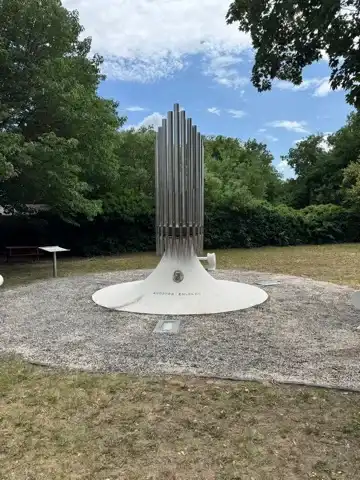
The Angster family had an organ and harmonica factory that, according to my walking tour app, GPSmyCity, “was a cornerstone of European musical craftsmanship from 1867 to 1951. Jozsef Angster and Son produced over 1307 organs and more than 3000 harmoniums, gracing cathedrals and village churches across the Carpathian Basin with their remarkable instruments.”
In 2010, the granddaughter of Joszef Angster, in collaboration with some other people, had the Angster Memorial erected.
It’s on a pure white base with a roughly volcanic shape, except that the sides are smooth. Above that is a circle of what resembles organ pipes of differing heights.
Set back from the memorial and spread around it, there are three two-seater concrete benches with armrests on either side. Each armrest allegedly has a light-sensing button. In theory, pressing the buttons would play information about the Angster family and organ music.
The recorded information is probably in Hungarian, but organ music knows no language. But it didn’t matter. I pressed the buttons — every single one of them. I held my finger over them for a while, hoping that would trigger the light sensor — every single one of them. But no sound, neither organ music nor spoken words, emerged.
It is an okay-looking memorial, but it would have been nice to get the whole experience. It’s a memorial. Lest we forget.

Lyceum Church
I’m not entirely certain that this church is called the Lyceum Church. My walking tour app calls it the Lyceum Church, but Google Maps calls it the Church of the Transfiguration of Our Lord.
There’s a metal sign bolted to the stone wall just above the door with words that Google Translate tells me are Latin for “dedicated to the glorious transfiguration of our lord Jesus.” So maybe that’s where Google Maps got the name.
But there’s also another sign bolted to the outside wall of the church at eye level that has a map and a lot of Hungarian words on it. Using Google Translate, I gathered it was a suggested walking tour route. That sign labelled the church as the Lyceum Church.
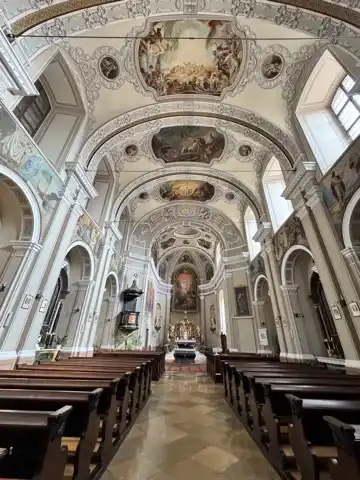
My walking tour app said that when the Elizabeth University of Pozsony relocated to Pécs, it became the University Church. Maybe that’s when it got the “Lyceum Church” name. Perhaps it’s named after the garden in which Aristotle taught philosophy, the Lyceum. I don’t know.
The Lyceum Church is on Király utca, the same street as my hotel, and the street I walked along and photographed for yesterday afternoon’s post. I would have gone in before, but it keeps weird, short hours (4:00 -5:30 p.m., Monday, Tuesday, Thursday, and Saturday; 9:30-11:45 a.m. Sunday; closed Wednesday). It was just never convenient before today.
The Lyceum Church, if that’s what it’s called, and the attached monastery were built between 1741 and 1756, using stones from a former Turkish mosque. Two towers were added between 1778 and 1779.
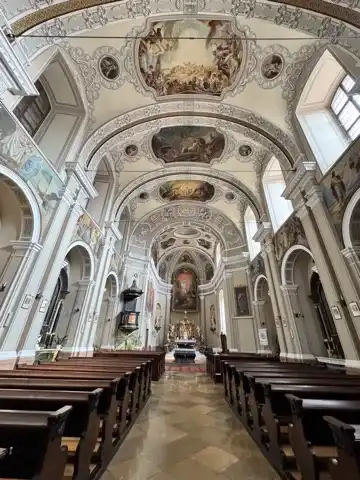
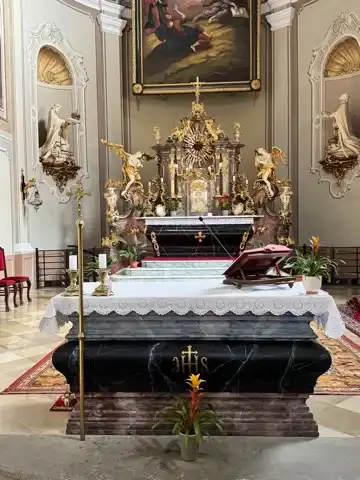
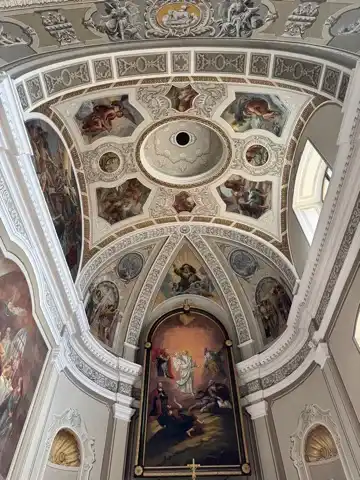
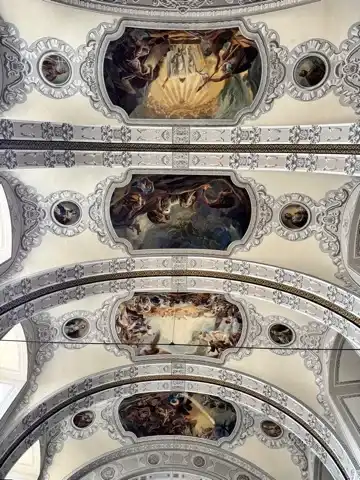
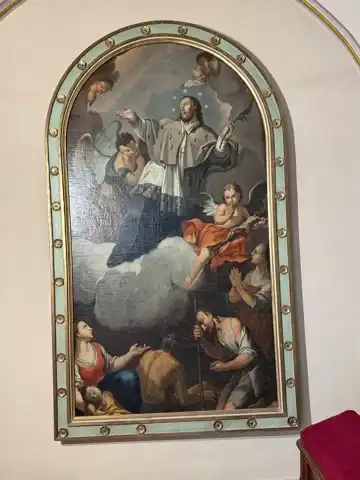
Inside, there are vibrant paintings on the ceilings and between the columns, under the column arches. It’s not at all a subtle church inside. And the altarpiece is particularly overdone, with a crucifix, a starburst, and a profusion of angels, urns, and gewgaws, all embellished with an abundance of golden ornamentation.
Upon leaving the Lyceum Church, I walked the few steps back to my hotel and ended the active portion of my time in Pécs.
More pictures from inside the Lyceum Church:
Pécs Summary
I really like Pécs, a lot, or at least the central part of it. Most of the streets are pedestrianized. Pedestrians don’t have to contend with cars. Nor do they have to hear them or smell them.
The buildings are mid-rise or low-rise. Most of them are elegant, or stately, or both, with pleasing colours. And there are two pleasant public squares.
There is a lot for tourists to see and do in Pécs, such as several small specialty museums, the cathedral, the bishop’s palace, the synagogue, the mosque, a former mosque that’s now a church, and probably a lot more that I’ve forgotten.
And I had some good meals here.
There’s a vibe to central Pécs that’s lively, without being overpowering.
This afternoon, as I said, I ran out of sights in the tourism sources I’ve been using here (a guidebook, a walking tour app, and TripAdvisor) that sounded interesting to me. So, my four nights, three-and-a-half days here were about right. Then again, if I could learn to simply experience and enjoy the vibe without feeling the need to constantly see new things so I get my money’s worth out of travel, Pécs wouldn’t be a bad place to do that.
Tomorrow, I head back to Budapest. There, I’ll have a few hours after I arrive in the afternoon, and, the airline-god willing, I’ll head back home the following morning. So, I’ll probably post only one more entry after this one on this trip.
Discover more from Joel's Journeys & Jaunts
Subscribe to get the latest posts sent to your email.

Pécs Cathedral and More

Mystery of the Lost Lapidarium; Gallery of Modern Hungarian Art; and More
Thanks so much for bringing us to Pécs. It looked like a lovely walk down the mountain, and the church – whatever it was called – was handsome. I especially liked your description of the gewgaw encrusted altarpiece. Nothing too technical, just the world through Joel Klebanoff’s eyes. It’s been a blast, and an honour to come along. I’ll be looking forward to joining you back in Budapest tomorrow (knock on wood!).
You’re welcome.
Oy. If anyone other than me is going to see the world through my eyes, maybe I should get that cataract surgery.
As you say, knock on wood.