Mystery of the Lost Lapidarium; Gallery of Modern Hungarian Art; and More
It was a slow morning for me. The biggest sight I saw, both by size and impact, was the Gallery of Modern Hungarian Art. But I also solved the mystery of the lost lapidary. And I have a brief aside to relate because I’m nothing if not a bearer of information that won’t interest 99% of my audience. Considering the size of my audience, it will thus interest only a small fraction of one person. If that’s you, I hope you can become whole again soon.
Mystery of the Lost Lapidarium

Yesterday afternoon on Joel’s Journeys and Jaunts, I related the story of my trying to find a lapidarium and archaeological museum recommended by my walking tour app. I found a museum at the location provided, and where the pin on the app’s built-in mapping facility said it was. But it had a wide variety of prehistoric, historical, and cultural exhibits.
There were some archaeological artifacts, including a few fragments of ancient architecture and funerary stones. Nevertheless, it wasn’t something properly called an archaeological museum and lapidarium.
While there, I hunted around the small museum for a doorway or hallway I had missed. With the help of Google Translate, I asked an attendant if they had any ancient stones. She pointed me to the very small number of fragments they had. She could offer no more.
It was an interesting little museum, but not what I was expecting to find.
When I got back to my hotel, I did some web searching and found that the museum I was at is part of a collection of mostly small, mostly not co-located museums under the auspices of the Janus Pannonius Museum (JPM).

Most of JPM’s museums are not co-located. Nevertheless, the JPM website listed the museum I was at and the “Roman Lapidarium” independently, but at the same address.
Now, you’re caught up with yesterday’s episode. Onward.
Armed with this alleged truth, I became obsessed with finding the Roman Lapidarium this morning. I was determined to do so before going to the Gallery of Modern Art. I was reasonably certain I could find it without spending all morning looking for it.
After first heading to view a solitary statue that I’ll describe in an aside below, I set out upon my valiant quest.
As you likely gathered from the four photos I lightly sprinkled here, above, and below, I solved the mystery of the missing lapidarium.
I went back to the museum I was at yesterday. It is at an intersection. I walked along the side of the building to see if there was another entrance. There wasn’t.
I double-checked the signage around the museum, using Google Translate to read any signs that were exclusively in Hungarian. None mentioned anything even vaguely resembling a lapidarium or an archaeological museum.
There’s a small, simple garden, more like a courtyard, beside the building containing the museum I was in yesterday. There’s a wrought iron fence separating it from the street. There’s a gate into the courtyard beside the museum building. Looking through the gate, I could see a café at the far end of the courtyard, with café tables set up around the yard.
There was also a semicircle of a few rows of folding chairs. They faced a guy who looked like he was preparing to put on a musical performance of some kind.
The only signage by the gate, or anywhere on the fence, advertised the café.

Then I looked at the small yard a little more carefully. Along the side of the yard opposite the building, stretching the length of the yard up to the café, there was a not-very-deep shed. It was glass-fronted.
From even the short distance of the width of the yard, the glass did a reasonably good, but not perfect, job of reflecting what was in front of it, rather than revealing what was behind it.
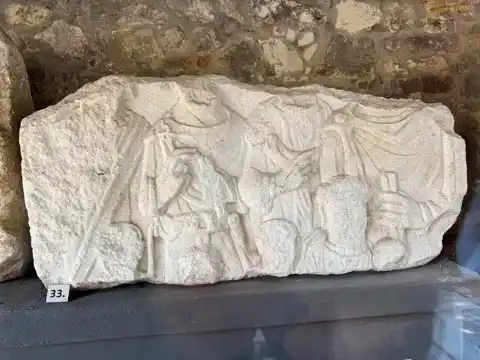
I walked into the courtyard and got a little closer. You’ve no doubt already guessed what I saw. Old stone objects. That’s what I saw.
There was no sign saying it was the Roman Lapidary or giving the exhibition any name whatsoever. However, each piece was numbered. And there were signs saying what each of them was. Most were funeral steles or fragments thereof, or altars or fragments thereof.
Eureka!
Aside
Janus Pannonius
Yesterday, when I told the story of my failure to find the lapidarium and mentioned that it fell under the umbrella of the Janus Pannonius Museum, a regular reader and commenter mentioned that Janus was a god with two faces, so maybe the museum has two faces to it. She suggested I might find the second face today.

It turns out that’s not the Janus for which the museum is named.
In my search for information about the errant lapidarium, I found a Wikipedia page about Janus Pannonius. If Wikipedia is accurate (I usually feel the need to put in an “if Wikipedia” caveat, or words to that effect, when I cite Wikipedia), the Janus in the museum’s name does not stand alone, nor is it the name of a god in this context.
I’ve never met Janus Pannonius. Neither have you. According to Wikipedia, he lived from 1434 to 1472, and he “was an influential intellectual in the Kingdom of Hungary, a Latinist, poet, diplomat, and Bishop of Pécs. He was the most significant poet of the Renaissance in the Kingdom of Hungary and one of the better-known figures of humanist poetry in Europe.”
I’d never heard of him before.
The Wikipedia page displayed a picture of a statue of Janus Pannonius. It’s in Pécs. I assumed that because the lapidarium is part of the JPM, it would have the same opening hours as JPM’s other museums, ten in the morning. Because I left my hotel before 9:30, I decided to see the statue first. Fortunately, it’s marked on Apple Maps and is located in a park beside the Bishop’s Palace. I’ve included a picture of it here.
Gallery of Modern Hungarian Art

I always worry about galleries that proudly proclaim they are galleries of modern art, such as the Gallery of Modern Hungarian Art. I worry that they will be filled with totally abstract pieces that I fail to appreciate, in large part because I rarely see the meaning or emotion the work allegedly presents.
“This work projects the artist’s desire for society to aspire to rise to a higher intellectual plane with a deep, visceral connection to all human consciousness and the complete cosmos. This masterpiece of watercolour, oil paint, tempera on canvas and cotton batting reflects this supremely optimistic feeling as no other artist can.”
Or, “The painter deeply feels the despair of the downtrodden and the destitute, while at the same time deploring the creeping, but rapidly accelerating degradation of human connection through increasing dependence on the faux-relationships fabricated, managed, and distilled by our expanding reliance on technology over which we’re ceding control. Gazing at this painting executed with blood, urine, and faeces on strips of toilet paper joined and stiffened with fabric starch, one cannot help but feel the artist’s anguish viscerally.”
Balderdash. They’re random blotches, lines, dots, and/or shapes, sometimes using inane or grotesque media. Go away.
I often think that modern, totally abstract art is today’s version of “The Emperor’s New Clothes.” The painters offer to supply galleries with magnificent new paintings. Only those who are incompetent or stupid will fail to see their meanings. Yeah, right. I’ve heard that story before.
You people really should work harder at stopping me when I go off on these rants. Otherwise, we’ll never get out of here alive.

Vilmos Huszár, 1906
The Gallery of Modern Hungarian Art exhibits Hungarian art. The works are of modern vintage and style. (Modern to art historians who consider any works that depart from classical styles and/or are less than at least a couple of centuries old or, better yet, more, to be modern.) What more do you need to know?
…
That was a question. Feel free to answer it at any time. How do you expect me to take this in a direction that meets your needs if I don’t know what those needs are?
…
Crickets.
Okay. I’ll blaze ahead on my own. Don’t blame me if I don’t provide information that satisfies you. Management pays me the same whether you’re satisfied or not. And it’s not like you’re ever going to leave a tip.
The Gallery of Modern Hungarian Art exhibits art on three levels (physical levels, not, say, planes of existence): the entrance level and two below it. That’s not quite as subterranean as it sounds.

Béla Kondor, 1959
The gallery is built on a small hill. The entrance level is fully above ground. But the next level is partially underground and partially above ground. A triangular window on the street side lets light into half of the gallery at this level.
The lowest level is entirely subterranean.
The street level doesn’t have much exhibition space. A hallway and a small room on that level displayed portraits on their walls.
I’m reasonably confident that they were all self-portraits. Two clues made me think that. For one, a few of the subjects held painters’ palettes or wore splattered painters’ smocks. Cementing my theory, I looked at several of the cards beside the paintings. All of them had only a single name, not two, the painter and the subject.
I trust none of my assumptions about art, so I asked the attendant (I don’t think the couple of staff members there were technically docents) if they were all self-portraits.
She said she didn’t know, but I don’t know if she meant she didn’t know whether they were self-portraits or whether she didn’t know what the heck I was asking. She wasn’t fully fluent in English. Not that there’s anything wrong with that. This is Hungary, after all.
I think all the artists (and, if I’m correct about them being self-portraits, then also their subjects) are Hungarian. I know. I know. That’s a bold guess. But considering it’s a gallery of Hungarian art, I’m going to stick with it.
Most of the portraits dated from the early 20th century. I saw a few from the late 19th century, a few more from the second half of the 20th century, and one from the 21st century.

Balazs Kicsiny, 2005
The next level down presents Hungarian art of a variety of subjects. Most of the works presented were identifiable as people, places, or things, although some of them were at least somewhat abstracted people, places, or things. However, there were a couple of small rooms with purely abstract Hungarian art. This floor also displayed a few small sculptures.
Again, the early 20th century was heavily represented on this floor of the Gallery of Modern Hungarian Art, but there were also some works from outside that range, including both the latter half of the 20th century and the first few years of the 21st century.
The lowest level of the Gallery of Modern Hungarian Art displayed some larger works, including larger sculptures and paintings. Most of the pieces on this floor were abstract or heavily abstracted.
To be honest, I couldn’t recognize any differences in style or substance between modern Hungarian art and modern art from other countries. Then again, I’m not trained or experienced in recognizing such things. I’d no doubt miss any consistent national subtleties of style or subject present in Hungarian modern art. I’d probably also miss it if it weren’t subtle, but more on par with a sledgehammer.
I didn’t hate the Gallery of Modern Hungarian Art. In fact, I bordered on liking it. That’s high praise coming from me.
A few of the paintings in the Gallery of Modern Hungarian Art spoke to me. Because they did, I feel obliged to relay to you what they said. I believe they’re yearning to be heard.

Runday Gyula, 1916
Gallery of Modern Hungarian Art
Cossack Head
Runday Gyula, 1916
The message here is so plain that even an art illiterate, even one with no familiarity whatsoever with modern Hungarian art, can’t possibly fail to see it. The Cossack is clearly thinking, why does this crap always happen to me? Why can’t I ever catch a break? Just once, I wish my ship would come in. If not a ship, maybe a decent cart that I can get my stupid cousin to pull for me along the deeply rutted roads so I can get my already rotted cabbages and potatoes to market.
Bravo, Runday Gyula. Bravo
Gallery of Modern Hungarian Art

Róbert Berény, 1907
Self Portrait With a Top Hat
Róbert Berény, 1907
A self-portrait, you say? How arrogant.
That sneer on his face clearly says, “I’m better than you. I know it. And you know it.”
For goodness sake, Róbert. You could have been a little less pretentious. You were just a guy who painted. There’s nothing wrong with painting. I’m sure many painters are kind, generous, compassionate and exemplary fellows.
But considering the haughtiness your face displays in that self-portrait, I’m guessing you weren’t one of them. (I used the past tense not because I think he has become humble, but rather because he has become dead. Róbert Berény lived from 1887 to 1953.)

Béla Veszelszky, 1963
Museum of Modern Hungarian Art
Composition 2 (Still Life)
Béla Veszelszky, 1963
Still life? No. It’s just a collection of relatively random dots. Points of paint on a page or canvas are still, but they aren’t life. Which leads me to ask, what’s the point?
And he made at least two of these things? Please see my rant above.
I would have stopped after just one if I were him. Then again, I’m glad I’m not him. Béla Veszelszky died in 1977.
Discover more from Joel's Journeys & Jaunts
Subscribe to get the latest posts sent to your email.


I am so happy to read your blogs, and equally pleased to see that you enjoyed some works of art. But as to your art analysis and rant, what do I hear?
crickets.
That’s the best I can do. Yet you beetle (cricket) on with every art gallery on the recommended list, and for that: trumpets!!!! Well done, although it is enigmatic sometimes as to why you bother. On the off chance that there is something that will move you? Trumpets!!!
By the way, congratulations on your success sleuthing out the location of the lapidarium. As to the Janus comment of mine last blog: it was a lame prompt rather than an assumption of godly patronage. I really appreciate that you looked up the historical Janus. I was surprised that it referred to someone who lived well over 500 years ago. I wonder whether his friends thought he was two-faced?
I’m glad you enjoy my posts.
When played well, trumpets can be wonderful instruments. Inspiring, even. I mean, they’re not kazoos, but what is?
Thanks for the congratulations on my finding of the old stones.
Truth is, I didn’t intentionally look up the historical figure. When I was trying to get more information about the museum, the name of which was carved in stone above the museum I went into when first hoping to find the lapidarium, I searched for “Janus Pannonius” without the “Museum” at the end because in Hungarian it’s “Múzeum” and I was hoping for an English reference, without wanting to exclude Hungarian references because I could, if necessary, get Chrome to translate it.
Little did I know there’d be a mortal Janus, but he popped up at the top of the search results.