A Mosque, a Synagogue, and a Street
“A mosque, a synagogue, and a street.” That sounds like the opening of a joke, doesn’t it?

A mosque, a synagogue, and a street walk into a bar …
Except, of course, there are few bars large enough to accommodate a mosque, a synagogue and a street. And if you ever see a mosque, synagogue, or street walking, I strongly recommend that you cut back on the hallucinogens you’re using.
The point that the title was trying to convey was that this afternoon in Pécs, Hungary, I visited a mosque and a synagogue and did some streetwalking.
Wait. That didn’t come out right. I walked along a specific street, enjoying the streetscape, without trying to solicit any business of any sort.
Warning: This will likely be a short post. Make sure you have other activities available to fill the rest of your day.
Jakovali Hassan Pasha Mosque and Museum

Unlike the Mosque of Pasha Qasim (Church of the Blessed Virgin Mary), which I was on my first day here, which was a mosque built with the bricks of the previous church it replaced and then turned back into a church when the Ottomans were turfed out of Hungary, the Jakovali Hassan Pasha Mosque still functions as a mosque. Well, and a museum. In fact, as far as I could tell, it looks like it’s mostly a museum these days.
Just past the ticketing area, there’s a small room with four display cases. Each rises from a low pedestal all the way to the ceiling. The display cases are distributed around the sides of the, I think, odd-shaped room. I say “I think” not because I’m undecided if the room is odd-shaped, but rather because I don’t know what shape the room is. Mirrors fill the space between the display cases, except for the entry from the ticketing area and another narrow open doorway.

I kept thinking I was about to walk into another room until I saw myself in front of me. It was a tad disconcerting. Consequently, I couldn’t quite figure out the shape of the room.
One display case held a couple of ceramics and some text about ceramics that were imported by the Ottoman Empire. Another held some coffee cups and a coffee urn, with accompanying text about the spread of the culture of coffee-drinking. Yet another held some calligraphy pens and an example of calligraphy, along with text about that. And finally, one held some items representative of a few motifs in Ottoman art, along with a description of those motifs.
The other doorway out of that room led to a short hallway. On the wall of the hallway, there was a timeline of the Ottoman period in Pécs. That hallway led to a room under the dome of the mosque. I think that is where prayers are held. But there wasn’t a lot of open space not filled with other stuff.

There was a smallish Persian carpet, but if that was the prayer portion of the mosque/museum, I would have thought there’d be restrictions against anyone going on it with shoes on, particularly non-believers. I didn’t see any such restrictions.
There is a small garden in the back of the mosque. The minaret is attached to the back of the mosque, so the only place it’s fully visible is back there.
When I entered the mosque (it’s free for people older than 70), I was handed four laminated sheets of paper stapled together. They provided information in English about the history of the Ottomans in Pécs, the construction of the mosque, Jakovali Hassan Pasha, life after the end of the Ottoman Empire in Hungary, and the architectural and religious elements of the mosque.
I won’t go into all of that, but the date of the construction of the mosque is not precisely known. It’s believed to have been built sometime between the turn of the 16th and 17th centuries, or possibly as late as the 1630s. According to the information sheet, Jakovali Hassan Pasha Mosque is the best-preserved mosque in Hungary. (I presume it means the best-preserved, centuries-old mosque.)
Pécs Synagogue
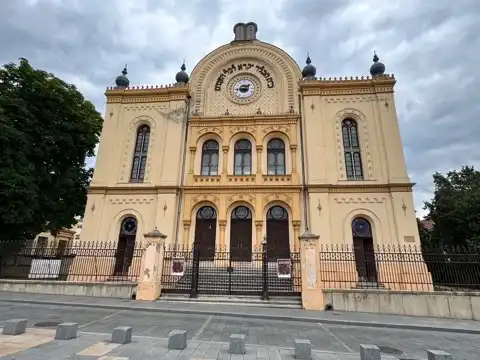
From the mosque, I went to the synagogue. There’s probably a heart-warming kumbaya message I could and should deliver with that, but I’ll let you come up with your own, except to ask, can’t we all just live together in peace?
The facade of the Pécs Synagogue is very attractive. Most of it is a sand colour, but the stone around the main door is a similar hue but more orangey.
The front facade has an arched piece in the middle that rises above the rest of the straight roofline. There’s a clock mounted in that arched section. I had trouble making it out, but according to the information I received inside the shul, there are two sets of numbers around the clock. One indicates the time in Pécs, the other in Jerusalem. And, while there is no second hand, the clock has a third hand. It’s golden and rotates counter-clockwise to symbolize the reading of Hebrew from right to left rather than left to right.

There are five doors at the front of Pécs Synagogue. Three are grouped close together. There is also a door on either side of the group of three, spaced farther from the group than each of the three is from each other.
Both of the doors on the sides were wide open when I arrived. All of the three doors in the main group were shut, but I found out later, not locked.
I went in one of the open doors. It led to a staircase. At the entrance of the building and on the stairwell walls, there were several trilingual (Hungarian, English and German) information panels. The one by the entrance noted that the first Pécs synagogue opened in 1843. The current one opened in 1869 and, according to the sign, is today the largest synagogue still in use in the Dunántúl region (which comprises about half of Hungary).

The other panels provided information about the Jewish community across Hungary and specifically in Pécs. They told the story of the growth and then sometimes tragic (especially the Holocaust) decline of the population, the periods of legal restrictions on the Jews and the periods of freedoms, and the nature of the Jewish community in Pécs throughout history.
The stairwell led to a balcony that runs along one side of the synagogue. That connects to another balcony at the back of the shul, which in turn connects to a balcony that runs along the other side.
There is another set of balconies above those, but I didn’t walk up there.
In the back balcony, there were some glass display cases holding various Judaica items. I’m a slob and dust only rarely. But even I would dust a little if my furniture ever got as dusty as the display cases were. Plus, they are up against a window. So light coming in through the glass at the back of the case lit up the dust and made it even more difficult to see inside the cases. So, I have no pictures for you of that.

I then went down the other stairwell, reading the information panels along the way, and out to the front of the shul.
I saw the lower level of the sanctuary from above. It looked beautiful. I wanted to see it from the ground floor. Because there was no way to get there from the balconies or the balcony stairwells, I tried one of the three doors. It was unlocked.
Inside, I had to pay a small fee. I was then handed a paper keepah and a laminated sheet with information about the synagogue (that’s where I got the information about the clock). I could then go in and take a look inside.
It looks beautiful from there too. The pews and the balcony walls are old wood. The balcony walls have coffered panels. The ceiling above the beemah and ark is arched and painted a rich blue. The other dominant colour is roughly terracotta. There is a pipe organ mounted on a side wall at the front of the synagogue.
I’m glad I visited the Pécs Synagogue.
Király utca

My walking tour app lists only one street in Pécs as a “must-see.” The app calls the street “King Street.” But the signs on the street name it “Király utca,” which is the translation of “King Street” into Hungarian. (Unlike in English, where the “Street” part of the name is capitalized, like “King Street,” “utca” is lower-cased in Hungarian.)
The app says that the street once had a tram on it. It no longer does. Now, the vast majority of the few-blocks-long street is pedestrianized. One end is at Széchenyi Square, which I mentioned in an earlier post. Pécs’ beautiful City Hall fronts on the square, but one of its sides, the one with City Hall’s tower, is on Király utca.
The buildings along Király utca are beautiful until the last block or so. That last part is the segment that’s not pedestrianized, and the buildings there are much plainer. The most beautiful building on the street is, in my opinion, the National Theatre of Pécs.
I’ve walked on Király utca several times during just the two and a half days I’ve been in Pécs. I couldn’t help it. My hotel is on Király utca. But until today, I hadn’t walked its full length or spent much time looking carefully at its buildings.
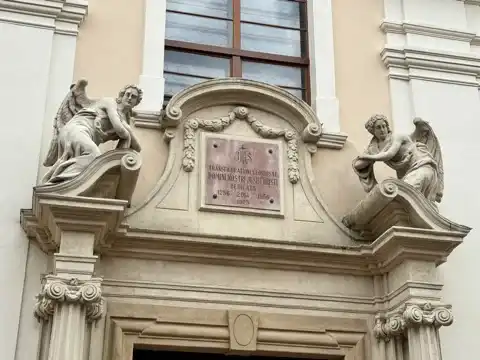
In lieu of my trying to write flowery words about the street and its buildings, here’s a slideshow of some of those buildings (except the National Theatre, which is pictured above), along with zoomed-in shots of features on some of them.
Images from Király utca:




Discover more from Joel's Journeys & Jaunts
Subscribe to get the latest posts sent to your email.

Mystery of the Lost Lapidarium; Gallery of Modern Hungarian Art; and More
Zsolnay Museum and More
Lovely Pécs! What a nice bit of streetwalking, I mean being a tourist and looking at the beauty of the pedestrianized areas of the main street (just to set things straight). A bit of a spacey experience in the mosque, it sounds like. I would find it particularly disorienting to continually find that I am confronting myself. It is something I expend a lot of energy trying not to do. The shul was lovely.
I frequently confront myself, but usually not visually. I think it’s called self-doubt. Doesn’t everyone constantly feel that? Hard to believe anyone doesn’t.