Plunging into Pécs

My guidebook tells me that Pécs, the Hungarian city I’m now in after leaving Keszthely this morning, is pronounced “PEH-ch.”
I was thrilled to learn that because pronouncing it the way my Anglophone tongue wants to pronounce it, I feared that the city expected me to work on my chest muscles while I’m here. There’s no chance of that. There are sights to be seen, not pushups to be pushed. I’d have to immediately leave if that were a city ordinance.
I’ll be here for four nights. So, including what I had of this afternoon, I’ll have three and a half days to explore Pécs.
I found out only yesterday that I’ve arrived in Pécs during its annual Zsolnay Light Festival.
I learned that when I received an email from the hotel I’m staying at, saying that the festival attracts a lot of visitors each year, and restaurants in Pécs are expected to be very busy. Hence, I might want to make a reservation in the hotel’s restaurant so I don’t risk dying a horrible death by starvation.

The hotel left out the death by starvation part, but I know that’s what they were thinking.
I haven’t so far taken up the hotel’s recommendation. It has a vested interest in that suggestion. The festival absolutely must be real because it has a website. But I don’t know if the hotel told me that restaurants may be full only to entice me into its restaurant. If not, I may be emaciated by the time the festival ends.
I learned from the festival’s website that this year it started yesterday and continues today (Friday), tomorrow, and Sunday.
Each year, the Zsolnay Light Festival identifies a country that is a guest of honour and the festival’s theme. This year it’s Ireland. Top o’ the morning to you, Pécs.
Pécs is the final stop on my Hungarian adventures before heading back to Budapest for one night to catch my flight back home the next day. So I’d best make the most of Pécs, bestn’t I?

From Keszthely to Pécs
Because I tend to be scatter-brained at times — those times being constantly, but only on days ending with “y” — I’m going to back up a bit. There is my journey from Keszthely to Pécs to discuss.
If I were considerate of my readers, I’d reword this entry so as not to jump around temporally. However, I’m too lazy and too busy travelling to accommodate those considerations.
I travelled by train between the two cities. The journey didn’t require any transfers, but it took almost four hours.
The duration was not entirely due to distance. The train made several stops. Most of them were at stations. A couple were at sidings. The route was a single track most of the way. And the train travelled slowly at times, sometimes very slowly.
Apart from Pécs itself, none of the stations between Keszthely and Pécs were major affairs. One or two (I didn’t look out the window all the time) bordered on being substantial, with multiple platforms. Some had small, quaint, homey, one-room station structures. A few made a mockery of the word “station.” “Stop” is more accurate. They were nothing more than a rough, concrete single platform and a sign.
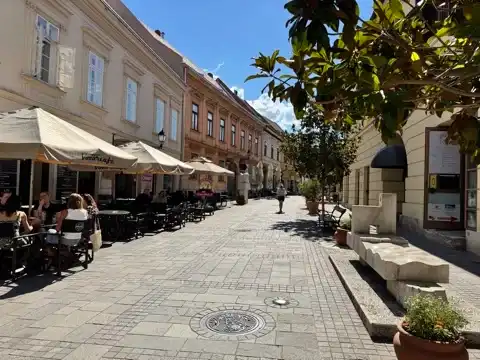
The train passed and stopped at a few villages and towns, including one that might have been classified as a small city. However, much of the way was by farmland and forests, including a few forested hills. Most of the journey was pastoral and pleasant.
That said, the train did venture through a few short tunnels. Those were a tad less scenic.
Eventually, I alighted in Pécs. The railway company must have anticipated the station and non-station stops —along with the occasional lethargy of the train — because the train arrived at roughly the appointed time. With that travel tale related, I can resume the narrative I commenced earlier.

In Pécs
My hotel is in the old centre of Pécs. The train station is not. I had about a twenty-minute walk between the two.
When I went on the Budapest Food Tour a couple of weeks ago, the guide pointed to a building. She said you can always recognize buildings from the Soviet era. They are boxy, unadorned, and mostly ugly.
On approximately the first half of the walk from the train station to my hotel, I think I passed several Soviet-era buildings. Central Pécs, on the other hand, is very charming.
The central area is composed mostly of pedestrianized streets lined with lovely edifices. There are also a couple of appealing public squares. Some of the streets have sheets of thin coloured cloth hung horizontally between the buildings on either side.

After I checked into my hotel, I still had the better part of the afternoon to take a look around. I restricted myself to central Pécs. It has a lively vibe to it, without feeling the least bit frenzied. The extreme heat I experienced in Hungary until now has backed off. It’s still far from cool, but the lower temperature might explain some of the liveliness.
In central Pécs, I wandered around somewhat aimlessly, never venturing beyond a half-dozen-or-so block radius of my hotel. I say “somewhat” aimlessly because, at a couple of points while wandering, I headed directly for and entered recommended sites, visited another, and cast my gaze on a few recommended building facades. Surprisingly, there are still many recommended sights for me to see in Pécs over the next three days.
Walking around, I passed a statue that stuck out like a sore thumb, or perhaps like a thumb that wasn’t sore. I’ll try to remember to post a picture of it. You’ll recognize it when you see it, particularly because I’ll caption it appropriately.
More random pictures of central Pécs:


Széchenyi Square
The bigger of the two squares in central Pécs that I mentioned above, Széchenyi Square, is about half a block from my hotel. A few of the buildings with recommended facades and the two sites I entered are on the periphery of the square. There are also two statues in the square.


Pécs City Hall
Let’s tackle the facades first. One is the Pécs City Hall. Its facade is predominantly Dijon mustard-coloured. There are some arched windows and several rectangular windows, some with arched decorations over them. The roofline has a few curves and peaks. There’s a relief coat of arms a little below the roofline, centred on the front facade.
There’s a tower that forms part of the side facade toward the back of the City Hall. It’s difficult to see from the front, but quite visible from the side. The street that runs along that side of the City Hall is the one my hotel is on.

It was the tower that attracted my attention. When I first saw it, I had no idea that the building was City Hall. I noticed some people on an observation deck near the top of the tower gawking down. You know me and towers. (Or maybe you don’t if you’re new here. I love climbing up towers to take in the view.) I desperately wanted to go up there.
There’s a tourist information office in a storefront on one corner of the building. I went in and asked how to go up the tower. The person there responded, “It’s open only on special occasions. We let two groups up today, and the last one is up there now. It won’t be open again until July 23.”
Today is July 3. By July 23, I’ll have been back home for two weeks, eagerly awaiting my next trip. So, that’s not going to happen.
After I got that information, I asked her what building it was. That’s when I learned it was City Hall. At that point, I was in my aimless wandering phase, not yet looking for any of the recommended sights, so I had no idea.
County Hall
I don’t have much to say about County Hall. It has, in my opinion, a mildly attractive, mildly stately facade. Between some of the windows on the top floor, there are what I assume are coats of arms.

Hunyadi Janos Statue
Hunyadi Janos is a Hungarian hero for his defence of the Kingdom of Hungary against the Ottoman invasion from 1441 until he died in 1453. He had to cut back beyond that because medical science strongly recommends that you curtail your defending after death.
In his statue, Hunyadi Janos is seated on a horse and holding what looks like a sceptre. Enough said about that statue because my narrative on the next one is probably going to be lengthy.

Holy Trinity Statue

The Holy Trinity Statue is a prominent feature of Széchenyi Square. It stands tall. The original version was erected in 1714. But that one decayed so much that it was replaced by the current version in 1908.
So, about the statue as it currently stands and, I imagine, originally stood. … Damn. There’s never an expert in Catholic iconography around when you need one. Hopefully, one will come along soon and feel pressed into service, possibly reluctantly.
My understanding, or possibly lack thereof, is that the Holy Trinity consists of the Father, the Son, and the Holy Ghost. I get the Son and Father part. That’s Jesus and his alleged (alleged by Christians) Dad, God, right? I’ve never known how the Holy Ghost fits in or who he or she is.
I’m pretty sure I recognized the Son and the Father. They’re seated side by side about midway up the statue. The cross Jesus is carrying gave him away. I’m surprised they let him keep the cross. Is that like the star player on a winning sports team getting to keep the game ball, except completely different?

But I’ve never known who the Holy Ghost is. So I don’t know where He or She is on the statue.
Three figures are standing below Christ and his dad (if I’m right about them). (Why do they have to stand all this time while Father and Son get to sit?) The middle figure is a woman with a halo circling her head. I assume she’s Jesus’s mom.
That raises a question that has always plagued me. Why doesn’t Mary get equal billing with the Father and the Son? She had to carry the Son to term and go through labour to bear him. It’s not as if Jesus’s putative dad had any part in that. Heck, I’ll bet he never changed a diaper or took his son to a ballgame.
And the Holy Ghost? Is he like a godfather?

The two figures flanking Mary are both men. The one to the left is suffering the slings and arrows of outrageous fortune. Or maybe just the arrows. He has three of them piercing his torso. He has a look on his face like he’s thinking, “Why does this sort of thing always happen to me?” I don’t know much about these things, but I think he’s a Roman centurion.
The guy on the right is holding a staff. Standing at his feet, there’s a dog with a bone or something in its mouth.
Wait! Is the dog the Holy Ghost? Is that it? It looks like a good dog. Maybe even holy.
Above the Father and Son, there are some cherubs. And a starburst perches atop the statue.
There’s a man at the back of the Holy Trinity statue. He’s cradling in his arms something that is too weathered for me to identify. It could be a baby human, a lamb, or possibly a toy Lamborghini. But it’s probably not the latter. I’m not going to hazard any guesses as to what his role is in the plot.
Zooming in on some of the individual figures on the Holy Trinity Statue:


The Mosque of Pasha Qasim (Church of the Blessed Virgin Mary)

As you can tell from the title, the Mosque of Pasha Qasim (Church of the Blessed Virgin Mary) has an interesting history. It was once a mosque, and then it became a church. The exterior still bears some mosque touches in the portion that was part of the original mosque, such as some reddish-brown vertical stripes framing some of the windows and edges. Some of the same decoration also appears inside.
There’s a dome over one portion of the church. At the top of the dome, there’s a cross, with a crescent below it. I paid to go inside.
The ticket seller handed me a laminated sheet that provided a history of the church in English. But there’s also bilingual signage inside.

The history dates back even before the mosque. There had been a church there, the Saint Bartholomew Church, since the 13th century.
Then the Turks invaded in 1543. Pasha Gazi Kassim used the bricks of Saint Bartholomew’s Church to build a mosque facing Mecca. According to the information sheet, “In 1766, after the expulsion of the Turks, the Jesuits converted the mosque into a Baroque-style Catholic church.”
In the church, there was an illustrated video in Hungarian with English subtitles about the church’s history. After it was a mosque, its dome was elevated, frescoes were added to the inside of the dome, and wings were added and demolished at various times.
The sanctuary is interesting. There are two sections to it. The altar is between the two sections.

The section under the dome has square walls up as far as the dome. The pews in it are in straight rows.
The section that’s not under the dome, and therefore the circle of the dome doesn’t influence it, has semicircular walls. The pews in it are in concentric semicircles.
There is a huge pipe organ high up at the back of the non-dome portion. The number of pipes is uncountable. At least, uncountable by me. I’d lose count before I came anywhere close to counting them. Fortunately, the information sheet told me there are 2,900.
There’s a choir stall on a balcony that I went up to so I could look down on the church’s interior.
It’s an interesting little church.
More photos of The Mosque of Pasha Qasim (Church of the Blessed Virgin Mary):


Church of the Order of Mercy for the Sick
I don’t know the name of this church. I got the section heading above from a Google Translate translation of a small plaque by the door. My walking tour app, however, calls it “The Church and the Hospital of the Hospitaller Brothers of St. John of God.” Google Maps seems to think it’s “Saint Sebastian’s Church.”
I trust the plaque (although not necessarily Google Translate’s translation). Why would they spend money on a plaque, small though it may be, only to misname the church on it?
Whatever it is, it’s a nice little church that, according to my walking tour app, was completed in 1727. A monastery was added in 1731, and a medical care facility in 1796. That latter facility was enlarged into a hospital in 1873. There is still a building attached to the church with a secular-looking white cross hanging off its wall.

Inside, still according to my walking tour app, there are Baroque embellishments, along with more recent influences added in 1908. I went inside. I think I recognized the Baroque elements, but they weren’t as overwhelming as Baroque can be.

Bath of Pasha Memi

I walked to what looked like almost the edge of the old town of central Pécs to take a look at the Bath of Pasha Memi. It’s a small, old ruin of what was an Ottoman-era Turkish bath. According to my walking tour app, it dates from the 16th century and is recognized as the longest-surviving Turkish bath from the period of Turkish rule.
It’s only a ruin now, beside a street, with a newish building almost abutting it on the side away from the street.
It’s not much. It’s just sitting there for anyone to look at, without any signage that I noticed. But it’s old. And it’s a ruin. So it’s worth a quick look. I had a quick look.
Hungarian Dancing
When I headed out for dinner, a small crowd was gathered in Széchenyi Square. Some costumed people looked like they were preparing to put on a show. I took a seat on a concrete block facing the seeming performance area.
That’s what it looked like. Looks can be deceiving, but not in this case. I didn’t have to wait long until the dancing started.
I stayed for two numbers and then left. The show continued, but I wanted to beat the other suckers before they found they couldn’t get a table at a restaurant.
I had no trouble getting a table at a restaurant with a patio on the square, within earshot, but not in eyesight of the ongoing show.
Lucky you. I took videos of the two numbers I stayed for. A combined video of the two is below.
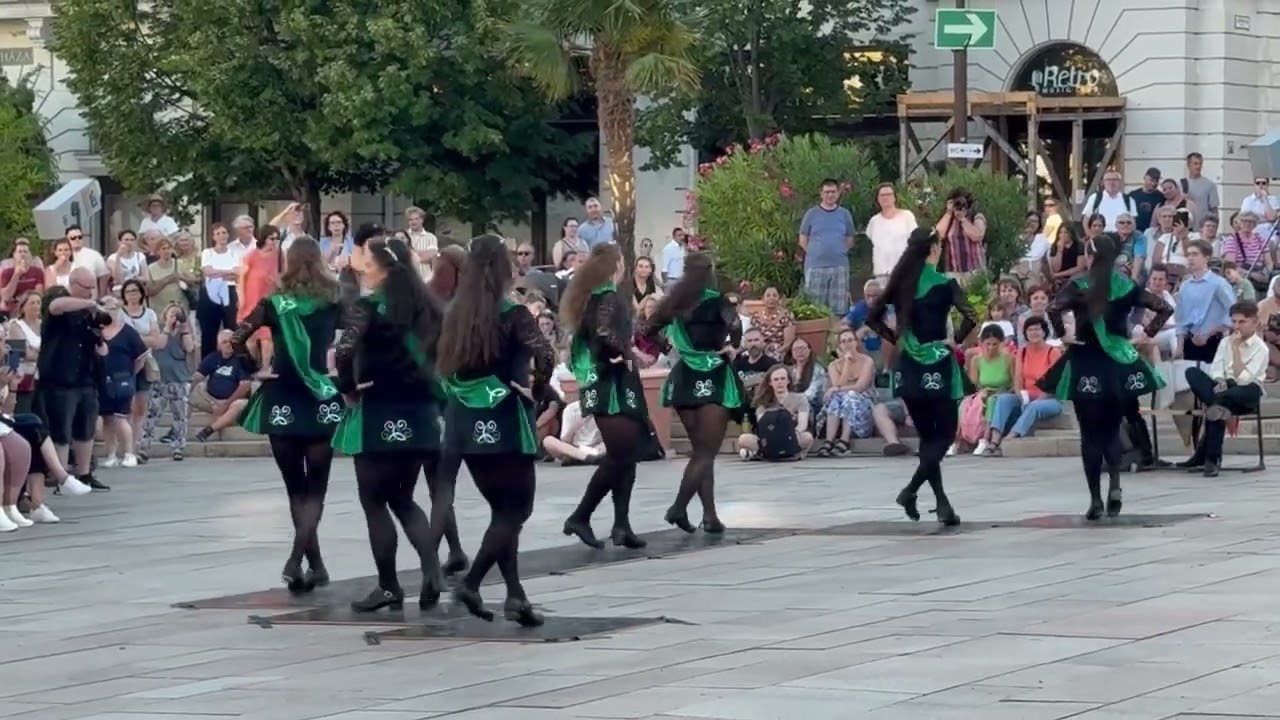
When I finished dinner, there was still a show going on in the same location. At that point, there was a guy doing tricks on a unicycle and a lovely assistant doing some twirls beside him. By then, the crowd was thick enough that a person who never reached regulation adult height, such as me, could at best catch glimpses of the show. So I didn’t stick around.
The streets in central Pécs were also filled with people strolling casually. Rather than joining them, I went to my hotel room to finish typing up these words because my dedication to my reader(s) knows no bounds.
Discover more from Joel's Journeys & Jaunts
Subscribe to get the latest posts sent to your email.


Pécs looks like a lovely place. Glad you’ll be staying for a while. I can’t imagine you were thinking of asking me, but the Holy Ghost is usually represented as a dove. I couldn’t tell in your pictures whether one was flapping around the statue. The guy with the arrows is definitely Saint Sebastian, who always has that particular problem. The one with the dog could well be Saint Roch. They are often shown together because they are both plague saints. The other one cradling the unidentifiable lump is, for that reason, not easily identifiable. If he is cradling an animal it might be Saint Francis, whose habit also sports a knotted belt. As to the rest of your colourful interpretation of Christian iconography, heck, one hardly knows where to start. But you get the last word because, well, colourful isn’t a bad thing. The church/mosque/church was interesting for its hybridity. And the dances – a lovely display of heartfelt cultural interchange between Hungary and Pécs’s current country of honour, Ireland. Hip hip hurray for the Light Festival! And for scampering around the hotel restaurant and finding yourself a proper table for dinner. No wasting away on your holiday!
Thanks for the information. I knew I could count on you. I looked closer at the starburst at the top of the statue in one of my pictures and there is, indeed, a bird on it. Now that you mention St. Roch I remember being in a church somewhere, I forget where, that had a statue of him and a dog.
And, yes Pécs, or at least the central part of it, is very pretty.