Tettye Ruins and Garden; TV Tower
Except for the train station and the walk from there to my hotel, I’ve so far stayed primarily in the old section of central Pécs. This morning I ventured out to the Tettye neighbourhood.
Tettye is on the outskirts of Pécs. It’s up a hill, on a plateau at the base of the Mecsek Mountains.
In Tettye, in the residential area, there are parks, ruins, and a botanical garden. I visited the latter two, unavoidably walking through the small park around the ruins. Then again, why would I want to avoid a park?
After the botanical garden, I left the Tettye neighbourhood and made my way to Pécs’ TV Tower.
On the Way to the Tettye Ruins
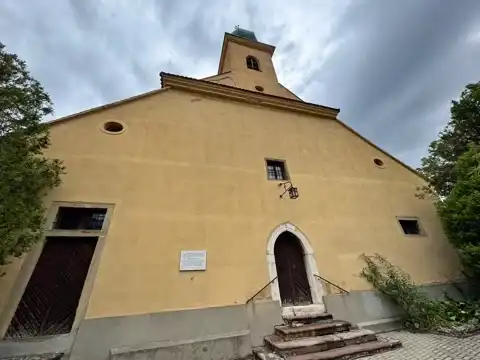
The Tettye Ruins are about a 25-minute walk from my hotel. The All Saints Church, recommended as a must-see by my walking tour app, was on the way to the ruins.
I wasn’t expecting to be able to go into the church because Google Maps said it was temporarily closed.
Google Maps was right about that. The door was locked when I was there. I don’t know how long temporary is in this instance.
There was no sign about the closure (or about opening hours) at the church. Nor were there any hints as to why it was closed. There was no nearby construction equipment. Nor did a construction fence or scaffolding obscure the exterior of the church.
I’m inclined to report them to the senior leadership of the DLJSSIA. Most of its chapters make at least some attempt, often an enthusiastic and impressive one, to pretend that their facilities are closed for some legitimate reason other than just because I’m there.
My walking tour app, GPSmyCity, says it’s “a historical and architectural landmark with a rich past dating back to the 12th century. One of the oldest churches in the city, it was originally built in Romanesque style and has since undergone significant Gothic and Baroque modifications.”
The facade is flat vertically and a monochrome pale yellow. The roofline angles down on both sides from the centre. A tiny tower pokes up from the midpoint of the roofline near the front of the church.
What does All Saints Church look like inside?
Why would you waste my time and other readers’ time (should any ever stop by) with that question? Haven’t you been paying attention? I’m not the sort of person who would commit a break-and-enter. The door was locked. I didn’t go in.
Let’s move on before you ask any other pointless questions.
Tettye Ruins
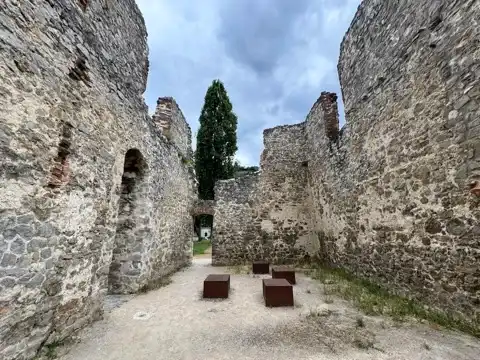
I didn’t look very hard, but I didn’t find much information on the Tettye Ruins. And the information I have is a bit confusing.
Hmm. It occurs to me that there might be a business opportunity for someone more ambitious than I am, which wouldn’t take much. They wouldn’t have to physically follow in my footsteps. Instead, they could, through available online and hardcopy sources, research the sites, sights, and institutions I visit.
The objective would be to correct the myriad mistakes I make and fill the massive abyss that is the information I lack about those sites, sights, and institutions. I suspect that the knowledge I lack is absolutely fascinating. Then again, how would I know? I don’t have that knowledge. Such an entrepreneur could probably build a lot of traffic to that site and sell advertising on it or erect a paywall. (If they were to provide a link here so I can get more than the trivial amount of traffic here I currently receive, that would be swell, too.)
Damn. Damn. Damn. Does anyone know if it’s possible to buy brain blinders? You know, like the screens placed on horses’ bridles to prevent them from seeing to the side and getting distracted, but for human brains instead? I’m too easily distracted by rhetorical sideroads in these posts.
Back to the Tettye Ruins.
GPSmyCity told me that what is now ruins was “Originally constructed atop a quarry, potentially utilized by the Romans, the site’s name may derive from the Turkish term ‘tekia,’ meaning ‘monastery.’ This connection traces back to Bishop Gyorgy Szathmary’s summer palace, erected in the early 16th century, which later served as a Dervish monastery during the Turkish occupation.”
Okay, where did the Romans come in? Are their structures now completely obliterated, with the brick possibly used to construct the bishop’s summer palace?
And, a bishop’s summer palace? I was envious of Bishops for having one palace. But now I learn that at least one also had a summer palace. If they also had spring and fall palaces, please, nobody tell me. I don’t want to know.

The ruins consist of fairly large chunks of the old walls, including some horseshoe-shaped doorways through them.
It started to drizzle when I was at the Tettye Ruins. I scurried under a tree in the surrounding park to wait it out for the less than a minute it lasted.
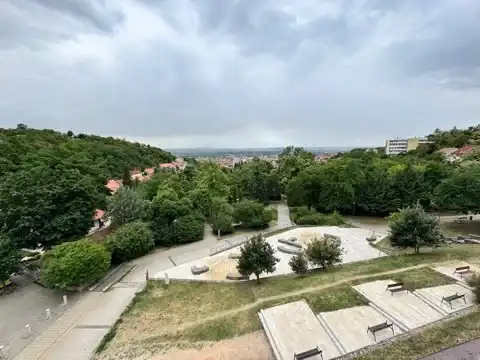
After it stopped drizzling, I climbed up a modern metal viewing platform at least one storey’s worth above the ground. One side faces the ruins. The other looks down the valley below the plateau. It was interesting in one direction and beautiful in the other.
It’s a good thing that the showers didn’t evolve into a thunderstorm. There was a sign at the base of the stairs up to the platform saying it’s PROHIBITED to stay on or near the lookout during thunderstorms. The use of all-caps for PROHIBITED, but not the rest of the sign, was their choice, not mine. You don’t need to warn me twice. But if you want to, feel free. Getting struck by lightning isn’t on my bucket list.

Pintér Botanical Garden
Pintér Botanical Garden is within the Tettye neighbourhood, a short walk from the ruins. It’s a peaceful, scenic nature reserve at the base of the Mecsek mountain range.
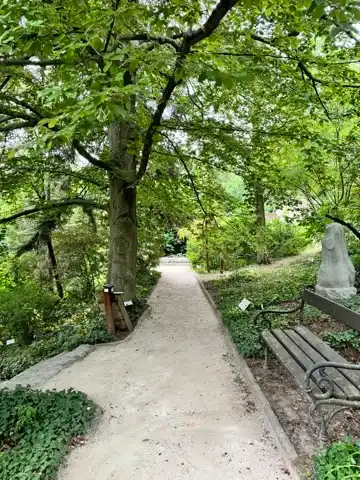
Most of the garden is an arboretum. But there are also lots of bushes and other plants, including a profusion of berries. There are at least a few flowering plants, but when I was there, many of the blossoms appeared to have gone to the great garden in the sky. Although some seemed only recently deceased. Maybe they’re in floral Purgatory.
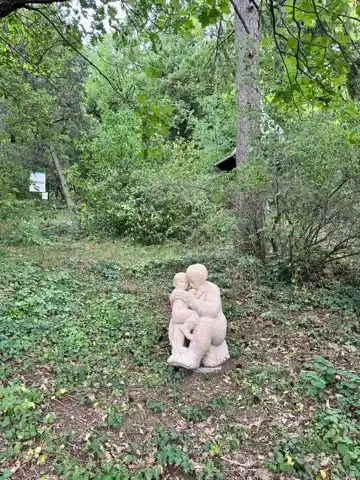
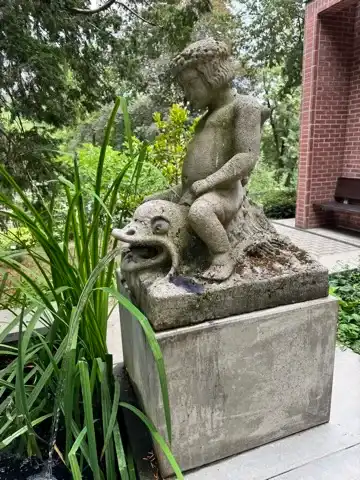
Several statues are scattered throughout the gardens.
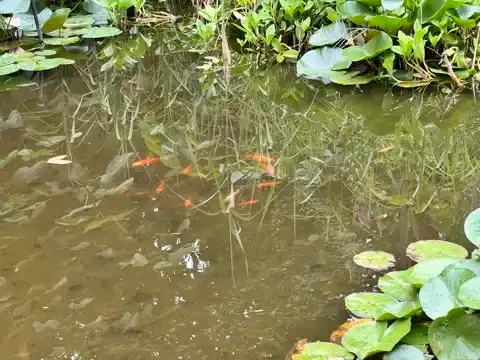
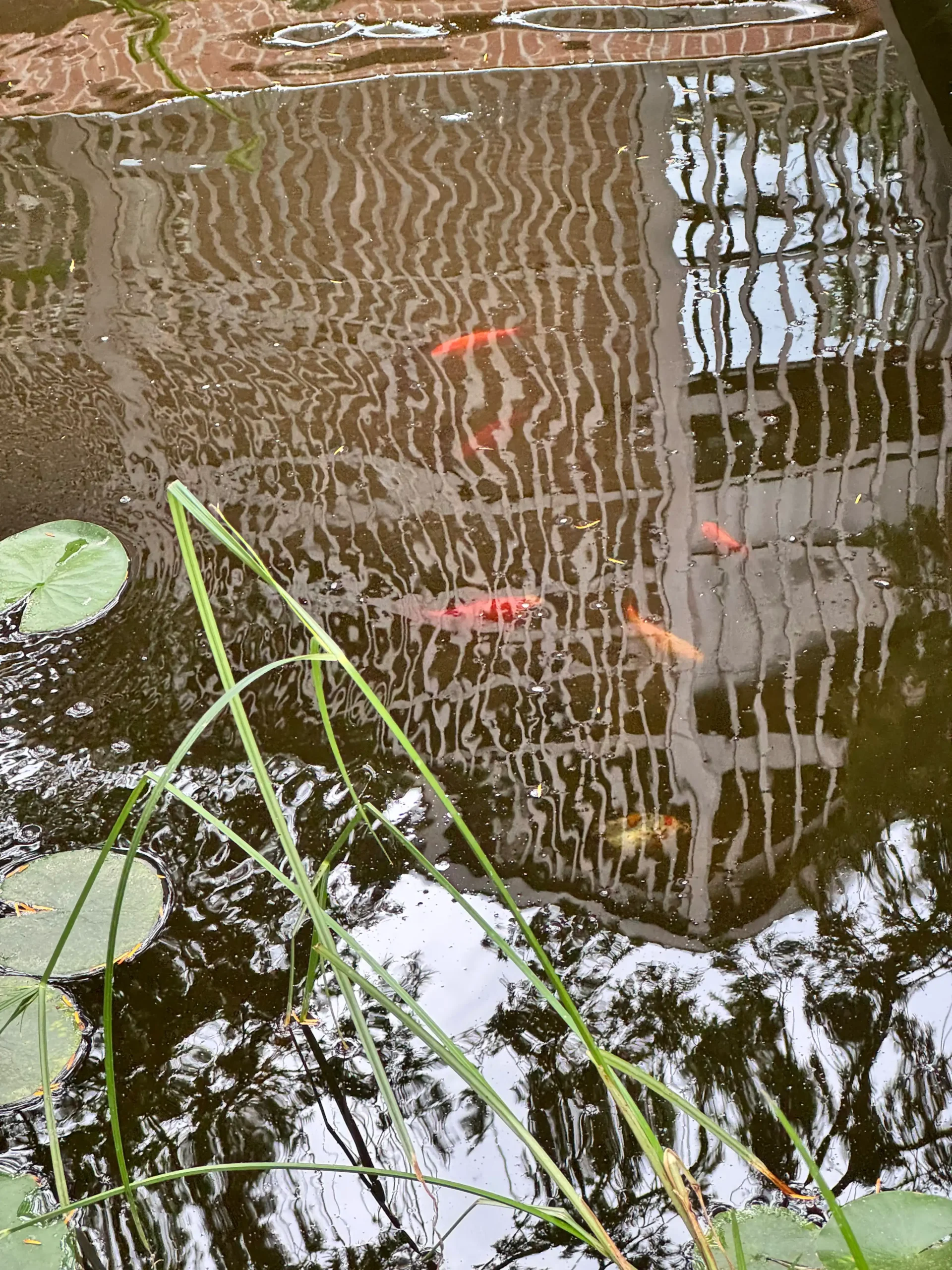
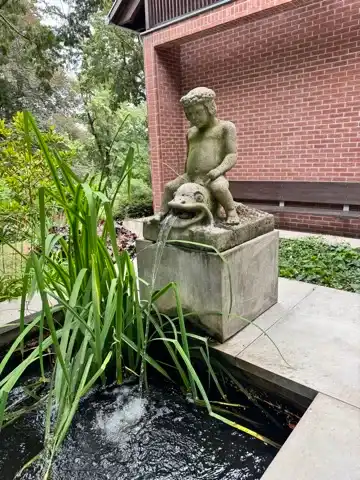
In addition, the garden has a small, circular pond with aquatic plants, and (alert #1 for a particular reader:) goldfish. Not far from that, there’s a small rectangular pool that also has some aquatic plants and (alert #2 for a particular reader:) more fish. That rectangular pool has a fountain statue at one end. It’s a boy sitting on some sort of lifeform. Because, with the boy sitting on it, only the head of the lifeform is visible, it’s hard to be certain what it is, but it definitely looked to me like a (alert #3 for a particular reader:) fish.
I walked along some of the paths. Because the garden is on the side of a hill, there was some climbing to do. At one point, I reached the base of a long set of stairs that climbed higher up the mountain through the woods. The top of the stairs turned right. The rest of the staircase, if any, was hidden by the trees, so I don’t know how high it went. I decided not to go further. Instead, I headed to the exit.
I quite enjoyed the Pintér Botanical Garden.
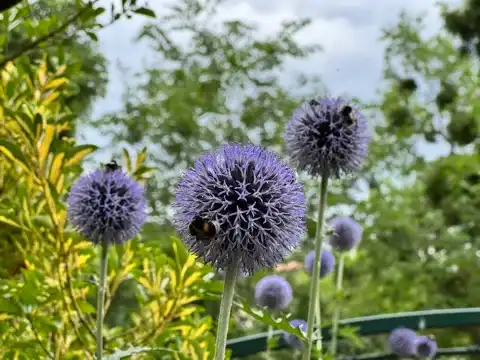
More photos from the Pintér Botanical Garden:




Pécs TV Tower
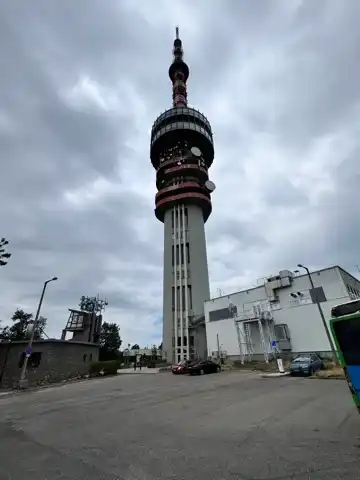
The Pécs TV Tower is at the top of the Misina peak of the Mecsek Mountains. Despite the Pintér Botanical Garden being on a plateau above the rest of Pécs, the TV Tower is considerably higher. And it’s not only outside of the Tettye neighbourhood, but I think it’s technically outside of the Pécs municipal boundary as well.
I walked for about 15 minutes to catch a bus to go up to the tower. The bus travels along a road with a few hairpin turns and a lot of bumpy surfaces. But at least I didn’t have to climb the mountain.
The Pécs TV Tower is 197 metres tall and, according to a page on a Pécs city website, it’s currently the tallest building in Hungary. Its construction took from 1968 to 1973, which was during the Soviet occupation.
On the Budapest Food Tour I took, the guide conditioned me to expect that structures built during the Soviet era would be bland. The Pécs TV Tower does not break that mould. A mundane, two-storey cylinder sits atop an uninteresting column. Above that is the transmission tower, which doesn’t add much more shape to it.

There is a single, not particularly large elevator to take visitors up and down the tower to the cylinder. The elevator goes only to the lower of the two levels, which contains a restaurant and washrooms. There are stairs from there to the viewing deck above.
There’s no glass or wire mesh around the perimeter of the observation deck. However, there is a corrugated metal wall that’s a little above belly height. (Belly height for a short, old guy.) That was high enough that my acrophobia didn’t kick in at all.
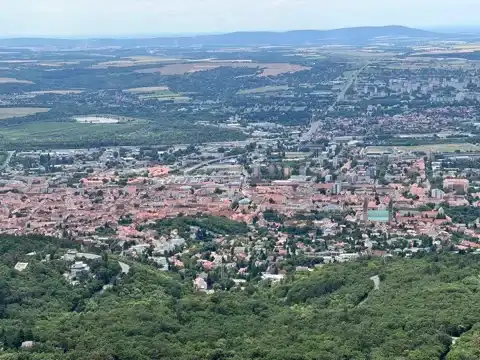
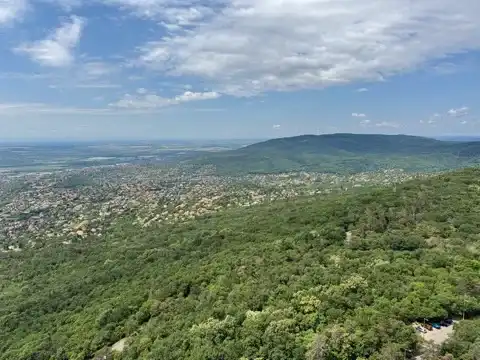
The 360° views are spectacular. Pécs is in one direction. There are green hills, mountains and rolling landscapes (plus one quarry that I think is currently inactive) in the other directions.
Today wasn’t the optimal day to go up the tower. When I set out in the morning, it was completely overcast. They were high clouds, so I was hopeful for good views. By the time I left the Tettye neighbourhood to head to the tower, there were a couple of small blue patches in the sky.
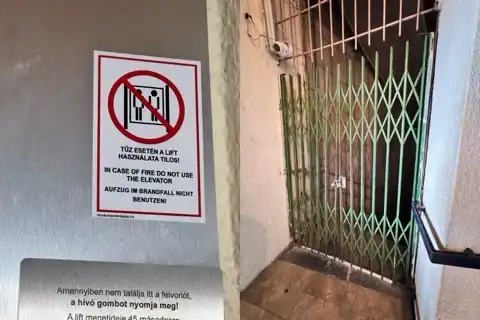
Right: The only stairs down.
I hoped that those blue blotches were infectious and would soon invade the broader body of the sky. My hope was partially fulfilled. The blue never reached all-encompassing epidemic conditions, but considerably more blue did open up in the sky when I was on the observation deck.
After getting my fill of the views, I walked down to the restaurant to have a spot of lunch.
After lunch, as I was waiting for the elevator, I noticed a trilingual sign beside the elevator door. The English said, in case of fire, do not use the elevator. Then I looked to the left at the only staircase. It was blocked by an entryway-filling collapsible metal gate stretched across the stairwell. The gate was shut. It was locked with a chain and not one, but two padlocks. I think the message should have read, “In case of fire, you’re all going to die a horrible death. * villainous cackling sound *.”
Fortunately, I made it out alive.
More views from the observation deck of the Pécs TV Tower:

Discover more from Joel's Journeys & Jaunts
Subscribe to get the latest posts sent to your email.

A Mosque, a Synagogue, and a Street

Pécs Cathedral and More

That was lovely. Thanks, again, for all the fish! Apart from the gorgeous views, the advantage of going up the tv tower is that you can’t see the tv tower from there. Happy to hear that there wasn’t a fire, or a thunderstorm when you were there. Things could have gotten very dicey.
You’re welcome!
Yeah. Ugly tower, but beautiful views.
I was not terribly disconcerted by the thunderstorm prohibition at the ruins viewing platform. That’s easy to deal with. If it looks thunderstormy, don’t go up.
But the locked stairs did have me concerned. There’d not be much I could do about it if there was a fire up there. I felt I should report it to someone other than just in my little-read blog, but I didn’t want to be thought of as one of *those*people.