Arriving in Arles
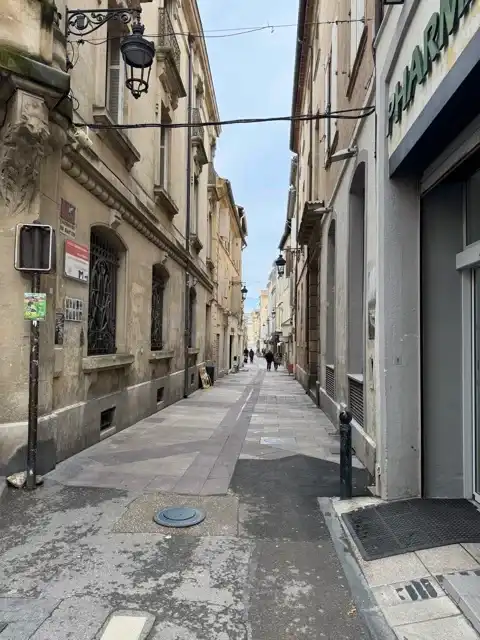
I left Marseille late this morning and took a train to Arles, France.
This is the second time in my life that I’ve been here. The first was in May 2017. That’s more recent than the only time I’d been in Marseille before this trip, in November 2010. Consequently, I have more recent memories of Arles, and I trust a little more my recollection of having very much enjoyed Arles. A little more, but not entirely. We’ll see how it goes.
That first visit to Arles, despite being more recent than my first trip to Marseille, was still before I started this journal. So don’t bother looking for any Arles pages posted before this one. They don’t exist.
So let’s make some new Arles memories, shall we? Who knows? Perhaps by journaling them here, they will indeed be memories, i.e., things I remember, as opposed to my usual, things I … what’s the word I’m looking for? …. Oh yeah. Things I forget.
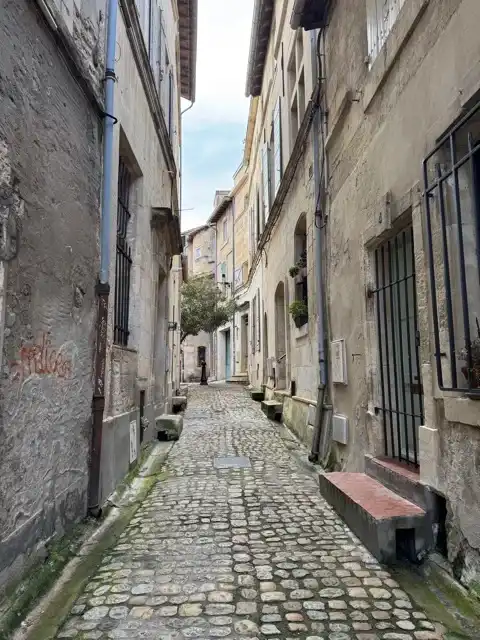
By the time I arrived in Arles (less than an hour’s train ride from Marseille), walked to my hotel, checked in, and was ready to go out again. It was comfortably into lunchtime.
So Arles began with lunch. It was a nice lunch, but uninspiring and not worth writing about. The point is, after lunch, there wasn’t a full afternoon left to explore Arles, but I did explore it a bit.
Based on my limited wandering and sightseeing this afternoon, Arles is every bit as delightful as I remembered it. In the old section of town, where I spent my time, the enchanting streets are lined with charming old low-rise buildings. Cars aren’t nonexistent on those streets, but they make themselves very scarce. It’s everything a smallish, old European city should be.
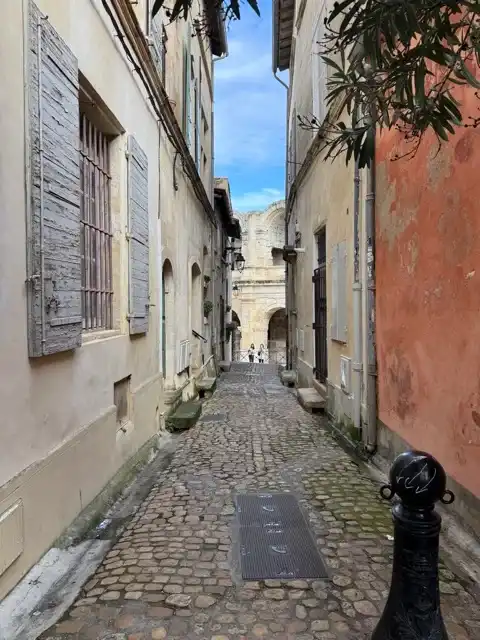
I didn’t just wander. I also headed intentionally to some of the sights.
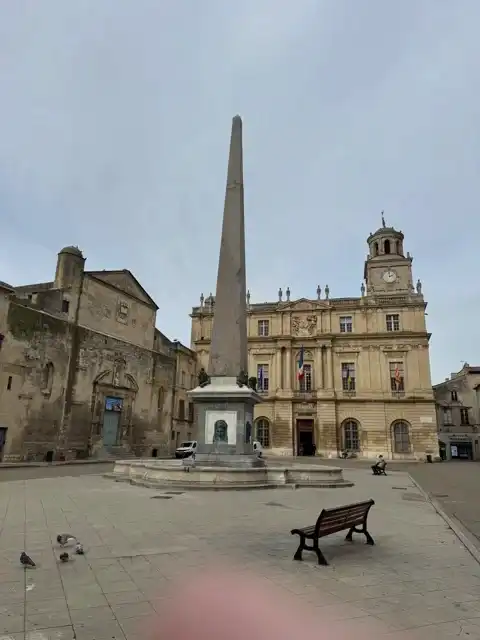
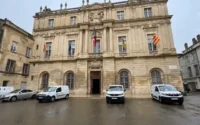
The first sight I took in, Cathedrale Saint-Trophime d’Arles, is an impressive church, fronting on the same square, Place de la Republique, that the Arles City Hall, another old building, fronts on. In the Place de la République, there’s a fourth-century Roman obelisk, just standing there, minding its business, all but ignored.
Cathédrale Saint-Trophime d’Arles
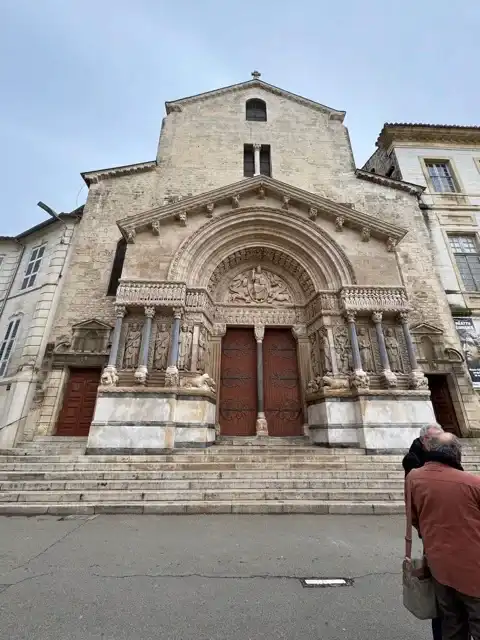
I’m not sure Cathédrale Saint-Trophime d’Arles is still technically a cathedral. I’ve also seen it named as just a church. But it was a cathedral once. So who am I to quibble?
My understanding is that a cathedral is a church that a bishop is officially associated with. Bishops come and go, but Cathédrale Saint-Trophime has staying power. It was built between the 12th and 15th centuries on the site of a former church.
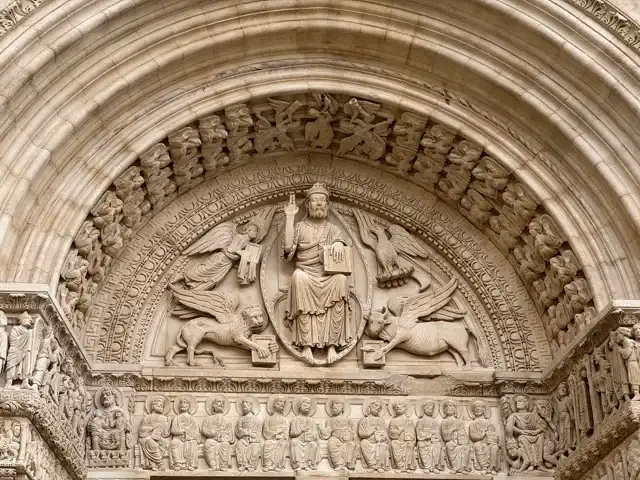
On the exterior, above the tall portal door, many impressive, intricately carved sculptures, added around 1180, keep watch on the square in front of the church. Both my walking tour app and one of my guidebooks raved, absolutely raved, about the portal and its sculptures. Even I, not exactly the most discerning of art observers, can see why.
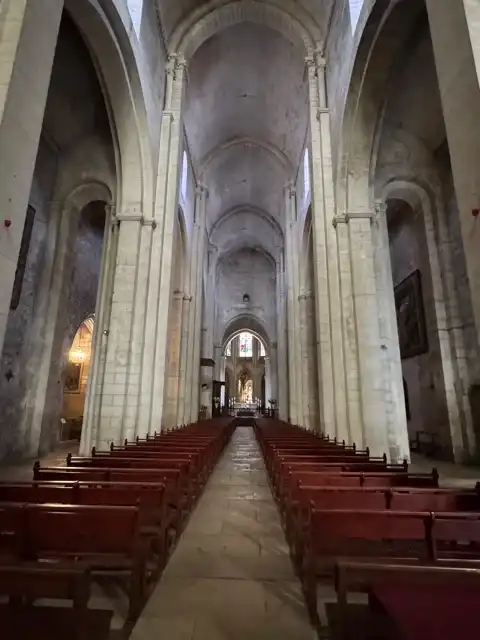
The Cathédrale Saint-Trophime looks its age, but it’s aged distinguishedly. The stone walls look ancient, and there’s a bit of a musty smell in some sections of the church, but in a good, musty, “hey, I’m old; leave me alone” sort of way.
The stone walls aren’t entirely bare. Old paintings and 17th-century tapestries adorn the walls. And there are stained glass windows in the wall behind the altar.
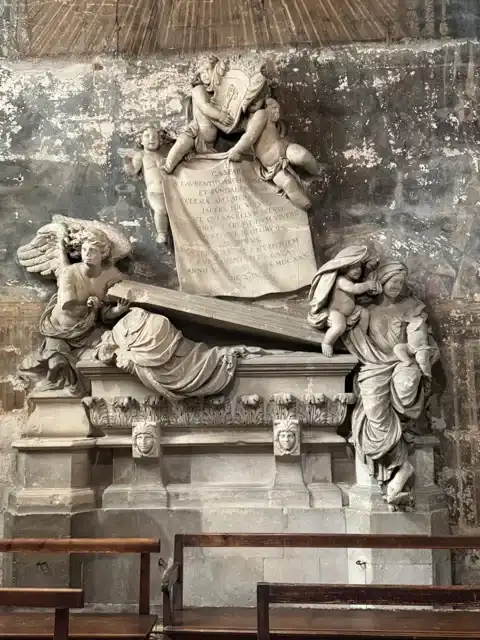
And as at Notre-Dame de la Garde in Marseille, Cathédrale Saint-Trophime has an elaborate créche (nativity scene) in one of the side chapels. Like at Notre-Dame de la Garde, this one also has a windmill in the back right of the tableau. But the windmill here doesn’t spin like in Notre-Dame de la Garde, nor do any of the figures have any motion. Okay. Notre-Dame de la Garde wins that round.
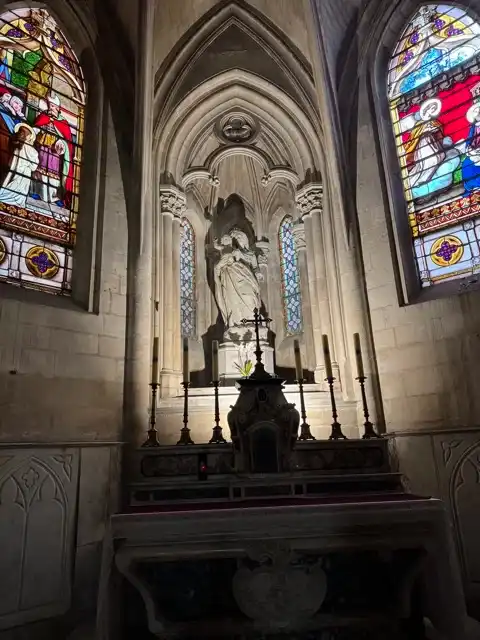
Cathédrale Saint-Trophime is a venerable old cathedral, or church, or whatever you want to call it, that looks like it’s seen some things and could teach young whippersnapper churches a thing or two.
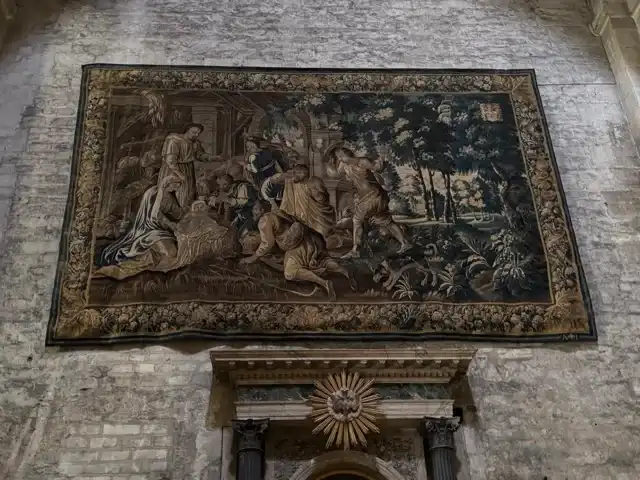

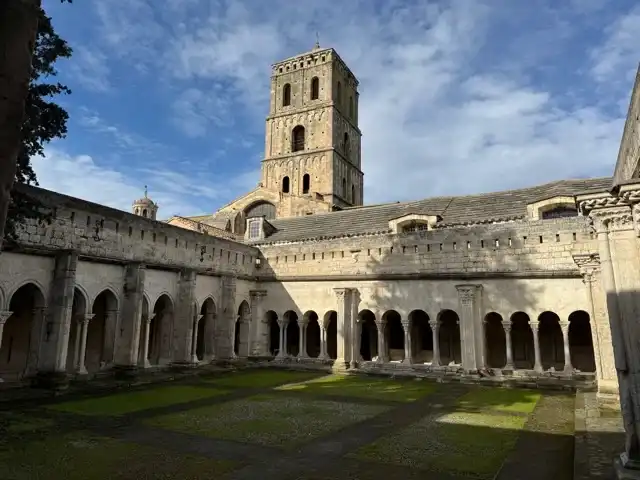
Cloitre Saint-Trophime
Cloitre Saint-Trophime (Saint Trophime Cloister) is beside Cathédrale Saint-Trophime, but you have to leave the church, walk through a somewhat barren courtyard, and climb a few stairs to get there. It’s worth it even though there’s a fee to go in. (They sell combo tickets that include several monuments and museums in Arles, which is valid for six months. I bought the combo ticket.)
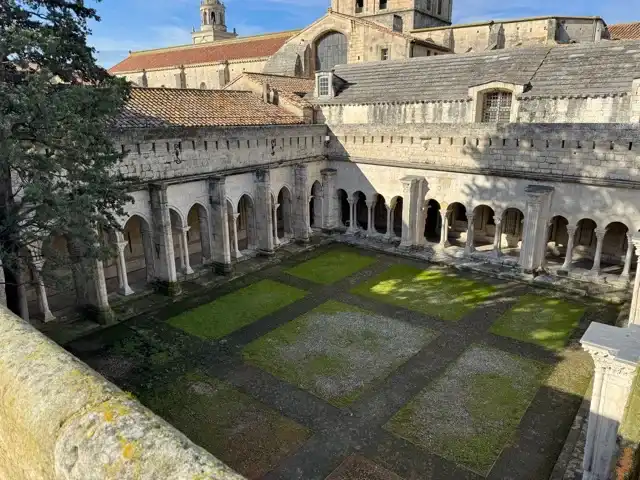
The cloister wraps around the four sides of a courtyard where a lot of people were buried when the entombment spots in the church got full.
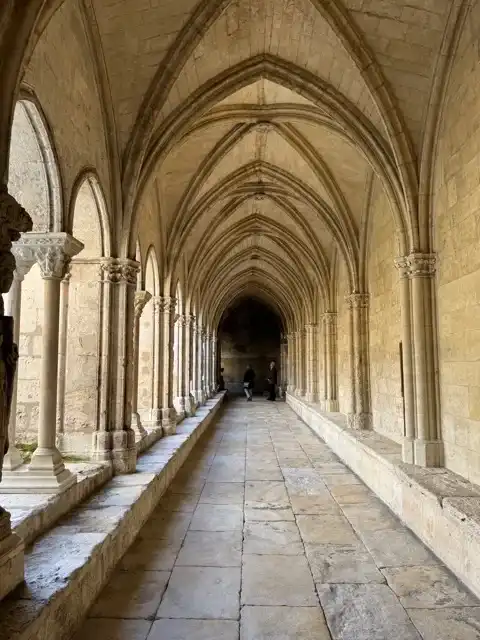
The cloister wasn’t built all at once. Construction spanned the 12th through 14th centuries, with some large gaps between building different sides. Because they were built at different times, the sides aren’t all identical. Two of the sides have fairly plain ceilings, but the other two have beautifully ribbed ceilings.
The fronts of all four sides, and their pillars and arches, all look like the same style and form to me.
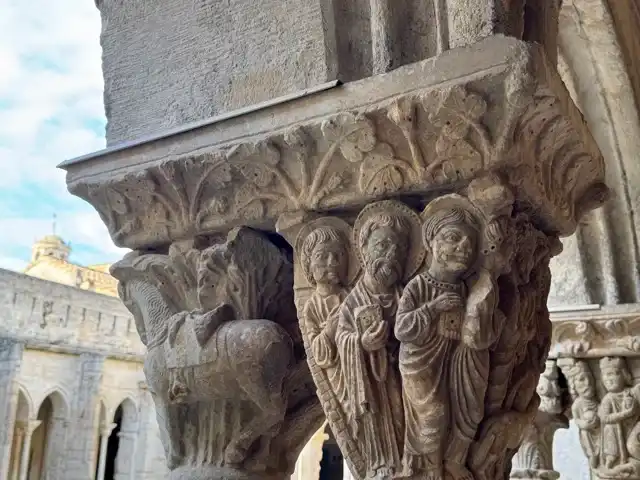
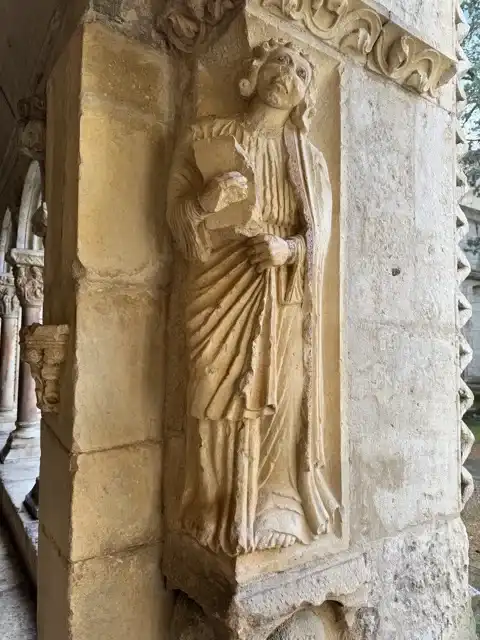
Statues of saints nestle up against the columns around the cloister. The capitals of the columns sport much smaller stone carvings that tell bible stories.
I got some of that information from a short video about the cloister that played in an old chamber off to one side of the cloister. The video was in French, but with English subtitles.
I walked up some stairs that took me to the flat roof of the cloister. I walked around that and got a view of the beautiful cloister below.
Théâtre Antique d’Arles
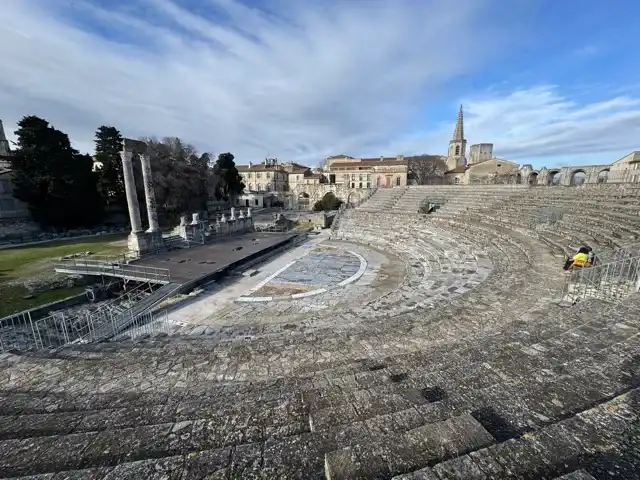
The Romans were in Arles. They left some Roman constructions. I visited one today, Thêatre Antique d’Arles, but there are more that I’ll visit during my time in Arles.
It is a typical Roman theatre. That came off sounding pretentious, didn’t it? Like I was offhandedly suggesting that I’ve seen so many Roman theatres that I can immediately spot a typical one. The truth is, I’ve seen a few, but then again, too many to not mention them.
The Théâtre Antique d’Arles was excavated and restored, I forget when. The stone seating tiers look complete. I don’t know how much, if anything, the restoration has to do with that versus how much of the seating area survived the ravages of the ages without the need for restoration.
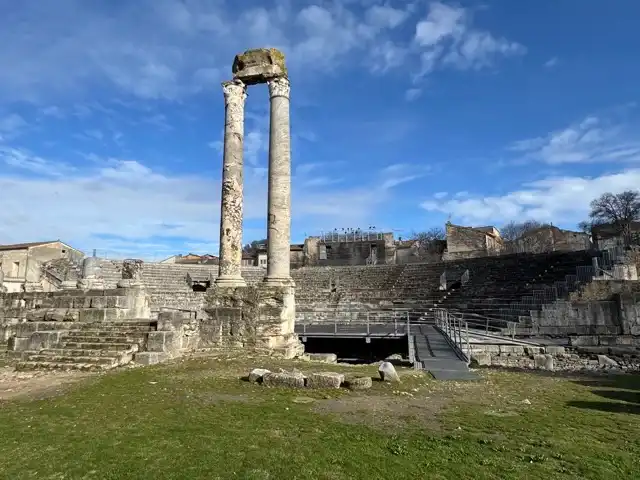
Behind the stage, two tall columns stand forlornly. The English subtitles of a short video told me that they used to form part of an elaborate backdrop behind the stage.
Beside the theatre, there was a bunch of Roman architectural elements such as fragments of columns, capitals, and what looked like fragments of walls. I called them a “bunch” of elements rather than a “collection” of elements because there was no signage associated with them, nor were they organized in any way that was apparent to me.
Nevertheless, I still greatly appreciated the visit. Roman theatres are beautifully imposing structures. And they remind me that, if you use the right timescale, I’m not that old. I’m planning to switch soon to a geological and then an astronomical timescale when talking about my age.
Café Le Soir
As I assume everyone knows, Vincent Van Gogh was Dutch. What I don’t remember is if I knew before the first time I came to Aries that he spent a couple of years here and in a nearby asylum.
Some of his time in the city was at a hospital where he was treated after he, famously, self-severed one of his ear lobes.
Poor Vincent was a troubled soul. Troubled though he may have been, he painted a few of his famous works in Arles.
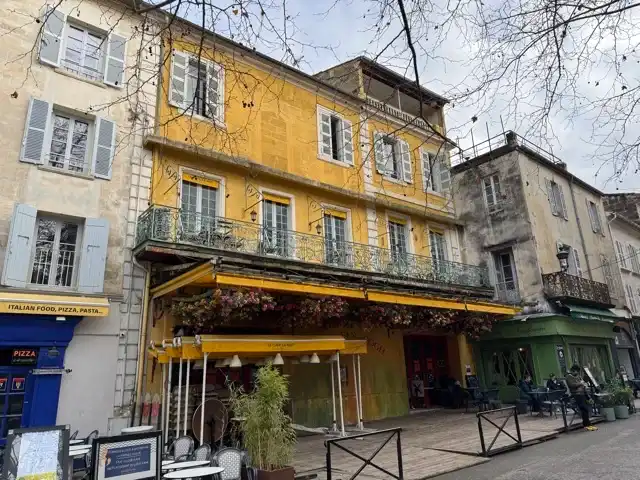
One of his more famous, “Terrasse du café le soir” (Which I’ve seen translated as “Café Terrace at Night,” but “soir” means “evening,” not “night.”), was of a, well, café terrace at night/evening. It was a real café and its real terrace. The café and terrace are still there today, beside the Place du Forum in Arles.
Today, the front wall of the café is painted an orangey yellow colour to match the painting. But in van Gogh’s days, it wasn’t that colour. The walls were bare limestone. The hue in van Gogh’s painting was the colour of the gas street lights reflecting on the walls. A more recent owner painted the walls the colour they are in the painting, so tourists would recognize it.
In my brief search online, I couldn’t find anything that told me if that was the name of the café in Vincent’s time, but it’s now called “Café Le Soir,” subtitled “Van Gogh Café.” I don’t know if a more recent owner renamed it Café Le Soir because of the title of van Gogh’s painting. Did van Gogh mean literally the terrace of a café called “Café le Soir?” Or did the title mean cafe in a general sense and it was in the evening, i.e., le soir.
You’ve probably already guessed that I was by the café today. It was closed. That was fine because I wouldn’t have gone in, just as I didn’t go in the first time I was in Arles. I read that the café’s primary purpose these days is to rip off tourists.
Non-Starry Afternoon over the Rhône
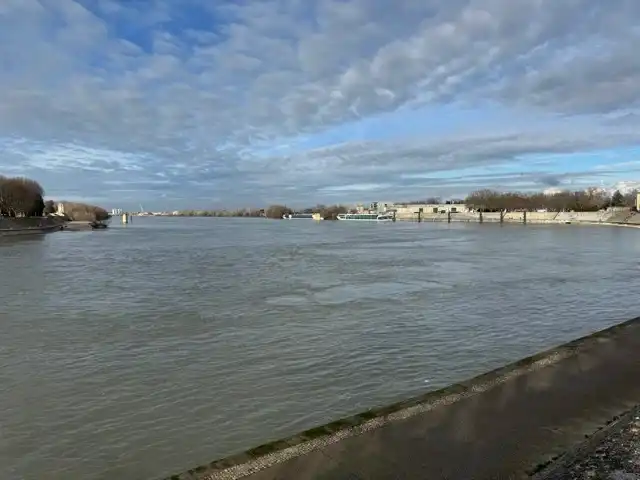
Arles isn’t by the sea, but the Rhône River runs through it. I took a walk over to the river after leaving the scene of Terrasse du café le soir. The Rhône is fairly wide there. Two river cruise ships were tied up by the wall farther along from where I met up with the Rhone.
It’s a peaceful, obviously navigable river as it flows through Arles.
Vincent van Gogh did one of his Starry Night paintings in Arles, although not his most famous one. The one he did here was titled “Starry Night Over the Rhône.”
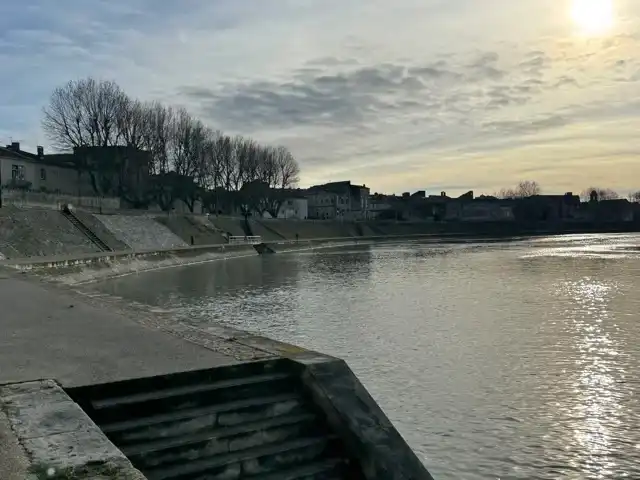
On the promenade that runs beside and a bit up from the Rhône, there’s a sign at the spot where Vincent stood to paint that picture. These days, there are tall, fat, relatively attractive poles standing up in the water in front of that point and a bit up and down the river from it. They weren’t there in van Gogh’s time, at least there weren’t any in his painting.
I thought that they were for river cruise ships to tie up at, but the two ships I saw there weren’t at the poles. So, I don’t know. Then again, it’s possible that the row of poles continued to where the ships were docked, but I just couldn’t see the poles from my vantage point.
To not get the poles in the shot, I walked a bit, I’m not sure if it was up or downstream, and took a picture not quite of the view van Gogh would have had. And it was afternoon, not night. And, therefore, there were no stars visible. Oh, never mind. I’ll post the picture anyway.
And now, it’s time for sleep.
Discover more from Joel's Journeys & Jaunts
Subscribe to get the latest posts sent to your email.
Musée Réattu and Museon Arlaten

LUMA Arles, and not an old church

You did cover some history, didn’t you? From ancient Roman to medieval (beautiful Saint-Trophime!) up to storied 19th century Arles. A good way to start your visit and to expand your time scales. Does taking the long view of history make one seem younger or just more piddly? Let’s go with younger, shall we?
I did cover a broad swath of history, didn’t I? And, yes, indeed. Let’s go with younger.