Keszthely by the Lake
“Keszthely by the Lake” is not the name of the town I’m in. It’s just Keszthely. But it’s a town by a lake. Lake Balaton, to be precise. After leaving Győr with its weirdly accented o this morning, that’s where I am now.
If you’re a regular reader, you might have noticed that I broke a rule. For the I don’t remember how many trips now, I’ve tried to come up with an alliterative title for the first post from each city or town I visit.
Pronouncing Keszthely
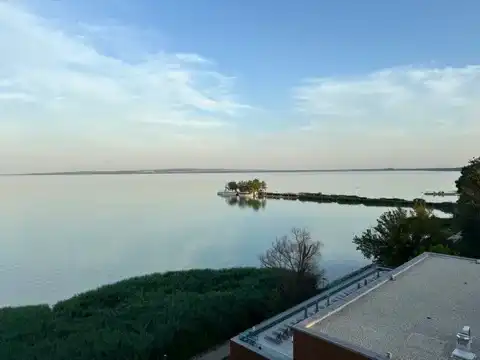
The problem is, I don’t know how to pronounce Keszthely.
I heard it a couple of times at the train station. Ten minutes before my train was scheduled to (and did) depart, the train’s platform still hadn’t appeared on the board. I went into the customer service office and asked the person there about the train to Keszthely. I pronounced it as a monolingual anglophone who’d never heard it before would say it.
She stared at me with a blank look on her visage. To be fair, the way I pronounced it, Keszthely sounded more like it could be an Irish town than a Hungarian one.
She asked me what train it was. (Although not in those words because she didn’t speak much English.) I showed her the train information on my phone.
She looked at it and said something like “oh, Keszthely.” However, “Keszthely,” apart from the first phoneme, didn’t sound at all like the way I had pronounced it. Not even a rough approximation. That’s not overly surprising, I guess, seeing as though I don’t speak the language at all.
The opening k does sound like an English k. So, for alliteration, I could have gone with, oh, I don’t know, maybe “Klebanoff in Keszthely.”
If my ears heard correctly (don’t bet on it), I think the opening “Kesz” is pronounced like “kess,” which is also how I pronounced it unaided. If I wanted to be alliterative with that phoneme, the only thing I could come up with was kestrel, but I don’t know if there are any of them here.
As to how the remaining phonemes in Keszthely are pronounced, I still couldn’t reproduce the sounds even after hearing them a couple of times.
On to other things.
Lake Balaton
My guidebook tells me that Lake Balaton is Central Europe’s biggest lake. It also says that it’s a shallow swimming lake, with a depth that’s surprising. It didn’t put any numbers on those assertions, but Wikipedia provided the following:
Max. length: 78 km (48 mi)
Max. width: 14 km (8.7 mi)
Surface area: 600 km2 (230 sq mi)
Average depth: 3.3 m (11 ft)
Max. depth: 12.2 m (40 ft)
There are several little towns around Lake Balaton. My guidebook recommended Keszthely because there’s lots to see there and it’s usually the least crowded of the towns because it’s the farthest from Budapest.
I didn’t and won’t, but I can stay in my air-conditioned hotel room and look at Lake Balaton all day. My hotel is right beside the lake. The corridor I’m on, and likely all corridors, has rooms only on one side. The side facing the lake.
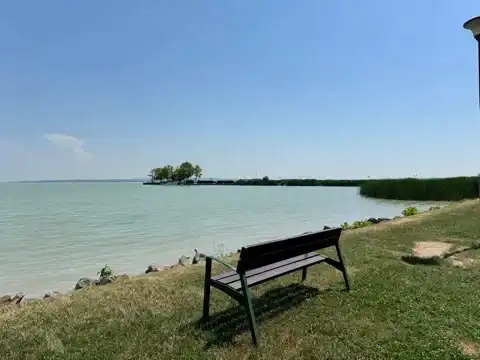
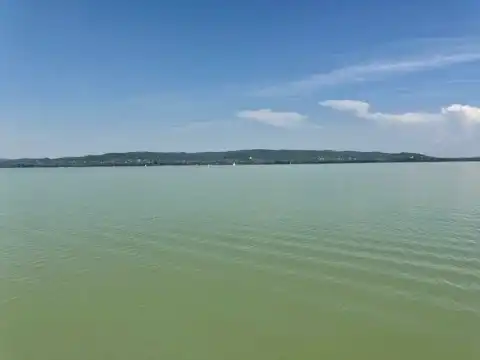
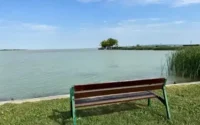
I have a small balcony. I didn’t go out there when I first got to my room because it had direct sunlight then, and it’s very hot here, as it’s been for my whole Hungarian trip so far. However, I did step out briefly later in the day, when the sun was behind the hotel, and snapped a picture.
Lake Balaton is a long but narrow lake. Keszthely is almost at its very western end. Looking out across it, I had no trouble seeing to the other side. With my old eyes, I couldn’t make out details, but I had no problem making out landforms.
I couldn’t swim across the width, but that’s probably just me. A half-decent endurance swimmer probably wouldn’t have a problem getting to the other side. And super-long-distance swimmers, ones who try to break world records, would laugh at how trivial a feat it is. I feel insecure about people who laugh in derision at the ease of efforts that are some multiple of the maximum I can do. But never mind that.
I arrived at my hotel about a quarter past noon and was ready to set out by 12:30.
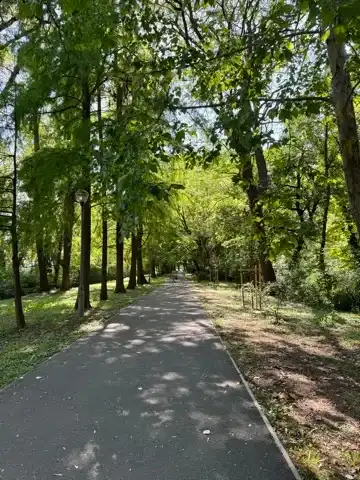
There’s a park with lots of trees immediately beside my hotel. Lots of trees translate to shade. I walked through there.
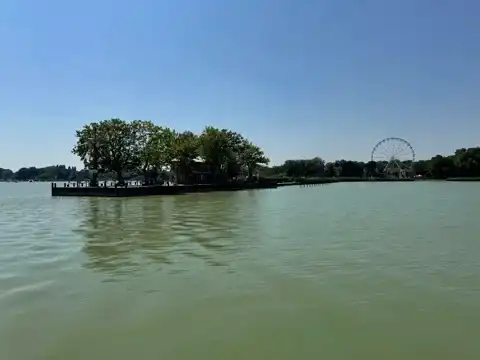
Walking along the coast of Lake Balaton, I came to a short artificial isthmus. Some would call it a pier, but close to the mainland, thick rows of tall bulrushes line either side, with boats docked only on the sides of the far end of the isthmus/pier.
I walked to the end of it.
Lake Balaton Cruise
At the end of the isthmus/pier, there was a boat docked. On the land beside it, there was a ticket booth and a sign advertising times of hour-long* cruises. The next was to depart in five minutes. I bought a ticket.
(*Being the age I am, I get nervous about a three-hour cruise tour. But a one-hour tour is fine. Two- or four-hour tours would be okay too. Just not a three-hour tour. A three-hour tour. If you know, you know. If you don’t know, ask The Professor.)
While I completed that transaction, cool, air-conditioned air flowed freely out of the booth and bathed me in its heavenly pleasantness. I asked the ticket seller if, rather than going on the cruise, I could stay in the booth.
He laughed. I don’t know why he thought I was joking.
The boat had some uncovered benches at its bow, but most of the seating was at the back in an open-sided section completely covered by a wooden roof supported by thin cylindrical poles that blocked little of the view. Except for one small bench at the stern facing the bow, there were just two rows of benches. They both faced out to either side of the boat.
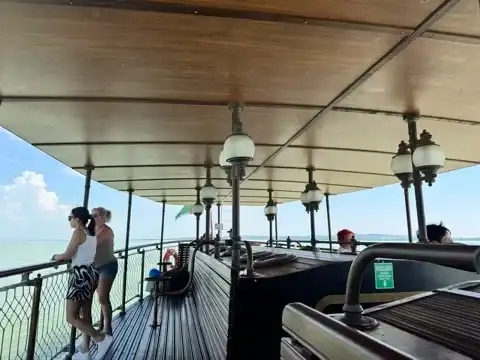
I sat in the covered section. Between the shade cast by the roof and the breeze that came across the lake, it was, I won’t say pleasant, let’s not get carried away, but edging dangerously close to being endurable.
It wasn’t a particularly narrow boat. Between those two rows, there was a raised wooden structure with portals on top. The boat had a lower level. I didn’t go down there, but a sign by the stairs pointed to a buffet. I suppose the portholes provide light for the lower deck.
I don’t know, but some nautically inclined people might object to me calling it a boat rather than a ship. We’re not talking about a rowboat here. Far from it.
But, by the same token, one of those massive ocean-going cruise ships could swallow it for breakfast and still be hungry. That was only a metaphor, you understand. I’ve never heard of any predatory cruise ships. Then again, if you include the viruses they incubate, maybe so.
The boat completed an hour-long oval around the Keszthely end of Lake Balaton. There was a bit of prerecorded commentary, but only for a few minutes at the beginning of the cruise, when we were still near Keszthely. I think there were two segments of the commentary, but I might have missed one. I believe they were in three languages, but I’m not entirely certain.
The first language was, I assume, Hungarian. A male spoke it. I think two languages followed it, both spoken by a woman or women.
The first segment was just a welcoming message. I caught most of that.
Then came a commentary about the boat we were on. At least I think that’s what it was about. When it switched to the woman’s voice, it was so heavily accented that I couldn’t determine the language.
But then I started picking up English words. Once my ears became attuned to the accent, I realized that she had been speaking English. I was then able to pick up most of what she said. She spoke about the one or two times the boat had sunk decades ago, but it was raised from the bottom, taken to a shipyard, and refurbished.
She obviously didn’t know who she was speaking to. I wasn’t worried before she said that, but then my neuroses kicked in. I became anxious about being in a boat with a clear predilection for sinking.
After a while, I once again could no longer understand what the woman, or possibly another woman, was saying. It took me a bit, but I realized she switched to another language, possibly German.
I didn’t find Lake Balaton to be especially scenic. It’s pleasant enough, nothing to complain about, just not spectacular.
The water is close to pea soup green. There’s nothing wrong with pea soup. I quite enjoy it. It’s just not my favourite lake colour.
Having said that, pea soup green might not come as close to describing the colour as I would like. This might be closer: I’ve never seen it in person, only in pictures, but I think the water in Lake Balaton was close to the colour you would get if you painted the bottom of a reflecting pool flag blue (American flag blue) and then algae invaded it.
I didn’t see any algae while on the boat or from the shore of Lake Balaton. So, the lake wins that round over the reflecting pool.
The shores I saw while on the cruise varied. There was a lot of flat land, but there were also some high hills and low mountains, along with some higher mountains in the distant background. It was pretty, even bordering on lovely, but, as I said, not exciting.
There is a bit of a low-rise sprawl around Keszthely, but less elsewhere based on what I was able to see on the one-hour cruise. However, it covered only a tiny portion of the western end of the lake.
Balaton Museum
Today was an all-Balaton day for me in Keszthely. After the cruise, I took a fifteen-minute walk inland to go to the Balaton Museum. I found it ironic that the museum is deeper into Keszthely and away from the lake it’s named after.
Large portions of the walk were through forested parks that provided dense shade. The shade is probably the only reason I survived the walk in the heat today. That, and I stopped to buy a bottle of water along the way. Remember, boys and girls, stay hydrated in the heat.
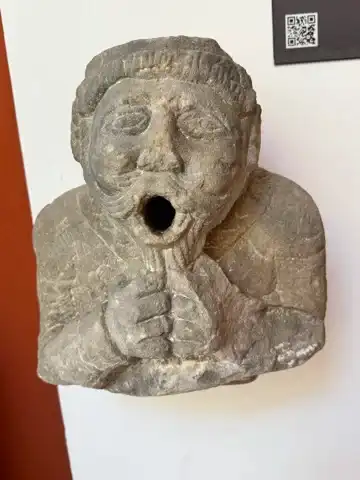
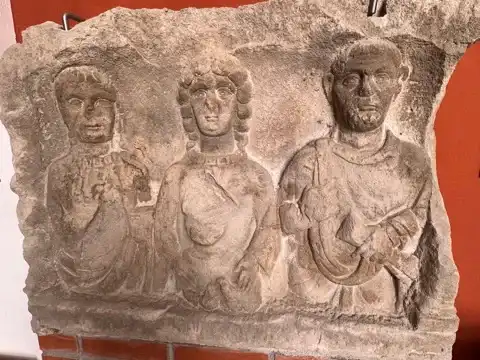
It’s an interesting little museum. There was a temporary exhibit with three small rooms of modern art on the ground floor. The ground floor also offered stones—pillars, capitals, gravestones, etc.—from Roman and Medieval times; a lapidary, if you will.
One floor up from that, there’s a small ethnographic exhibit. It had no English text, only Hungarian. It offered a collection of old (not old-old, but not thoroughly modern) stuff like clothing, an old tape recorder, housewares, and other tchotchkes.
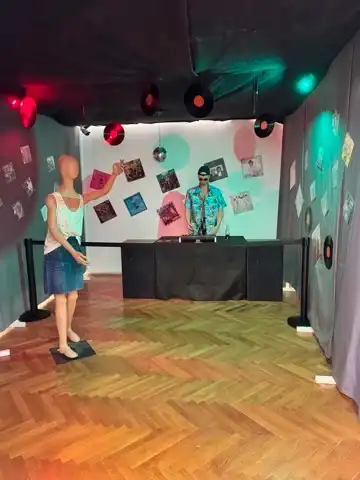
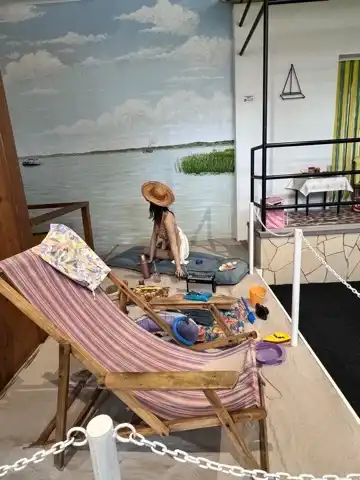
There was also a small, I won’t say room, but closer to a cubicle, that was supposed to represent a disco from the disco era. It was weird. There were two mannequins. One was in a dance pose. The other was a DJ.
The majority of the floor with that ethnographic section, i.e., the first floor (the second floor by North American numbering), was an exhibition on Lake Balaton. There was a table map with points of light that lit up to represent the populations around the lake over time. There was text about how human endeavours around the lake affected water quality. (Text in the Lake Balaton section of the museum was in both Hungarian and English.)
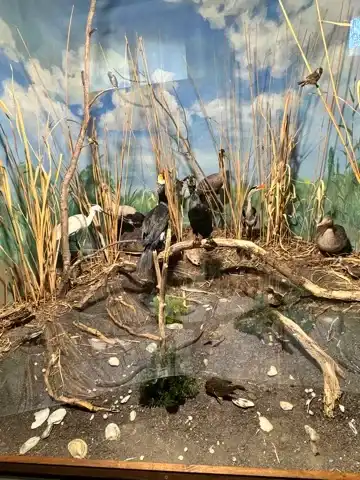
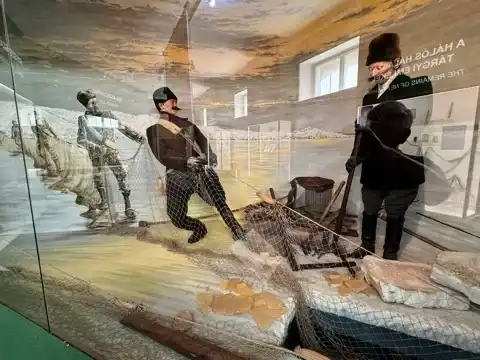
Dioramas and other 3D displays depicted waterfowl among water flora, birds and animals on land, fishing on the lake, including ice fishing, recreation on the lake, and probably some I’ve forgotten.
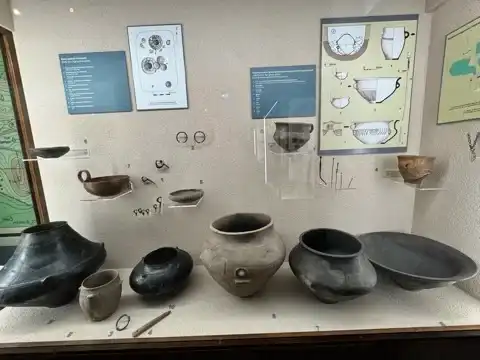
Some display cases held fossils and other archaeological finds from around Lake Balaton, including relics from the Iron and Bronze Ages.
There was considerable discussion on the text panels of castles that had been built around the lake. And another table map, this one topographical, showed the locations where castles had been built.
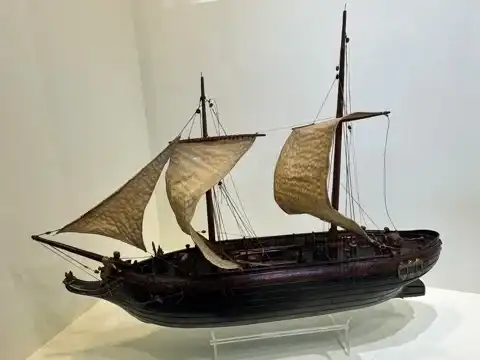
There was a room with scale models of notable boats that had sailed the lake over the years, including more recently. It’s hard to tell because they were small-scale models, but based on the sails on some of them and what was on the decks of almost all of them, I’m pretty sure that most of them were larger than the boat I was on today. Yet, the English on the sign announcing this room in the museum said, “Boats on Lake Balaton,” not “Ships on Lake Balaton,” So I feel vindicated in calling the vessel I was on a boat.
And that was it for my afternoon in Keszthely. I’m here for three nights. So there are two full days yet to come in Keszthely. As they used to say in TVland, stay tuned.
More pictures from the Balaton Museum:

Discover more from Joel's Journeys & Jaunts
Subscribe to get the latest posts sent to your email.
Festetics Palace & More
Aristocratic Travels and Adventures Exhibition & More
I’ve always thought of ships as vessels that are ocean-going, and boats as inland water craft. That seems to be the case, but then there is the wrinkle of size, sea-worthiness and whether the activities are carried out on the vessel (boat) or in the vessel (ship), or whether the craft can be carried on another one (boat) or not (ship). I think my definition (ocean vs inland) is cleaner and simpler, as well as being generally acceptable. Otherwise, well, we just have too many difficult decisions to make in life to add this one, don’t we? As to your activities today: as I have often said, nothing more relaxing than a short boat ride, and I thought that museum seemed rather cute. Liked the little man you showed (I assume that open mouth was once a water spout) and the disco diorama was just, well, interesting. Wouldn’t want that era to just fade into obscurity, would we? Nice that you have a hotel room with a scenic view. Better a lake that colour than a reflecting pool. Enjoy.
I’m going to go with your definition of boat vs ship as inland bs ocean. As you say, it’s simple and clean. I don’t know how the freighters that ply the Great Lakes feel about that, but you can’t please everyone.
That little man was one of a collection of three. I chose him because he was the most striking of the three.
Long live disco. Or not. Whatever.
I couldn’t resist the reflecting pool reference.
Sailboats?
I saw a couple anchored or docked, but none out sailing.
You saw them inland on the lake. But sailboats definitely ply offshore waters.
Yes, sailboats are pretty much indifferent as to what sort of body of water they sail on. Well, except maybe bathtubs. They generally require a body of water a little larger than that. And, of course lakes that are too shallow for their keels might present a problem. And rivers that aren’t wide enough for them to tack when they need to. And, oh, never mind. Sailboats will sail where they will.