2 Rose Gardens, 2 Galleries
I ended my morning with lunch at the Old Parliament House cafe in the Parliamentary Zone of Canberra. I wasn’t ready to make the long trek back to my side of the lake, so I chose to visit other places in the Parliamentary Zone this afternoon before returning to my hotel.
I planned to visit one rose garden and two galleries, but I ended up seeing two of each.
Two Rose Gardens

I planned to head to the National Rose Garden, which is not particularly far from the Old Parliament House. But I hadn’t walked very far when I saw a sign beside an opening in a wall saying “Old Parliament House Gardens.”
I stepped inside. There are two sections to the gardens separated by a narrow lawn. Both sections are gorgeous rose gardens with a profusion of different types and vibrant colours of roses.
Wait. Does each section count as a separate rose garden? If so, I visited three rose gardens this afternoon.
After spending some time enjoying the unexpected delight of the roses in the Old Parliament House Gardens, I continued my journey to the National Rose Gardens.

There are roses there. They are in some irregular, large and small patches spread throughout long, weedy grass. It didn’t look so much as if they were planted as a rose garden, but rather the roses colonized some rough, random clearings in the grass on their own.
Don’t get me wrong, there are a lot of roses. And, if you possess sufficient concentration and mindfulness to be able to separate the roses from their ragged surroundings in your mind, you’ll probably find them gorgeous. But it wasn’t what I expected when a nation claimed a rose garden to represent itself.
National Gallery of Australia
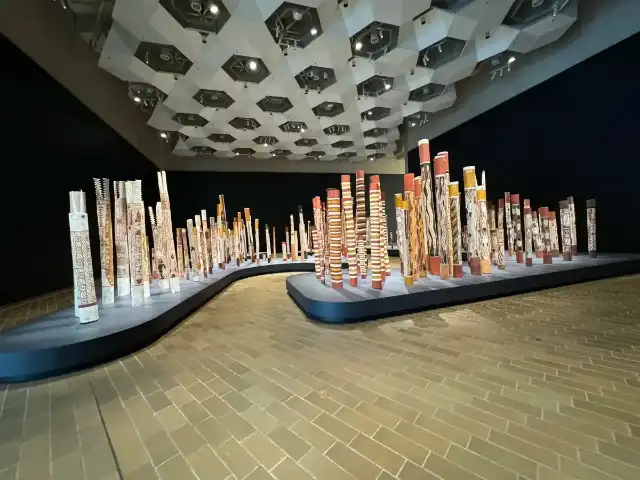
After looking at the rose gardens, my next stop was the National Gallery of Australia. Its galleries are big, with high ceilings. Most of the collection is Australian art, including, but not exclusively First People’s art.
One large First People’s installation is titled “The Aboriginal Memorial.” It was conceived by Djon Mundine OAM, a member of the Bundjalung people of northern New South Wales. The piece consists of 200 very colourful, hollow log ceremonial coffins arranged so that a path through them mimics the course of the Glyde River.

(I had never heard of a hollow log ceremonial coffin. I don’t know how much you can trust Wikipedia on this, but it says that hollow log ceremonial coffins were originally made in the Northern Territory of Australia by the Yolngu and Bininj peoples to hold the bones of deceased people or for use in burial ceremonies, but now they’re made as art.)
The vast majority of the Australian art at the gallery is relatively modern in age and much of it is very modern in look (i.e. abstract).
But the collection is not all from Australia. The National Gallery of Australia also displays art from around the world, including sculptures from Africa and paintings from Europe. The earliest European piece I saw dated from the 14th century, but most of the works are considerably younger than that.
National Portrait Gallery

The National Portrait Gallery is almost next door to the National Gallery of Australia. Just the High Court of Australia sits between them. There’s probably a joke to be told about the highest court of Australia being placed between two national art institutions, but for the life of me, I can’t think of one.
The National Portrait Gallery exhibits—wait for it—portraits. Most of them are paintings, but there are also a considerable number of photographs and also some sculpted portraits.
I’ll highlight just two portraits here. Consider the first photo of a portrait I posted in this section. It’s a portrait by an unknown artist of Mrs. Fairfax, circa 1835-36. She was born in Birmingham, but emigrated to New South Wales, Australia. Her dependents remembered her as a very religious person. The text beside the portrait did not mention any notoriety, good or bad, that might be cause for a portrait of her.
But look closely at the portrait. It’s obvious what Mrs. Fairfax’s claim to fame is. She clearly won first prize in a sternest person in the country contest, and probably in an international championship. Plus, she may be the only person in the world to never have had as much as a minute’s worth of fun in her entire life.

The second portrait I’ll note here is a 1902 portrait of Nellie Melba by Hugh Ramsay. Ramsay was living in Paris when he met Nellie Melba and painted this portrait of her. I was surprised to learn that Dame Nellie Melba (1861-1931 was a “Melbourne, Australia-born diva then regarded as one of the world’s greatest sopranos” and not the inventor of Melba toast.
The second portrait I’ll note here is a 1902 portrait of Nellie Melba by Hugh Ramsay. Ramsay was living in Paris when he met Nellie Melba and painted the portrait of her posted here. I was surprised to learn that Dame Nellie Melba (1861-1931 was a “Melbourne, Australia-born diva then regarded as one of the world’s greatest sopranos” and not the inventor of Melba toast.1
Then again, maybe she did invent Melba toast, but the gallery left that part out of the placard beside the portrait. It was a small placard.
Commonwealth Place
My route back to my hotel took me by Commonwealth Place. That wasn’t entirely accidental. I read about something in Commonwealth Place that I wanted to see.

Commonwealth Place is an interlocking brick sidewalk running between two lawns. The lawns curve upward away from the path.
Embedded in the bottom portion of one of the lawns is a paved mural that was given to Australia as a gift to honour the centenary of the Australian Federation. Who was the giver of the gift? The Government of Canada, that’s who.
As a Canadian, I just want to say to the people of Australia, you’re welcome. And I’m so very, very sorry. I wish we could have given you something nicer than that farshtunken piece.
- UPDATE: If you look in the replies below, you’ll see that, according to research by a friend and regular reader/commenter, while Nellie Melba didn’t invent melba toast, it was named after her. I should either start doing more research of my own or stop making jokes about this kind of thing. I honestly assumed that she had absolutely nothing to do with melba toast. Then again, I enjoy my inanity even if nobody else does. And I can’t be bothered doing the research every time I want to make a joke. So, expect more of these mistakes on my part. ↩︎
Discover more from Joel's Journeys & Jaunts
Subscribe to get the latest posts sent to your email.

Not the Australian National Botanic Gardens

National Museum of Australia, Old Parliament House

I am writing only one comment – this one – for today, mainly because I am feeling a little grumpy and I am sorry that some of the unsightly sites you saw did not come up to tourist star quality. One doesn’t want to hear about one’s closest-followed world traveller having a less than stellar experience. Weedy rose gardens, dreary walks, and Parliament Houses modelled on classic penitentiary architecture. Not that there weren’t highlights – museums! art works! at least one nicely laid out garden! roughage! I hope dinner was a hit, and I look forward to a fine day of touring tomorrow. For you, not for me. Grading. 🙁
It wasn’t all bad. As you say, one beautiful rose garden. I liked the interior of the Old Parliament House even if I was less than thrilled with the exterior. And the museum and galleries were nice.
A rose garden is a rose garden is a rose garden? And a melba? Dame Nellie Melba actually did inspire the eponymous melba toast as well as Peach Melba, the dessert. Credit for the “invention” of both foodstuffs is ascribed to 19th century French chef Auguste Escoffier. So much fun to put flesh on the bones of discovery! Yes, this enquiring mind needed to know, and an internet search yielded details. First came the dessert (peaches and raspberry sauce with vanilla ice cream), credited to Escoffier at London’s Savoy Hotel 1892-3, presumably when the singer stayed there (or at least dined there) during a singing tour. I was shocked, shocked to see a similar story with the same protagonists attaches to melba toast. And, had the singer performed under her given name, we might now be talking about Peach Mitchell and Mitchell toast. Wikipedia dates the latter’s invention to 1897, prepared by the chef for an ailing songstress. César Ritz (eponym of hotel and not the crackers) was, it turns out, the hotelier in both instances. Tra la.
Damn. I should have researched Dame Melba. I would never have guessed melba toast (or Peach Melba) was named after her. That’s important information that the gallery should have put on the accompanying tag.