Australian War Memorial

After I finished my not-to-be-mentioned lunch at the National Zoo and Aquarium, I summoned an Uber to take me to the Australian War Memorial.
I don’t know about you, but if I didn’t have any other information about it, the name “Australian War Memorial” would have conjured up an image of a stand-alone, austere, respectful statue or obelisk with a dedication to the war dead inscribed on it. It may be a due commemoration for those who made the ultimate sacrifice for their country and/or their ideals, but I somewhat shamefully admit that that sort of thing usually won’t drag me more than a block or two out of my way to see it when I’m travelling.
It’s a good thing that the two guidebooks and one walking tour app I’m using on this trip highly recommended the Australian War Memorial and told me a little more about it. Because of that, I went. And I am glad I did.
The Australian War Memorial is certainly a war memorial and a spectacular one at that, but it is much more. It’s also a large museum. And the memorial itself is so much more than just a solemn obelisk or some such monument.
To visit the Australian War Memorial, you have to sign up online for a no-cost, timed ticket. When I looked a couple of times yesterday and today, all of the slots not yet in the past had spots available. So, I waited until I summoned the Uber from the zoo and used my phone to book a time slot for when the Uber would get me there. If you visit during busier times I can’t promise this strategy will work for you.
Australian War Memorial—Memorial, Museum, and More

I arrived at the Australian War Memorial about 15 minutes before the start of a volunteer-led guided tour. When I said I wanted to go on it, I was handed a lanyard indicating I was on the tour. The person who gave me the lanyard suggested I look at some of the exhibits nearby, but don’t go too far.
The high-ceilinged entry hall where I got the lanyard contains a couple of old propeller-driven fighter planes. Next to the entry hall is a hall of honour with some information on Australian war heroes. I looked at that and then went back for the tour.

The tour leader, Andrew, waited for the nine people, including me, on the tour. He then introduced himself and the tour. He said it is an “eighty-minute highlights tour. The reason it’s eighty minutes, but only a highlights tour is that if I spent just one minute talking about every artifact and display, and we restricted ourselves to just the normal operating hours, the tour would last five months.” That might have been an exaggeration, but, if so, not by much.
Andrew was amazing. As he walked us through the commemorative area and museum, he provided a wealth of information about the museum. He also delivered considerable historical information and stories about various battles and vignettes about particular soldiers and things that happened to them in the war. He covered primarily World War I, but also World War II.
Andrew spoke for most of the 80 minutes. And he did so without notes. He carried an iPad with him, but he never opened its cover. He is a volunteer at the museum, but if he is not a professional historian then war history certainly seems to be his hobby and passion.
One more thing about Andrew. I’m terrible at guessing ages. But I think he’s older than I am. If so, I was the second oldest person on the tour. Except for one of the other visitors on the tour, that age gap was quite large. And for even that one, I’m relatively certain there was at least a decade, and probably two or more decades between us.
I mention this because Andrew walked quite briskly. I usually kept up with him by walking a little faster than my normal pace. When Andrew got to whatever it was he wanted to talk about, he and I usually had to wait a bit for the others to catch up. Not bad for men our age, I’d say.
Commemorative Area

The commemorative area of the National War Memorial is a mostly outdoor area that consists of stone flooring and a long rectangular reflecting pool with walkways on either side of it. Near one end of the reflecting pool, coming out of the water is an eternal flame.
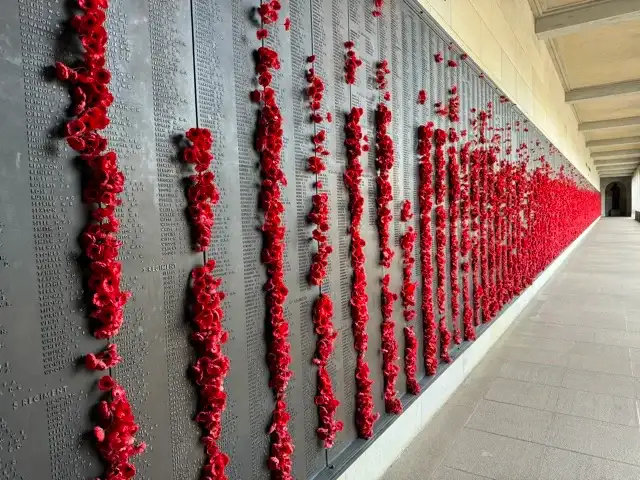
Beside the walkways are walls with the names of the various places where Australian troops fought engraved on them. Those walls support second-level cloisters on both sides of the reflecting pool. On the back wall of each cloister is a Roll of Honour listing all of the Australian soldiers who died in the wars the country fought. On one side are the names from World War I. On the other side is World War II, as well as the Korean and Vietnam wars.
Andrew told us how many thousands of names are on each side, but I forgot the numbers. The names are organized by battalion and then alphabetically. No ranks appear. That was intentional. It was done to indicate that all sacrifices were equal, regardless of the rank of the deceased.

Thousands of plastic poppies are inserted into the crevices between the plaques containing the names. As Andrew paused at the poppies (and told us stories about a couple of the people named there), he mentioned (as I already knew) that poppies have become the symbol of remembrance for all Commonwealth countries.
He then recited the first few lines of a poem associated with the poppies of remembrance. I’ve heard it many times. I don’t know if it’s familiar elsewhere, but if you’re from a Commonwealth country you’ve probably heard it too. It’s “In Flanders Fields,” by the late Canadian physician, Lieutenant-Colonel, John McRae.
Behind the reflecting pool and Roll of Honour stands the roundish-shaped Hall of Memory. It contains several stained glass windows and mosaics. At the centre of its floor is Australia’s Tomb of the Unknown Soldier.

Looking out from the Hall of Memory’s entrance, along the reflecting pool and beyond, there’s a very long view corridor. Peering along it, in the distance, you can see, first, the Old Parliament House and then, behind it, the current parliament buildings. (You probably can’t see it in the accompanying photo because it’s so far away, but it is visible when standing there, even with my old eyes.) According to Andrew, that design is intentional. Sitting in the Cabinet Room, if the Prime Minister turns, I forget if it’s left or right, he or she can see the Hall of Remembrance and be reminded of the human cost of war.
Museum
The Australian War Memorial contains two fair-sized sections dedicated to World Wars I & II. And there are two smaller sections devoted to the Korean War and the Vietnam War.
(Full disclosure: This is probably yet another display of my incredible ignorance, but until today I didn’t know that Australia fought in the Vietnam War.
I have this not entirely helpful tendency to shorthand Australia as a rough equivalent of Canada, my lifelong home country, because we’re both British Commonwealth countries, and we are both large geographically, but with a relatively small population for our landmass. Canada didn’t fight in the Vietnam War. We’re the country where the American Vietnam draft dodgers came. So it never occurred to me that Australia might have been in that war.)

The displays in the Australian War Memorial Museum include artifacts such as medals, helmets, weapons, military vehicles, paintings and more. There are also videos and textual information. And in the World War I and II museums, particularly World War I, there are dioramas of battle scenes.
It seems those dioramas were created some time ago. According to Andrew, soldiers who fought in the depicted battles helped with the creation of some of the dioramas. He stopped and talked in particular about one diorama (the one pictured here) where the former soldier who helped to create it is also depicted in it. Tragically, working on the diorama triggered his PTSD and he committed suicide in the 1930s, I think Andrew said 1930. Andrew gave the name of the soldier, but regrettably, I’ve forgotten both it and the name of the battlefield.

The museum is quite extensive and Andrew seems to love every piece of it. Although, not everyone had time to share his love.
At the start of the tour, one person who was part of a group of four asked if Andrew would mind if they left early because they had something else they had to do. Andrew graciously said yes and told all of us that if we had to leave early we should feel free to do so and he wouldn’t be insulted.
About halfway through the tour, the group of four made profuse apologies, handed in their lanyards, and left the tour. A little while later, a couple did the same.
After the couple left Andrew quipped, “I’m losing them faster than they did in the war.”
Then there were just three of us and Andrew. We continued with and completed Andrew’s planned tour. The three of us shook Andrew’s hand and thanked him abundantly.
Canberra Summary
I’m booked on a train from Canberra to Sydney, my last city on this trip, tomorrow. It’s scheduled to leave Canberra a little before noon and arrive in Sydney a little after 4:00. I’ll probably lounge around the hotel in here until it’s time to leave.
I might have time to do something in Sydney tomorrow, but not much.
That is a long way of saying this is likely my last post from Canberra and I’ll probably post only one entry tomorrow, if even that. And being the last post from here, it’s time for a summary of Canberra.
Sorry, Canberra. My review is nowhere near as glowing as for the other cities I’ve visited so far on this trip.
For one thing, the city is, in my opinion, too spread out for tourists. That does allow for more grass and trees than one finds in denser cities, but very little of it feels welcoming.
Being spread out it means walks are long if you want to use your feet to get just about anywhere. To say the very least, I don’t enjoy driving, so I try to avoid it when travelling. And I refuse to it anywhere where they drive on the opposite side of the road from what I’m used to.
There is public transit here, but whenever I looked on Google to find out how to get from where I was to where I wanted to go by transit it told me I had to walk six minutes to a bus stop, take the bus that stopped there, change to another bus, and then walk to my destination. The length of the second walk depended on the destination.
And I’m talking only about walks that didn’t take more than 45 minutes, and usually less, not intercity journeys.
There is a light rail line that terminates almost right in front of my hotel. But it goes the other way from just about anything a tourist would want to see. There are signs saying they’re extending that line into the core. But construction appears to be only just beginning. And they haven’t even started at the current terminus point. So it’ll be a while.
But I didn’t hate Canberra. It has its good points
The lake is scenic, although Canberra could make better use of it. More restaurants and cafes on its shores would be nice. (I saw only one, but there are probably more that I simply didn’t pass by.) Just an idea, but a multi-stop ferry service would save pedestrians the walk over a boring bridge, and it would make for shorter distances for pedestrians trying to get from someplace at one end of the lake to somewhere at the other end.
But, wait. There’s more. There are good museums and galleries here.
If I were planning this trip again knowing what I know now I’d probably skip Canberra if I planned to spend the same amount of time in Australia. As I said, Canberra has its good points, and if you have a lot of time, definitely visit. But if time is short, to my mind, your time is better allocated elsewhere, such as perhaps in any of the cities I’ve visited so far and maybe taking day trips from those cities.
Discover more from Joel's Journeys & Jaunts
Subscribe to get the latest posts sent to your email.
Not the Australian National Botanic Gardens

2 Rose Gardens, 2 Galleries

That was an impressive war museum, and I am quite taken with your description of your guide, Andrew. Regrettably, it takes a considerable effort put into a war monument to get me to spend more time with it than it takes for a respectful acknowledgement. I don’t like war, and I will usually stick my head in the sand rather than think about it if I can. Not noble of me. However, this one seems to go out of its way to invite your engagement, and bravo to Andrew for his skill.
I am sure Canberra is a lovely place to live, but it is good to know about its challenges for visitors. I think Sydney just might have an attraction or two for tourists, no? I’ll be here when you want to tell us about it.
Who likes war? I think on would have to be deranged to like war. But wars happen. And often one side is fighting for a just cause that can’t be defended any other way, such as self-defence or defence of the defenceless after an attack by the other side. I think it’s important to tell those stories and honour the dead who fought on the side of good.
I thought that about Canberra. It’s probably a nice place to live, particularly if you drive. But I found it difficult for a visitor without a car (me) to love. Like, but not love.
Well, Canberra’s a fairly young city and a government town to boot. It lacks the surprises of organic growth and the accreted patina of time.
Yes Canberra is a young city, but I didn’t see many construction cranes here. Although, as I said, they are allegedly extending a light rail line farther into the core. (And maybe beyond. I don’t know.)
There’s something to be said, though, for Great grandpappy Berra and his can-do attitude. There’s something to be said and that’s done. That fork mentioned by the fictitious Can and mauled by Yogi of the diamonds? I’m inclined to take that fork, stick it into your account of your Canberra visit, and declare it done.
Huh. It never occurred to me that Canberra might be named after Yogi Berra’s can do attitude. I wish I’d put that into the entry to really mess up people who assume that everything they read on the internet is true.
(In truth, I read in one of the places I visited in Canberra, I forget which one, that Canberra is a rough transliteration of an Aboriginal word for “meeting place.”)