The Rocks (Sydney)
The Rocks district is so named because of the geology of the area before the settlement of it. I realize that in the entries in this Australian journal I have sometimes fabricated the origins of place names. So you might wonder about the veracity of the first sentence. How do you know whether I’m speaking the truth? I read it somewhere that I think is reliable. (Of course, those sources might have been pulling my leg without me realizing it.)
Consider this. In those previous instances, I either concocted a story so implausible that no one literate enough to read my words would believe it all the way through, or I admitted to my deception at the end of the story, or both. I’m not doing that here simply because that’s the explanation I read as true in a few different sources.

As you can guess from the title of this entry and the preceding narrative, my morning today was spent in The Rocks.
The eastern boundary of The Rocks is the western side of the Circular Quay, which I visited yesterday afternoon.
The streets of The Rocks are lined with Victorian-era buildings. The neighbourhood also plays host to Cadman’s Cottage. Built in 1816 as barracks for crews of the governor’s boats, it’s the oldest dwelling still standing in Sydney.
Cadman’s Cottage is easily visible, with an open space in front of it. But the average person isn’t allowed inside. I don’t know about above- and below-average people, but other than the keepers of the keys to the joint, I don’t think they’re allowed in either.
The Rocks Markets

Every weekend there’s a street market in The Rocks. Today is Saturday here.
A permanent-looking, white canopy shelters one street for a block or two. Most of the vendors who sold from there sold art, crafts, jewelry, or some specialty foods. But some other merchants set up tables along some of the other streets in The Rocks. The latter vendors lean more heavily toward clothing. Unlike you see in some street markets elsewhere, all or, if not all, most of the clothing looked new, not vintage (aka pre-worn, aka used, sometimes aka seen far-better days).
in addition to the goods listed above, a few vendors sold candles or herbal remedies and probably some other things I forgot.

Observatory Hill

I’m not sure if Observatory Hill is actually in The Rocks. One of the guidebooks I use lists it in with the sights in The Rocks. But to get there I had to walk under an elevated roadway that I would have thought was the border of The Rocks. Observatory Hill is immediately on the other side of that road.
Observatory Hill is called that for two reasons. For one, it occupies a small hill. For another, there’s a small, old observatory, the Sydney Observatory, at the top. Hence, Observatory Hill. Clever of them to come up with that name, eh?

No, I’m not kidding. That is the reason for the name. The observatory was built in the 1850s.
One of my guidebooks tells me there is a collection of vintage equipment inside. The sign on the gate in the fence around the observatory told me you can only go in on a prearranged tour.
I also read somewhere that you can book some stargazing time on the still-operational optical telescope, but I didn’t investigate that. I imagine light pollution is more of a problem for stargazers in Sydney now than it was when the observatory was built in the 1850s.
There is a gazebo high on the hill that provides a nice view of the Sydney Harbour Bridge
The Rocks Discovery Museum

I went to Observatory Hill first because it was already hot this morning and forecast to get hotter. So I wanted to get the outdoor stuff over with early. After leaving Observatory Hill, I headed back to the centre of The Rocks and into the small, but free and air-conditioned The Rocks Discovery Museum.
The museum begins by quickly noting the age of the rocks under The Rocks. We’re talking hundreds of millions here, but I don’t remember how many hundreds of millions. It then rapidly advances to the first inhabitants, jumps over that quickly, and spends more time on Aboriginal history and the history of the colonial period of The Rocks.
The museum displays a few artifacts associated with some of the material it discusses.
As I said, it is a small museum, so there’s not a lot of depth to artifacts and hard-copy text. But there are a few touch-screen video displays where you can call up a little more information about various topics related to the Rocks and its inhabitants over the years.
Museum of Contemporary Art

The Museum of Contemporary Art is in The Rocks district and immediately faces the Circular Quay. Its structure has a stark modernist entrance and additions out back grafted onto an oldish, statelyish building.
The interior is a holistic, integrated assembly of positive and negative spaces that insinuate the diversity and complexity of the soul, both as represented in the individual psyche and the collective human life force.
I made up the previous paragraph on my own. It’s inane and complete claptrap. Please forget you read it. It’s a museum of contemporary art. The paragraph felt experientially appropriate to me.
In truth, for me, the essence of the gallery is its air-conditioning, at least today.
One room on the first level of exhibits housed a room that contained a collection of boxes, rocks, metal beams, and basins of water. Wires ran from each of the objects to some sort of device.

Speakers in the room played discordant sounds that defy description by the likes of me.
At the entrance to the room, a gallery employee explained that, unlike in the rest of the Museum of Contemporary Art, in this gallery, you can touch many of the pieces, including the boxes, rocks, and beams, but you cannot touch the wires or water. Not touching water in basins with attached electrical wires sounded like a good plan to me.
He explained that if you touch the touchable objects you might feel vibrations that are part of the soundscape in the room.
I felt nothing. I asked the attendant about it. He said he can usually feel it on the beams, occasionally on the boxes, but he’s never been able to feel it on the rocks, and many people can’t feel it on any of the objects. “So,” he said, “I’d try the beams and if you don’t feel anything there, I’d write it off as a loss.”

I put the palm of one hand firmly on a beam and held it there for a little while. I felt nothing. I wrote it off as a loss.
On the next level up, there’s an opening that looks down on that room. That’s where I took the accompanying photo.
Another room on the first exhibition floor contained a couple of round, slowly rotating tables. On top of each table was a collection of brightly coloured toys. More toys, along with some shoes and socks, sat on the floor. Other stuff hung from the ceiling and walls.
I could probably make a joke about what I thought about the artistic merit of these pieces. I rarely shy away from even the blatantly obvious, but the joke was too obvious even for me.
One level up, there’s a wall with two series of photographs by Tracey Moffat. According to the sign on the wall, she’s “one of Australia’s most noted artists.” One of the series represents all of the jobs she held when she was younger. The other series consists of photographs of only people who came in fourth in their events at the Sydney 2000 Olympics.

I don’t pay much attention to the Olympics, so I might be wrong, but I think fourth-place finishers get a tin medal. So it’s nice that they also had the honour of being immortalized in a Tracey Moffat photograph. “If you didn’t push yourself so hard Tracey Moffat would have taken your picture. But, no, you had to go for gold, silver or bronze. What a chump!”
One exhibit I particularly liked was a series of very colourful masks by Alick Tipoti, a young indigenous artist from the Torres Strait Islands, an archipelago of islands north of the Australian mainland that’s part of the Australian state of Queensland.
All of the permanent exhibits at the Museum of Contemporary Art are free to visit, but there was also a temporary exhibit. I would have had to pay to see that. I didn’t.
Lunch
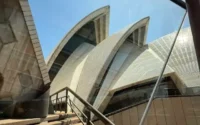
I had lunch at the cafe upstairs at the Museum of Contemporary Art. It has an outdoor patio with a great view of the Sydney Opera House. But all of the shaded tables out there were occupied. And it was getting hot even in the shade.
I’d already taken a long peak at the view on the patio, so I asked for a table inside. The inside tables are wide open to the patio, but there are cool blasts of air-conditioning at the inside tables. Those blasts don’t penetrate far outside.
For lunch, I had a delicious roasted cauliflower salad with baby spinach and a few other vegetables and grains that I’ve forgotten. If you’ve been reading my morning posts from this trip, when I mention lunch, I usually mention a glass of wine. I chose to skip wine at lunch today because of something I booked for this afternoon. But that’s for later.
Discover more from Joel's Journeys & Jaunts
Subscribe to get the latest posts sent to your email.
Sydney Opera House and a Peninsula

Darling Harbour and Circular Quay

There you go. A morning with plenty of variety and a valiant attempt at getting on board with a contemporary art museum. I liked the mask, too. For the rest of it, I’ll take your claptrap in lieu of a good gander at what was there for myself. That’s what I paid for, and that is what I am coming back for. I want to hear what you are up to this afternoon. See you later.
I am so glad you feel you’re getting your money’s worth out of this journal. Management will be so happy to hear that. (Management, here. Yup, I am.)