Kungliga Slottet: Apartments & Treasury

Google Translate tells me that “Kungliga Slottet” translates to “Royal Palace.” Okay, fair enough. It was and still is a Royal Palace. (There is no way in the world I’m going to try to pronounce Kungliga Slottet. The attempt would probably get me in trouble with Swedish speakers and English speakers.)
But Google Translate translates “Slottet,” without the “Kungliga,” to “The Castle.” And “Slott” to just “Castle.” I guess “et” is a Swedish definite article, but they smash it onto the end of the noun, rather than the article being at the front and a separate word, strong enough to stand on its own however-many letters, as is the case with English articles.
Never mind the definite article. The laxness involved in the use of one word for both castle and palace, with, I imagine, context making the difference, is not helping me.
Verbally, I confuse the two. I’ll sometimes say palace when I mean castle, or castle when I mean palace. (More often the latter.)
Some friends might have had occasion to catch me in that malapropism. I suspect that only a few of the people who’ve met me have had that opportunity, and if they have, probably not often, because I don’t travel in circles where people spend much of their time talking about either palaces or castles.
In my understanding, a palace is a lavish residence, often, but not necessarily, for royals. A castle, on the other hand, might accommodate a royal residence, but its primary purpose is defensive.
That is not to say that palaces can’t have defensive features. Over the course of history, royals have occasionally experienced some rousing of the rabble.

And, I don’t know if it’s happened in Sweden, but in some cases, royals have even had their heads chopped off. I’m not in a position to think like a royal, but I imagine they’d prefer to avoid that end. Hence, palaces can have some defensive features, but they’re usually intended to protect the occupants, not the broader populace.
I need to stress that’s only my understanding. In a great many areas, my understanding is wrong. So, if the palace vs. castle distinction is important to you, you should make the effort to look it up in another source. However, if the sole site that you use for that research also tells you that the only effective treatment for any disease or illness is to place a crystal on the affected area for some length of time, then you might as well trust me. At least I have some chance of being correct, slim though that chance may be.
Based on my understanding of the difference, the Kungliga Slottet is unquestionably a palace.
After reading that long preamble, I imagine you guessed I visited the Kungliga Slottet this morning. If so, you guessed correctly.
There are four components of Kungliga Slottet accessible via a single ticket. I visited two this morning. I probably would have done more, but my left foot is still being painfully evil. I thought about telling it, “If you don’t behave, I’m going to turn right around and we’re going home.” But I’m not a parent, so I don’t think I’m legally allowed to say that.
The point is, I was moving very slowly this morning and I couldn’t do more. Although I did sort of take in something else at the castle. I’ll get to that later in this post.
I’ll try to tackle the other buildings in the palace this afternoon.
Oh, by the way, yesterday, when I visited the Stockholm Cathedral, I said that my view of it did not match the pictures provided by my walking tour app and guidebook. I guessed that they used a back view because the lack of much space out front makes it difficult to get a good picture there. I was right.

The Kungliga Slottet is close to the Stockholm Cathedral. In getting to and around the palace, I had to walk beside and behind the cathedral. They did indeed use a view of its backside.
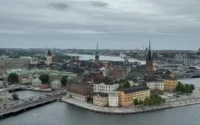
Kungliga Slottet
There has been a fortress on the site of the Kungliga Slottet since the 12th century. At some point, it was converted into a palace. But on May 7, 1697, a fire destroyed much of the old palace. (And, even before that, the Vikings had built a blockade there in the 10th century.0

The royals’ home in Stockholm was wrecked. I imagine they were forced to live in one of their other palaces until the new Stockholm Royal Palace was ready for occupancy in 1754. Oh, the life of a royal. Such hardship.
Royal Apartments
The first part of Kungliga Slottet I visited was the Royal Apartments. Kungliga Slottet is still a working palace today, and some of the rooms in the Royal apartments are used for various functions. For example, there is a council chamber where cabinet meetings are held three or four times a year. The Advisory Council on Foreign Affairs meets in one of the former dining rooms.

Plus, despite being a democracy, Sweden has a royal family. I’ve long thought that a hereditary monarchy in a democracy, even a constitutional monarchy, is an anomaly. But being a Canadian, I have no reason to complain. Our head of state doesn’t live in Canada. It’s currently the King of Canada, King Charles, but for the vast majority of my life, it was the Queen of Canada, Queen Elizabeth. Yes, “King/Queen of Canada” is a separate, formal job title for them.

The King of Sweden sometimes uses the Royal Apartments in Kungliga Slottet for state dinners. In addition, he invites the Nobel Prize winners there for dinner every year. Wait. The Nobel Prize winners get two dinners, one at the City Hall (see yesterday’s post) and a more private one with the royal family? I’ve got to figure out how to win a Nobel Prize. Two free dinners. Seems worth it to me.

Before getting into the Royal Appartments, the mandatory route took me through a few elegant rooms. One is the Hall of State, where the King used to open Parliament until 1975. The opening ceremony now occurs in the new parliament building, but some state ceremonies still take place in the Hall of State. That’s a good thing because it’d be a shame if the silver throne there went unused. The throne was a gift to Queen Kristina on the occasion of her coronation in 1650.

Beyond the Hall of State, there is a series of rooms having to do with the Order of the Seraphim, Sweden’s highest order. There’s a meeting room for the order. In a couple of rooms beyond it, there are rooms with display cases showing medals and commemorative badges.
There’s also a room with two models, one of the castle as it was before the fire and another of the current palace.
And then the exquisite Royal apartments begin. There are antechambers, bed chambers, dining rooms, galleries, audience rooms, dining rooms, and more. One of the galleries is a long hall, with tapestries hung on the walls. Another has paintings.

One room was dubbed the Don Quixote Room because tapestries on the walls feature scenes from Cervantes’ story of Don Quixote. They were woven in Paris in the 1770s.
The Royal Apartments are breathtaking. They left me wondering what the rent on them must be, and who could afford them?

The Treasury

Next, I went to The Treasury in Kungliga Slottet. It’s in the basement and rather small. It contains display cases with swords, a bunch of old crowns, and the coronation cloak of Queen Lovisa, who was crowned with her husband, Karl XV in 1860. There’s also a silver baptismal font sitting there on its own.

Changing of the Guard
At this time of year, there’s a changing of the guard ceremony at the Kungliga Slottet every day at 12:15. I arrived at the courtyard where it takes place at about 12:05. That wasn’t nearly early enough.
The closest I could get to the area in the courtyard where the action would take place was behind about four or five people. I’m not the tallest of people. Had everyone ahead of me been munchkins or hobbits, I might’ve been able to see most of the ceremony. But they weren’t.

That’s a shame because I would have liked to have seen the pomp. But even more, I would’ve liked to have seen munchkins and hobbits in real life.
Pretty much the only view I got of the changing of the guard was when I raised my arms as high as they could go with my iPhone in my hand, took a picture, and then pulled my arms down and looked at the picture to see if I captured anything. Surprisingly, I did get a few decent photos.
Audibly, I could tell that the guards were led in by a marching band. And via the above-described means, I could see that the marching band was dressed in white. The guards were dressed in black. I presume there was a lot of marching. There were also a lot of barking of commands that I could hear. But I could see little of the response to the commands.

After most of the guards marched out, the marching band remained and played a couple of numbers. And that was my entire experience of the changing of the guards at Kungliga Slottet.
Then it was time for lunch. My left foot was bothering me quite a bit whenever I put pressure on it, so I found a nice restaurant where I spent about an hour and a half over my meal, stretching the time out to rest my foot. Lunch consisted of a glass of wine, something they called salmon pudding, and sorbet for dessert. (The menu had both Swedish and English. I’ve forgotten the Swedish name for the salmon dish, but it started with “lax.”)
Salmon pudding is ground, cooked salmon sandwiched between sliced potatoes, with some sauce and accoutrements. I don’t know if that sounds good to you or not, but it was quite tasty. And after an hour and a half, it was time to tell my foot to get moving, which it did reluctantly.
Stay tuned to hear what I did in the afternoon.
Discover more from Joel's Journeys & Jaunts
Subscribe to get the latest posts sent to your email.


Nice of you to rest your foot at lunch and send on down some lovely salmon pudding in its direction. I am glad you solved the mystery of the Stockholm cathedral, but I was a bit discomfited by the idea of its main view being its backside. I would be very discomfited if my main view was my backside. On professional websites. Posters for talks I have given. Not that my front view is a splendid sight, but, really. Backside is not usually better. Not that I can tell. My head doesn’t turn around that far.
I wonder, if they are not using their Hall of State that much, whether they are looking to get rid of that old silver throne. I am redoing my home office now that I am leaving my professional office, and want to get rid of my IKEA armchair for something a little more delicate – maybe something a little more regal. That old thing would be just perfect. You are in Stockholm for another few days. I wonder if you could hobble over and ask someone. I would be much obliged. Ditto with the old crowns. If they are not doing anything with them. However, they are not as practical. I don’t even like hats.
Lovely looking rooms in the palace. Don’t think I could afford their apartments.
I hope your foot is restored now that your salmon pudding has had time to work its effects. If not, easy does it can still be very nice.
One never gets a good look at one’s backside does one? You should be proud of all of your sides.
I’ll see what I can do about the royal furniture and hats.
Regrettably, the salmon didn’t cure my foot. I’ve only got until Sunday here. I can take it easy at home. Onward. Ever onward.
No hassle at the castle. Quite lovely. Thanks for a royal tour. Healing wishes for your foot.
You’re welcome.
Thanks for the best wishes on my foot. It’s now a couple of days after that entry. Yesterday, I expressed optimism that it was healing. Today, it seems my optimism might have been misplaced.