Taking Stock of Stockholm

This is it. I’m now in the last city of this trip in Sweden, Stockholm, after a train trip of a little less than an hour and a half from Linköping.
I’ve almost come full circle. The airport that serves the first city in my trip, Uppsala, also serves Stockholm. The two cities are roughly equidistant from Arlanda Airport, a less than 20-minute train ride on either side of the airport.
Stockholm was the impetus for this trip. As I’ve mentioned before in earlier posts from Stockholm, I visited this city more than a decade ago, well before I started this journal, on a trip that also took me to Copenhagen. I loved both cities, but especially Stockholm. For some time now, I’ve wanted to come back. And here I am.
Several questions await answers during this week:
- How much of Stockholm will I remember?
- How much has Stockholm changed in the past decade or so?
- Will the reality of Stockholm be as good as my memories of it?
- Was I right about a week being the correct amount of time to allot to Stockholm?
- And, most importantly, where should I eat while I’m here, and what should I order there? Seeing sights is enjoyable and edifying, but eating is essential.
I arrived at my hotel a little before noon. Fortunately, my room was available and I had the whole afternoon to explore.

I visited three sights: Stockholm City Hall, Stockholm Cathedral, and the Nobel Prize Museum.
The Stockholm City Hall is close to my hotel. The other two are close to each other and less than a 20-minute walk away from the City Hall.
Despite this being the last city of this trip, you won’t be rid of me all that soon. I’m here for a full week before I head back home.
I didn’t do any wandering around. My walking was composed of direct routes to, between, and from those three sights. There’s a reason I didn’t do more walking.
Yesterday, I told you I developed pain in my left foot. It subsided a little yesterday afternoon, but it was back again today with a vengeance. I slowly hobbled and limped my way around. There’s a fine line between hobbling and limping. I did my best to do both in equal measure, so it’s not a favour one over the other.
But the point is, I wasn’t prepared to do a lot more walking than that.
I don’t know what the pain is. I didn’t bang my foot. There’s no redness, blisters, or other swelling. It just hurts when I put pressure on not one particularly large spot on my left foot. I hope my foot starts feeling better soon.
Let’s leave the discussion of my foot at that because I’m not one to complain or seek sympathy.
(*Joel deletes the 42 lengthy paragraphs of complaining and begging for sympathy that he just finished writing, and continues*)
Stockholm Stadshuset
Stadshuset is the Swedish word for City Hall. Stockholm has a beautiful one. It was designed by Ragnar Östberg and completed in 1923.
Östberg didn’t just design the building. He was given complete control over both the building and its decorations.
Tourists can visit Stockholm City Hall only on a guided tour. There was an English one available within about 20 minutes of my arrival.
The tour lasted about 45 minutes. The guide was very informative. He provided lots of information about the City Hall, its architecture, its functioning, and its history. The tour stopped in four rooms: the Blue Room, the council chamber, the banquet hall, and a civic reception hall.
Blue Room
The blue room is on the ground level, just past the entrance. That’s where the tour started.

Ironically, there’s no blue in the Blue Room. Östberg’s original idea for the room was to have sparkling blue walls. But he changed his mind. In the final design, and the way it stands now, the walls are bare red brick. There’s a row of windows just below the ceiling on three of the walls.
Below the ceiling on the fourth wall, there’s decorative wood that hides a 10,000-pipe organ.
A marble staircase descends from the level above beside one of the walls before making a 90° turn into the blue room.
The Blue Room and the banquet hall, which I’ll talk about later, are used for civic functions, but they’re also rented out to companies and pretty much anyone who wants to use them. I forgot what the guide said, but I think they’re rented out more than 200 days a year.
However, there’s one day of every year when they’re used for the same thing. The banquet for the Nobel Prizes, except for the Peace Prize, is held here every year on December 10th. The Stockholm City Hall is just used for the dinner and reception. The awards are handed out at the nearby Stockholm Concert Hall.
The Peace Prize is awarded in Oslo.

I was in Oslo on a Norway trip I took about a year ago. There, I went to the Nobel Peace Prize Centre. I learned on that trip that nobody knows why Alfred Nobel insisted on the Peace Prize being awarded in Oslo, despite all the other prizes being awarded in Stockholm. He put it in his will that that was the way it was to be, but he never told anybody why.
For the Nobel dinner, most guests arrive in the Blue Room through the ground-floor doors, the same ones the tour used to enter the room. Honoured guests, including the prize recipients, enter through another door and are taken upstairs. They then enter the Blue Room ceremonially down the marble staircase. It all sounds quite grand.
All of the other rooms the tour visited are one level up from the Blue Room.
The tour climbed up the marble staircase and moved on to the council chambers.
Council Chamber

The council chamber is a sumptuous room with dark wood tables for the counsellors and a red canopy over where I think it is the mayor sits. The carpet in the room is red, as is the upholstery on the seats. The walls are decorated with seemingly random zigzags of narrow wood pieces, with fabric between the wood.
All the fabric in the room was designed by the same woman. I’ve forgotten her name. The carpeting comes from Scotland, but all the other fabric was made in Venice.

In this room, the guide explained that Stockholm has 101 city councillors. There’s currently a majority in the city council that resulted from a coalition of three parties. Of those 101 councillors, only 13 are full-time. The other 88 have other jobs and usually come in only for city council meetings, which generally occur every third Monday.
Along the way to the next room, we passed through a small circular room. We didn’t stop there because the guide would only congregate us in the larger rooms. But he did tell us about the room. There were tapestries on the walls. The guide said they date from the 17th century and are probably the oldest things in the Stockholm City Hall. The room is used on Saturdays for weddings. I don’t imagine that any of them are very large weddings because it’s a very small room. And what the heck are they doing having weddings on Shabbat anyway? But maybe that’s not the religion most people practice here.

Civic Reception Hall
The next room was a civic reception hall. It was nice, but not particularly special. On the Nobel Prize banquet night, the Royal family meets the honoured guests in this room. The media are not allowed in the room that night. So, any of the honoured guests who want to escape the media are allowed to hang out there.
Banquet Hall
The final room on the tour was the banquet hall. It is dazzling. All of the walls are completely covered with tile mosaics. If I remember correctly, the guide said there are about 10 million tiles, but they were still able to complete it in two years.
The images in the mosaics are multi-coloured, but the background is composed of dazzling gold tiles. I don’t know if they’re real gold or just gold coloured, but they do dazzle,

On one side wall, the figures are of Swedish royalty. On the opposite wall, there are figures of men of science. But they’re symbolic images of real people, not dressed the way they would have been dressed. For example, I saw one dressed as a Roman in a toga, despite that not being who he was.
The back wall has Swedish symbolism. The front wall has a stylized and imaginary Queen of Stockholm. There are also some images representing iconic buildings around the world, like the Empire State Building and the Eiffel Tower, symbolizing that Stockholm is an international city that people come to from all over the world.
It’s an incredible room.
You might have noticed that I said that the Blue Room is used for the Nobel dinner, not the banquet hall. The banquet hall is also used that night, but for dancing.
It wasn’t always that way. In the early years of the Nobel Prizes, the banquet hall was where the dinner was, and dancing was in the Blue Room. I forget when it switched. The reason for switching the uses of the rooms is that, in the early years, the Nobel banquet wasn’t as popular as it is now, and not many people wanted to come back then.

Now, more than 1,000 people attend.
The Blue Room is bigger than the banquet hall and can accommodate that many people for dinner. The banquet hall can’t. So they switched them.
That switch presented a challenge. The banquet hall was indeed designed as a banquet hall. The kitchens are all above it, with a large elevator between the kitchens and the banquet hall. But the elevator doesn’t go down to the ground floor, where the Blue Room is.
At the Nobel banquet, servers march the dishes out through the banquet hall, and then down the marble staircase for the long table of honoured guests. Another army of servers uses other elevators scattered around the City Hall to move food from the upper floor down to various entrances to the Blue Room. The operation is so well choreographed that they can have food out of the kitchen and in front of the more than 1000 guests in just eight minutes.

There is a tower attached to the city hall. Visitors can also go up to the top of the tower, but it requires buying a separate ticket. They were sold out for the rest of the day today.
They allow only 27 people into the tower at a time. Each visit is for 45 minutes. One group goes up, and the next one doesn’t enter until the previous one leaves. So they have only 27 tickets for time slots at 45-minute intervals. I can buy I ticket online. I’ll try to snag one for the next available slot on a clear day. Rain is forecast for the next two days, so probably not until after that.
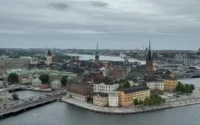
The City Hall sits just back from the water, with a courtyard and promenade between them. The views from the promenade of Stockholm are beautiful.

Storkyrkan (Stockholm Cathedral)
Once again, I’m so confused. Google Translate tells me that the Swedish word “Storkyrkan” translates to “The Cathedral” in English. But in other cities I’ve been to in Sweden, their cathedral has been called “Domkyrkan,” which Google Translate also translates to “Cathedral.”
Here’s another thing that I’m confused about. One of my guidebooks and my walking tour app have pictures of one of the facades of the Stockholm Cathedral. (The walking tour app calls it “Stockholm Cathedral. The guidebook calls it “Storkyrkan”) Neither looks like the front of the building I visited.
The entrance is tight up on a street. There’s a building tight on the other side of the street. So it was difficult to get a good picture of the front, and impossible without using the widest angle my iPhone camera allows me.

The pictures in the guidebook and app are taken from across what looks like a square. My guess is that their pictures are of the back of the cathedral.
I know what you’re thinking. “Joel, you idiot. It wasn’t the other side of the cathedral. You were at the wrong building.”
Nope. There was a sign out front confirming it was the cathedral. And when I went inside and bought my ticket (yes, there’s an entry fee), the ticket seller handed me a leaflet in English headed, “Welcome to the Stockholm Cathedral.”
Plus, the interior was exactly as the app and book described it.

With my foot being what it was today, I wasn’t prepared to walk around a full block to see if the back provided the pictured perspective. And I couldn’t very well leave my foot behind while I went off exploring, now could I? I thought about it, but I couldn’t figure out how to do it. Besides, I didn’t want my left foot to feel hurt about being left out of the activities. That would damage its self-esteem.
The Stockholm Cathedral, and the Nobel Museum, are both in Stockholm’s Gamla Stan (Old Town). Gamla Stan is what I loved most about Stockholm the last time I was here. I didn’t venture very far into it today.
I’ll no doubt be back in Gamla Stan at least once more on this trip. Hopefully, my foot will be a little better or, better yet, back to normal, and I’ll do a proper ramble around Gamla Stan. Maybe I’ll see the pictured view of the cathedral then.
The cathedral is small as cathedrals go, but it’s amazing.

The oldest part of the church that stands today was consecrated in 1306. There have been extensions added and remodelling done to the church since then.
The eagle-eyed among you might have noticed that I called it a church rather than a cathedral in the preceding paragraph. You should have that looked into right away. Humans should have human eyes, not eagle eyes, better though they may be.
For the benefit of those of you who didn’t stop reading so they could run off to have their eagle eyes tended to, the use of “church” was intentional. The edifice wasn’t always a cathedral. It used to be St. Nicholas Church.
It was designated a cathedral comparatively recently. It gained that status in 1942 in the then-new diocese of Stockholm. Belated congratulations on your promotion, Stockholm Cathedral, nee St. Nicholas Church.

The columns in the cathedral are fluted, but the fluting is done with red bricks and white mortar.
The pulpit is boldly decorated with gold-coloured figures, including a trumpeter, a couple of what I think are cherubs, and another guy who was just hanging around holding what I think is a palm frond and looking manly. There’s also a gold sun-like object. It has a circle with rays radiating out from it in all directions. What I didn’t notice when I was there, but saw in the picture I took, is that in the centre of the sun, there are four of what look to me like Hebrew characters. Perhaps someone who is more familiar with Hebrew can confirm that for me and possibly translate it if it is. Although the resolution here probably isn’t good enough to read it. Sorry about that.

The altarpiece is also stunning. It’s pure black ebony with silver decorations embedded in it.
But wait, there’s more. There’s also a large,1696 painting by David Klöcer van Ehrenstrahl titled “The Last Judgement.” And there’s a smaller painting of the Crucifixion by the same artist.
And there’s a large oak statue of St. George and the Dragon. The leaflet didn’t date it. It gave the name of the sculptor as “probably by Berndt Notke of Lübeck.” (The emphasis is mine.)

There’s another painting off to one side near the entrance called The Parhelion Painting. It depicts a light phenomenon that allegedly occurred in Stockholm on 20 April 1535. Six sparkling luminous rings of light were said to be observed in the heavens. They were interpreted to be a revelation of the impending collapse of worldly power. (And yet, here we are.)
In addition to the regular wooden pews, there are also two floor-level loges near the front of the church. They face each other across the centre aisle. They each have one padded bench parallel to the aisle, probably capable of holding two or three royals, more if they’re intimate. Two shorter, perpendicular padded benches are attached to the ends of the longer one. The shorter benches probably could seat one person, if indeed anyone was intended to sit there at all.
The Stockholm Cathedral fits a lot of splendour into a small package.

Nobel Prize Museum

The Nobel Prize Museum is extremely small. At the front, display panels show each of last year’s winners in all of the categories. Some displays in the museum relate to some of the discoveries that led to Nobel prizes in the various categories in the past. There’s also a small room with some memorabilia of Alfred Nobel and a little bit of information on his life.
There’s a stone mask of Alfred Nobel. Below it, there is a metal plaque with a replica of his handwritten will, including his signature, engraved on it. I don’t think it was full will on the engraving. There was a screen above that scrolled through his will as well. The top line was in Swedish with a plain font. The second line in his handwriting. And the third line on the screen was in English with a plain font. I wasn’t able to match it up to the engraving, but I don’t think everything on the screen was on the plaque.

There were also some videos running back-to-back about some of the past Nobel Prize winners.
There were a couple of touchscreen displays where you could look up past winners in each of the categories. I felt the need to look up in 1957 Nobel Peace Prize winner, not because I didn’t know who it was, but because I did. It was Lester B Pearson. He was a former Prime Minister of Canada, although he wasn’t yet Prime Minister when he won the Nobel Peace Prize.
There isn’t much else to say about the Nobel Prize Museum. Like I said, it’s very small.
That wasn’t bad for just a half day in Stockholm with a bad foot. I still have six more days to go here. I’m expecting them to be great. We’ll see if it works out that way.

Discover more from Joel's Journeys & Jaunts
Subscribe to get the latest posts sent to your email.
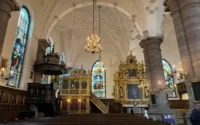
Gamla Stan Again (German Church & Judiska Museet)
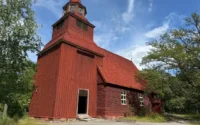
Skansen (Stockholm)
What a handsome building that city hall is! How grand, how evocative – how expensive! It is more Italianate than I would have expected. I tend to think of a city hall as generally workaday, even though yours is a darn impressive piece of architecture from the outside. But not Stockholm. I like their style. And the cathedral has nothing to be ashamed of either! I didn’t know what to expect of the architecture in Stockholm, perhaps, subconsciously, and foolishly, more modern IKEA Scandi, I guess, but I am impressed so far. I have never investigated Scandinavian art and architectural history, so I am looking forward to seeing more. Rest up that tootsie of yours and enjoy the rest of the week.
I’ve loved everything I’ve seen so far, and it does bring back some fond memories of my previous time here.
I’m trying to figure out how to rest up my tootsie and still enjoy the rest of the week. So far I haven’t come up with anything.
Impelled by cat-killing curiosity, I looked to resolve the question of the Hebrew lettering on the elaborate Storkyrkan pulpit. A Google search yielded up a high resolution photo. Lordy, Lordy. There it was. Clear as day. יהיה. Yud hay yud hay: i.e., Jehovah.
Thank you. You were who I was thinking of when I asked if someone could read and interpret it.
Again , thanks.